CommandEleven Intelligence Desk // Tradecraft Desk, Tradecraft Primer. Part of the series How CommandEleven Intelligence Thinks.
Bottom Line Up Front
Intelligence fails at a specific step of the process, and often at more than one. The Intelligence Cycle gives us a map for finding where. Two official reviews, the 9/11 Commission and the WMD Commission, examined two of the best-known US intelligence failures of the last quarter century and traced them to particular points in the cycle: questions that were never asked, collection that was missing, assumptions that hardened into conclusions, and information that never reached the person who needed it.
This primer follows the cycle step by step and shows where each review found the break. It does not try to explain why the breaks happen, which is the subject of the next primer, or how they are corrected, which is the subject of the one after.
How to Read a Failure
An intelligence failure is not the same thing as a wrong prediction. Intelligence works under uncertainty, and a sound judgment can still turn out wrong. The reviews we use look at something narrower: whether the process that produced the judgment had flaws that could have been avoided.
Both reviews were written with knowledge of the outcome, and the 9/11 Commission says so. It states that its authors write with the benefit and the handicap of hindsight. That warning applies to this primer as well. A signal that looks obvious after an attack was one item among many before it. The right question is what the people involved could reasonably have known and done at the time.
Where the Cycle Breaks
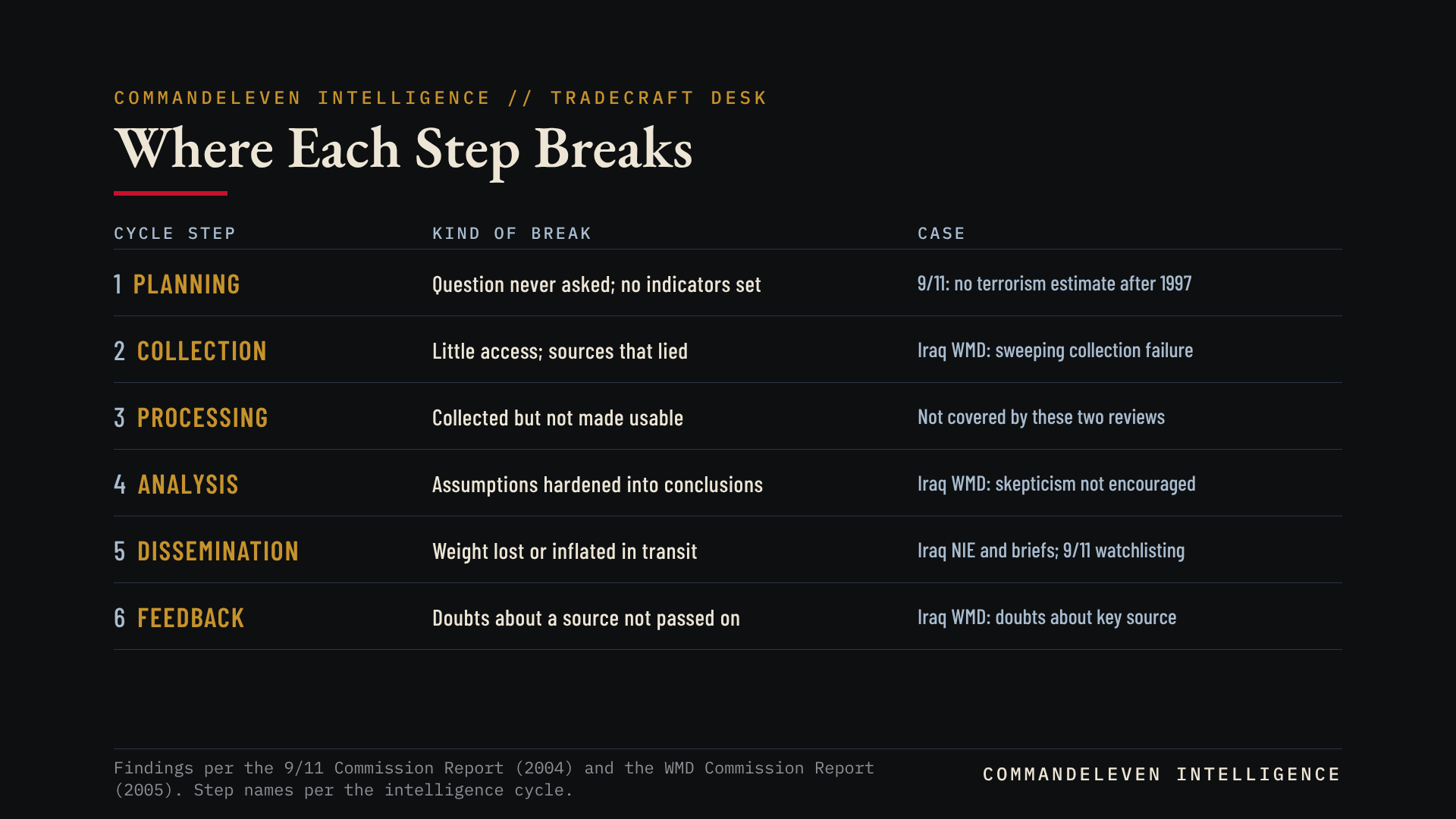
The cycle has six steps. The table below sets each step beside the kind of break the reviews found there and the case that shows it.
Planning and Direction
The cycle starts with the questions, and a question nobody asks produces no collection and no analysis. The 9/11 Commission found that the last national estimate on terrorism completed before the attacks was a 1997 update, and that none was produced between 1997 and 9/11. It found that the Counterterrorist Center did not analyze how a hijacked aircraft might be used as a weapon, did not examine the problem from the enemy’s perspective, and did not develop indicators for that method of attack. Nor did the community’s collection management process set requirements to look for them. The Commission called this a failure of imagination and recommended finding a way to routinize, even bureaucratize, the exercise of imagination.
Collection
Collection can only gather what it can reach. The WMD Commission, reporting on the Intelligence Community’s pre-war judgments about Iraq, wrote that the failure did not begin with faulty analysis but with a sweeping collection failure. It found little human intelligence on Iraq’s weapons programs, lost access to important Iraqi communications, and imagery that was weak against chemical and biological work housed in ordinary buildings. It also found that the community’s position on Iraq’s biological weapons program was largely determined by sources who were telling lies. Weak collection forced analysts to fill gaps with assumptions, which is where the next break begins.
Processing
Processing turns raw collection into something an analyst can use: translating, decoding, correlating, filtering. A failure here looks like material that was collected but never made usable in time. The two reviews we rely on say much less about this step than about the others, and we do not stretch them to cover it. We include it in the table so that the map is complete, not because we can cite a case.
Analysis and Production
This is the step where the WMD Commission found the Iraq failure took its shape. Assumptions formed in the 1990s, that Iraq was still pursuing weapons programs, began as working hypotheses and, in the Commission’s words, became more or less unrebuttable conclusions. Analysts accepted evidence that supported them, even when its reliability was doubtful, and discounted evidence that did not. The Commission also noted that, in no instance, did political pressure cause analysts to alter their judgments. Its finding was that the environment did not encourage skepticism about the prevailing view. It faulted the analysis for a lack of rigor and for not stating what the community did not know.
Dissemination
A sound judgment that reaches the reader distorted is a failure at this step. The WMD Commission found that the October 2002 national estimate took defensible assumptions and presented them with the weight of secret intelligence, without conveying how thin the evidence was. It found the daily briefs for senior officials more alarmist than the estimate, with attention-grabbing headlines and repetition that gave the impression of many corroborating sources where there were few. The 9/11 Commission found a different break at this step: the CIA did not watchlist Khalid al Mihdhar or tell the FBI when it learned he held a valid US visa, and it lists a similar omission for Nawaf al Hazmi in March 2000. The Commission added that watchlisting alone probably would not have prevented the attacks.
Evaluation and Feedback
The last step is meant to catch errors and send the lessons back to the start. The WMD Commission found that CIA officials did not pass on new information casting doubt on a key biological source, the one known as Curveball, between the national estimate and Secretary of State Powell’s February 2003 speech to the UN, even though the source mattered so much to the judgment. Later doubts about earlier reporting were not always passed on. The Commission’s recommendations for this step include a devil’s advocate for consensus views, competitive analysis across separate analytic units and mechanisms to make sure dissenting views reach customers.
A Worked Example: One Judgment Through Four Breaks
This is our reading of the WMD Commission’s findings on Iraq’s biological weapons program, presented as an illustration. It is not a new finding.
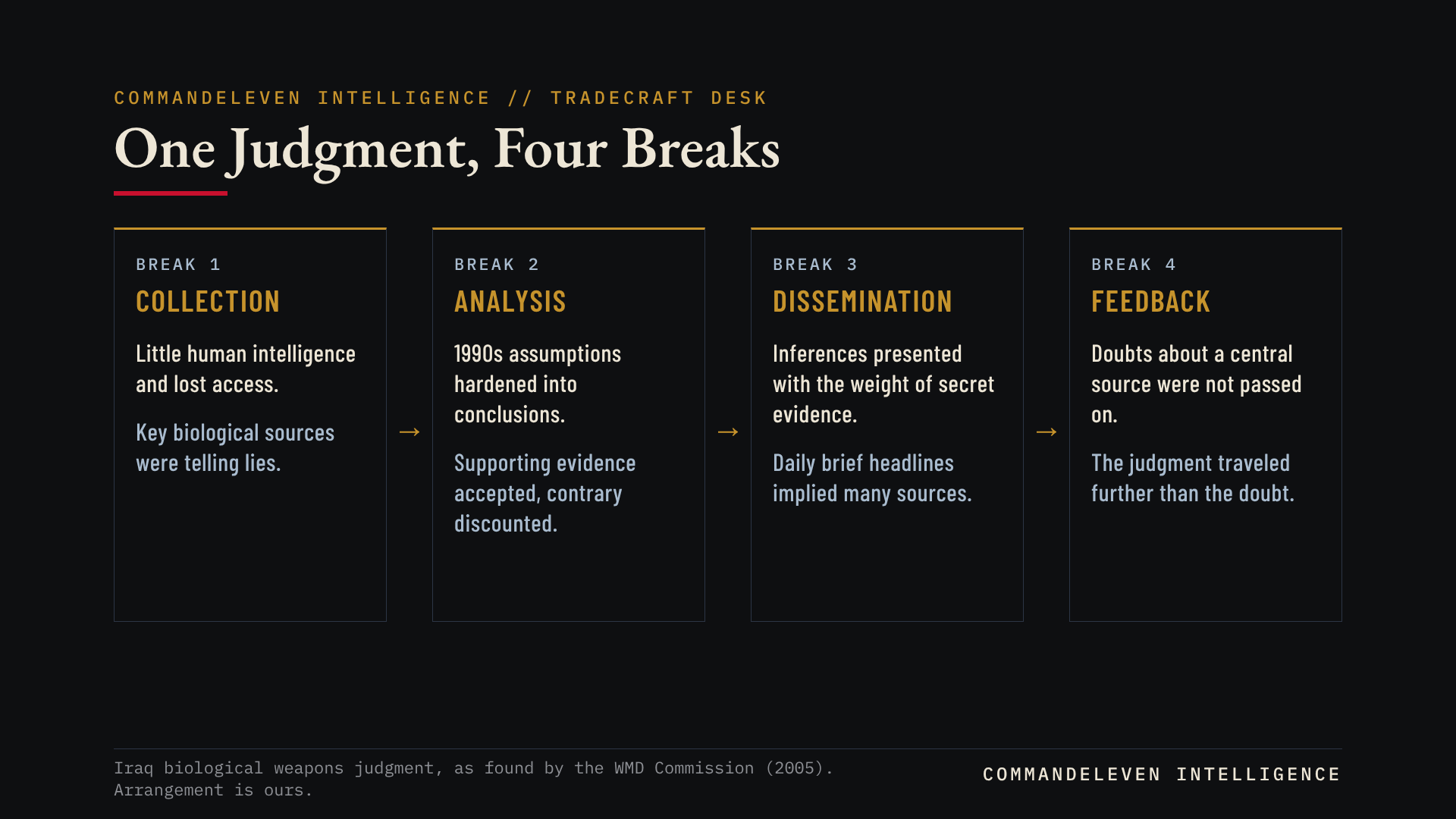
The chain starts in collection, where the community had little direct access and relied heavily on sources that proved unreliable. It continues in analysis, where an assumption formed years earlier shaped how new information was read. In dissemination, the resulting judgments reached readers with more certainty than the evidence carried. In feedback, doubts about a central source did not travel as far as the judgment did. No single break accounts for the failure. Each one made the next harder to see.
How We Apply This
We use the cycle as a checklist for our own work. Before a judgment is published we ask where it could be wrong at each step: whether the question was the right one, what we could not see, what we assumed, how far the wording carries the evidence, and whether anything has changed since. Our confidence tiers label the weight each claim can bear, and our Foresight Record lets readers check our past judgments against what happened. These habits reduce the risk of the breaks above. They do not remove it.
Common Errors in Reading Failures
- Judging by outcome alone. A wrong result does not prove a flawed process, and a right one does not prove a sound one.
- Using hindsight as evidence. Signals look clearer after the event than they were within the flow of other reporting.
- Looking for one culprit. Both reviews found failures spread across steps and organizations.
- Assuming bad faith. The WMD Commission found no case in which political pressure changed an analyst’s judgment, and the failure was real anyway.
- Treating the fix as the lesson. A reform answers one failure, and it does not guarantee that the next one will look like it.
Frequently Asked Questions
What is an intelligence failure?
A case where the intelligence process did not give decision-makers an accurate, timely and usable understanding when one was reasonably achievable. It is a judgment about the process, not only the outcome.
What did the 9/11 Commission call the main failures?
It grouped the failures into four kinds: imagination, policy, capabilities and management.
Did political pressure cause the Iraq WMD failure?
The WMD Commission found no instance in which political pressure caused analysts to change their judgments. It found that the community’s own assumptions and weak collection and analysis were the main causes.
Which step of the cycle fails most often?
The reviews do not rank the steps. Both found failures in several, and the failures linked together.
Is hindsight a problem when studying failures?
Yes. Knowing the outcome makes earlier signals look clearer than they were, so reviews must judge people by what could have been known at the time.
What should I read next?
Why Intelligence Fails looks at the reasons the breaks happen and why they repeat.
Related CommandEleven Intelligence Reading
- How CommandEleven Intelligence Thinks: the series this primer belongs to, with every primer listed.
- The Intelligence Cycle: the six steps used here as a map.
- Indicators and Warning: Knowing What to Watch For: how warning is meant to work, and where it breaks.
- Writing for the Decision-Maker: how an assessment is written so the reader can weigh it.
- Foresight Record: how our own past judgments are checked.
Sources
- The 9/11 Commission Report, Chapter 11, Foresight and Hindsight, National Commission on Terrorist Attacks Upon the United States, 2004: the four kinds of failure, the 1997 estimate, the absence of indicators and collection requirements, the watchlisting findings and the hindsight caution.
- Report to the President of the United States, Commission on the Intelligence Capabilities of the United States Regarding Weapons of Mass Destruction, 31 March 2005: the collection, analysis, dissemination and feedback findings on Iraq, and the finding on political pressure.