CommandEleven Intelligence Desk // Tradecraft Desk, Tradecraft Primer. Part of the series How CommandEleven Intelligence Thinks.
Bottom Line Up Front
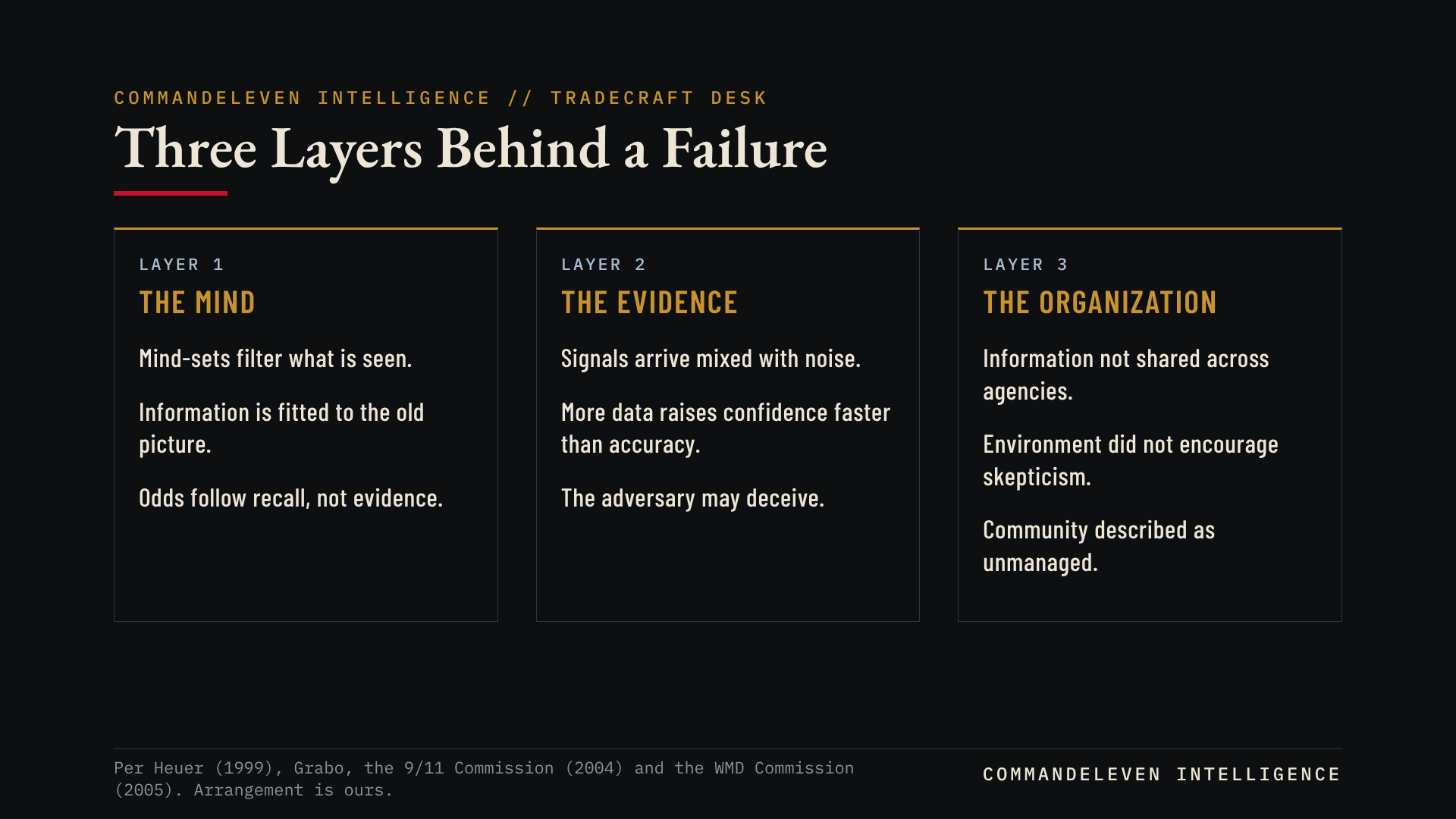
Intelligence fails for reasons that are mostly ordinary. The previous primer showed where in the process failures were found. This one asks why they happen. The answers fall into three layers: the analyst’s mind, which filters and simplifies by nature; the evidence, which is incomplete, noisy and sometimes planted; and the organization, which decides what is asked, shared and challenged.
The central point comes from Richards Heuer’s study of analytic psychology: these weaknesses belong to how people think, so they do not disappear with effort or goodwill. That is why they repeat, and why the next primer deals with corrections that are built into the process, not left to willpower.
The Analyst’s Mind
Richards Heuer Jr. wrote Psychology of Intelligence Analysis for the CIA’s Center for the Study of Intelligence, which published it in 1999. It draws on cognitive psychology to explain why capable analysts reach flawed judgments.
Mind-Sets Filter What Is Seen
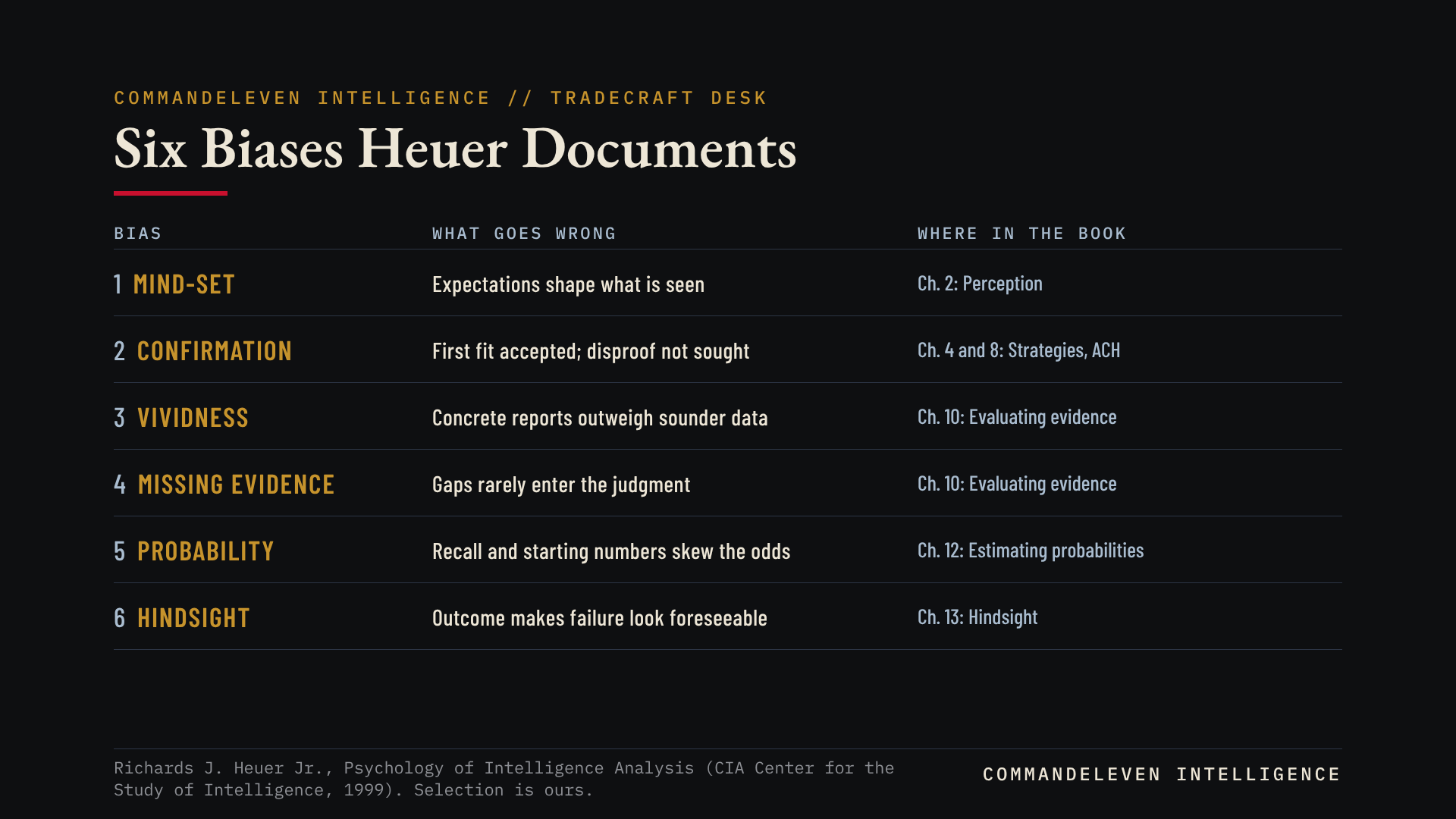
Heuer argues that perception is an active process of inference, not passive recording. Expectations shape what people notice and how they read it. A mind-set works like a lens, and he treats it as unavoidable, because nobody can process the volume of incoming information without simplifying assumptions. Mind-sets form quickly and resist change: new information tends to be absorbed into the existing picture, and early impressions can persist after clearer information arrives. His practical conclusion is that objectivity comes from making assumptions explicit so others can challenge them, not from having none.
Confirmation Comes Easily
Heuer describes analysts who accept the first explanation that seems to fit, a strategy he calls satisficing. He warns that an analyst trying to confirm a favored hypothesis is easily misled, because most supporting evidence is also consistent with other explanations. Evidence can make a hypothesis unlikely but rarely proves it impossible, and he concludes that the case for seeking disconfirming evidence is stronger than the case for seeking confirmation.
Evidence Is Weighed Unevenly
Heuer’s chapter on biases in evaluating evidence lists several habits. Vivid, first-hand or concrete information outweighs abstract or statistical data, even when the abstract data is sounder. Analysts rarely factor missing information into a judgment. Consistent evidence can mislead if it is redundant or comes from a small or biased sample. And beliefs formed from evidence often survive after the evidence is discredited, because the explanations people built around it remain in their heads.
Odds Are Judged by Recall and Starting Points
People judge how likely something is by how easily they can recall or imagine examples, so recent and vivid events seem more probable. Building a detailed scenario also makes it seem more probable, although each added step makes it less so. Estimates anchor on a starting number and are adjusted too little. Heuer also notes that words such as “possible” and “probable” mean different things to different readers, which is the problem Sherman Kent described and which we address in Confidence Tiers.
Governments Look More Coordinated Than They Are
Heuer notes that analysts tend to assume other governments act on coherent, rational plans. That overestimates their coordination and the predictability of what they will do next, and it overlooks blunders, bureaucratic bargaining and unintended consequences.
Hindsight Distorts the Review
The last of Heuer’s chapters on bias concerns hindsight. Knowing an outcome changes how people remember what they knew beforehand. Analysts overestimate how accurately they predicted events, readers underestimate how much a report taught them, and reviewers conducting a postmortem judge failures to have been more foreseeable than they were. Heuer reports that these biases persisted even when subjects were told about them and asked to compensate. This is the same caution the 9/11 Commission attached to its own report.
The Evidence
Better thinking does not fix thin or noisy evidence. Three problems recur.
Signals sit among noise. The 9/11 Commission cited Roberta Wohlstetter’s observation that it is much easier after an event to sort the relevant signals from the irrelevant ones. Before the event they arrive together, and the Commission said the warning system lacked methods used in earlier decades to detect surprise attacks.
More information is not always more accuracy. Heuer reports that once analysts have a minimum of necessary information, additional data usually raises their confidence more than their accuracy.
The adversary may be shaping what is seen. Cynthia Grabo, a US intelligence warning analyst, listed deliberate concealment and deception among the reasons warning fails, alongside mind-set and the problem of timing. Heuer adds that rejecting the possibility of deception too early biases the analysis, because analysts then stop looking for evidence that would support it.
The Organization
Individuals work inside institutions, and both reviews we use found failures at that level.
The 9/11 Commission found that information was not shared or pooled across agencies or across the foreign and domestic divide, and that no one clearly managed transnational cases. The WMD Commission found that the environment for Iraq analysis did not encourage skepticism about the prevailing view, and it described the community as not so much poorly managed as unmanaged. It also found that political pressure did not change analysts’ judgments, which is a reminder that the explanation does not have to be bad faith. Grabo adds a further organizational effect: repeated alerts that come to nothing breed skepticism, so a real warning may be discounted.
A Worked Example: Reading the Aviation Warning
This is an illustration, continuing the aviation example from the earlier primers. It describes how the habits above could shape a reading of such a warning. It is not a finding about any analyst or agency.
A warning that echoes a well-known attack makes a hijacking scenario easy to picture, and an easily pictured scenario feels likely. That is availability at work. An analyst who expects a holiday-season warning to be routine may read every new detail as confirming routine, which is mind-set. The fact that officials have named no specific plot is a gap, and Heuer found that gaps rarely enter the judgment. A detailed story about how a plot could unfold feels convincing, although each added step makes it less likely. Each of these is a small, ordinary slip, and together they can move a judgment well away from the evidence.
Why the Failures Repeat
Three things keep these failures coming back. First, the biases belong to ordinary thinking, and Heuer reports that awareness of them does not reliably remove them. Second, the evidence will always be incomplete, so judgment will always be needed. Third, organizations change slowly, and the habits that produce failure, such as not sharing information or not rewarding doubt, are usually part of how they work. Each of these points to the same conclusion: protection has to be built into the process instead of relying on each analyst to resist their own mind.
How We Apply This
We treat our own judgments as exposed to the same weaknesses. Our confidence tiers separate what is sourced from what is judged, which makes gaps visible, and our structured analysis habits test more than one explanation. Our Foresight Record lets readers check our past calls, which works against hindsight. None of this makes us immune, and we say so.
Common Errors
- Blaming the individual. Both reviews found failures built into process, structure and habit.
- Assuming awareness is enough. Heuer reports that knowing about a bias does not reliably correct it.
- Treating consistency as proof. Evidence that fits one story often fits others.
- Ignoring what is missing. A gap in the evidence can itself be informative.
- Reviewing with hindsight. Judging the past by what is known now makes failures look more foreseeable than they were.
Frequently Asked Questions
Why do intelligence analysts get things wrong?
Mostly for ordinary reasons: the mind filters and simplifies, the evidence is incomplete or noisy, and organizations shape what is asked, shared and challenged.
What is a mind-set?
A lens that filters perception and interpretation according to expectations. Heuer treats it as unavoidable and says the remedy is to make assumptions explicit so that others can challenge them.
Is more information always better?
No. Heuer reports that beyond a minimum, extra information usually raises analysts’ confidence more than their accuracy.
Does knowing about bias fix it?
Not reliably. Heuer reports that hindsight and anchoring biases persisted even when people were told about them, which is why protections are built into the process.
Can deception cause intelligence failures?
Yes. Grabo lists deliberate concealment and deception among the reasons warning fails.
What should I read next?
Correcting Intelligence Failures looks at the remedies the official reviews recommended and what they can and cannot fix.
Related CommandEleven Intelligence Reading
- How CommandEleven Intelligence Thinks: the series this primer belongs to, with every primer listed.
- Where Intelligence Fails: the steps of the cycle where failures were found.
- Structured Analysis: Testing Our Own Thinking: techniques that test a judgment against alternatives.
- Indicators and Warning: Knowing What to Watch For: how warning fails in Grabo’s account.
- Confidence Tiers: How We Label What We Know: the labels that make weight and gaps visible.
Sources
- Psychology of Intelligence Analysis, Richards J. Heuer Jr., CIA Center for the Study of Intelligence, 1999: perception and mind-sets, bounded rationality and confirmation, biases in evaluating evidence, cause and effect, probability, hindsight, and the value of information.
- The 9/11 Commission Report, Chapter 11, Foresight and Hindsight, National Commission on Terrorist Attacks Upon the United States, 2004: the warning system, the hindsight caution, the observation on signals and noise, and the management failures.
- Report to the President of the United States, Commission on the Intelligence Capabilities of the United States Regarding Weapons of Mass Destruction, 31 March 2005: the environment for skepticism, the “unmanaged” finding and the finding on political pressure.
- Strategic Warning: The Problem of Timing, Cynthia M. Grabo, CIA Historical Review Program: deception, mind-set and repeated false alarms as causes of warning failure.