CommandEleven Intelligence Desk // Tradecraft Desk, Tradecraft Primer. Part of the series How CommandEleven Intelligence Thinks.
Bottom Line Up Front
An assessment is only as useful as the decision it supports. The best analysis fails if the person who has to act cannot find the judgment, cannot tell how sure the analyst is, or cannot see what would change it. Writing for a decision-maker means putting the judgment first, stating how much weight it can bear in words that mean the same thing every time, separating what is known from what is assumed, saying what would change the view, and delivering it while there is still time to act.
US intelligence standards turn this into specific requirements. This primer walks through them, shows how vague wording damages a good judgment, and explains how our own products apply the same rules.
Who the Reader Is
The reader of an intelligence product is a customer with a decision to make and a schedule to keep. They are rarely an expert in the subject, and they are almost never short of other things to read. Intelligence Community Directive 203, the US standard for analytic tradecraft, builds this into the rules. It requires products to address issues relevant to their customers and to explain the implications of the findings. It also lists timeliness among its core standards: analysis has to reach the customer in time to be actionable, which means analysts must stay aware of their customers’ activities and schedules.
The test of a finished product is therefore not whether it is complete. It is whether a busy, intelligent person who is not an expert can pick it up, find the judgment, understand how far to trust it and know what to do next.
The Parts of a Finished Judgment
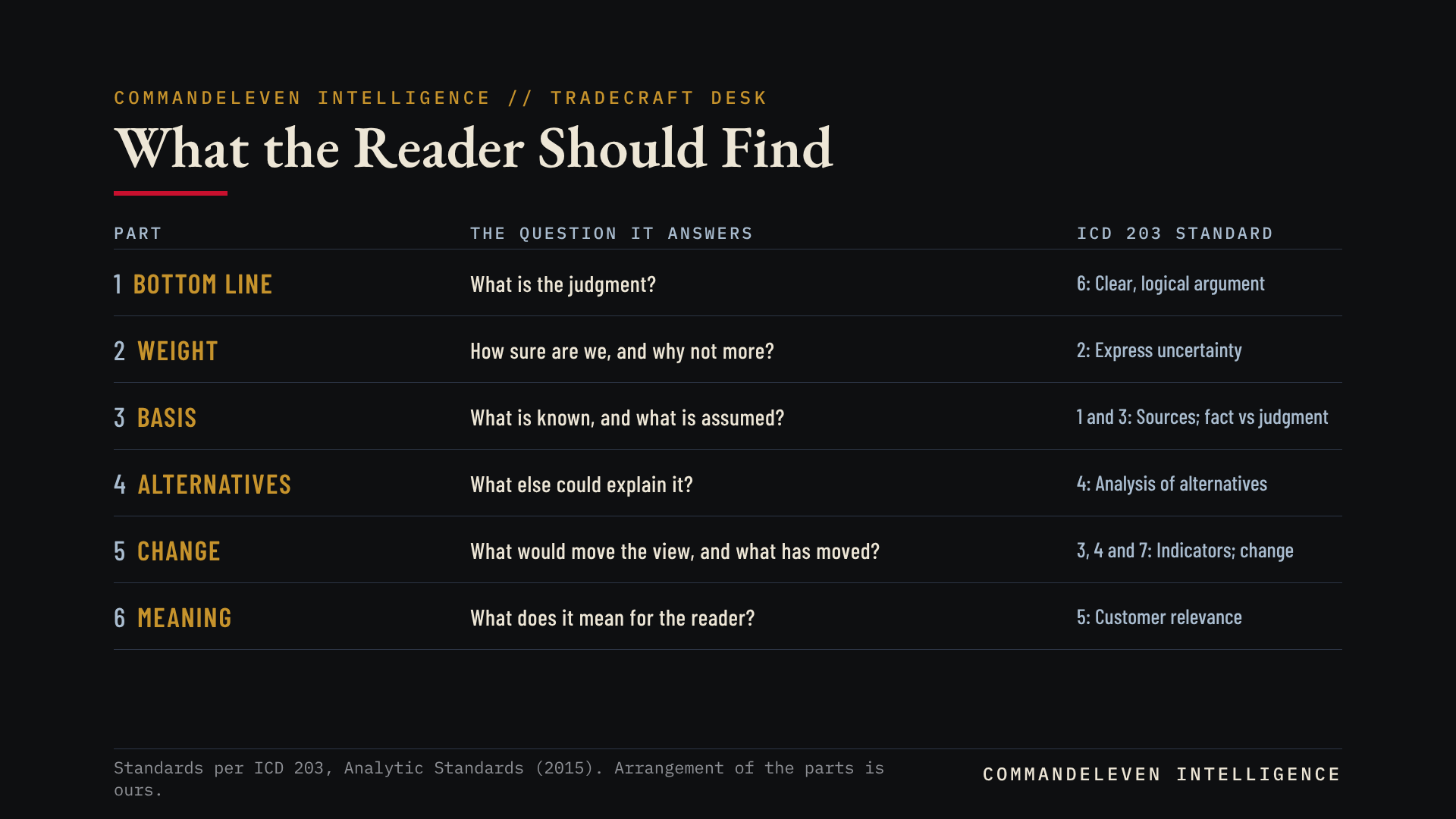
ICD 203 sets nine analytic tradecraft standards. Several of them describe what a reader should be able to find in a product.
Lead With the Bottom Line
The standard on clear and logical argumentation says a product should lead with a clear main message that draws together its judgments, support each judgment with relevant evidence and sound reasoning, use unambiguous language, and address both supporting and contrary information. In practice this is the bottom line up front: the reader should know the conclusion before they know anything else. Our primers open this way for the same reason.
Say How Sure You Are, and Say It Consistently
A second standard asks analysts to express how likely an event is and how confident they are in the judgment, and to explain what causes the uncertainty, such as gaps in the information or its age. It also tells them to use likelihood terms from a fixed set, not to mix terms from different rows, and not to put a confidence level and a likelihood term in the same sentence.
The reason is old. In a short essay from the mid-1960s, Sherman Kent described a 1951 national estimate on the probability of an invasion of Yugoslavia. Its key judgment called an attack a “serious possibility.” Kent privately meant odds of about 65 to 35 in favor. Policy readers took the phrase to mean much lower odds, and members of the board that had approved the estimate gave personal odds for the phrase that ranged from about 20 percent to 80 percent. Everyone had agreed to a phrase and no one had agreed on what it meant. Kent’s remedy was a fixed scale of terms, each tied to a rough range, which is the same idea as the likelihood scale ICD 203 uses today. We explain our own labels in Confidence Tiers.
Separate What Is Known From What Is Judged
Another standard requires products to separate underlying intelligence from the analyst’s assumptions and judgments, to state key assumptions openly, and to say what would change if an assumption proved wrong. A reader who cannot tell a documented fact from an inference cannot decide how much risk to take on either.
Say What Would Change the View, and What Has Changed
ICD 203 also asks analysts to consider alternative explanations and to name indicators that would make each more or less likely, and to say whether a judgment is consistent with, a change from, or the first coverage of earlier ones. Where a judgment has changed, the explanation should be brief and specific about what new information or reasoning drove the change, without boilerplate. For the reader, this is the difference between a view that moves for a reason and one that simply drifts.
Say What It Means
A fact with no implication leaves the work to the reader. The relevance standard asks products to explain what the findings mean for the customer, including prospects, context and the factors that affect opportunities to act.
Use Visuals Only When They Help
The last standard says visual information should be used where a concept, such as a spatial relationship or a sequence in time, is clearer as a graphic than in text, and that visuals must meet the same standards as the text. A graphic is not exempt from the rules about certainty and sourcing. Ours follow the same rule: a graphic is never more certain than the paragraph it illustrates.
A Worked Example: Rewriting a Sentence
This is an illustration, continuing the aviation example from the earlier primers. The wording is ours for teaching purposes and is not taken from our dossier.
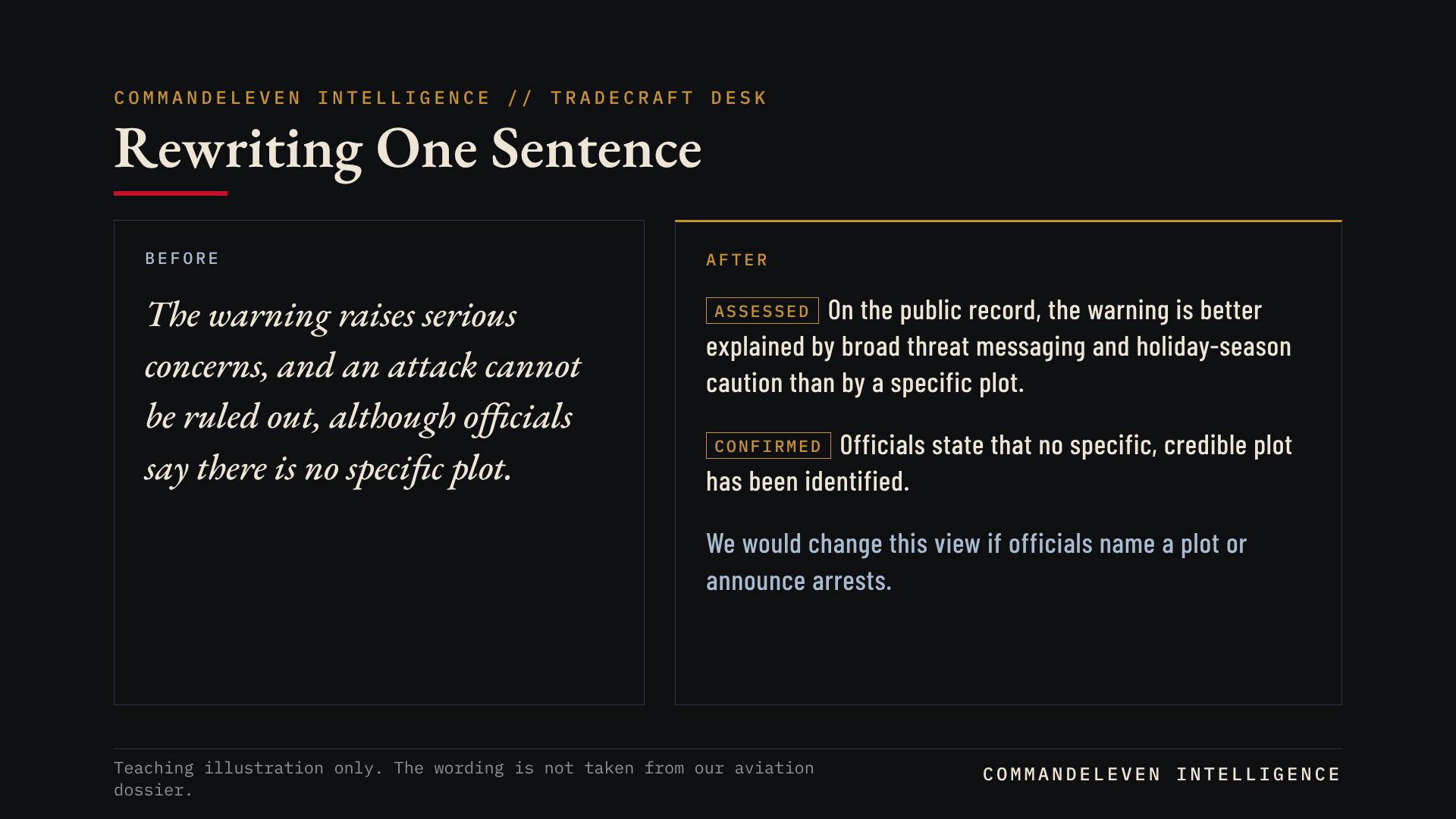
The first version sounds careful and says very little. “Raises serious concerns” does not say who is concerned or why. “Cannot be ruled out” is true of almost anything, so it gives the reader nothing to weigh. The fact that officials found no specific plot is buried, and the sentence offers no guide to what would change the picture.
The second version leads with the judgment and labels it as judgment. It separates the documented fact from the inference. It ends with the developments that would move the view, which are the indicators from our Indicators and Warning primer. A reader can act on it, challenge it or check it later, and each of those is impossible with the first version.
How We Apply This
Our Analytical Methodology names three forms of finished product: the SitRep, the Strategic Briefing and the Assessment. Across all of them the same habits apply. Each claim carries a confidence tier so the reader can see what is fact and what is judgment. Our dossiers state what an assessment does and does not establish. Our judgments carry the developments that would change them, and when they do change, the Revision Annex records it. The aim in each case is that the reader never has to guess how much weight a sentence can bear.
Common Errors
- Burying the judgment. The conclusion appears in the last paragraph, after the reader has stopped looking.
- Hedging by vocabulary. Words such as “possible,” “may” and “cannot be ruled out” avoid commitment without telling the reader anything.
- Mixing confidence and likelihood. “We are highly confident it is likely” blends two different things into a phrase no one can interpret.
- Presenting inference as fact. The reader cannot tell what was reported from what was concluded.
- Silence about change. A judgment shifts between products and nothing says why.
- Writing for peers. Jargon, acronyms and background the customer does not need push out the answer they do.
- Arriving late. An accurate assessment that reaches the customer after the decision is not useful.
Frequently Asked Questions
What does bottom line up front mean?
Putting the main judgment first, so a reader gets the conclusion before the supporting detail.
What is ICD 203?
Intelligence Community Directive 203, the US standard for analytic tradecraft. It sets nine tradecraft standards and a set of core analytic standards, including timeliness, for intelligence products.
Why do analysts avoid words like “possible”?
Because readers hear very different probabilities in the same word. Fixed terms tied to ranges make a judgment mean the same thing to every reader.
Why separate fact from judgment?
So the reader can see what rests on evidence and what rests on the analyst’s reasoning, and can decide how much weight each deserves.
Does a product need a graphic?
Only if the graphic explains something clearer than text. It must meet the same standards for sourcing and certainty as the text.
What should I read next?
Where Intelligence Fails looks at the places in the process where intelligence breaks down.
Related CommandEleven Intelligence Reading
- How CommandEleven Intelligence Thinks: the series this primer belongs to, with every primer listed.
- Confidence Tiers: How We Label What We Know: the labels that tell the reader how much weight a claim can bear.
- Indicators and Warning: Knowing What to Watch For: the signs that would change a judgment.
- The Military Decision Making Process: the decision that an assessment feeds.
- Editorial Standards: the rules that govern what we publish.
Sources
- Intelligence Community Directive 203, Analytic Standards, Office of the Director of National Intelligence, 2 January 2015: the nine analytic tradecraft standards, the requirement for timeliness and customer relevance, and the rules on expressing uncertainty.
- Words of Estimative Probability, Sherman Kent, CIA Center for the Study of Intelligence, mid-1960s: the 1951 estimate on a possible invasion of Yugoslavia, the different readings of “serious possibility,” and the proposal for a fixed scale of terms.