CommandEleven Intelligence Desk // Tradecraft Desk, Tradecraft Primer. Part of the series How CommandEleven Intelligence Thinks.
Bottom Line Up Front
An indicator is an observable event that would show a situation is developing in a particular direction. A warning is a judgment that something may happen, issued early enough to be useful. The two work together: the analyst decides in advance what would be seen if a hypothesis were true, then watches for it. The practical result is that a judgment stops being an opinion and becomes something a reader can check as events unfold.
Warning is not prediction. It deals in probability, it is often right about the direction and uncertain about the date, and it is easily damaged by false alarms, fixed mind-sets and deliberate concealment. This primer explains how indicators are built, how warning is framed, and how it goes wrong.
What an Indicator Is
US analytic doctrine describes the technique plainly. Analysts build a list of the events they would expect to see if a particular situation were developing, and they review that list regularly to see what is changing. The list gives an objective baseline. It also makes the reasoning visible: by naming the variables that matter, the analyst shows why they expect those variables to matter, and a reader can follow along.
Indicators are most useful when they come from hypotheses and not from a general feeling. The usual method has four steps.
- Identify the competing hypotheses or scenarios.
- For each one, list the activities, statements or events that would be expected if it were true.
- Review and update the lists regularly, noting which indicators have changed.
- Judge which hypotheses look most likely based on how many indicators have moved.
Doctrine also recommends keeping two lists for each hypothesis, one for signs that a development is emerging and one for signs that it is not. The second list is what lets an analyst make the case that something is unlikely, instead of only waiting for it to happen. This is the same logic as Structured Analysis, carried forward in time.
Warning Is Not Prediction
Cynthia Grabo, a US intelligence warning analyst, argued that strategic warning is best understood as a forecast of probable attack, not a certainty and not a countdown. A common assumption is that warning grows clearer as an event approaches. In her account it does not necessarily do so.
She also separated two kinds of warning. Strategic warning is the early judgment that hostilities are probable, made with enough lead time for leaders to decide and act. Tactical warning is short-term and mostly an operational problem for commanders. The lesson she drew is that analysts should make their probability judgments early, from the strategic evidence, and should be modest about forecasting exact timing.
Why Warning Fails
Grabo’s cases run from Verdun in 1916 to Czechoslovakia in 1968, and the same patterns recur.
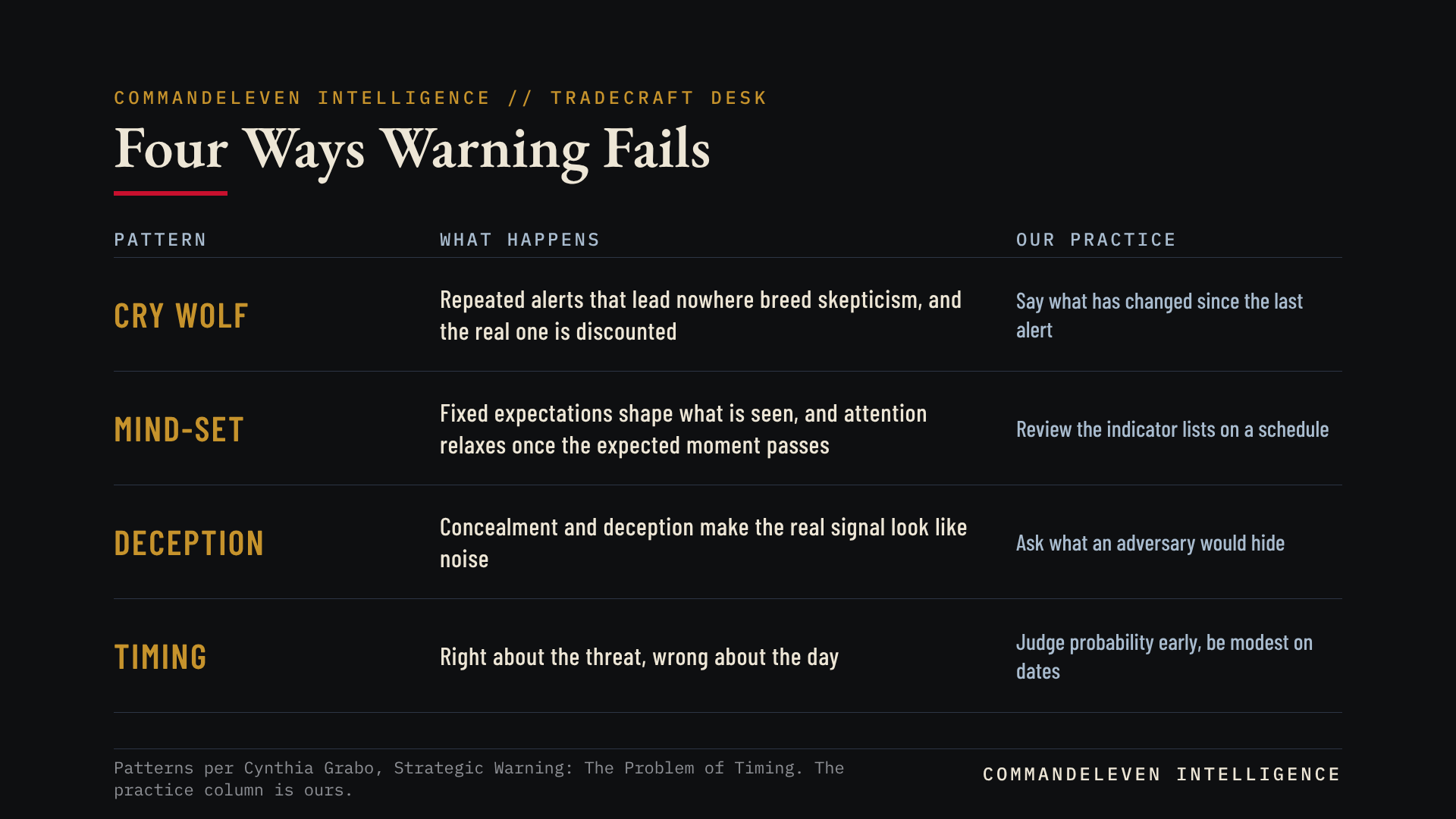
- Cry wolf. Repeated alerts that come to nothing breed skepticism, so the real one is discounted.
- Mind-set. Fixed expectations shape what analysts see, and attention relaxes once the expected moment has passed.
- Deception and concealment. Deliberate concealment and deception hide the real preparations, so the real signal can look like noise.
- Timing uncertainty. The date is the hardest part to judge. An analyst can be right about the threat and wrong about the day.
Grabo also put a demand on the reader. More facts do not automatically produce more warning, and policymakers should act on a warning instead of blaming collection when the timing turns out differently.
A Worked Example: What to Watch on the Aviation Warning
This is an illustration, continuing the example from the structured analysis primer. It is not our full assessment, which is in Al Qaeda Aviation Threat: What the FBI-DHS-TSA Warning Means for US Air Travel.
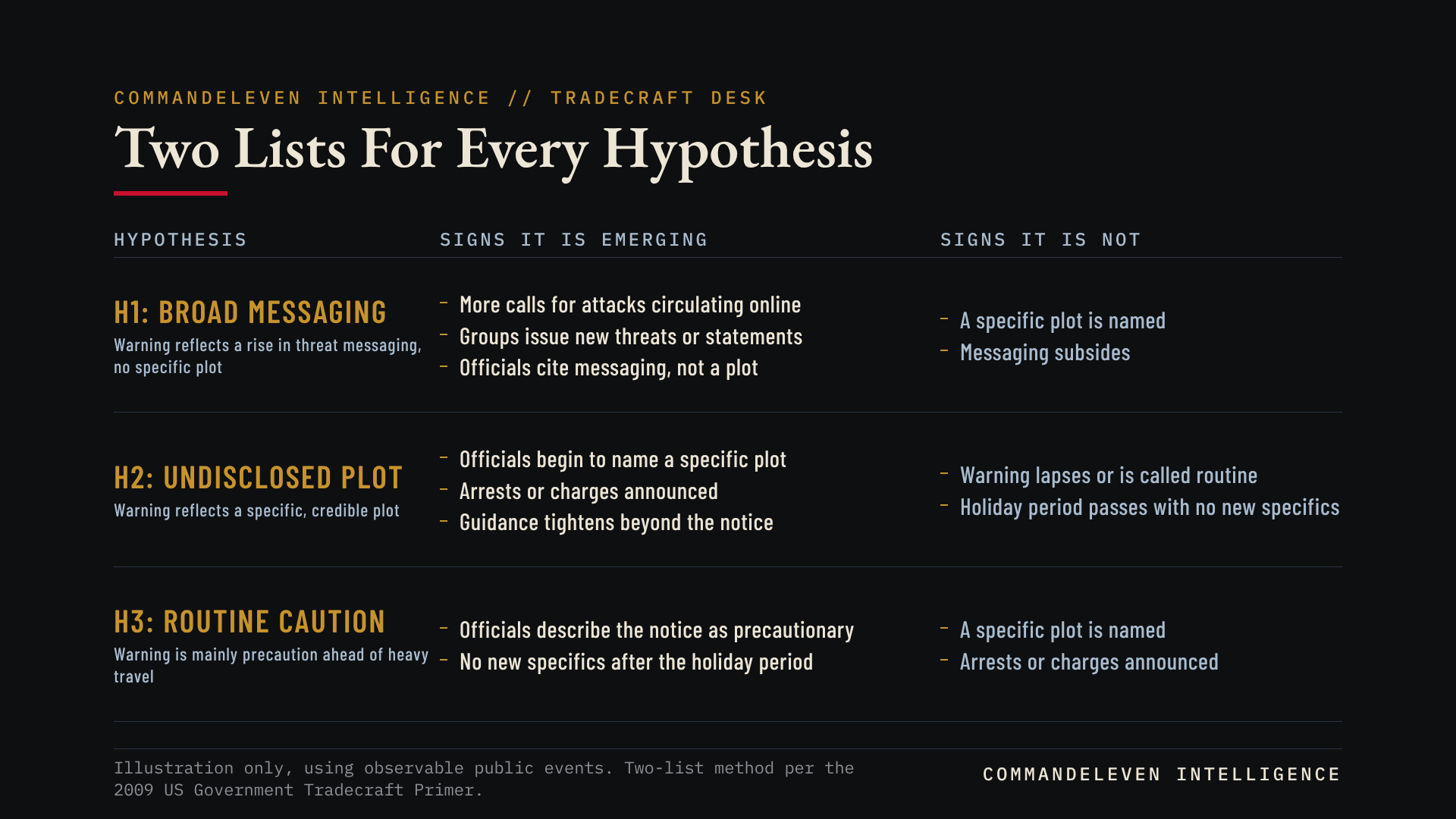
Take the hypothesis that the warning reflects a specific, credible plot that officials have not disclosed. An analyst would write down, before the holiday period, what would make that more likely and what would make it less likely. Public, observable events are enough. Official statements that begin to name a specific plot, announced arrests or charges, or a change in the government’s own guidance would strengthen it. A warning that lapses or is described as routine, and a quiet holiday period without new specifics, would weaken it.
The same exercise applies to the other two explanations. If the warning reflects only a broad rise in threat messaging (H1), we would expect more calls for attacks and new statements from groups, with officials citing messaging and not a plot, and a named plot or fading messaging would count against it. If it is routine caution ahead of heavy travel (H3), we would expect officials to call the notice precautionary and no new specifics after the holiday period.
The list does two things. It tells readers what to look for, so they do not have to rely on our reading of the news. And it commits us: if the weakening signs arrive, we say the hypothesis has lost support, and if the strengthening signs arrive, we say it has gained. That is the same habit our dossiers follow in their “What To Watch” sections.
How We Use Indicators
Our Analytical Methodology names Indicator Monitoring among its analytical techniques, alongside Analysis of Competing Hypotheses and Red Teaming. In our published work it shows up as the list of developments that would change an assessment, and as the dated calls we register on the Foresight Record and score against what happened. Dated calls carry no percentages. The point is the date, the outcome and the record.
When events move against an assessment, the Revision Annex records the change and the Confidence Tiers label is revised.
Rules for Indicators That Work
- Write them before the event. An indicator chosen after the outcome is known is a story, not a test.
- List both directions. Signs that something is emerging, and signs that it is not.
- Make them observable. Anyone should be able to check whether the event happened.
- Tie each to a hypothesis. An indicator that fits every hypothesis tells you nothing.
- Do not promise the date. Judge probability early and be modest about timing.
- Act on the change. An indicator that moves and does not change the assessment was never an indicator.
Frequently Asked Questions
What is an indicator in intelligence analysis?
An observable event or trend that would be expected if a particular situation were developing, tracked over time to show whether it is.
What is the difference between strategic and tactical warning?
Strategic warning is an early judgment that an event is probable, with time for leaders to act. Tactical warning is short-term and mostly useful to commanders in the field.
Is warning the same as prediction?
No. Warning is a judgment about probability. It can be right about the threat and uncertain about the timing.
Why do warnings fail?
Common causes are repeated false alarms, fixed mind-sets, deception and concealment, and the difficulty of knowing the timing.
Why list signs that something is not happening?
Because without them an analyst can only wait for the event. A second list makes it possible to show that an outcome is becoming less likely.
What should I read next?
Threat, Vulnerability and Risk explains how a threat judgment becomes a statement of risk.
Related CommandEleven Intelligence Reading
- How CommandEleven Intelligence Thinks: the series this primer belongs to, with every primer listed.
- Structured Analysis: Testing Our Own Thinking: the hypotheses that indicators are built from.
- Confidence Tiers: How We Label What We Know: the labels that change when indicators move.
- Foresight Record: where our dated calls are scored.
Sources
- A Tradecraft Primer: Structured Analytic Techniques for Improving Intelligence Analysis, prepared by the US Government, March 2009: the Indicators or Signposts of Change technique, its steps and its value.
- Strategic Warning: The Problem of Timing, Cynthia M. Grabo, CIA Historical Review Program, adapted from her A Handbook of Warning Intelligence: warning as a forecast of probability, strategic and tactical warning, and the patterns by which warning fails.