CommandEleven Intelligence Desk // Tradecraft Desk, Tradecraft Primer. Part of the series How CommandEleven Intelligence Thinks.
Bottom Line Up Front
Information reaches an analyst through a small number of collection disciplines: people, intercepted communications, imagery, technical measurements and open sources. Each discipline sees part of the picture and has its own blind spots, so no single one is enough. Whatever the discipline, two separate questions have to be answered before a report is used: how reliable is the source, and how credible is the information it supplied.
We answer both with the Vetting Matrix described in our Analytical Methodology, which grades sources A to F and information 1 to 6. The most common mistake in the field is to merge the two questions into one, and assume that a source we trust has told us something true.
The Collection Disciplines
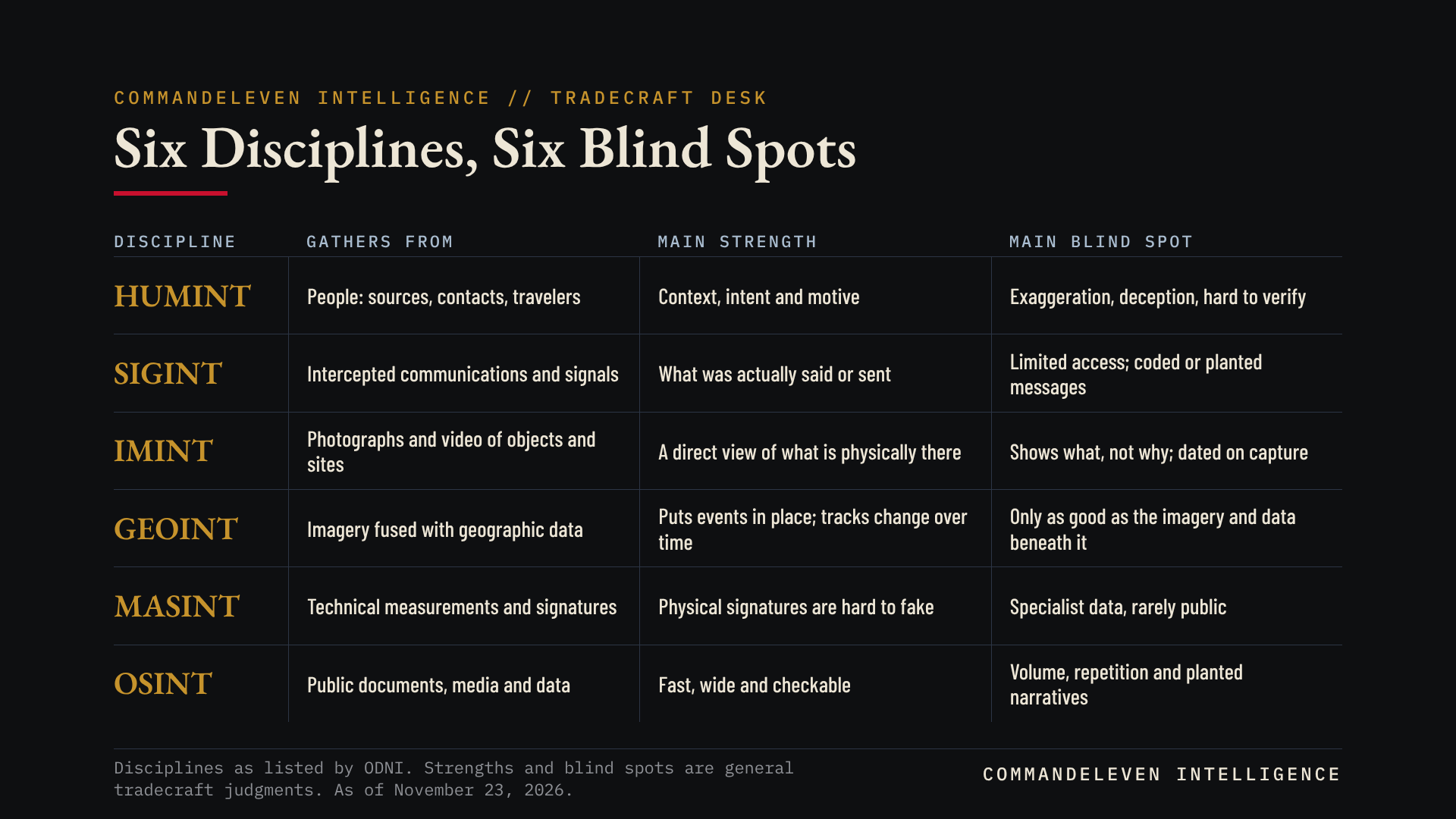
Intelligence agencies group collection by the kind of source it draws on. The Office of the Director of National Intelligence lists six basic types of collection, and each has a short name ending in “INT.” The sections below describe what each gathers, where it is strongest and where it tends to fail.
HUMINT: Intelligence From People
Human intelligence comes from people: sources, informants, contacts, travelers, defectors and the questioning of detainees. It is the oldest collection method. Its strength is context. A person can explain intent, motive and relationships that no document or photograph will show. Its weakness is that people are fallible and sometimes deceptive. A source may exaggerate to look valuable, repeat rumor as fact, or pass on information they were given in order to mislead. HUMINT is also hard to verify, so it needs to be rated with care and checked against something independent.
SIGINT: Intelligence From Communications and Signals
Signals intelligence comes from intercepting communications and electronic signals passing between people, machines or both. Its strength is that it can show what was actually said or transmitted, in the sender’s own words, without relying on a human intermediary. Its weaknesses are limited access, the volume of material, and interpretation: a message may be coded, ambiguous or planted. It is also mostly unavailable to the public, so it is rarely something a reader can check.
IMINT: Intelligence From Images
Imagery intelligence comes from images of objects and sites produced electronically, optically or on film and other media: satellite and aerial photographs and video. Its strength is a direct look at what is physically there, which can be compared over time. Commercial satellite imagery has made a version of this widely available. Its weakness is that an image shows what is there, not why. A shape on the ground can be read several ways, and imagery is only as current as its capture date.
GEOINT: Intelligence From Geographic Data
Geospatial intelligence combines imagery with geospatial and geographic information, such as maps, terrain and location data. Its strength is that it puts events in a place and tracks physical change over time: what has been built, moved or destroyed, and where. Its weakness is that it is only as good as the imagery and data beneath it, and a location says where something is, not why.
MASINT: Intelligence From Technical Measurements
Measurement and signature intelligence uses scientific and technical measurements to locate, identify or describe specific targets, such as the distinctive signature of an engine, a material or an emission. Its strength is that physical signatures are hard to fake. Its weakness is that it is specialized, depends on expensive sensors and expert interpretation, and is seldom available in open reporting.
OSINT: Intelligence From Open Sources
Open-source intelligence draws on material anyone can lawfully access: official releases, court filings, news reporting, academic work, commercial databases and online material. Its strength is that it is fast, wide and checkable, and a reader can follow the citation to the same document the analyst used. Its weakness is volume and manipulation. Open sources are crowded with repetition, rumor and deliberately planted narratives, and a claim that appears in many places may trace back to a single origin.
How We Use Them
Our methodology organizes collection into three layers: human intelligence, open-source intelligence, and signals and technical collection. For anything we publish, a public source must corroborate the claim, which is why our work leans heavily on primary documents such as government releases, court filings and original reports. The Intelligence Cycle primer shows where collection sits in the wider process.
Two Questions, Not One
Every report raises two separate questions. The first is about the source: has this person, system or outlet been right before, and did they have a way to know? The second is about the information: is this particular claim consistent with what else we know, and does it hold up when checked? The answers can differ. A source with an excellent record can pass on a rumor in good faith. A new and untested source can report something that later proves entirely true.
That is why the two judgments are rated separately, and why a rating of the source alone tells you little about whether to rely on a claim.
The Vetting Matrix
Our Vetting Matrix uses a two-part rating. This kind of pairing has a long history in military practice, and US Army doctrine on human intelligence collection, FM 2-22.3, includes a source and information reliability matrix of the same kind. Ours has a letter for the source and a number for the information.
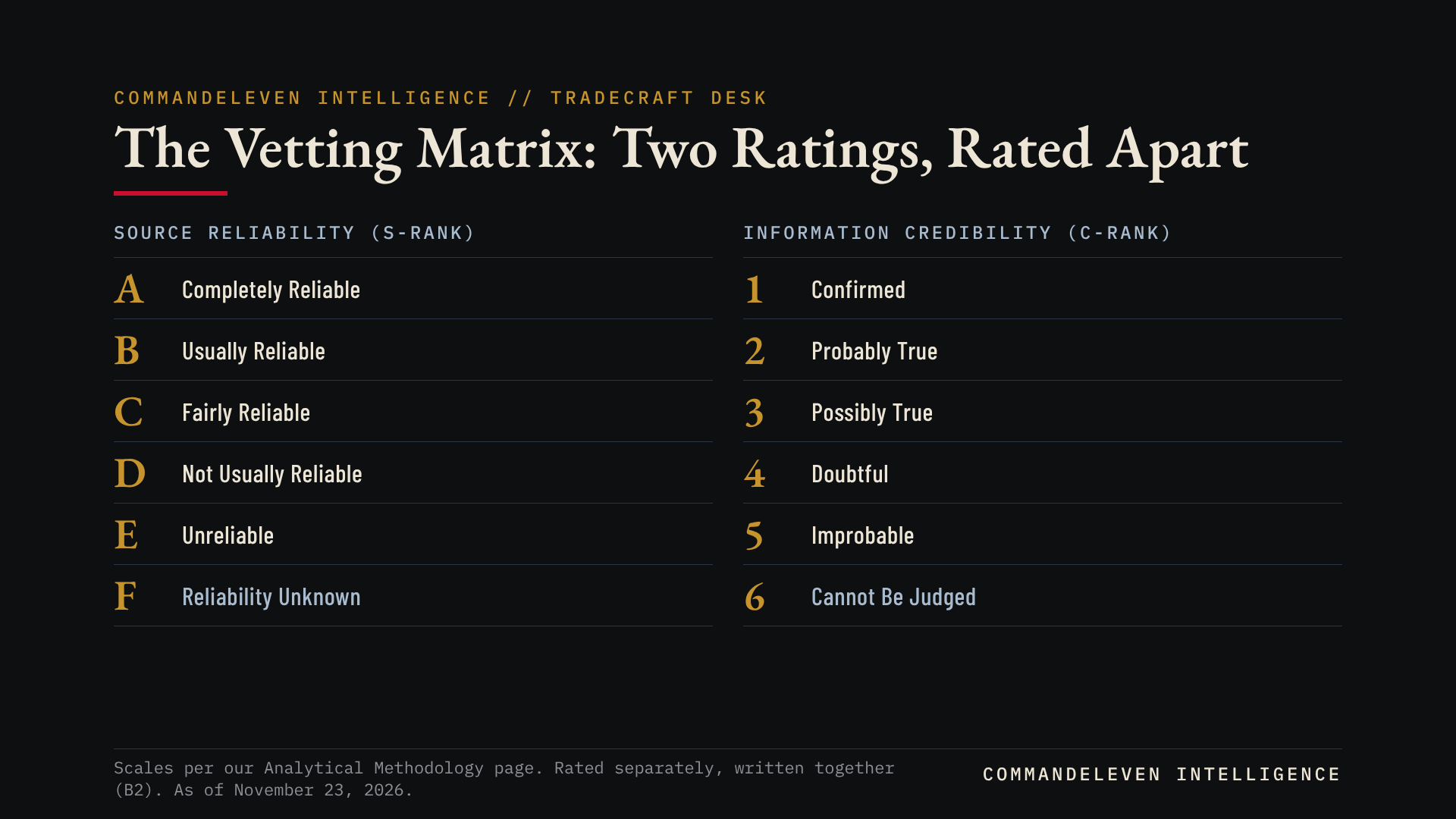
Source reliability (S-Rank) runs from A, completely reliable, to E, unreliable. F means reliability unknown, which is the honest grade for a new source with no track record. Information credibility (C-Rank) runs from 1, confirmed by independent, reliable sources and consistent with other information, to 5, improbable. A 6 means the information cannot be judged because there is no basis for evaluating it.
The two ratings are written together. A usually reliable source (B) passing on information that independent sources confirm (1) is a B1. A new source (F) reporting something plausible but unconfirmed (3) is an F3, which is a lead to be tested and not a finding to be published.
How Reliability Goes Wrong
Most failures of source evaluation fall into a few familiar patterns.
- Single-source reliance. One report carries the whole claim. Our methodology prohibits single-source publication for this reason.
- Circular reporting. Several outlets seem to confirm a claim, but all of them trace back to one original report. Counting repetitions as confirmation is how a rumor becomes a fact.
- Trusting the source over the claim. A reliable source is not infallible, and the information still has to be checked on its own merits.
- Convenient sources. The source who is easy to reach, quotable or aligned with the analyst’s expectations gets more weight than their record deserves.
- Deception and planted material. Adversaries and interested parties feed material into open and closed channels alike. This is why we screen incoming material for manufactured narratives and bias, in a step we call Narrative De-Noising.
- Stale information. A reliable report about last month’s situation may be wrong about today’s.
- The digest instead of the original. A summary or aggregator can drop a caveat or change a number. We go to the primary source wherever we can, and say so when we cannot.
How We Apply It
Before a data point is promoted into analysis, it must pass Triple-Node Verification: a redundancy scan against independent field assets, technical correlation against open-source and signals data, and temporal authentication of when the report was made. The ranks grade what comes in. The confidence tier on a finished claim, such as CONFIRMED, REPORTED or ASSESSED, is the label a reader sees, and the Confidence Tiers primer explains each one.
Our dossiers also show the habit in practice. ARTEX: What the FBI Alert Says About AI-Run Intrusions, and What the Outage Rumors Get Wrong separates what a primary document says from what rumor adds to it, and treats each according to its source.
Frequently Asked Questions
What are the main intelligence collection disciplines?
The Office of the Director of National Intelligence lists six: human intelligence (HUMINT), signals intelligence (SIGINT), imagery intelligence (IMINT), geospatial intelligence (GEOINT), measurement and signature intelligence (MASINT) and open-source intelligence (OSINT). Agencies group and name them slightly differently, and imagery and geospatial work overlap heavily.
What is the difference between source reliability and information credibility?
Source reliability is about the track record and access of whoever supplied the report. Information credibility is about whether the specific claim is consistent with other evidence and holds up when checked. They are judged separately because a good source can be wrong and a poor one can be right.
What does a rating like B2 mean?
It combines the two grades. The letter rates the source and the number rates the information. In our matrix, B2 is a usually reliable source supplying information that is probably true.
Why does it matter if several outlets report the same thing?
Because repetition is not confirmation. If every report traces back to one origin, you have one source, not several. Checking where each report began is a basic test.
Is open-source intelligence less reliable than secret intelligence?
Not automatically. Open sources can be checked by anyone and are often primary documents. They are also heavily manipulated, so each one is rated on its record and on the claim it carries, like any other source.
What should I read next?
Confidence Tiers: How We Label What We Know explains the labels you see on every claim in our dossiers.
Related CommandEleven Intelligence Reading
- How CommandEleven Intelligence Thinks: the series this primer belongs to, with every primer listed.
- The Intelligence Cycle: where collection fits in the wider process.
- Analytical Methodology and Source Validation: the intelligence engine and the Vetting Matrix in full.
- Confidence Tiers: How We Label What We Know: the labels that sit on top of the ratings.
Sources
- How the IC Works, Office of the Director of National Intelligence: the collection disciplines and what each gathers.
- FM 2-22.3, Human Intelligence Collector Operations, US Department of the Army, 2006: continuous evaluation of both the source and the information, and the source and information reliability matrix.
- Intelligence Community Directive 203, Analytic Standards, Office of the Director of National Intelligence: the standard that analysis describe the quality and credibility of its sources.
- Joint Publication 2-0, Joint Intelligence (Intelligence Series), US Joint Chiefs of Staff: the collection process in joint doctrine.