CommandEleven Intelligence Desk // AI and Cyber Desk, status as of November 18, 2026
Bottom Line Up Front
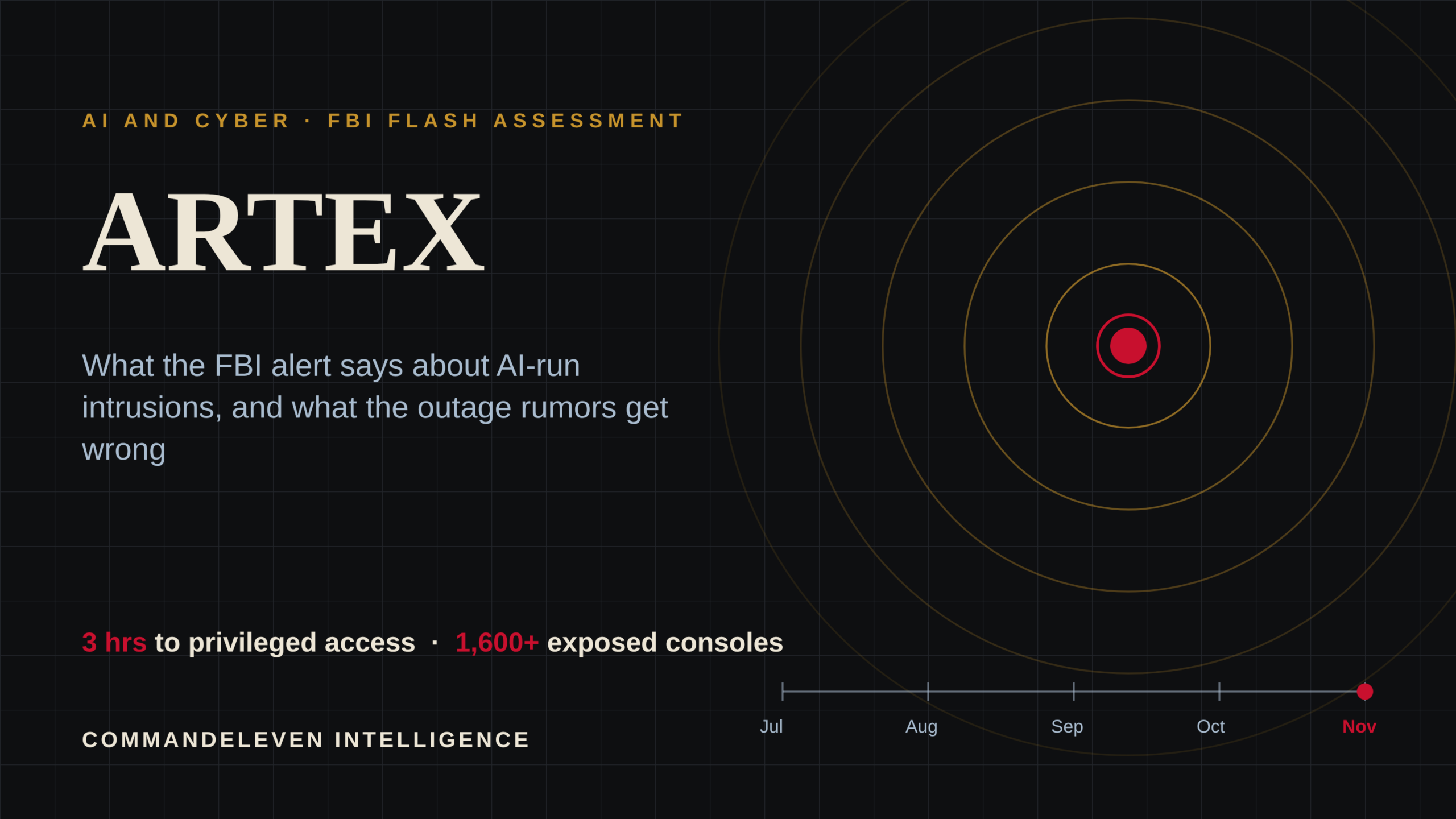
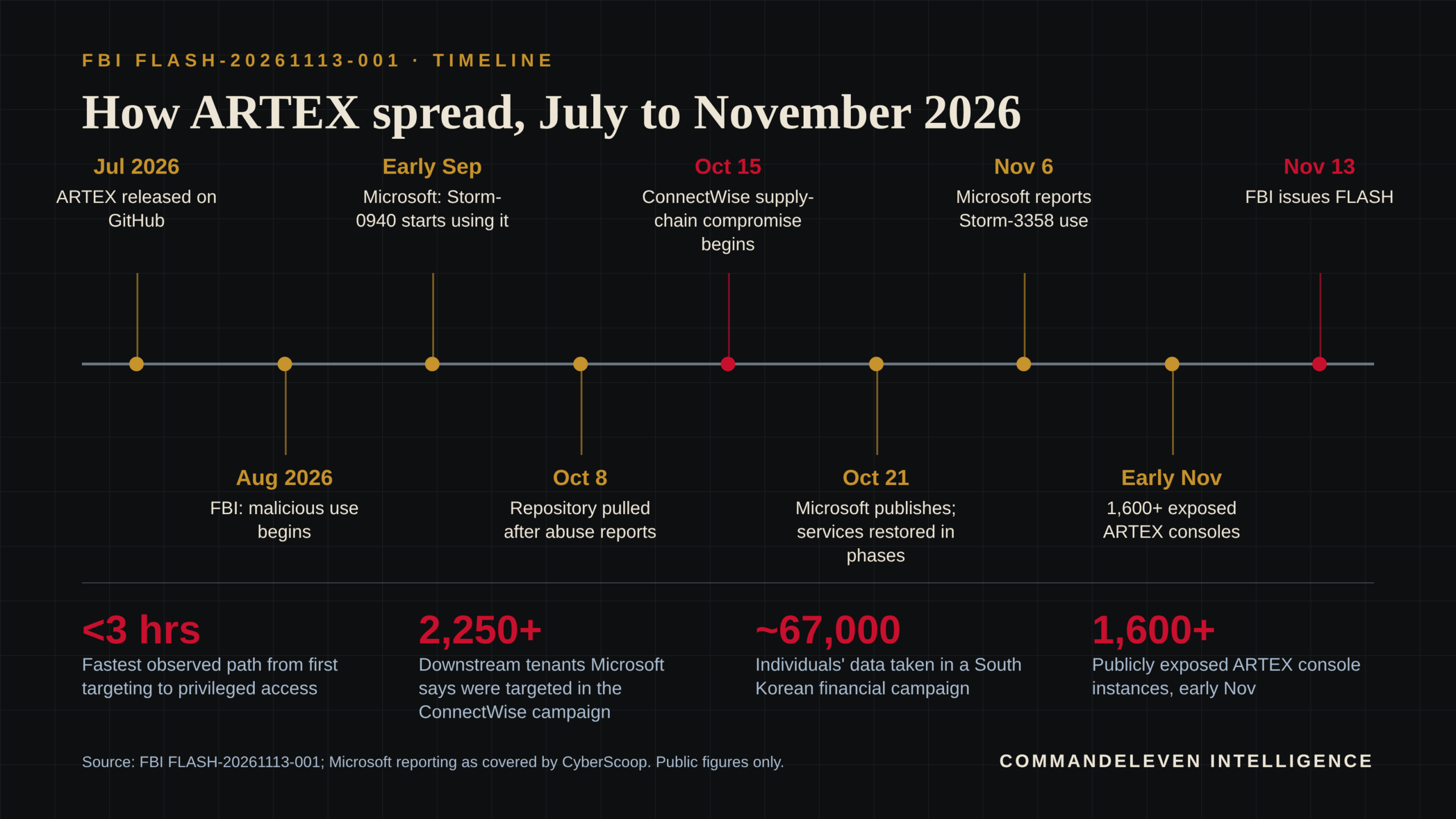
On November 13 the FBI issued FLASH-20261113-001, a TLP:CLEAR alert on ARTEX, an open-source framework that lets large language model agents run penetration tests on their own. The alert says malicious actors have used it since at least August 2026, that some intrusions went from first targeting to privileged access in under three hours, and that the tool is now spreading through forks, a commercial variant and more than 1,600 exposed console instances. It does not say ARTEX caused the wave of outages that hit US banks, airlines and email last week. Officials have said they see no evidence of that. The real story is narrower and more durable: the time between finding a weakness and exploiting it is shrinking, and defenders’ patch windows were set for a slower adversary. We set four dated calls below.
Key Judgments
- CONFIRMED: The FBI alert describes ARTEX as an LLM-driven agentic penetration-testing platform written in Go, released on GitHub in July 2026 and removed on October 8 after abuse reports. It reached roughly 1,500 to 2,000 stars within ten weeks. The alert names Anthropic Claude, OpenAI GPT, DeepSeek, GLM, Grok and Kimi among the model providers it can call.
- CONFIRMED: The FBI says malicious cyber actors have used ARTEX since at least August 2026 against financial services, government, technology, defense, semiconductor, energy, healthcare, manufacturing, telecommunications and legal targets. It does not name the actors.
- CONFIRMED: Microsoft publicly attributes a supply-chain campaign against ConnectWise Cloud Backup customers to Storm-0940, a China-state aligned group, and says ARTEX was used to reach more than 2,250 downstream tenants at up to 2,900 sign-in attempts per minute. Microsoft did not say how many were compromised, and the attribution is its assessment.
- CONFIRMED: Microsoft separately reports a different actor, the financially motivated Cambodia-based cluster Storm-3358, using ARTEX against financial organizations, mostly in Southeast Asia. The two clusters should not be conflated.
- ASSESSED: ARTEX changes speed and scale, not the kind of attack. The techniques the FBI lists are conventional. What the agents add is persistence at machine tempo: reconnaissance, exploitation and follow-on steps chained without waiting for a human.
- ASSESSED: The recent outages are, on current public evidence, unrelated. The Secretary of State said officials found “zero evidence” tying them together or to malicious actors, and the Director of National Intelligence said he does not see indicia of a coordinated or state-sponsored attack. Companies cited a software defect, a software release, maintenance and a fiber-replacement project.
- SPECULATIVE: Whether ARTEX or any successor will produce an incident large enough to be mistaken for, or compounded with, an infrastructure failure is unknown. We assign it no probability.
What the FBI Actually Said
The alert is a threat overview, and its tone is precautionary. It describes a tool that turns a natural-language goal into machine commands and needs little human input beyond setting the objective. It lists sectors, notable campaigns, proliferation signs and defensive steps. It carries detailed indicators and techniques for network defenders, which we deliberately leave out of this public assessment. Three points matter at the strategic level.
- Speed. Some intrusions went from initial targeting to privileged access in under three hours. That compresses the window in which a defender can notice and respond.
- Proliferation. The original repository came down on October 8, but community forks, a commercial “ARTEX PRO” and over 1,600 publicly exposed ARTEX consoles as of early November mean removal did not remove the capability.
- Cheap model access. Reporting cited in the alert says attacker-controlled instances lean heavily on lower-cost DeepSeek models. We have not independently verified the vendor figures behind that claim.
What Is Documented So Far
| Campaign or actor | What is on the record | Source status |
|---|---|---|
| ConnectWise Cloud Backup supply chain | A password-spraying campaign in mid-October preceded a compromise that began October 15. Microsoft says ARTEX agents progressed into directory and identity operations and attempted sign-ins to more than 2,250 downstream tenants. ConnectWise suspended services and restored them in phases from October 21. | Microsoft attribution to Storm-0940 (China-state aligned); compromise scale not stated |
| South Korean financial institutions | The FBI alert cites exfiltration of personal data on about 67,000 individuals. | FBI FLASH; actor not named |
| Financial sector, Southeast Asia and beyond | Microsoft reports Storm-3358, a Cambodia-based, financially motivated cluster, using ARTEX from October alongside conventional tooling. | Microsoft report via secondary coverage |
| Aerospace and wider agentic tooling | Google Threat Intelligence Group says hackers’ use of AI has reached an inflection point and cites other frameworks beyond ARTEX, including Cairn, CyberStrikeAI, HexStrike AI and PentAGI. | Google GTIG via secondary coverage |
What the Outage Rumors Get Wrong
The FLASH went out on November 13, the same week as a run of high-profile failures, and the two stories merged online. The primary document does not link them: the word “outage” does not appear in it. Officials who have addressed the question say the opposite. The Secretary of State said there was “zero evidence” tying the outages together or to malicious actors, the Director of National Intelligence said he does not see indicia of a coordinated cyberattack or state-sponsored activity, and an FBI official told ABC News that ARTEX does not appear connected to the incidents, and that the advisory was aimed at year-end preparedness.
| Date | Incident | Cause given by the organization or official |
|---|---|---|
| Nov 12 | Microsoft 365 disruption | A previously undetected software defect, higher traffic and reduced server capacity (Microsoft executive) |
| Nov 13 | FAA national ground stop | Contractor work replacing copper with fiber caused an overload (Transportation Secretary); FAA later traced it to routers in Arkansas and Texas |
| Nov 16 | Chase online disruption | A software release (JPMorgan Chase); no sign of external cyber activity |
| Nov 17 | NSA internal systems | Scheduled routine maintenance (NSA) |
| Nov 17 | Apple | An internal update (Apple) |
| Nov 17 | Marriott sign-ins | A technical problem; the company reports no sign of a cybersecurity issue |
This is a sourcing point, not a reassurance. Organizations can be wrong about causes in the first week, and some explanations are incomplete. The point is that nothing public connects ARTEX to these events, so a reader who asserts the link is asserting more than the evidence supports.
Why It Still Matters
Strip the rumor away and the alert still describes a real shift. Frameworks like ARTEX do not need a new exploit. They automate the slow, skilled middle of an intrusion, and they can run against thousands of targets at once. Microsoft’s own reporting on the ConnectWise campaign put the pace at thousands of sign-in attempts per minute. Defenders who patch on a monthly cycle, leave administrative interfaces exposed or grant broad application consent are the ones whose margin shrinks.
There is also an uncomfortable dual-use point. ARTEX is a penetration-testing tool whose legitimate purpose is finding exactly these weaknesses, and it calls commercial AI models to do so. That makes provider-side abuse detection and exposed-console hygiene part of the defense, not only the victim’s patching.
What To Watch
- Further FBI, CISA or allied advisories that name ARTEX forks or successor frameworks, and whether any attribute activity to named actors.
- Law enforcement action: indictments, sanctions or infrastructure seizures tied to ARTEX-enabled intrusions.
- Model providers’ reporting on blocked accounts and abuse patterns involving agentic offensive tooling.
- Whether the count of exposed ARTEX consoles falls from the 1,600 the FBI cited, or rises through new forks.
- Any official cause finding for the November outages, and whether any is revised to include malicious activity.
Calls We Will Score
These are CommandEleven Intelligence calls, set from the alert and the reporting around it. They are scored on the Foresight Record.
- By December 31, 2026: No US government agency publicly attributes any of the November 12 to 17 outages listed above to a cyberattack or to ARTEX.
- By March 31, 2027: At least one major AI model provider publicly reports disrupting or banning accounts tied to the use of an agentic offensive security framework.
- By June 30, 2027: The FBI, CISA or a Five Eyes partner issues a further public advisory that names ARTEX, a fork of it or a successor open-source agentic offensive framework.
- By December 31, 2027: The US Justice Department or Treasury announces charges or sanctions naming a person or entity for intrusions that used ARTEX or a named agentic framework.
What This Assessment Does and Doesn’t Establish
It reports what the FBI alert says, sets the Microsoft and Google reporting beside it, and tests the outage claim against official statements. It does not establish who is behind any specific ARTEX campaign beyond what Microsoft has attributed, which is an assessment and not a legal finding. It does not reproduce the alert’s indicators or techniques, forecast a specific attack, or verify vendor figures we could read only through press coverage. Microsoft, Google and the other vendor reports were not available to us in full, so we cite them as reported.
Frequently Asked Questions
What is ARTEX?
An open-source, LLM-driven framework that automates penetration testing, from reconnaissance to exploitation, by directing AI agents. The FBI says criminal and state-linked actors have used it since at least August 2026.
Did ARTEX cause the November outages?
No public evidence says so. The FBI alert does not mention outages, and officials who have addressed it say they see no sign of a coordinated cyberattack.
Who is using ARTEX?
The FBI does not name actors. Microsoft attributes the ConnectWise campaign to Storm-0940, a China-state aligned group, and reports a separate Cambodia-based, financially motivated cluster, Storm-3358.
Is ARTEX still available?
The original GitHub repository was removed on October 8, but forks, a commercial variant and exposed instances remain, per the FBI.
What should organizations do?
The alert’s mitigation themes include inventorying internet-facing systems, restricting administrative interfaces, hardening identity and consent grants, and preserving evidence. Read the alert itself for specifics.
Related CommandEleven Intelligence Reading
- Grey Zone Warfare Explained: The Framework Behind China, Russia, Iran & North Korea
- Fortress and ‘Be Ready’: What the Pentagon’s 90-Day Plan and Britain’s Campaign Actually Say
Sources
- FBI, FLASH-20261113-001, Threat Overview of ARTEX Autonomous Penetration Testing Framework, TLP:CLEAR, November 13, 2026
- CyberScoop, Microsoft attributes ConnectWise supply-chain attack to China-linked Storm-0940 (reporting on Microsoft, October 21, 2026)
- LetsDataScience, Microsoft reports Storm-3358 using ARTEX against the financial sector (reporting on Microsoft, November 6, 2026)
- Cybersecurity Dive, coverage of Google Threat Intelligence Group and the FBI alert, November 2026
- Fox News, America hits a tech wall as outages cripple email, ground flights and disrupt major banks, November 17, 2026