CommandEleven Intelligence Desk // Europe and NATO Desk, status as of November 18, 2026
Bottom Line Up Front
RAND Europe’s November 2026 paper, Ready for War 2030: a scenario, sets out one illustrative pathway to a Russia-NATO war. Putin dies in January 2027, a ceasefire freezes the Ukraine front, and in May 2030 Russia moves on the Estonian border city of Narva, betting that NATO will not hold together. RAND states plainly that this is a scenario, not a prediction. Its value is the twelve readiness gaps it exposes in the United Kingdom, from undersea cables and defense-industrial single points of failure to air defense stocks and nuclear escalation. Several of those gaps are already visible in public 2026 data, and we set four dated calls below so readers can track them.
Key Judgments
- CONFIRMED: The paper is a RAND Europe Expert Insights publication by James Black, Kiran Suman-Chauhan and Leanne Iorio. It builds a baseline timeline from January 2027 to January 2031 and tests it through twelve vignettes. The authors call it illustrative and “in places deliberately provocative.” It is a written scenario, not a played war game.
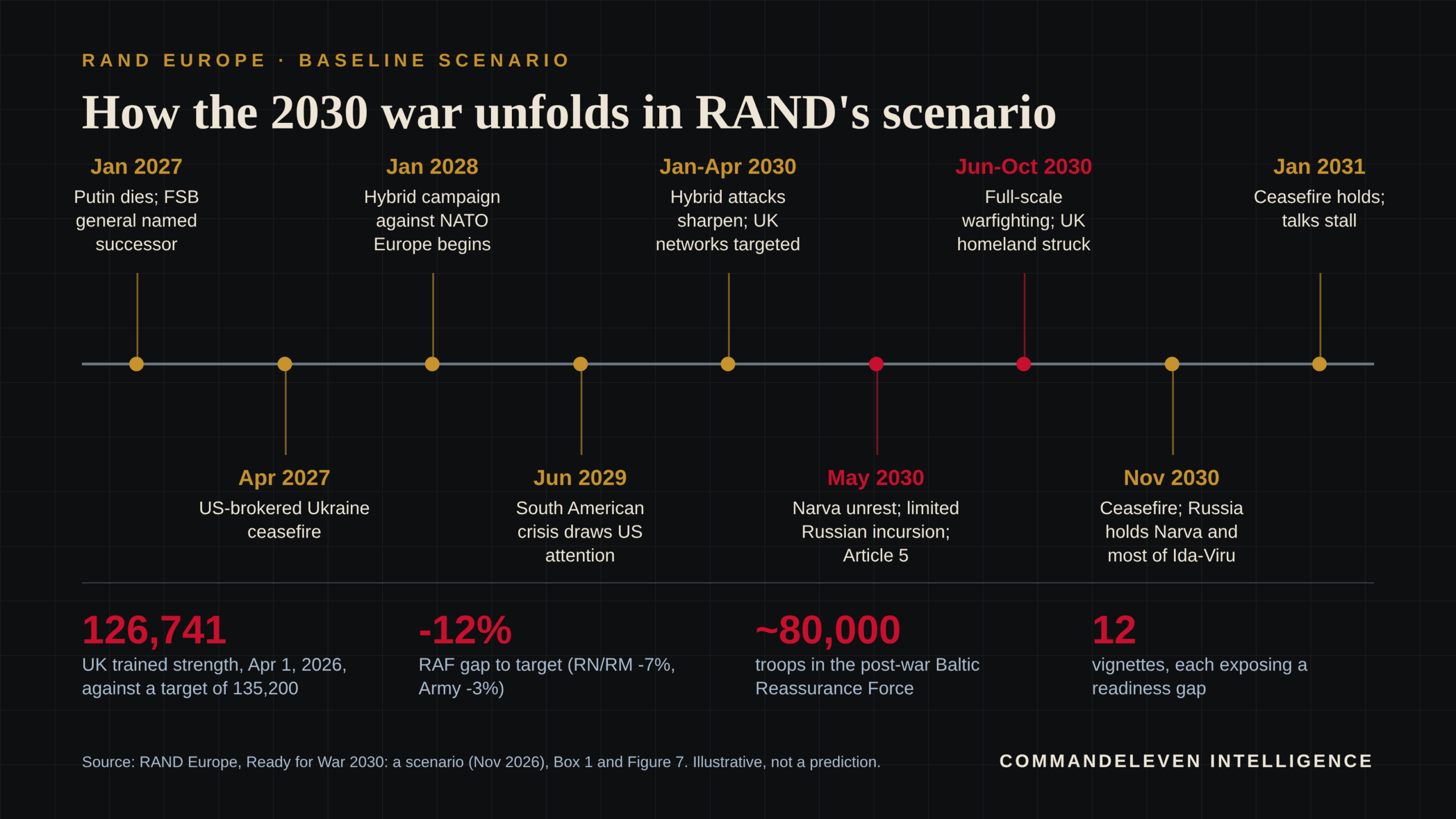
- CONFIRMED: On April 1, 2026, UK trained strength stood at 126,741 against a target of 135,200, a shortfall of 8,459 or about 6 percent. The RAF was 12 percent below target, the Royal Navy and Royal Marines 7 percent and the Army 3 percent, per Ministry of Defence figures reproduced in the paper.
- CONFIRMED: In the scenario, Russia treats the UK as a priority target because it leads NATO’s forward presence in Estonia, anchors the Joint Expeditionary Force, hosts the Allied Rapid Response Corps headquarters and sits astride the Greenland-Iceland-UK gap. Ports, air bases and defense plants are struck early.
- ASSESSED: The paper’s sharpest finding is that society and industry fail before the armed forces do. The UK relies on goodwill and just-in-time supply, has no pre-set powers to direct industry short of declaring an emergency, and may reach its “crisis point” late or never.
- ASSESSED: Air defense is a cost-exchange problem. Spending expensive interceptors on cheap one-way drones is, in RAND’s words, unsustainable, and the scenario’s saturation strikes exhaust stocks within a single wave.
- ASSESSED: The most consequential vignette is the nuclear one. RAND finds the UK has no public vision of intra-war deterrence and relies on a single leg of the triad, so a long conventional war carries real escalation risk.
- SPECULATIVE: The scenario’s triggers, including Putin’s death in January 2027, an FSB successor and a South American crisis that pulls US attention in June 2029, are RAND’s inputs, not intelligence. We assign them no probability.
What RAND Built
The baseline scenario runs in nine steps. A succession struggle in Moscow ends with a security-service president who agrees to a ceasefire in Ukraine, then turns to a hybrid campaign against NATO Europe to prove his authority. By 2030 military hardliners push for a limited Baltic operation meant to show that Article 5 does not deliver collective defense. The paper is explicit that the aim is a wedge inside the Alliance, not territory.
| Date in scenario | What happens |
|---|---|
| January to March 2027 | Putin dies of natural causes; a former FSB general becomes president. |
| April to July 2027 | US-negotiated ceasefire in Ukraine with partial sanctions relief; peace talks stall and the front freezes. |
| January 2028 onward | Hybrid campaign against NATO Europe: communications, energy and key industry players are disrupted, with attribution kept deliberately murky. |
| June 2029 | A South American crisis becomes the US national security priority; Europeans do not expect large US reinforcements. |
| January to April 2030 | Hybrid attacks sharpen and concentrate on UK military networks, defense industry and transport. |
| May 2030 | Unrest in Narva escalates; Russia launches a limited incursion on a claimed protection mission. NATO declares Article 5 and most Allies commit forces. |
| June to October 2030 | Full-scale warfighting on the eastern flank, a High North and North Atlantic campaign, and Russian strikes on the UK homeland. |
| November 2030 | Russia, holding Narva and most of Ida-Viru County, proposes a ceasefire before NATO can counterattack. |
| January 2031 | The ceasefire holds, talks stall and the post-war settlement is left unresolved. |
Why the UK Is the Target
RAND’s Russian planners reason that knocking the UK out early opens the Atlantic. The UK is the framework nation for the Enhanced Forward Presence in Estonia and for the Joint Expeditionary Force, and it hosts the Allied Rapid Response Corps, one of two strategic reserve corps available to NATO’s Supreme Allied Commander Europe. Removing it opens the Greenland-Iceland-UK gap to Russian submarines and puts sea lines of communication at risk.
The target list that follows is built from single points of failure. The ports of Felixstowe, Southampton and Dover, the Marchwood Sea Mounting Centre, RAF Brize Norton and the submarine yard at Barrow-in-Furness each carry a disproportionate share of UK deployment, reinforcement or industrial capacity. In the paper’s logic, the UK is not the weakest Ally. It is the Ally whose loss changes the geometry of the war.
The Twelve Gaps
Each vignette follows the same pattern: a plausible sequence of events, the broader problem it exposes, and what the UK could do by 2030. The table condenses them at the policy level.
| Vignette | Gap RAND identifies | What RAND suggests |
|---|---|---|
| 1. Societal resilience | Slow, inconsistent progress on whole-of-society resilience; low public awareness of threats. | A lead department with binding authority, a ring-fenced budget and private-sector levers. |
| 2. Supply chains and war economy | Single points of failure, such as a propellant binder shortage three tiers down; no pre-set emergency powers. | Legislate predetermined powers, map and stress-test supply chains, stockpile. |
| 3. Critical infrastructure | Undersea cables, interconnectors and pipelines under-protected, with long repair times. | Multilateral monitoring, risk mapping and stronger cybersecurity. |
| 4. Health system | Peacetime strain; reservists in NHS jobs are double counted; hospitals are soft targets. | A joint civil-military workforce register and surge capacity. |
| 5. Cyber and AI | AI-enabled malware, IT and operational-technology convergence, and attribution that cannot separate humans from autonomous AI. | Human fallbacks, early ties to frontier AI labs and pre-agreed parallel responses. |
| 6. Space | Heavy dependence on space with limited ability to protect and defend assets. | An own-collaborate-access framework and alternatives to space-based services. |
| 7. People | Services below target strength; niche industry skills short; public attitudes cool toward defense careers. | Targeted recruitment, modern incentives and enterprise workforce planning. |
| 8. Industry | Limited capacity, depleted stockpiles and soft physical sites. | Harden sites, raise supply-chain cybersecurity, stockpile long-lead parts and speed procurement. |
| 9. Air and missile defense | Costly interceptors against cheap drones; a fragmented, out-of-date concept. | Cheap interceptors, layered defense and research, with directed energy as one element. |
| 10. Critical military capabilities | Exquisite platforms with little depth and a few vulnerable ports and airfields. | Affordable precision mass, survivability, dispersal and organizational learning. |
| 11. Deterrence and escalation | No public intra-war deterrence vision; a single-leg deterrent; outmatched in non-strategic nuclear weapons. | Harden targets, run escalation gaming and keep military-to-military channels open. |
| 12. War termination | Vague ceasefire terms and no post-war plan. | Plan the post-war architecture now and define roles and accountability. |
What 2026 Reporting Already Shows
RAND’s scenario is fiction, but three of its building blocks are checkable against current reporting.
- Manpower. The April 1, 2026 trained-strength figures above are Ministry of Defence statistics, not RAND estimates. We have not independently re-pulled the quarterly release, so we treat the figures as RAND’s reproduction of MOD data.
- Submarines. The scenario has the Royal Navy down to two attack submarines within six weeks of war, one then taken out of action by a technical failure. The UK Defence Journal reported on June 7, 2026 that all five in-service Astute-class boats were alongside with none at sea, citing dock-space, manpower and maintenance bottlenecks and a recovery plan launched in January. The Ministry of Defence does not comment on individual boats and declined to give availability figures.
- Undersea infrastructure. RAND’s third vignette features Russia’s Main Directorate of Deep-Sea Research (GUGI) near Svalbard. A September 2026 Reuters report, carried by the Irish Times, said, citing two anonymous Western officials, that Britain, Norway and the US confronted a Russian exercise simulating cable disablement there. On the record, the UK Ministry of Defence pointed to its April 9 statements acknowledging attempted covert GUGI activity in Norwegian and British waters, and Norway’s defense minister spoke of a clear message to Russia. The Kremlin denies conducting sabotage in NATO countries. The weapon and exercise details rest on anonymous sources, so we rate them ASSESSED.
Where Our Read Differs
ASSESSED: The paper is written for a UK audience and says so, so it sets Estonian and wider Baltic capacity aside and treats the US role in the war as limited by assumption. A reader should not take it as a net assessment of the eastern flank. As far as we can tell from the text, it also does not examine a Chinese role. Finally, its Russian decision-making rests on a regime shaped by a succession fight, which is the least checkable input in the model. We would treat the vignettes as stress tests of the UK system, not as a map of Russian intent.
The nuclear vignette deserves more weight than its length suggests. RAND’s argument is that NATO’s own theory of victory, which is to block, blunt and if necessary break an adversary’s warfighting system, points toward deep strikes inside Russia, and that is exactly where Russian nuclear signaling intensifies. In the scenario the result is decision paralysis, not a defeat in the field.
What To Watch
- The next Ministry of Defence quarterly personnel statistics, covering April 1, 2027, for movement against the trained-strength targets.
- Public attribution of any new damage to undersea cables, pipelines or interconnectors in the Baltic, North Sea or Arctic, and any naming of Russian-linked vessels.
- Any UK legislation or framework that sets pre-agreed powers to direct defense production without declaring a national emergency, including the Armed Forces Bill RAND mentions.
- UK contracts for low-cost counter-drone interceptors and the build-out of the new integrated air and missile defense directorate.
- Hybrid incidents near military and defense-industrial sites in Europe, and whether governments move from vague to specific attribution.
- Allied discussion of European nuclear coordination between the UK, France and NATO, which RAND calls a live conversation.
Calls We Will Score
These are CommandEleven Intelligence calls drawn from the paper’s gaps. They are not RAND’s, and they are scored on the Foresight Record.
- By May 31, 2027: Ministry of Defence statistics for April 1, 2027 show total UK trained strength still below target.
- By June 30, 2027: At least one NATO government publicly attributes new damage to an undersea cable, pipeline or interconnector in the Baltic, North Sea or Arctic to a vessel or operator linked to Russia.
- By December 31, 2027: The UK government legislates or formally publishes a framework giving it pre-agreed powers to prioritize defense production short of declaring a national emergency.
- By December 31, 2027: The UK Ministry of Defence announces at least one production contract for low-cost counter-drone interceptors for homeland or base defense.
What This Assessment Does and Doesn’t Establish
It reports what RAND’s paper says, tests three of its building blocks against public reporting and sets dated calls. It does not forecast a Russia-NATO war, assign probabilities to RAND’s assumptions, assert Russian intent or intelligence, verify the vignette details beyond the cross-checks above, or judge the policy merits of RAND’s recommendations. Claims resting on anonymous officials are marked as such, and the Kremlin’s denial is noted.
Frequently Asked Questions
Is the RAND 2030 scenario a prediction?
No. RAND says the scenario is illustrative, not predictive, and that conflict is not inevitable. It is a tool for finding readiness gaps.
Is it a war game?
No. It is a written baseline scenario with twelve vignettes. RAND recommends simulation and gaming as a follow-on for escalation dynamics, but the paper itself is not a played game.
Why does the scenario focus on the UK?
RAND Europe wrote it to bolster UK and NATO preparedness. Russia targets the UK in the story because of its role in Estonia, the Joint Expeditionary Force, the Allied Rapid Response Corps and the North Atlantic.
Is a Russian move on Estonia likely by 2030?
We assign no probability. The scenario depends on assumptions, including a leadership change in Moscow, that nobody can verify today.
What can ordinary households take from it?
RAND stresses that resilience is a whole-of-society task. For practical household preparedness, see our Fortress and Be Ready analysis.
Related CommandEleven Intelligence Reading
- Fortress and ‘Be Ready’: What the Pentagon’s 90-Day Plan and Britain’s Campaign Actually Say
- Grey Zone Warfare Explained: The Framework Behind China, Russia, Iran & North Korea
- Leipzig’s Fallout: Germany’s Escalation and the Trap Russia May Have Set
- CENTCOM’s 25,000 Systems: Bases Still Exposed
- Jet Gerans and the Geography of Fear
Sources
- RAND Europe, Ready for War 2030: a scenario: Bolstering the UK and NATO’s preparedness (James Black, Kiran Suman-Chauhan, Leanne Iorio, November 2026)
- Irish Times (Reuters), Nato allies say they foiled Russian subsea cable sabotage plot, September 11, 2026
- UK Defence Journal, Why are all of Britain’s attack submarines in port?, June 2026