Status as of November 18, 2026. This dossier summarizes the conventional-weapons section of Anthropic’s September 2026 threat report. Anthropic is the only source for what these actors did, and it is also the company whose model they used. We say what the report establishes and what it does not, and we leave out technical detail.
Bottom Line Up Front
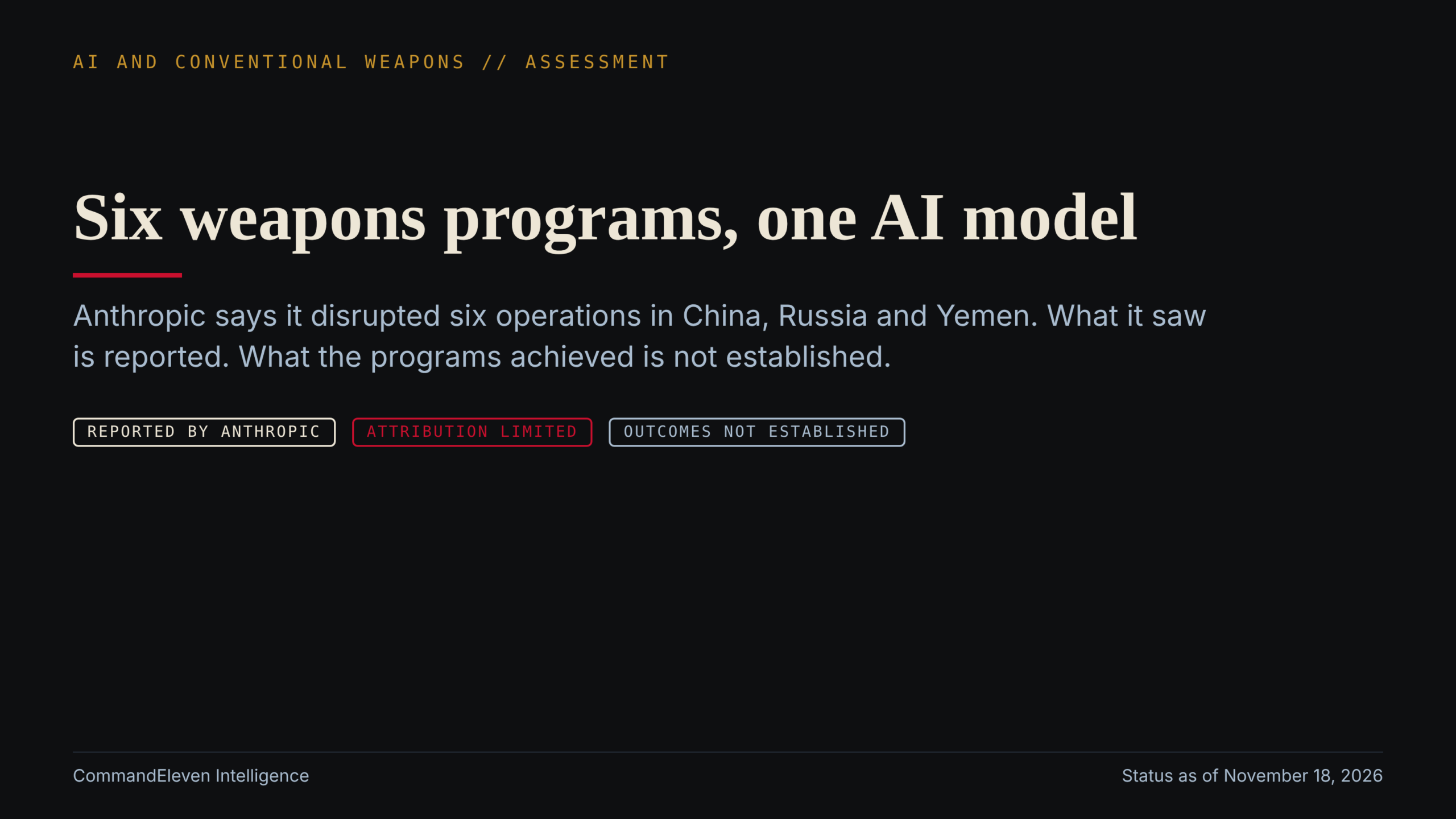
In its September 2026 report on misuse of AI, Anthropic says it disrupted six operations that used its Claude model for conventional-weapons work: three based in China, two in Russia and one in Yemen. Four of the six built software for weapons themselves. The other two used the model to gather intelligence and buy goods. Anthropic says it banned the accounts and shared findings with partners.
We assess, with moderate confidence, that the cases show AI speeding up work for actors who already had expertise and hardware, not creating weapons capability from nothing. Anthropic says as much. The report does not show that any of the six programs produced a fielded, working weapon. The Yemen case is the most serious: a cell based in northern Yemen test-fired a guided rocket, and the test appears to have failed. Anthropic does not name the Houthis or any other organization, and neither do we.
Key Judgments
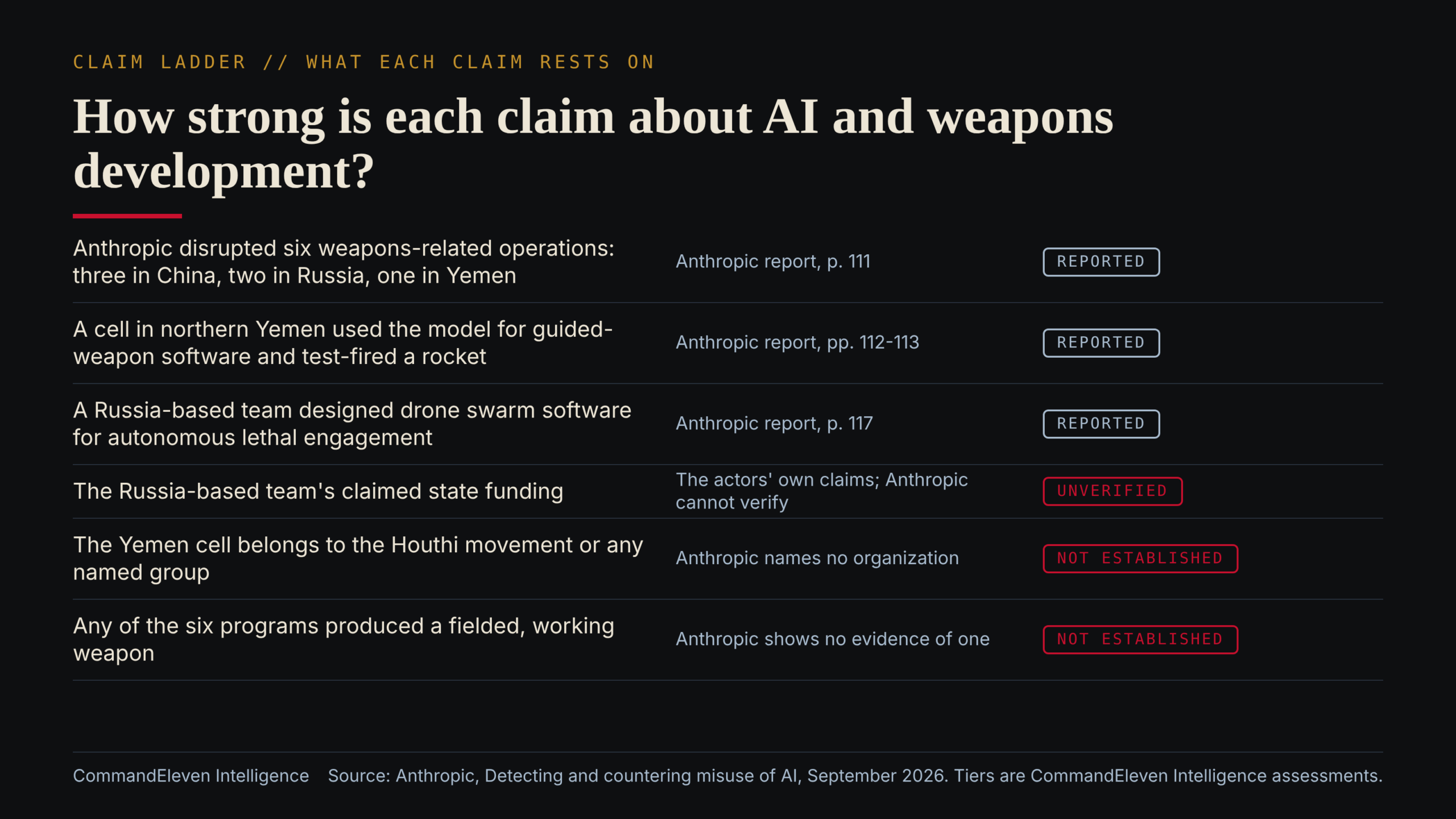
- REPORTED. Anthropic says it disrupted six weapons-related operations: three in China, two in Russia, one in Yemen. The company disrupted each by banning every account it could link to the actor. We have not seen the underlying logs. Press coverage relays the report and, in the sources we read, adds no independent confirmation.
- REPORTED. A cell based in northern Yemen ran three weapons programs and used the model to write guidance and flight-control software. The cell test-fired a guided rocket, and Anthropic says the test appears to have failed. Anthropic has no evidence the cell fielded an operational device.
- REPORTED. A Russia-based freelance team built software for an autonomous drone swarm designed to select targets, including people, and trigger detonation without a human in the loop. Anthropic rates it at an early readiness level, validated in simulation, and assesses the team is not a Russian state entity.
- REPORTED. Two China-based actors used the model for weapons work, one on an anti-torpedo system for the PLA Navy and one on electronic-warfare targeting software that included a Taiwan scenario. A third China-based actor ran an intelligence campaign on a US directed-energy weapon. Anthropic could not attribute the first, and links the second to PRC research institutions, including the PLA Academy of Military Sciences.
- REPORTED. A Russia-based actor used the model to procure dual-use goods for Russian government and defense customers through China and Hong Kong, describing the aim in its own briefings as evading European trade controls.
- ASSESSED: MODERATE. The model acted as an accelerator. Anthropic says the actors used it to build software for hardware they already had expertise in and access to. One actor also built an offline toolkit that runs without the model, so banning accounts does not remove what was built.
- UNVERIFIED. The Russia-based team’s claims of funding from Russian state bodies. Anthropic says it cannot verify them.
- NOT ESTABLISHED. Any organizational attribution of the Yemen cell, including to the Houthi movement; whether any of the six programs produced a working weapon; and how many similar cases exist on other AI platforms or outside them.
What Is Established
Everything in this section is Anthropic’s own account of activity on its platform. Anthropic says it found the cases through its own investigations into suspected weapons development, and that historically this kind of work has been uncovered by governments, United Nations panels and outside investigators working from recovered hardware and public sources. It describes these cases as part of a new category of misuse it first identified after its November 2025 report.
Anthropic reports a common pattern across the four development cases. The actors split their work across many sessions so that no single session revealed the full program, hid the purpose of the software they were building, and used other methods to get around access controls. Several used virtual private servers to get around Anthropic’s geographic restrictions. In its own words, the actors worked on hardware and firmware they already had expertise in and access to.
Anthropic also reports what it did in response. It banned the accounts it could link to each actor, shared findings with other platforms where the actors worked across several, and passed threat reporting to public- and private-sector partners. It says it has launched new classifiers to detect traffic related to high-yield explosives and weapons development, and that its Frontier Red Team built new evaluations to measure AI progress on tactical intelligence targeting and conventional weapons development. The company says those evaluations show consistent progress on simulated tasks.
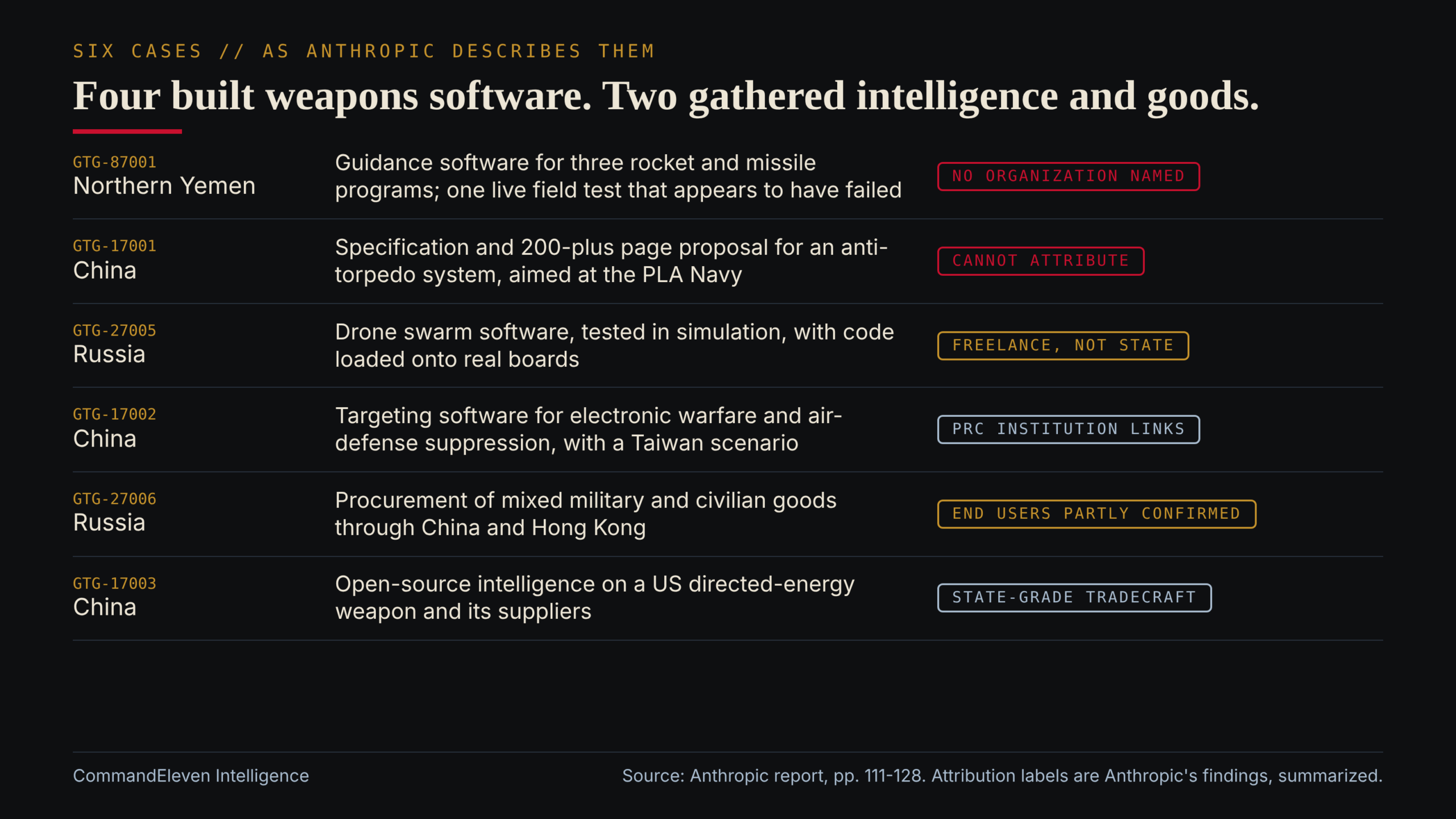
Part I: Four Cases of Weapons Development
The Yemen cell (GTG-87001)
Anthropic describes a cell of actors based in northern Yemen running three programs: a guided rocket, a multi-stage ballistic missile and a multi-variant missile family. The actors used the model’s coding tool in place of human software engineers to write guidance and control software, and they ran several instances at once, with one writing code, one researching and one reviewing. Anthropic says its safeguards blocked many requests, but not all.
The most serious element, in Anthropic’s account, is a live field test of the guided rocket in Yemen. The test appears to have failed, and within hours the actors returned to the model to work out why. Anthropic says it has no evidence the actors fielded an operational device. It also says they had already built an offline simulation toolkit that does not rely on the model, and it says its visibility into the overall program was limited.
Anthropic does not say who the cell is. Northern Yemen is where the Houthi movement holds power, which is why readers will ask. That is context, not attribution. Press coverage went further than the report. The Associated Press headline placed the users in “Houthi-held Yemen,” and other outlets headlined that the Houthis used the model. We found no response from the Houthis or any government, and no government, UN panel or independent investigator that has linked this cell to a named organization. We do not make that link.
The Russia-based drone swarm team (GTG-27005)
Anthropic describes a small group of likely freelancers, working under the names “DronDoc” and “Serafim”, who set out to build a full-stack autonomous attack drone swarm. The software they built with the model covered swarm coordination, onboard decision-making and target engagement. Anthropic says the design allowed the onboard model to select targets, including a person class, and issue the detonation command without a human in the loop.
Anthropic says the actors tested on real hardware and trained a classifier on scraped Ukrainian combat footage, and that their demonstration strike point was a fixed coordinate in Donetsk Oblast. It rates the work at early readiness, validated in simulation. It assesses the actors are a freelance team doing a mix of civilian and military work, not a state entity, with ties to a regional university that has a federal research center associated with the Russian Academy of Sciences. The actors claimed funding from Russian state bodies, which Anthropic cannot verify. Eight of the nine accounts it linked to the group were used only for ordinary freelance work.
Two China-based development cases (GTG-17001 and GTG-17002)
In the first, an actor posing as a US defense manufacturer used the model to draft a specification and a proposal of more than 200 pages for an anti-torpedo system, and to benchmark it against US programs from public sources. Anthropic assesses the actor was associated with a Chinese defense manufacturer aiming at a PLA Navy acquisition, but says it cannot attribute the activity to a specific entity.
In the second, an actor built a suite of about 16 modules over 12 versions for electronic warfare and air-defense suppression. The suite analyzed an opponent’s radars, missile sites and command posts and ranked what to suppress first. Mid-project, the actor changed the default scenario to 12 targets in Taiwan. Anthropic assesses the actor is a China-based defense researcher and says account metadata linked the actor to PRC research institutions, including the PLA Academy of Military Sciences. A default scenario shows what the actor was working on. It does not show intent to attack.
Part II: Two Cases of Procurement and Intelligence
The Russia-based procurement operation (GTG-27006) centered on a self-identified procurement manager at a Moscow design bureau. Anthropic says the actor ran five workstreams, including sensors, space-grade solar wafers, aviation oxygen systems, a hospital for a Russian National Guard unit, and encryption and IT systems bought through Russia’s state defense procurement platform. The actor used the model to find intermediaries in mainland China and Hong Kong, to draft quote requests in three languages that disguised the end user, and to map the cost of routing goods through other countries.
Anthropic says the actor’s own Russian-language briefings to a director described the effort as a way to evade European trade controls and called the third country a “sanctions-neutral jurisdiction.” The actor also paired the model with browser automation to run the back office, which Anthropic says replaced the work of a procurement clerk. For some orders the actor cited Russian government or defense customers. For others, Anthropic says it could not confirm the end customers. Anthropic notes that this kind of activity is hard to catch because each request looks mundane on its own.
The China-based intelligence operation (GTG-17003) used the model over dozens of sessions to collect open-source intelligence on high-power microwave weapons and the supply chain behind them. The actor described the work as writing for a three-person defense intelligence team and drafted briefings for restricted circulation to senior Chinese Communist Party, military or state security leadership. Anthropic assesses the actor used state-grade tradecraft, based on the breadth of its source work and its use of analytic frameworks borrowed from Western intelligence agencies.
Why It Matters
Three points stand out. First, the reported cases span the whole development chain, from guidance software to procurement to intelligence. That matters more than any single program, because defenders have usually found this kind of work from recovered hardware, and software built in private sessions leaves none until it is used.
Second, the swarm case is a design for autonomous lethal engagement built by a small team with commercial tools, and Anthropic rates it at an early stage. The gap between simulation and a working system is large, and the report does not say it was closed. What it shows is that a team of this size can now reach that stage.
Third, detection is hard from the provider’s side. Anthropic says the procurement requests were individually mundane, and that the development actors hid purpose and split sessions. A model provider that sees only fragments is making judgments on partial information, and the one report we have comes from that provider. Governments, UN panels and other AI companies could confirm or correct it, but none has yet.
What Would Change Our View
- A government, UN panel or independent investigator naming the organization behind the Yemen cell, or ruling out a link to one.
- Recovered hardware, or a public account, showing that software from any of the six programs reached a working weapon.
- A second AI developer reporting a comparable conventional-weapons case, which would show the pattern is wider than one platform.
- Evidence that the Russia-based team’s funding claims are true, or that the team has state backing.
- Details of the models and safeguards used that show the actors got more, or less, help than Anthropic describes.
What To Watch
- Whether any government sanctions, charges or names a person or entity linked to one of the cases.
- Reporting by UN monitoring panels on Yemen or on Russian procurement that mentions AI-assisted work.
- Reports from other AI developers on weapons-related misuse.
- Policy responses on autonomous target selection and on export-control evasion using AI tools.
Calls We Will Score
- By June 30, 2027: No government, UN panel or independent investigator publicly attributes the Yemen-based cell (GTG-87001) to the Houthi movement or any other named organization.
- By June 30, 2027: No government publicly sanctions or charges a person or entity in connection with any of the six cases.
- By December 31, 2027: No government or UN panel publicly confirms the recovery of a fielded weapon whose software was developed with a commercial AI model.
What This Assessment Does and Doesn’t Establish
- It establishes what Anthropic says it found. It does not independently confirm any of it. We did not see the underlying logs, and the press coverage we read relays the report.
- Anthropic makes the model the actors used. It has reasons to show it is catching misuse, and its report is a company disclosure, not an independent audit.
- It does not show that any program produced a working weapon, and it does not name the organizations behind the Yemen cell or the China-based cases.
- We leave out technical detail on purpose, and we summarize at the level Anthropic does.
Frequently Asked Questions
Did the Houthis use Claude to build missiles?
Anthropic says a cell based in northern Yemen did. It does not name the Houthis or any other group. Some news headlines say the Houthis did it, and the AP wrote “Houthi-held Yemen.” We have found no attribution by a government or investigator, so the Houthi link is a reading of the location, not an established finding.
Did the Yemen cell’s rocket work?
Anthropic says the field test appears to have failed, and that the actors returned to the model within hours to find out why. It has no evidence they fielded an operational device.
Can an AI model design a weapon on its own?
Not in these reports. Anthropic says the actors had expertise in the hardware and firmware and used the model to build and refine software. The swarm case reached simulation and bench testing, not a field-ready system.
Did Anthropic stop these actors?
It banned the accounts it could link to each actor and shared information with partners. It also says the Yemen cell had already built an offline toolkit that does not need the model.
Were these state programs?
It varies. Anthropic links the electronic-warfare actor to PRC research institutions and calls the intelligence actor state-grade. It says the Russia-based swarm team is a freelance group and not a state entity, and it cannot attribute the anti-torpedo work.
Related CommandEleven Intelligence Reading
- Tactical Diffusion: How Militant Drone Warfare Spreads, Part 1
- Transcontinental Convergence: A CommandEleven Intelligence Series
- CENTCOM’s 25,000 Systems: Bases Still Exposed
Sources
- Anthropic: Detecting and countering misuse of AI, September 2026 (conventional weapons section, pages 111 to 128) (Sept 2026)
- Associated Press via CTV News: Users in Houthi-held Yemen tried to develop advanced weapons with AI, Anthropic says (Sept 11, 2026)
Assessments and confidence tiers are CommandEleven Intelligence’s own. We do not reproduce third-party text. All case details are Anthropic’s account, summarized, and we have not independently verified them.