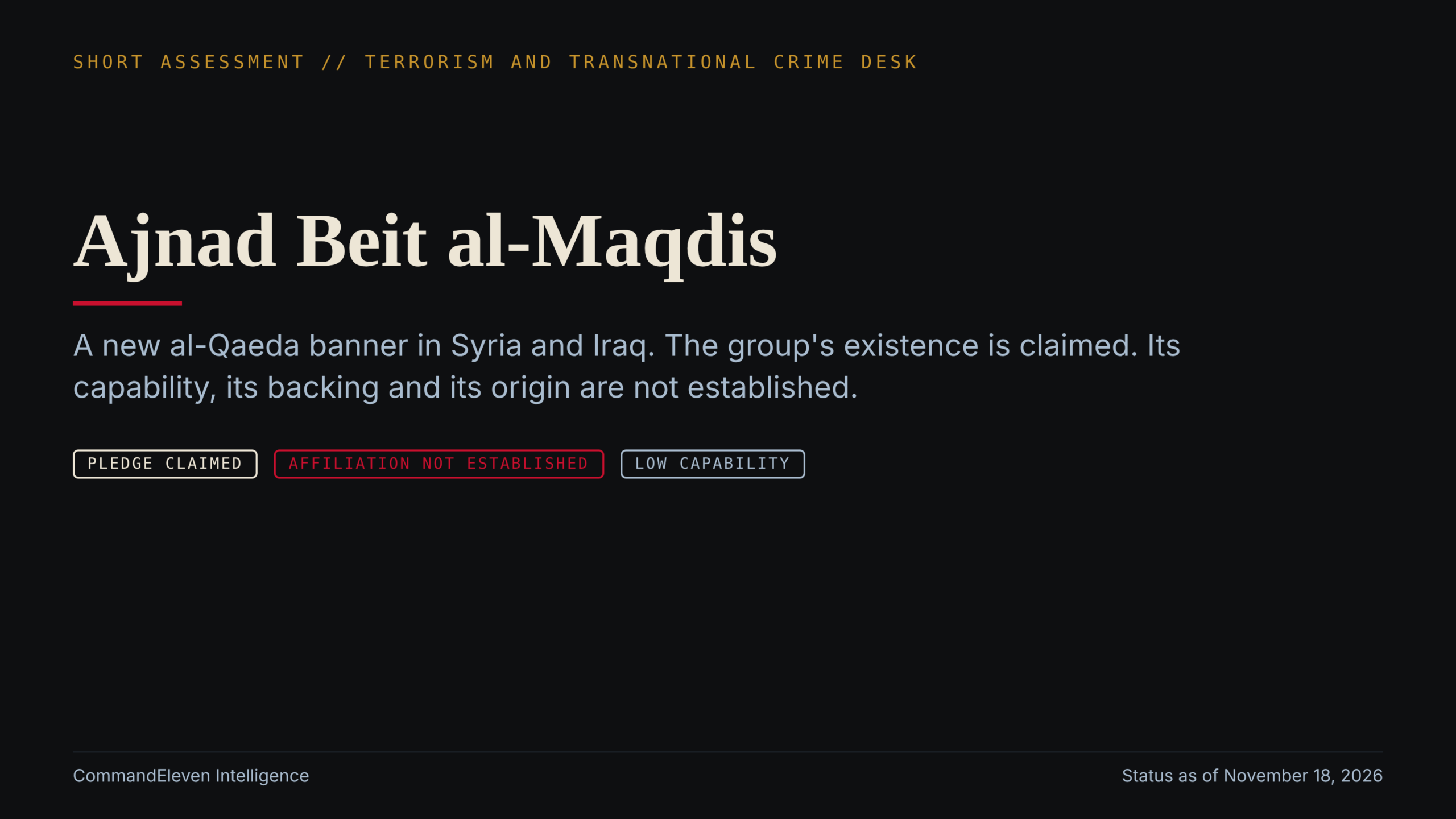
Status as of November 18, 2026. This is a short assessment of a thinly sourced story. We will update it if al-Qaeda recognizes the group, if an independent source verifies a claimed attack, or if the group goes quiet for good.
Bottom Line Up Front
Since February, a group calling itself Ajnad Beit al-Maqdis has said it pledged allegiance to al-Qaeda, claimed a rocket attack on U.S. forces in northeastern Syria and released a video with a speech by the head of al-Qaeda in the Arabian Peninsula. Jamestown has argued that the group may signal an early reorganization of al-Qaeda-aligned networks in Syria and Iraq after Hurras al-Din dissolved in January 2025. The Middle East Forum has asked whether it is a genuine affiliate at all.
We assess, with low confidence, that the group is real but marginal: a small, loosely connected cell using al-Qaeda branding. We do not assess that it is a rebuilt Hurras al-Din, and we do not assess that it is a hoax. The evidence supports neither. Its importance, if any, lies in what it shows about how a crisis gives small actors a story to attach themselves to, not in what it can do.
Key Judgments
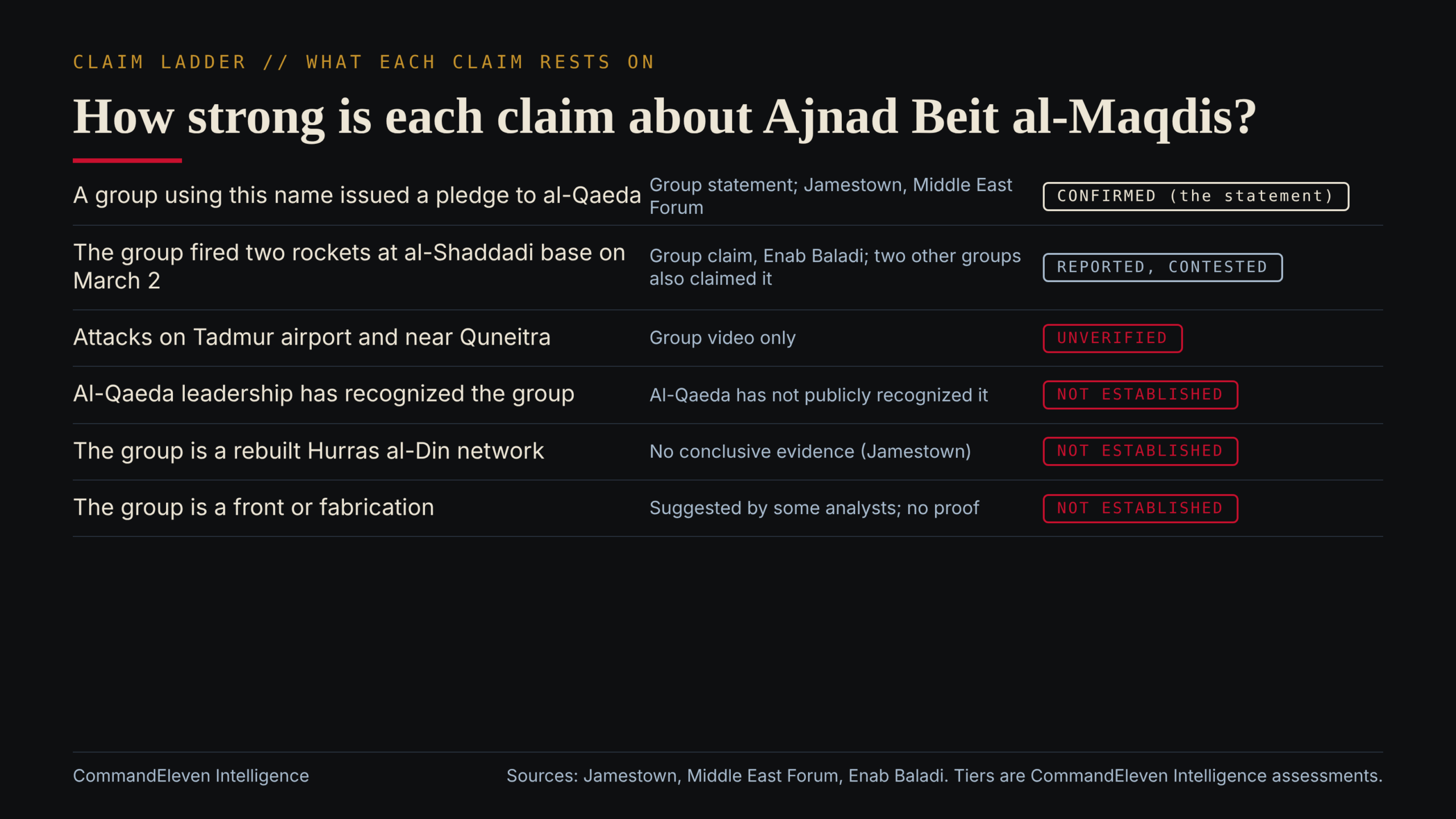
- CONFIRMED. A group using the name Ajnad Beit al-Maqdis issued a statement pledging allegiance to al-Qaeda. The statement is dated February 22, 2026, per the Middle East Forum.
- REPORTED, CONTESTED. The group claimed a March 2 rocket attack on al-Shaddadi base, using two 107mm rockets. Other groups also claimed the same attack.
- UNVERIFIED. The April 11 video claims attacks on Tadmur military airport and on Israeli positions near Quneitra. Jamestown says these claims are independently unverified.
- NOT ESTABLISHED. Al-Qaeda has not publicly recognized the group. A link to Hurras al-Din is not shown. Whether the group is a genuine affiliate, an Iranian-linked front or something else is unknown.
- ASSESSED: LOW. The group is real but of low capability, with a media presence larger than its operational one.
- ASSESSED: LOW. The group is a sign of broader al-Qaeda reorganization in Syria. One group with no confirmed backing is too little to show a trend.
What Is Known
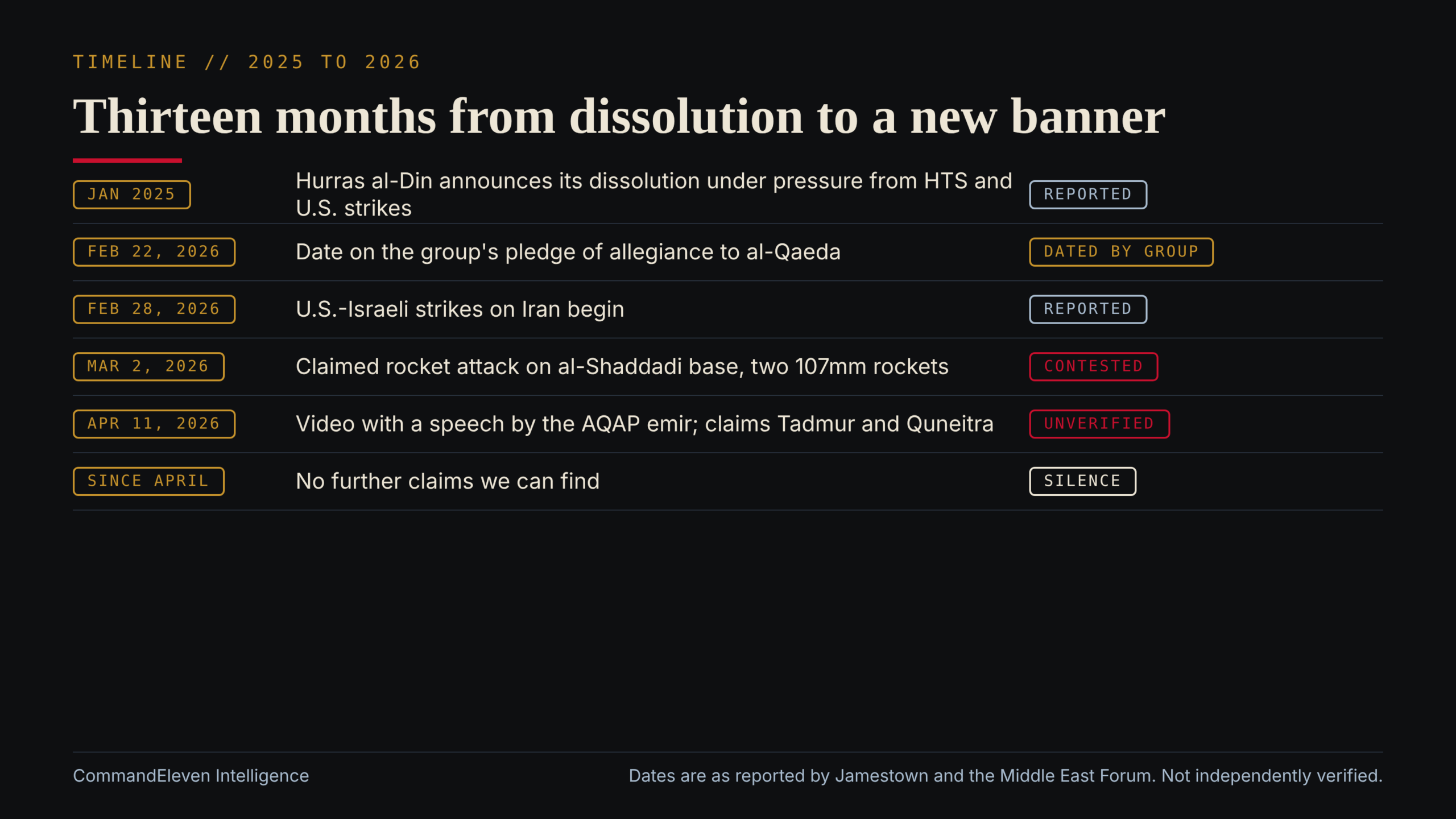
Jamestown reports that the group first appeared in an Arabic-language statement pledging allegiance to al-Qaeda and framing its mission around opposing what it called “Crusader-Zionist aggression.” Days later, it claimed the al-Shaddadi attack, which it described as the work of a unit called “Jund al-Aqsa.” Photos showed rockets prepared for launch and handwritten placards naming the group.
On April 11 it released a video of about two minutes. It opened with a speech by Saad bin Atif al-Awlaki, the emir of al-Qaeda in the Arabian Peninsula. Jamestown reads this as symbolic authorization rather than proof of operational cooperation. We agree, and we add that a speech can be reused by anyone who has the recording. It tells us the group wants to be seen with al-Qaeda. It does not tell us that al-Qaeda wants to be seen with the group.
The timing is the unusual part. The pledge is dated six days before the U.S.-Israeli strikes on Iran began on February 28. The first claimed attack came two days after. The group presented it as a response to that campaign. Jamestown concludes that the war did not necessarily create the group but handed it a ready-made message.
Why It Matters Less Than the Headlines Suggest, and Why It Still Matters
The group has done little that can be confirmed. Two rockets at a base is a small act, and the claim is shared with other groups. A claim made by several parties is more likely to tell us who wants credit than who fired. We have seen no further claims since April.
Why it still deserves a note is the setting. Hurras al-Din, al-Qaeda’s formal Syrian affiliate, dissolved in January 2025 under pressure from Hay’at Tahrir al-Sham and U.S. strikes. Syria is now governed by a former al-Qaeda-linked figure, Ahmed al-Sharaa, and the status of foreign fighters in the new security structures is unsettled. Islamic State remains active. Fighters who no longer fit an organization often look for a banner, and a known brand costs little to borrow. The question for analysts is whether the brand is attached to real people with real links, or only to a feed of videos.
The Middle East Forum notes that al-Qaeda supporters themselves are divided on whether the group is genuine, and raises the possibility of an Iranian-linked front. We have no evidence for that and we do not assert it. We mention it because it shows how little is settled. Any explanation that confidently names a sponsor is going beyond the sources.
What Would Change Our View
- Public recognition from al-Qaeda’s senior leadership or an established affiliate, which would move the group from claimed to confirmed.
- Independent verification of an attack beyond al-Shaddadi, such as on Tadmur or near Quneitra.
- Evidence naming individuals with links to Hurras al-Din, or showing a financing or facilitation chain.
- A pattern of repeated attacks, or a first attack with casualties.
- Continued silence, which would point to a brand with no sustained base.
What To Watch
- Whether al-Qaeda media or leaders refer to the group by name.
- Further claims, and whether other groups contest them.
- U.S. or Syrian government statements about the group.
- Any move on foreign-fighter integration in Syria, which shapes the pool a group like this could draw on.
Calls We Will Score
- By June 30, 2027: Al-Qaeda’s senior leadership or an established al-Qaeda affiliate does not publicly recognize Ajnad Beit al-Maqdis as part of the network.
- By June 30, 2027: No independent source verifies an Ajnad Beit al-Maqdis attack that causes casualties.
- By June 30, 2027: No public evidence establishes that the group is a successor organization to Hurras al-Din.
What This Assessment Does and Doesn’t Establish
- It establishes that a group using this name has issued claims. It does not establish who stands behind it.
- Most of the facts rest on one Jamestown analysis and one Middle East Forum piece, which in turn rely on the group’s own material and on monitoring accounts. We could not review the original statement or video.
- The date of the pledge differs by source: Jamestown places the statement in early March, while the Middle East Forum gives February 22. We use the group’s own date and flag it.
- We have not seen the group’s claims independently confirmed by a government or a news organization with local sources, other than the al-Shaddadi report.
Frequently Asked Questions
What is Ajnad Beit al-Maqdis?
It is a group that appeared in 2026 and says it has pledged allegiance to al-Qaeda. Its name refers to Jerusalem. It has claimed attacks on U.S. and Israeli targets in Syria, only one of which looks plausible.
Is it part of al-Qaeda?
It says so. Al-Qaeda has not publicly recognized it, so we treat the link as claimed, not confirmed.
Is it the successor to Hurras al-Din?
Not shown. Jamestown says there is no conclusive evidence for it, and that human networks may have outlasted the dissolved organization.
Is it a threat to the United States?
Its confirmed capability is low. We see it as a signal to watch, not a threat on its own.
Related CommandEleven Intelligence Reading
- The 2026 U.S. Counterterrorism Strategy: what it leaves out
- The Corridors: where terrorist and criminal supply chains meet
Sources
- Jamestown Foundation: Ajnad Beit al-Maqdis and al-Qaeda’s Restructuring in Syria and Iraq (2026)
- Middle East Forum, Aymenn Jawad Al-Tamimi: A New al-Qaeda Affiliate in Iraq and Syria? (Mar 4, 2026)
Assessments and confidence tiers are CommandEleven Intelligence’s own. We do not reproduce third-party text. Attributions are to the named outlets and analysts.