Status as of November 17, 2026, 7:55 AM Eastern (updated to add the Expedia, SCKit and Navy Federal items and an AI-era scams section). This is a global review of cyber incidents from November 1 to 17. It will be updated at the close of November 17 and as official statements appear.
Bottom Line Up Front
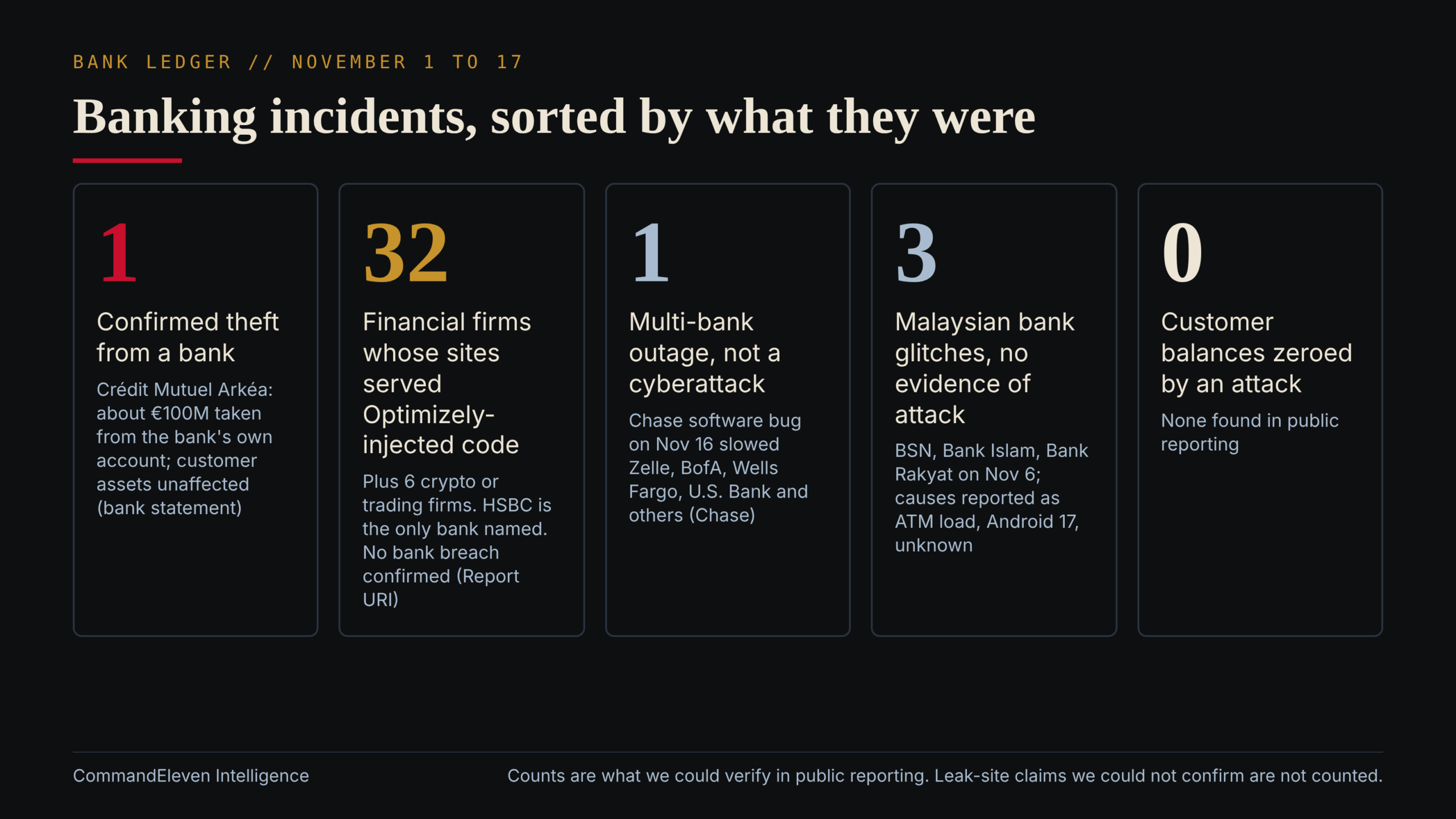
Between November 1 and 17, 2026, the incidents we can verify include one confirmed theft from a bank, one supply-chain attack that put malicious code on the websites of 178 organizations (32 of them banking or finance firms), one government platform taken offline as a precaution, and a multi-bank outage in the United States that the lead bank says was a software bug and not an attack. We found no case of customer balances being wiped or of a bank network going dark because of an attack.
The claim circulating for November 17, that the internet will be shut off worldwide and bank accounts will show zero, is not supported by any bank, regulator or security company we could find. It traces to a November 1 post citing an unnamed dark-web source. It borrows real events (the PHP2Shell vulnerabilities, the government website shutdowns that followed them, and genuine outages) and stretches them into a date. The real risk to an ordinary reader is narrower and more practical: a compromised third-party script on a site they use, a scam built on the rumor, or an unpatched phone or computer. The common thread across the real incidents is shared vendors: one compromised supplier reaches many customers at once.
Key Judgments
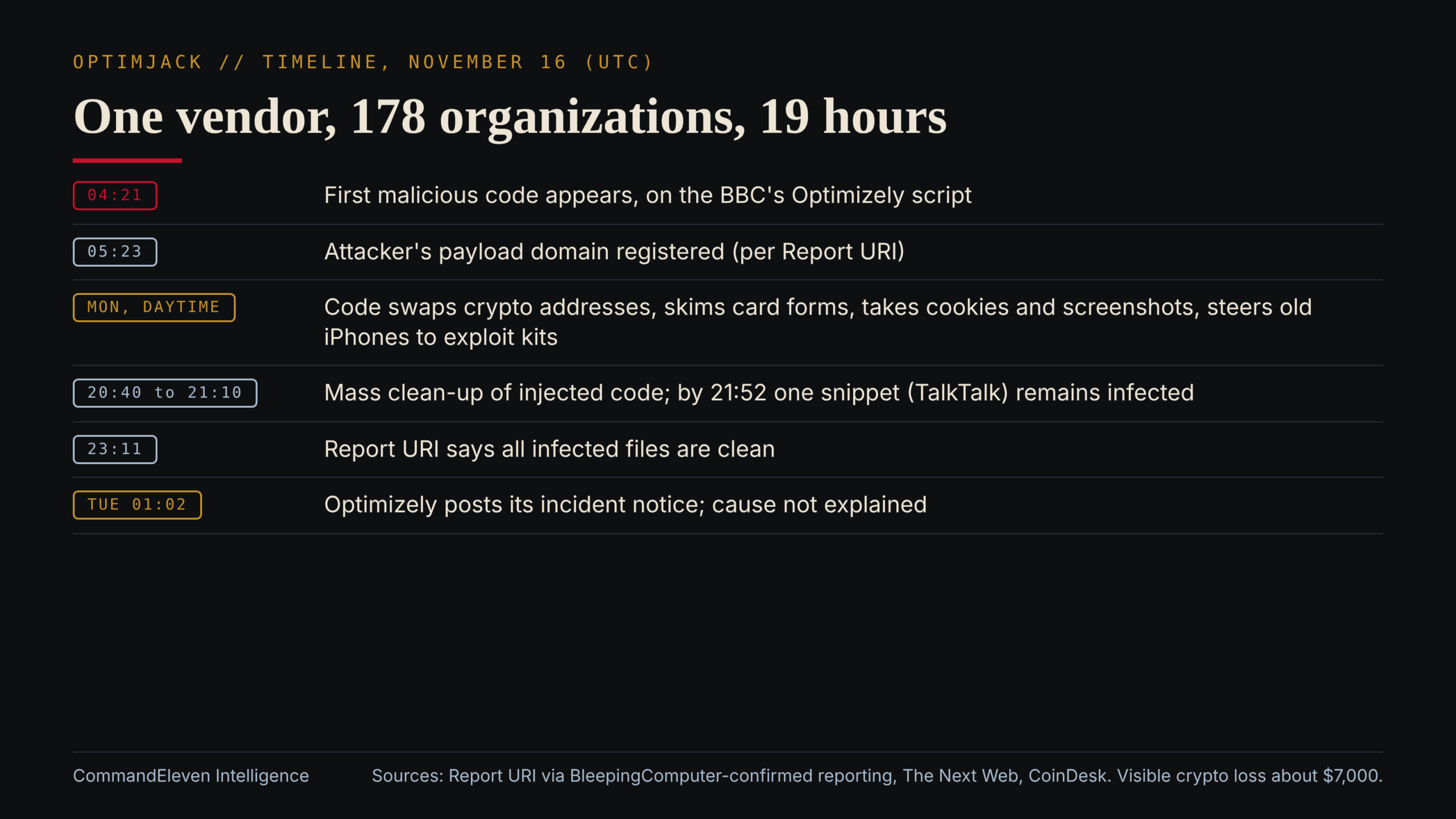
- CONFIRMED. On November 16 an attacker inserted malicious JavaScript into Optimizely web projects, and Optimizely’s own delivery network served it to visitors of 178 organizations. Optimizely says it blocked the vulnerable path and deployed a fix.
- CONFIRMED (BY THE VICTIM). Crédit Mutuel Arkéa, a French bank, disclosed on November 4 a theft of about €100 million from its own account. It says customer assets were not affected. Reported estimates run higher.
- CONFIRMED (BY THE VICTIM). The November 16 outage at Chase and several other U.S. banks was, per Chase, a software bug in on-premises hardware and not a cyberattack. We found no published evidence to the contrary.
- CONFIRMED (BY THE GOVERNMENT). Poland took its ePUAP government services platform offline on November 10 after a cyberattack, as a precaution. Officials say the system was not compromised.
- ASSESSED: MODERATE. Shared third-party vendors were the common weak point in the month’s real incidents: Optimizely, the service-provider platform behind Arkéa, the data platform behind Expedia’s confirmed breach, and the ScreenConnect extensions targeted by the SCKit worm. The incidents are separate and we do not assess that one actor or event links them.
- NOT ESTABLISHED. That cyberattacks surged in November. One tracker we checked counts 106 dated incidents in October and 44 in November through the 15th. The count is partial and definitions vary, so we rate this unproven in either direction. What did rise sharply was exposure and alarm: the PHP2Shell disclosures and the defensive shutdowns that followed.
- NOT ESTABLISHED. That any bank has had customer balances zeroed by an attack, or that a worldwide internet shutdown is planned for November 17.
- DATA DEFICIT. We cannot give a complete global count. Many incidents surface only as attacker claims on leak sites, and we do not count claims we cannot corroborate.
The Lead Case: Optimizely and the 178 Websites
Optimizely sells website experimentation software. Customers add a small script to their pages, and Optimizely’s servers deliver it. On Monday, November 16, an attacker used a flaw in Optimizely’s account signup process to add malicious JavaScript to the custom sections of some customers’ projects. Because the script is served from Optimizely’s own network, the affected sites’ own code was never changed, and nothing looked wrong on their end.
Researchers at Report URI, led by Scott Helme, checked 1,611 Optimizely scripts and found malicious code in 188, belonging to 178 organizations. They believe the true number is higher. Named victims in reporting include the BBC, CNN, Zoom, Salesforce, GitLab, IKEA, HSBC, Equifax, Air France-KLM and Ledger. Report URI counted 32 banking and finance firms and 20 retailers among them, and CoinDesk adds six crypto or trading businesses. HSBC is the only bank named in the coverage we read. BleepingComputer independently confirmed the malicious script loaded, or tried to load, on several of the sites.
What the code did
- Replaced cryptocurrency wallet addresses on affected pages, including text copied to the clipboard, with the attacker’s own.
- Skimmed card numbers typed into the sites’ own forms. It could not reach cards entered into hosted payment fields such as Stripe’s.
- Copied cookies and captured screenshots.
- Sent visitors on iPhones and iPads toward two exploit kits (reported as Coruna and DarkSword). The kits list iOS 18.7.3 and later, and iOS 26.3 and later, as patched. No researcher has reported an actual iPhone takeover, and Cynet describes this stage as conditional delivery and not a confirmed compromise.
What it cost, and what is unknown
Visible theft was small: roughly $7,000 in cryptocurrency by Monday evening, according to Report URI. StepSecurity estimated about $6,600 and noted two of the attacker’s addresses were already in use. Bloomberg could not independently verify the figure. Nobody can yet say how many cards, cookies or phones were exposed. Report URI sells malicious-script detection, so its framing deserves the usual caution, but BleepingComputer’s confirmation supports the core facts.
Still unexplained: how the signup flaw worked, how many projects were changed, and who is responsible. Optimizely posted an incident notice at 01:02 UTC on Tuesday without those details. Salesforce disabled Optimizely scripts as a precaution. Hudson Rock reported similar code spreading through three other web services beginning with an earlier wave on November 13, which suggests Optimizely may not be the only vector. Note that this is separate from Optimizely’s February 2026 voice-phishing breach, which exposed basic business contact data.
Did Attacks Surge After PHP2Shell?
The premise of this question is widespread: that cyberattacks have jumped sharply since the PHP2Shell flaws were disclosed in late October. We tested it and could not confirm it. Our earlier paper on that episode is Black October: the PHP2Shell disclosures.
- The count. The tracker we checked lists 106 dated incidents for October and 44 for November through the 15th, a pace of roughly 88 for the full month. That is below October, not above it. The tracker calls November partial, and one source is not a census.
- What did change. PHP2Shell opened two critical flaws in software that runs a large share of the web. The PHP project issued fixes beginning October 21. Governments and organizations took sites offline as a precaution. As of November 4, 32% of government and military organizations in one multi-country sample still reported affected PHP versions, and nearly 80% of affected addresses ran releases that no longer receive regular updates.
- Confirmed exploitation. Attackers used the PHP flaw to compromise Check Point gateways and deploy a VMware ESXi wiper, per BleepingComputer as relayed by Borns IT.
- Our assessment. ASSESSED: MODERATE that exposure and public alarm rose sharply. NOT ESTABLISHED that the number of successful attacks did. A busy month for vulnerabilities (17 critical and 12 exploited in the tracker’s November entries) is not the same as a surge in victims.
Banking: What Actually Hit Banks
Banking websites are the reader’s biggest worry, so we sorted every bank-related incident we could verify into what it actually was. The distinction between a real intrusion, a service disruption, a technical fault and an unverified claim matters more than the headline.
| Incident | Date | Tier | What it was | Customer money affected? |
|---|---|---|---|---|
| Crédit Mutuel Arkéa (France) | Early Nov; disclosed Nov 4 | Confirmed (by the bank) | About €100M taken from the bank’s own account, reportedly via a service-provider platform. Paris prosecutors investigating. Reported estimates run higher. | Bank says no. Some transfers delayed by precautionary suspensions. Fortuneo denied involvement. |
| Optimizely injection, 32 banking and finance firms (HSBC named) | Nov 16 | Confirmed exposure; no bank breach confirmed | Malicious code on the firms’ public sites. Card skimming reached only forms on the sites themselves. | Unknown. Card and cookie losses not quantified. |
| Chase, Zelle, Bank of America, Wells Fargo, U.S. Bank, Capital One, Truist (U.S.) | Nov 16 | Confirmed outage; cause stated as a bug | Chase says a software bug in on-premises hardware slowed transactions. Downdetector reports peaked near 5,000 for Chase. No cyber evidence published. | No. Chase says accounts and funds remained accessible. |
| BSN, Bank Islam, Bank Rakyat (Malaysia) | Nov 6 | Reported; no evidence of attack | ATM withdrawal trouble (attributed to volume), an app problem (linked to Android 17), and a website that was briefly unreachable. | No evidence of loss. Online claims of card fraud are unverified. |
| Binance (crypto exchange) | Theft about Oct 29; disclosed Nov 3 | Confirmed by Binance; attribution is the FBI’s | Hot-wallet theft described as the largest crypto theft on record. Outside the window and not a bank, listed for completeness. | Exchange assets, not bank deposits. |
Our counts, then: one confirmed theft from a bank, 32 financial firms exposed through a third party script (none confirmed breached), one multi-bank outage that was a technical fault, three Malaysian glitches with no evidence of attack, and zero cases of customer balances reduced by an attack. We did not count attacker claims that we could not corroborate, so the true number of bank-related claims is higher than this table shows. That is a data deficit, not a clean bill of health.
Governments That Shut Systems Down to Protect Them
Precautionary shutdowns are the clearest sign of how seriously governments took the PHP2Shell warning. We keep them in their own list because they are a defensive decision, not damage.
| Government or agency | Date | Tier | Status |
|---|---|---|---|
| Poland: ePUAP government services platform, including mailboxes; digital ID may be affected | Nov 10 | Confirmed (digital affairs ministry) | Offline as of the last report we found (Nov 11). Ministry says it was disabled as a precaution after a detected attack and gave no restoration date. We could not confirm a later status. |
| Preceding wave from Oct 21 (PHP2Shell): Dutch NCSC and DigiD, Port of Rotterdam, French Interior Ministry, German federal IT provider, Belgian Foreign Ministry, Finnish state IT agency, Canadian federal agencies, Japan’s tax agency and Finance Ministry, Australia’s cyber portal, others | From about Oct 21 | Reported; per-agency dates and status not confirmed by us | One roundup names about 15 entities across eight countries. Dates and restoration are not given for each, so we treat this as a reported pattern and not a verified list. |
| Malaysia: raised national cyber threat level; no shutdown | Early Nov | Confirmed (government) | Prime Minister warned Parliament on Nov 3. Officials and banks told the public online banking was operating normally. |
The contrast worth keeping: a government can take a service offline deliberately, as Poland did, for a stated reason and a fixed scope. That is different from the claim that an attacker or authority will switch off the internet. Country-wide connectivity shutdowns do happen, but they are imposed by governments on their own populations, as in Iran earlier this year, and not the result of a hack.
Outages That Were Not Attacks
The hardest part for readers is that an attack and an outage look identical from the outside. A bank app that will not load, a payroll system that is down, or a flight ground stop all feel the same. In November the large visible outages were, as far as published statements go, technical. The Chase and U.S. bank outage was a software bug. The Microsoft 365 disruption was tied to a capacity problem. Our earlier assessments cover the FAA ground stop, the Microsoft 365 outage and the Workday outage: what was documented and what was not and the November 15 update. The practical lesson is the same for readers and companies: have a plan that works whether or not the cause turns out to be hostile.
Also in the News: Vendor Breaches and Overnight Bank Reports
Four items are being shared alongside the Optimizely story. Each is real in part, and none is established as connected to the others or to the bank outages.
| Item | Tier | What is established | What is not |
|---|---|---|---|
| Expedia Group breach (Nov 12 statement) | Confirmed intrusion; scope unverified | Expedia says attackers reached its systems through an external data platform provider, in a supply chain attack, and that it contained it. Wiz documented an attacker abusing the cloud credentials of the data platform Qubole between Oct 14 and 26. | The extortion group n0n claims 830 million loyalty rows and 333 million account records. Expedia has verified no figure, and a row is not a person. That Expedia was hit through Qubole is a hypothesis, not a confirmed fact, and the “single stolen vendor key” is analysts’ description of the technique. |
| SCKit worm targeting managed service providers (reported Nov 12) | Confirmed; limited impact reported | Malware spread through ConnectWise ScreenConnect support sessions. Huntress counted 288 endpoints across 48 organizations, mostly within a ten-minute window. ConnectWise disabled five third-party extensions across about 400 partner environments. The file-transfer flaw (CVE-2026-84869) is fixed in ScreenConnect 26.6.5. | The attempt failed on patched clients and Huntress found no successful exploitation in the logs it recovered. The authentication gap in the extensions was the actual entry route and is a separate issue from that patch. |
| Navy Federal and American Express reports (Nov 16 to 17 overnight) | Reported; cause unknown | Downdetector showed 900+ reports for Navy Federal from about 11:08 PM ET and 200+ for American Express from about 12:25 AM ET. Navy Federal said a technical team was working on a fix. | No cause stated by either. No link to each other, to the Chase bug, or to any attack has been published. |
| CSCTelecom SMS database (reported Nov 11) | Reported exposure | Cybernews found an exposed database of 125 million+ SMS records covering about four years at a Latvian provider, including live two-factor codes and bank alerts, with brands such as Swedbank and SEB. | It is not 125 million one-time codes, and we found no report that the database has been secured. |
A fifth claim, that DHS Secretary Markwayne Mullin admitted AI-written code is breaking infrastructure, is overstated. On November 13 he described the FAA ground stop as a telecommunications problem with no malicious intent and, asked about the FAA’s new AI tool, said “You can’t rule out anything.” We found no broader admission. Likewise, we found no evidence of a United Airlines outage on November 16.
The November 17 Rumor
A post on X dated November 1, with more than four million views, claims hackers will breach systems worldwide, banks will show zero balances, and the internet will be off for about three months, after which an AI will fix the bugs. It cites an unnamed dark-web source and offers no evidence. The date coincides with a real event: the routine nationwide emergency alert test, which we covered in a separate assessment, No Countdown: the November 17 alert.
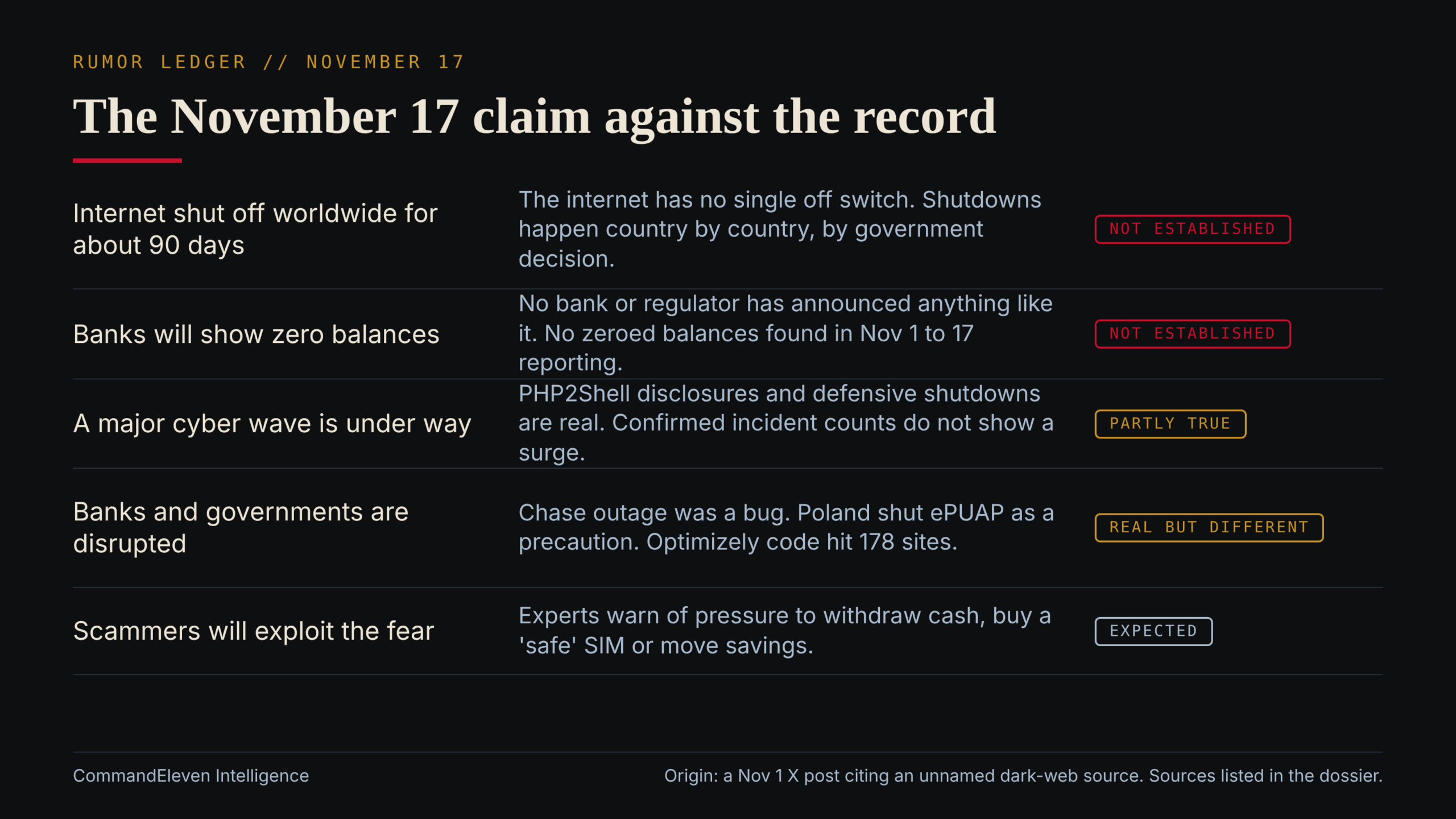
- What is true. Two critical PHP flaws were disclosed around October 20. Governments and organizations took sites offline. Real outages and real thefts happened in November.
- What is not. No bank, regulator or security company has announced anything resembling a global shutdown or zeroed balances. An expert quoted in Russian reporting notes the internet has no single owner or off switch, runs on tens of thousands of independent networks, and that banks use their own protected channels and national payment systems.
- Where the harm is. The same expert warns the prediction is mainly a tool for scammers, who push people to withdraw cash, buy a “safe” SIM card or move savings. Malaysian officials made a similar point after reports of people withdrawing cash from ATMs.
- Status. As of this writing, early in the U.S. day on November 17, we found no reporting of a worldwide outage. We will add a closing note at the end of the day.
How to Protect Your Phone, Computer and Company
Attackers already know every technique below. These are chosen because each one answers a specific failure in the incidents above, and each can be done today.
Phone
- Update iOS or Android now and turn on automatic updates. The Optimizely code pointed iPhone visitors at exploit kits for iOS 13 through 18, and reporting lists iOS 18.7.3 and later, and 26.3 and later, as patched. Check Settings, General, Software Update on iPhone, or Settings, System, Software update on Android.
- Pay with a phone wallet or a virtual card number when you shop on a website. The injected code skimmed card numbers typed into sites’ own forms and could not reach hosted payment fields. Apple Pay, Google Pay or a bank-issued virtual card keeps your real number out of that form.
- Set bank alerts to the lowest threshold. Turn on push alerts for every transaction and every new payee, and know where your bank app’s card-freeze switch is before you need it.
- Use passkeys, or an authenticator app, instead of SMS codes for your email and bank. Add a port-out PIN or number lock at your carrier so your number cannot be moved to another SIM.
- Do not tap links in texts or messages about your bank. Open the bank’s app or call the number on the back of your card. On November 17 expect messages built on the rumor.
- For cryptocurrency, verify the address on your wallet’s own screen, not the clipboard. Compare the first and last several characters and send a small test first. The Optimizely code swapped addresses in copied text.
- High-risk users: turn on iPhone Lockdown Mode or Android’s Advanced Protection if you are a journalist, executive or official.
Computer
- Update your browser and operating system, then restart. Listings in the roundups we checked show a Chrome flaw (CVE-2026-125350) exploited in the wild on November 9 and an Outlook flaw (CVE-2026-124194) exploited before its patch on November 10 that leaks login hashes. A pending update is an open door.
- Use a password manager and let it check the domain. It will not autofill on a look-alike site. Make your email account the first one with a security key or passkey.
- If you visited an affected site on November 16 and typed a card number or crypto address, act: check your statements for that day, confirm any crypto transfer destination, and sign out of sensitive accounts everywhere so stolen cookies stop working.
- Keep a dedicated browser profile for banking with no extensions and no other tabs.
- Back up with one copy offline, and test a restore. The ESXi wiper cases erased backups over about ten days.
- Router: install the firmware update, change the default admin password, and turn off remote administration.
AI-era scams: five habits
- Never dial a support number from a chatbot or AI search summary. A campaign called Dark Sourcery, reported in September by Vigilance Security, poisons answers from ChatGPT, Gemini and Google AI Overview with fake support numbers, emails and login pages for at least 374 brands, including airlines and banks. Use the number printed on the back of your card or inside the official app.
- Agree on a family safe word today. Voice cloning makes a panicked call from a relative convincing. If the caller cannot give the word, hang up and call them back on their known number. The “three seconds of audio” figure circulating online is not one we could verify, so treat any public clip of your voice as enough.
- Move email, bank and crypto accounts off SMS codes. A Latvian provider’s exposed database held 125 million+ SMS records, including live two-factor codes. Use a passkey, hardware key or authenticator app, and add a carrier port-out PIN.
- Set photo access to “Selected Photos” or “Ask Every Time.” Italy’s data regulator fined Meta €805 million over a Facebook feature on Android that suggested gallery photos under one broad permission without clear consent. The regulator did not find that files were uploaded or examine AI training, and Meta disputes the decision and plans to appeal. The setting is still the right one for an app that does not need your whole camera roll.
- Verify any urgent video or audio request through a second channel. In November the U.S. Justice Department announced charges over more than $129 million wired after AI-faked CEO and lawyer calls (the scheme ran 2024 to 2026), and a separate case over $400 million+ stolen through fake Zoom and Teams meetings linked to North Korea. Never wire money, change bank details or share credentials on the strength of a call. Call back on a known number.
Corporate systems
- Inventory every third-party script on login, checkout and account pages. Optimizely worked because a vendor-delivered snippet ran with the page’s full trust. Remove testing and marketing scripts from payment and login pages entirely.
- Restrict who can write to vendor consoles (experimentation, tag managers, analytics). Require single sign-on and MFA, grant least privilege, and alert on any change to a custom JavaScript field.
- Deploy a Content Security Policy that allowlists script sources, starting in report-only mode. Subresource Integrity does not help here because vendor scripts change legitimately. Add monitoring that compares what scripts actually deliver.
- Use hosted payment fields or iframes from your payment provider. In this incident they were the thing the skimmer could not reach.
- Build a vendor kill switch. Know who can disable any vendor script or integration within minutes without a release. Salesforce did exactly that for Optimizely scripts.
- Map your fourth parties and set breach-notification windows in contracts. Arkéa’s loss reportedly ran through a service-provider platform, and Maersk’s confirmed breach through its LF Logistics platform.
- Audit cross-account cloud roles and remote-support extensions. Wiz found attackers assumed customer-created roles that trusted a data platform’s cloud account, and some roles were still active at customers that had stopped using the platform. Remove unused trust relationships and require unique external identifiers. For ScreenConnect, update to 26.6.5 or later and review every third-party extension.
- Patch by exploitation, not by severity score. Start with the CISA Known Exploited Vulnerabilities list and with internet-facing devices: VPNs, firewalls and gateways. Inventory every PHP install and every unsupported PHP version.
- Protect virtualization management. Put vCenter and ESXi administration on a separate network with MFA, keep immutable or offline backups, and keep the backup server out of the main domain.
- For payments: require dual approval and a callback to a known number for any change to bank details, and set bank-side limits. A theft from a bank’s own account, as at Arkéa, is a control failure in the payment path.
- Decide your outage rule in advance. Who can declare “cyber” versus “technical,” who tells customers, and what the status page says. Publish an estimated restoration time whenever you can. A shutdown with no timeline, as Poland’s ePUAP had, leaves the public to guess.
- Run two tabletop exercises this quarter: a compromised vendor script, and a payroll or core-platform vendor outage of a full day.
What To Watch
- Whether Optimizely or investigators publish a root cause and a final victim count, and whether Hudson Rock’s three other affected services are named.
- Any bank or regulator statement about customer losses tied to the Optimizely code.
- The status of Poland’s ePUAP and the PHP2Shell patch rate among government sites.
- The end-of-day picture for November 17: reported outages, and scam reporting that uses the rumor.
- Completion of the November count against October by an independent tracker.
Calls We Will Score
- By December 31, 2026: Optimizely or an independent investigator publishes a root-cause explanation of the signup-flow flaw, and the public count of affected organizations rises above 178.
- By December 31, 2026: No bank in the United States, European Union or United Kingdom publicly confirms that a cyberattack reduced customer account balances to zero or otherwise removed customer funds from accounts at scale.
- By February 28, 2027: At least one more third-party script or tag platform is publicly confirmed as compromised in a campaign reaching 50 or more victim sites.
What This Assessment Does and Doesn’t Establish
- It establishes the incidents above at the tier stated, based on public statements and reporting. Most of our sources are secondary; we did not obtain victims’ internal data.
- It does not establish a complete count of global incidents, and it does not claim November was quieter or busier than October. The one comparison we cite is a single tracker’s partial count.
- Attacker claims on leak sites that we could not corroborate are excluded. They would raise the bank-related total.
- Navy Federal and American Express had no stated cause when we wrote this. Expedia’s scope is unverified and rests largely on the attacker’s claims.
- The CVE identifiers are as listed in the roundups we cite and should be checked against vendor advisories before you act.
- The protection lists are general guidance, not legal, financial or compliance advice.
Frequently Asked Questions
Is my bank account safe on November 17?
Nothing in public reporting indicates a threat to account balances. The practical risks are scams that use the rumor, and weak account security. Turn on alerts, use passkeys or an authenticator, and ignore messages that tell you to move money.
Was the Optimizely attack the same as the February breach?
No. February was a voice-phishing breach that exposed basic business contact information. The November 16 attack inserted malicious code into customers’ web projects through a flaw in the signup flow.
Was the Chase outage a cyberattack?
Chase said it was a software bug in on-premises hardware and not cyber-related. Other banks described their issues as technical or said their own systems were not directly affected. We found no published evidence of an attack.
Should I withdraw my savings or stock up on cash?
We are not financial advisers. Nothing we found supports emptying accounts, and the experts we cite say panic withdrawals are what scammers want. Outages of hours do happen, as November 16 showed, so ordinary resilience, such as a small amount of cash and a second payment method, is a reasonable household habit.
Can the whole internet be shut off for 90 days?
Experts we cite say no. The internet is tens of thousands of independent networks and routes around failures. Shutdowns happen inside a single country when its government orders them.
Did Navy Federal and American Express go down because of a cyberattack?
No cause has been published for either. Downdetector showed more than 900 reports for Navy Federal and more than 200 for American Express overnight on November 16 to 17. Nothing links them to each other or to the Chase bug. We will update if a cause is stated.
Was the Expedia breach the same as Optimizely?
No. Expedia confirmed an intrusion through an external data platform provider. Optimizely was malicious code inserted into customer projects through a signup-flow flaw. Both are supply-chain attacks, but we have seen no evidence that they are connected.
Related CommandEleven Intelligence Reading
- Black October: the PHP2Shell disclosures
- FAA ground stop, Microsoft 365 and Workday outages: what is documented and what is not
- FAA ground stop update, November 15
- No countdown: the November 17 alert, the stock-up warnings and the one real date
- Deepfake CEO fraud: what the alleged $129 million case shows about voice-clone impersonation
Sources
- The Next Web: Optimizely hack, 178 sites (Nov 17, 2026)
- CoinDesk: crypto-stealing code on 178 organizations’ sites (Nov 17, 2026)
- Breach History: OPTIMJACK timeline (Nov 2026)
- Ransom News: Chase and Bank of America outage (Nov 16, 2026)
- CNN: Chase and other banks report trouble (Nov 16, 2026)
- Nation Thailand: Crédit Mutuel Arkéa (Nov 2026)
- RTÉ: why France is so targeted by hackers (Nov 17, 2026)
- The Record: Poland shuts down ePUAP (Nov 11, 2026)
- Latest in Cyber: PHP flaw forced governments offline (Nov 14, 2026)
- Borns IT: PHP2Shell status (Nov 15, 2026)
- Sherlock Forensics: weekly roundup Nov 1 to 14 (Nov 14, 2026)
- ExplainX: November 2026 cyberattacks tracker (Nov 15, 2026)
- RIAMO: the November 17 digital apocalypse claim (Nov 2026)
- The Star (Malaysia): don’t panic over banking downtime (Nov 10, 2026)
- Observatorio Blockchain: Expedia confirms the breach and verifies no figure (Nov 2026)
- Secure in Seconds: SCKit ScreenConnect MSP worm (Nov 15, 2026)
- IBTimes Singapore: Navy Federal app problems (Nov 2026)
- Identity Week: CSCTelecom breach exposes 125 million SMS records (Nov 11, 2026)
- IANS: Dark Sourcery campaign (Sep 24, 2026)
- Bitdefender: Meta fined over Facebook Android photo access (Nov 2026)
- Help Net Security: $129 million deepfake CEO fraud indictment (Nov 9, 2026)
- Bitcoin Foundation: North Korea deepfake calls, DOJ (Nov 12, 2026)
- Latin Times: Mullin and the FAA SMART tool (Nov 13, 2026)
- Phemex: three Malaysian banks, same-day disruptions (Nov 8, 2026)
Assessments and confidence tiers are CommandEleven Intelligence’s own. We do not reproduce third-party text. Figures come from the cited reporting and are attributed where we could not verify them independently.