CommandEleven Intelligence Desk // Critical Infrastructure Desk, status as of November 15, 2026.
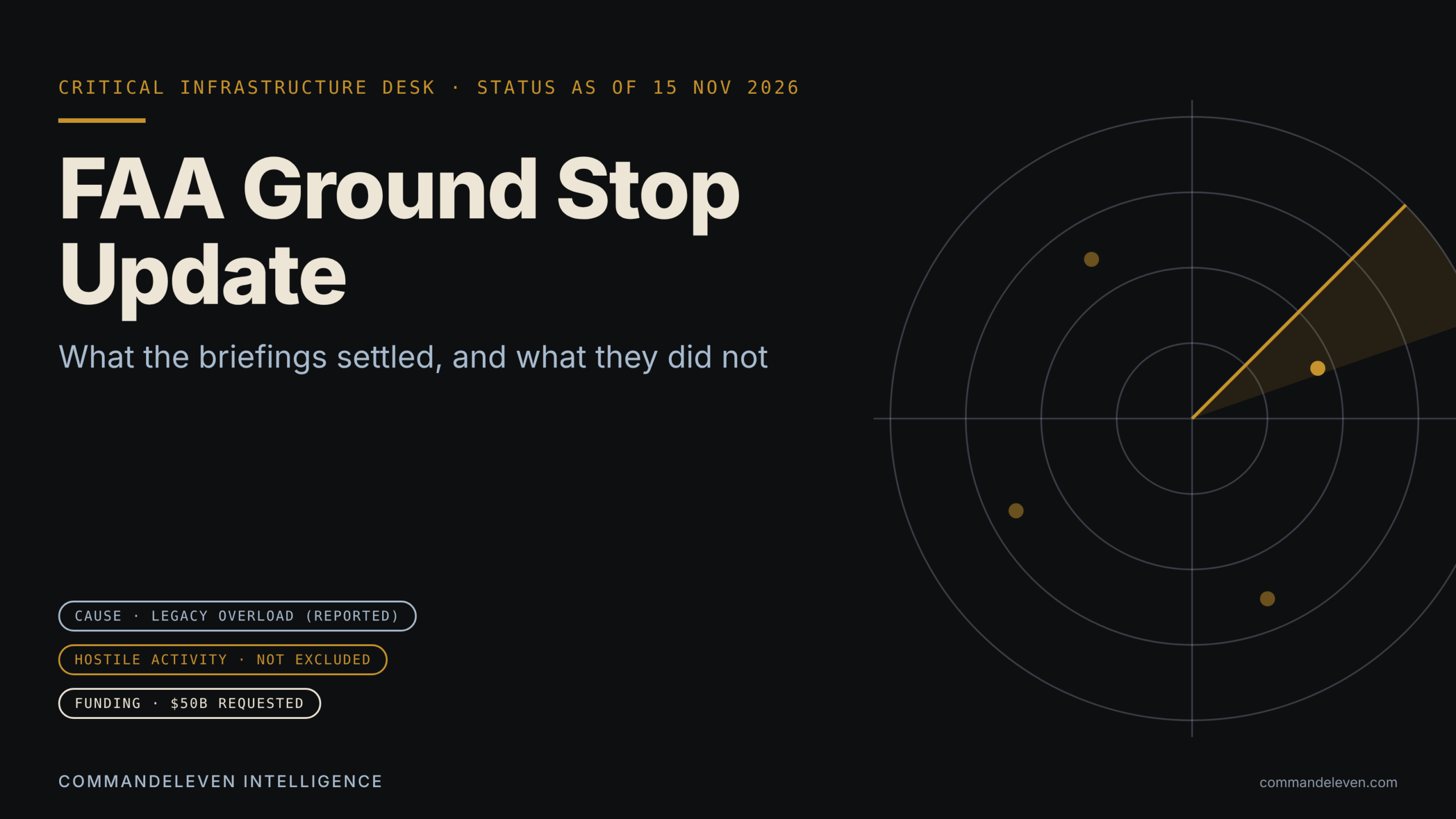
This update builds on our November 14 assessment of the FAA ground stop, Microsoft 365 and Workday outages. It covers what the Friday White House briefing and the Transportation and Homeland Security secretaries added, what it did not settle, and what the money behind the fix looks like.
Bottom Line Up Front
Officials now say the November 13 ground stop began when new equipment overloaded old communications hardware, and that they have seen no evidence of a cyberattack. They also say the investigation is not finished, and the Transportation Secretary said he did not want to rule out malicious activity. Our position is unchanged: a hostile cause has not been shown and has not been excluded. [REPORTED]
Three things are new. The Homeland Security Secretary used the phrase “continuity of government” while answering a question about a possible cyberattack. A U.S. Air Force base in England reported suspected unauthorized drone activity on the same afternoon. And the Transportation Secretary asked Congress for $50 billion in emergency funding, which sits alongside a $30 billion Senate bill and a $12.5 billion down payment already appropriated. Whether Congress releases the balance without conditions is now an open question.
What the briefings added
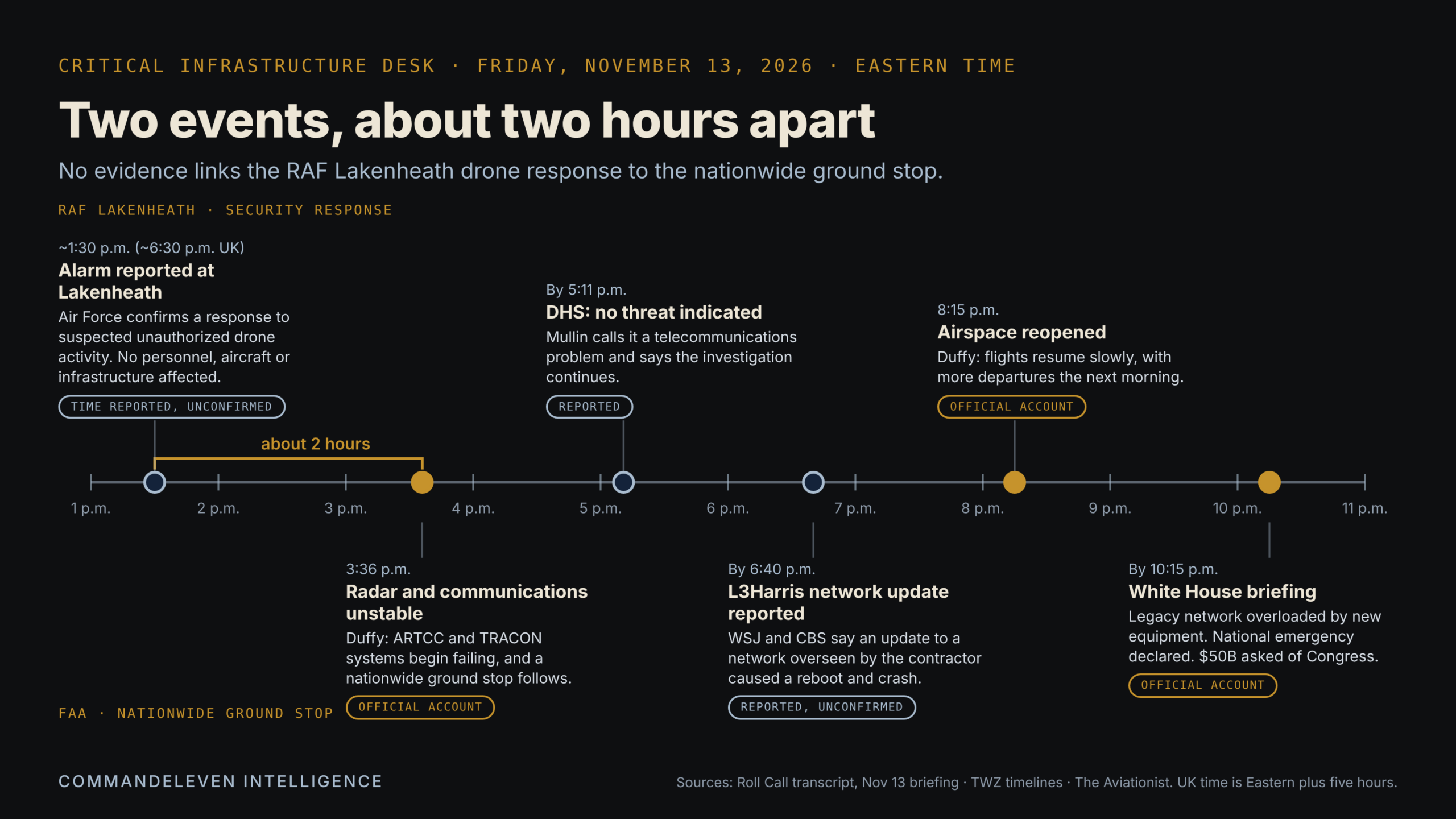
- Transportation Secretary Sean Duffy said radar, communications and facility systems became unstable at about 3:36 p.m. Eastern on Friday, which led to the nationwide stop. About 3,500 aircraft were airborne at the time. The airspace reopened at about 8:15 p.m. [CONFIRMED] (TWZ timeline)
- Duffy attributed the failure to overloaded old switches and routers on telecom lines that date to the 1980s. Homeland Security Secretary Markwayne Mullin said new equipment installed during FAA patching overwhelmed the older system. Duffy said the newer IP-based equipment did not fail, and that the new SMART airspace system was not connected to the failed systems. [REPORTED]
- Duffy said communication with aircraft was intermittent, not a full blackout. Mullin said more than 3,000 flights were airborne and all landed safely. [REPORTED]
- Mullin said the President declared a national emergency, and that FEMA, NSA, CISA and the Department of War were engaged. Duffy said the White House assembled its intelligence assets. [REPORTED]
- The Wall Street Journal and CBS reported that the failure involved a network overseen by L3Harris Technologies and that an update caused a reboot and crash. Neither the company nor the FAA has confirmed that account in the sources we reviewed. [REPORTED]
Source for the quotes and exchanges above is the Roll Call transcript of the November 13 briefing. The transcript we reviewed ends at about the 27-minute mark, so we have relied only on what it shows.
Hostile activity: still not ruled out
Our November 14 assessment said the outside-actor question belongs in the analysis even without evidence. The briefing supports that. Mullin said the team had seen zero evidence of a cyberattack, that the outage appeared mechanical, and that Iran involvement was not being seen. He also said nothing was completely certain, and that the cyber investigation would continue and any change would be reported. Duffy said he did not want to rule out malicious activity and deferred to the cybersecurity team. [REPORTED]
Two readings do not survive the transcript. One is that officials have excluded a cyberattack or a nation-state. They said they have found no evidence so far, which is a weaker statement. The other is that the cause is settled. The mechanical explanation is consistent with the GAO’s earlier warnings, but no post-incident report has been published. [DATA DEFICIT]
Continuity of Government: what the phrase means and what it does not
Asked whether the instability sounded like a cyberattack, Mullin answered that DHS exists to provide the continuity of government and to bring all resources together in an emergency like this. [REPORTED]
In federal planning, “continuity of government” has a specific meaning. It is a coordinated effort across the executive, legislative and judicial branches to keep essential government functions running through a catastrophic emergency. It differs from continuity of operations, which is agency-level planning triggered by anything from a fire to a hurricane. Continuity of government is reserved for major disasters that threaten the stability of government itself (FEMA guidance; Congressional Research Service). Under the national continuity directive the CRS describes, the Homeland Security Secretary is the lead agent for coordinating executive-branch continuity operations. [CONFIRMED]
Our reading, in order of likelihood:
- Descriptive use. Mullin was describing DHS’s mission in an emergency, not announcing that continuity plans were activated. This fits the wording and the setting. [ASSESSED, moderate confidence]
- Worst-case posture. When a failure across the national airspace system has no confirmed cause, planners treat it as possibly deliberate until attribution is excluded, because the same failure could degrade the movement of officials, forces and cargo. The national emergency declaration and the activation of intelligence and security agencies are consistent with that posture. [ASSESSED, low confidence]
- A gap between language and declared cause. A legacy telecom overload would not normally call for this vocabulary. The gap is the reason the question is worth asking, and it is not evidence of a hidden threat. [ASSESSED, low confidence]
We have no evidence that formal continuity plans or readiness levels were raised, and none that any hostile act occurred. The questions to put to DHS are whether any continuity plan was activated, who convened it, and why the phrase was used. [DATA DEFICIT]
The drones over RAF Lakenheath: sequence, not causation
The U.S. Air Force confirmed that Security Forces responded to suspected unauthorized drone activity over RAF Lakenheath on the evening of November 13, with no personnel, aircraft or infrastructure affected. The U.K. Ministry of Defence said the situation was resolved and that it was working with the U.S. to establish the facts. No operator has been identified. [CONFIRMED] (TWZ)
- An alarm was reported at about 6:30 p.m. local time, which is about 1:30 p.m. Eastern, roughly two hours before the first instability at 3:36 p.m. The time comes from open-source reporting and the Air Force has not confirmed it. [REPORTED] (The Aviationist)
- Alarms at RAF Mildenhall and RAF Feltwell come only from an unverified open-source account. The Air Force confirmed Lakenheath alone. [REPORTED]
- Earlier that week, security at Lakenheath and Mildenhall was reportedly raised. The Wall Street Journal, as cited by TWZ, tied the change to an unspecified Iran-related threat. The Air Force has not confirmed the security level or the reason. [REPORTED]
We see no evidence connecting the drones to the ground stop. The timing is a coincidence of afternoon and evening on opposite sides of the Atlantic, and we treat it that way until something links them. [ASSESSED, low confidence] We will carry it in this series because both events involve infrastructure that depends on systems built for an earlier threat environment. For the drone-defense policy backdrop, see our analysis of the new U.S. counter-drone interagency policy.
Outdated technology: air traffic control and the grid
Duffy described a system running on 1980s technology and 1990s software, with 1970s radar for which parts are no longer made. He warned that without an upgrade there would be more outages like this one. [REPORTED] That language echoes the Government Accountability Office’s earlier findings that we covered on November 14.
The electric grid shares the pattern, and one of its best-known warnings is more than a decade old. In March 2014 the Wall Street Journal reported, citing people familiar with a Federal Energy Regulatory Commission analysis, that disabling as few as nine of the nation’s roughly 55,000 transmission substations could black out the grid. Former FERC chairman Jon Wellinghoff told the Journal that fewer than 100 critical high-voltage substations need physical protection, and that protecting them is neither a monumental task nor an inordinate expense (IEEE Spectrum; NPR). The nine-substation figure is secondhand, because the study was never published, and the warning is twelve years old. [REPORTED] Whether that exposure has since been closed is a question for our Critical Infrastructure series.
Our assessment is that air travel and electricity are two core functions running on aging systems where one change or one fault can spread across a network. That is a vulnerability for an accident and an opening for an adversary, and the two functions depend on each other: airports and air traffic facilities need power, and grid operators need communications. [ASSESSED, moderate confidence]
The money: what is being asked for air traffic control
| Figure | What it is | Status |
|---|---|---|
| $12.5 billion | Down payment Congress already appropriated for the air traffic control overhaul | Appropriated; the FAA targets 2028 for deployment [REPORTED] |
| $31.5 billion | Duffy’s July 2025 estimate of the full program cost | Estimate [REPORTED] |
| About $20 billion | Additional funding FAA Administrator Bryan Bedford said was still needed, as of December 2025 | Stated by the FAA [REPORTED] |
| $30 billion | Modern Skies Act (Sen. Eric Schmitt), introduced September 28, 2026 | Introduced; no floor vote reported [REPORTED] |
| $50 billion | Duffy’s November 13 request for emergency funding to replace aging hardware, telecom equipment and towers | Request; unclear whether additive to the $12.5 billion [REPORTED] |
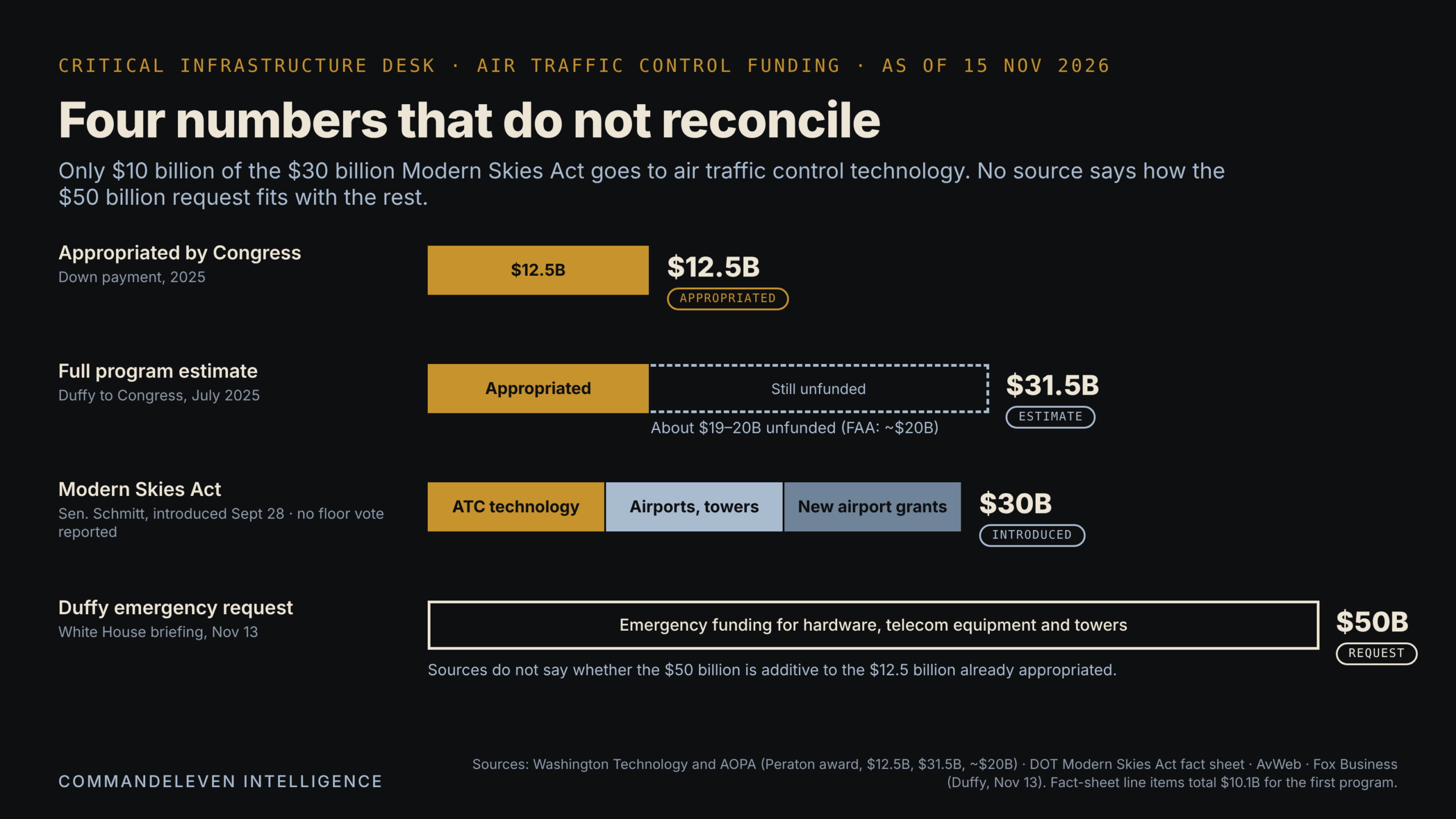
The $30 billion in the Modern Skies Act is not all for air traffic control technology. The Transportation Department’s fact sheet splits it into three $10 billion programs. The first, a reliable digital architecture, funds $7.2 billion for controllers’ separation tools, $2 billion for data architecture with more bandwidth and cybersecurity, $600 million to deploy SMART and a flow-management system, and $300 million to consolidate terminal facilities. The second covers airport terminal and improvement grants and $2 billion for FAA-owned towers. The third is a new grant program for airports serving 5 to 25 million passengers a year. The bill would also give the FAA more flexibility over the $12.5 billion. The fact sheet states no oversight provisions. [REPORTED]
The oversight gap matters because a GAO review found the FAA still lacks a complete lifecycle cost estimate and an integrated master schedule for the overhaul (AvWeb). Nearly 60 aviation organizations support the bill, including the controllers’ union and the pilots’ association. [REPORTED]
Duffy’s request was made at the White House, where he said “I want $50 billion” and called it an emergency (Fox Business). Mullin said the President declared a national emergency and that Congress must now act and fund it. The $12.5 billion plus the Senate bill’s $30 billion does not reconcile with a $50 billion ask, and none of the sources says how the figures fit together. [DATA DEFICIT]
Who is building it
The FAA named Peraton prime integrator of the overhaul on December 4, 2025. It received two bids, from Peraton and from Parsons teamed with IBM, and the Transportation Department has not published a contract value (Washington Technology; AOPA). [CONFIRMED]
An independent Substack, AJ Signal’s “Money Trail” piece, argues the outage is being used to justify a pre-arranged contract and points to lobbying and ownership ties. It is the source of the $31 billion figure circulating online, which matches Duffy’s $31.5 billion estimate and is not a new bill. We could not confirm its claims about individuals, and some of its details conflict with the record: it calls the award single-bid, but two bids were received, and it dates the ground stop to Thursday, when it occurred on Friday. We are not repeating those claims, and we have not used its graphics. [UNVERIFIED]
The grid bill and why it may stall
The Senate voted 73 to 25 on November 10 to take up the Bipartisan American Affordability and Jobs Act, which overhauls permitting for energy projects and requires data center owners to pay for the infrastructure that powers them (Al Jazeera). It is a permitting and transmission bill, with no single dollar figure attached. Incoming House Democratic leaders say it falls short, and some Democrats want to wait for the new majority. [REPORTED]
Earlier permitting efforts have a record of stalling. Sen. Joe Manchin dropped his push in September 2022, and a bipartisan effort died in the December 2024 lame-duck session. That history is a reason for caution, not a prediction. [ASSESSED, low confidence]
Can Duffy get the full $31.5 billion?
Congress appropriated the $12.5 billion down payment in 2025. Reaching the full $31.5 billion means winning roughly $19 billion to $20 billion more (the FAA administrator put it at about $20 billion), and Duffy’s $50 billion request goes beyond that. The politics have shifted since the first money was approved.
- Democrats on several committees pledged oversight of the ground stop. House Homeland Security Committee Democrats told officials to preserve documents and emails and said oversight is coming, and Rep. Chris Deluzio (D-PA) called for a full investigation by the House Transportation Committee. Sen. Tammy Duckworth (D-IL) said Republicans had controlled Congress for two years and found money for vanity projects but not for air traffic control. The coverage we reviewed does not report a Democratic position on the $50 billion itself (Yahoo News). [REPORTED]
- Al Jazeera reports that some Democrats want to hold the Senate energy bill until new Democratic majorities are sworn in early next year, and that House Minority Leader Hakeem Jeffries, whom it describes as the likely next Speaker, will not rubber-stamp Senate legislation without more involvement from his caucus. [REPORTED]
- Support for modernizing air traffic control is broad in principle. Nearly 60 aviation organizations back the Modern Skies Act, and Duffy calls the issue bipartisan. [REPORTED]
- The bill as described in the fact sheet has no stated oversight provisions, and the GAO found the FAA lacks a complete lifecycle cost estimate and an integrated master schedule. [REPORTED]
Our assessment is that money for air traffic control has bipartisan support in principle, but a Congress that has pledged oversight of this outage is unlikely to release the balance without conditions, such as a firm cost estimate, a master schedule and contractor accountability. The likelier result is delay and strings, not refusal. An emergency appropriation before the new Congress is seated is the path to watch. [ASSESSED, low confidence] The record does not yet tell us how Democratic leaders will vote on the request, and we will update this when they state a position. [DATA DEFICIT]
Our assumptions, revised
| Assumption | Status after the briefings | Confidence |
|---|---|---|
| The pattern is shared fragility, not a shared attacker | Strengthened. The official account, legacy hardware overloaded by new equipment, fits it | Moderate |
| A hostile cause cannot be excluded at this scope | Unchanged. Officials themselves have not excluded it; they report no evidence so far | Low that an attack occurred |
| Nothing public links Microsoft, the FAA and Workday | Unchanged. DHS says the FAA stop was not tied to the Microsoft outage | Reported |
| SMART is irrelevant to November 13 | Unchanged. Duffy says it was not connected to the failed systems | Reported |
| New: the outage will shape the funding debate | The $50 billion request and the Senate bill both rest on it | Moderate |
| New: official language is outpacing the stated cause | National emergency and “continuity of government” wording against a legacy-overload explanation | Low |
| New: the full $31.5 billion will not arrive quickly or without conditions | Oversight pledges and the new Congress make conditions and delay more likely than outright refusal | Low |
What we are watching
- Any FAA, Transportation Department or inspector-general post-incident report, and whether L3Harris or the FAA addresses the network update reports.
- A DHS statement on whether any continuity plan or readiness level was activated.
- Attribution for the Lakenheath drones and any official link to the Iran-related posture reports.
- How the $50 billion request is reconciled with the Modern Skies Act, and whether the bill gets a floor vote.
- Recurrence as the FAA deploys further patches, which Duffy said could bring more outages, and Thanksgiving travel.
Frequently asked questions
Was the November 13 ground stop a cyberattack?
Officials say they have seen no evidence of one and attribute the failure to new equipment overloading old communications hardware. They also say the investigation is not finished, and the Transportation Secretary said he did not want to rule out malicious activity. Our position is unchanged: a hostile cause has not been shown and has not been excluded.
What does “continuity of government” mean, and was it activated?
It is the federal planning framework for keeping essential government functions running during a major disruption. The Homeland Security Secretary used the phrase while answering a question about a possible cyberattack. Using the phrase does not show that any continuity plan was activated, and we have seen no official statement that one was.
Are the drones over RAF Lakenheath connected to the ground stop?
No official link has been made. A U.S. Air Force base in England reported suspected unauthorized drone activity on the same afternoon. We treat it as sequence, not causation: the timing is worth tracking, but it does not establish a connection.
Why is the air traffic control system still running on old technology?
Duffy attributed the failure to overloaded old switches and routers on telecom lines that date to the 1980s. The grid shows the same pattern: former FERC chairman Jon Wellinghoff has warned about this, and 2014 reporting by IEEE Spectrum and NPR described a federal analysis finding that the loss of a small number of substations could cause a wide outage. Both systems are essential and both depend on aging equipment.
How much money is being asked for, and are the figures added together?
Five figures are in play: $12.5 billion already appropriated, Duffy’s $31.5 billion July 2025 estimate of the full program, about $20 billion more that the FAA Administrator said was needed as of December 2025, the $30 billion Modern Skies Act, and Duffy’s $50 billion request of November 13. It is not clear whether the $50 billion is in addition to the $12.5 billion, so the figures should not be summed.
Will Congress approve the full amount?
We assess this with low confidence. The Modern Skies Act has had no floor vote, Democrats have pledged closer oversight, and a change in the majority could slow or condition the money. Funding after a visible failure raises the pressure to act, which cuts the other way.
Could it happen again?
Duffy said further patches could bring more outages. Until the fixes are complete and an independent post-incident report is published, we treat a recurrence as a real risk, especially around Thanksgiving travel.
Does this update change your earlier assessment?
It refines it. The new details on the cause, continuity of government and the funding ask are in the Assumptions revised table above. The core judgment in our November 14 dossier stands.
Sources
- Roll Call: Press briefing transcript, November 13, 2026
- TWZ: FAA orders ground stop for all flights across the U.S. (live updates)
- Fox Business: Duffy demands $50B to rebuild aging air traffic control
- U.S. Department of Transportation: Modern Skies Act fact sheet
- AvWeb: $30 billion ATC modernization bill introduced
- AOPA: DOT, FAA pick company to lead ATC modernization
- Washington Technology: Peraton wins air traffic control overhaul contract
- Congressional Research Service: Continuity of government
- FEMA: Continuity of government guidance
- TWZ: Suspected drones over RAF Lakenheath trigger security response
- The Aviationist: RAF Lakenheath sounds alarm after suspected unauthorized drone activity
- Al Jazeera: U.S. Senate advances major bill boosting energy infrastructure
- IEEE Spectrum: Attack on nine substations could take down U.S. grid (March 2014)
- NPR: Report, small-scale attacks could cause national blackout (March 2014)
- Yahoo News: Democrats pledge to investigate nationwide aviation ground stop
- Route Fifty: Manchin drops push to overhaul energy infrastructure permitting
- Senate Energy Committee: Manchin statement on permitting reform
- AJ Signal: The Air Traffic Control Money Trail (unverified, see text)
- CommandEleven Intelligence: FAA Ground Stop, Microsoft 365 and Workday Outages (November 14)