
Maritime and Trade Security Desk | Status as of November 15, 2026 | CommandEleven Intelligence Desk
Bottom Line Up Front
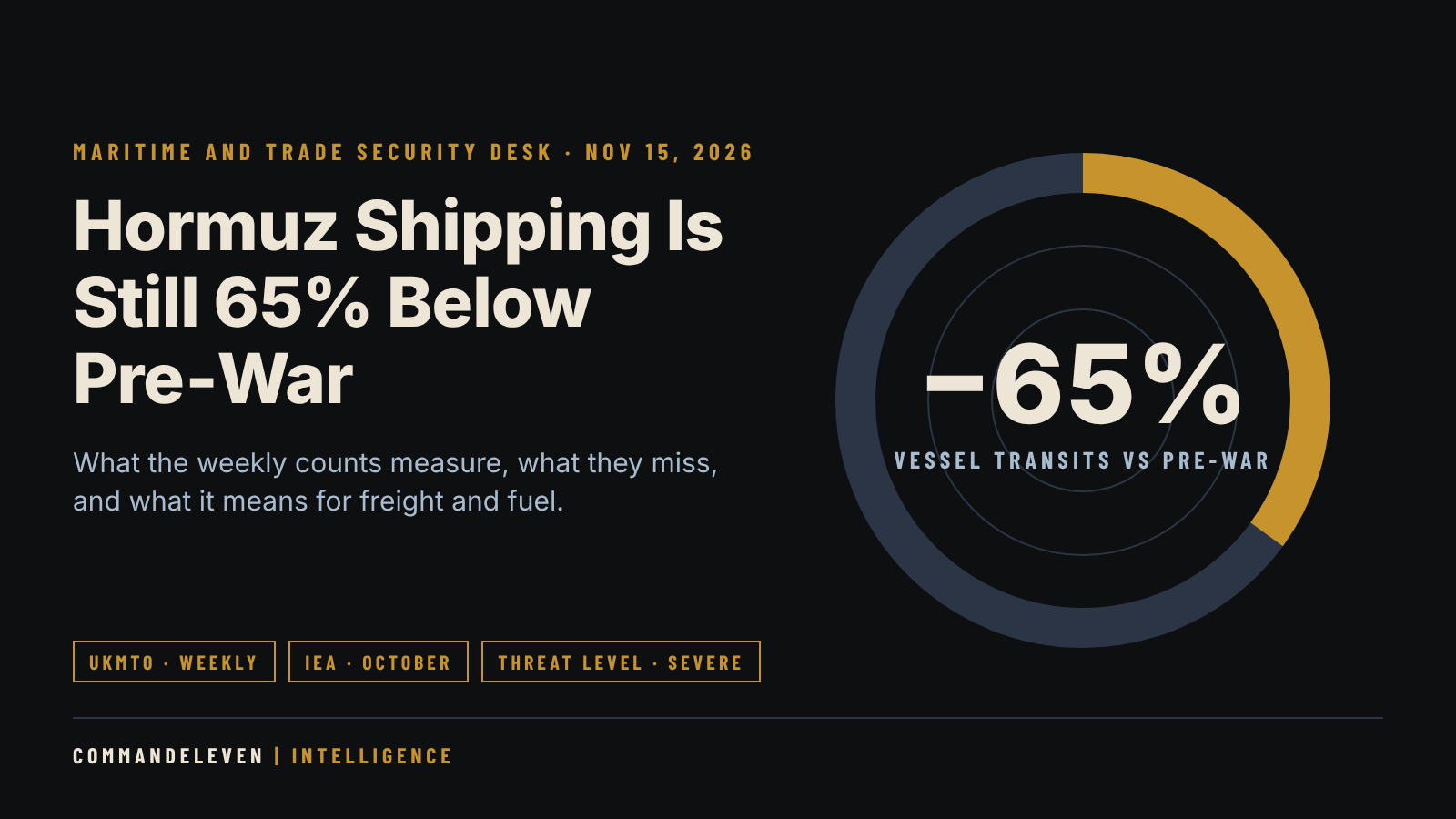
The weekly UKMTO assessment released November 13 counted 139 outbound and 169 inbound transits of the Strait of Hormuz, about 65% below pre-conflict levels. That is a measure of ships. It is not a measure of oil. The IEA’s November report puts Gulf oil exports (excluding Oman) at 18.4 million barrels a day in October, 26% below pre-war, with crude much closer to normal than refined products and LPG. A reader who treats the 65% figure as the size of the oil loss will overstate it, and a reader who treats falling prices as an all-clear will understate the risk to ships.
Key Judgments
- High confidence: Transit counts remain far below pre-conflict levels, and the threat level remains severe. UKMTO counted 8 incidents in its latest period, 7 of them tanker attacks.
- Moderate confidence: Oil flows are recovering faster than ship counts. The IEA reports crude exports at roughly 82% of pre-war, and Dated Brent has fallen from an October peak of $136 to about $93.
- Moderate confidence: The count is a blend. UKMTO combines AIS-tracked movements with U.S.-reported facilitated transits, and says it cannot independently verify the U.S. figures.
- Low confidence: IRGC claims of mine strikes on ships using “unauthorised” passage are unverified. We treat them as signaling until independently confirmed.
What the Weekly Count Measures
UKMTO’s weekly figure adds outbound and inbound transits. The latest report shows 139 outbound and 169 inbound, down from 170 outbound and 155 inbound in the prior report. Our own arithmetic puts the 308 transits at about 44 a day. UKMTO’s sources do not state the pre-war baseline, so we cannot reproduce the 65% figure ourselves. Data deficit: the baseline and method behind the percentage are not published in the material we reviewed.
The count has a second limit. It combines vessels tracked by AIS with transits the U.S. reports as facilitated, and UKMTO cannot independently verify the second group. JMIC tracking shows lower daily numbers, single-digit to low-double-digit transits, alongside about 30 U.S.-facilitated transits a day on November 5 to 7. The two series are not directly comparable.
Two Yardsticks: Ships and Oil
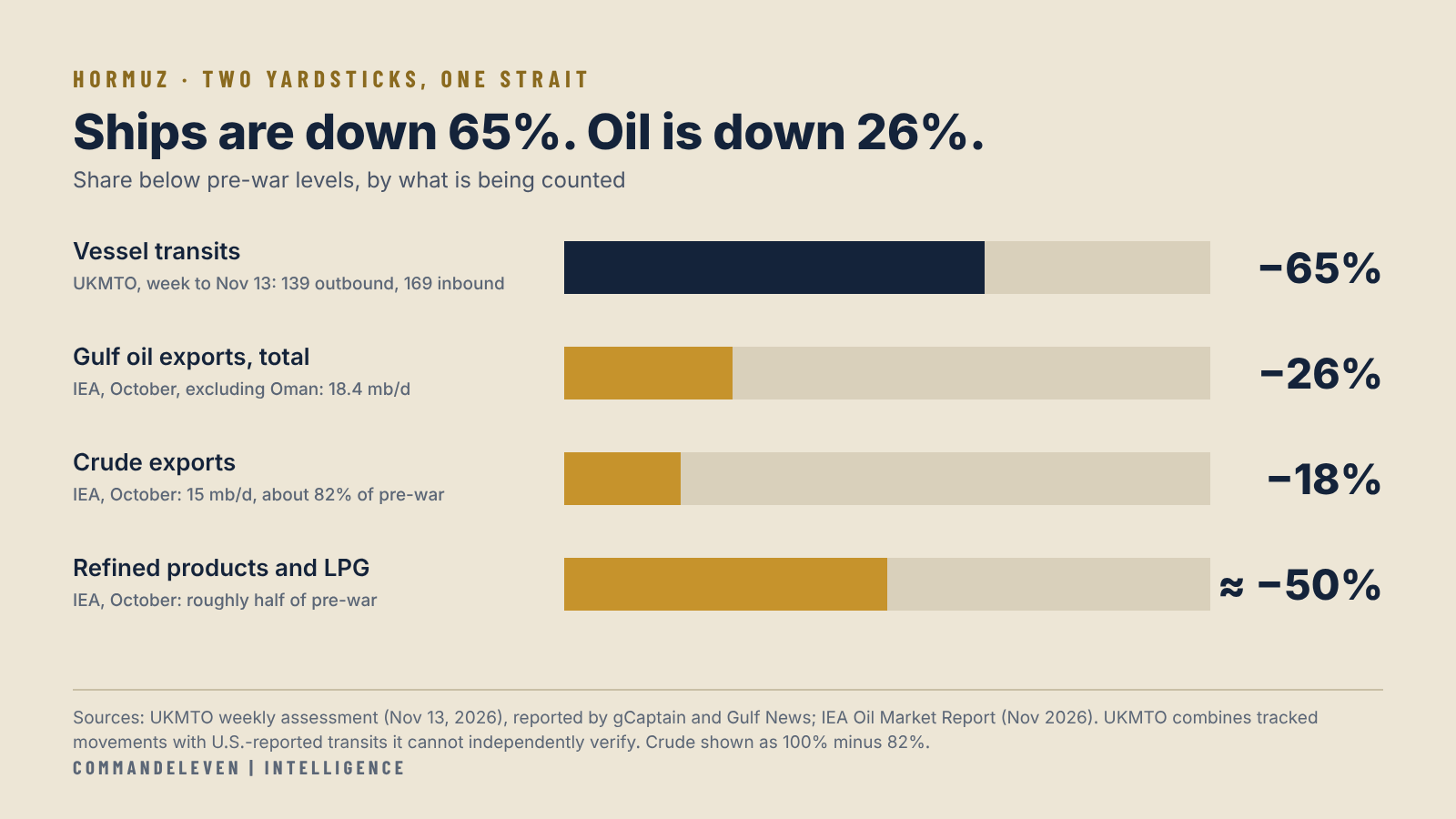
The IEA’s November Oil Market Report gives the barrel view. Gulf oil exports excluding Oman averaged 18.4 million barrels a day in October, 26% below pre-war. Crude was about 15 million barrels a day, roughly 82% of pre-war. Products and LPG were down about half. Fewer ships can carry a larger share of crude if the ships that do sail are large tankers, which is one plausible reason the two measures diverge. We have not confirmed that explanation.
The market is reading the barrel measure. The IEA estimates Q4 supply exceeds demand by 1.7 million barrels a day, October inventories rose 52 million barrels, and oil on water rose 86 million barrels to the highest level since January. IEA members plan to release 71 million barrels of emergency stocks by the end of February, including 15 million barrels of diesel. The pressure is concentrated in refined products: European diesel is near $180 a barrel, about 77% above pre-war, and Middle East to Asia crude freight is near a record.
Why Ships Are Still At Risk
- UKMTO’s latest period logged 8 incidents: 7 tanker attacks, 5 in the Strait, 2 in the Arabian Gulf and 1 in the Gulf of Oman. Three vessels continued, three needed assistance, two outcomes are unknown, and none sank.
- Since February 28 UKMTO counts 163 conflict-related incidents (JMIC counts 177 since March 1 in its November 8 update), 88 projectile strikes since early July, and 722 GNSS interference reports in 2026.
- At least 11 ships were attacked in the week to November 6, and 3 of them sank.
- Most AIS-tracked vessels use the Iranian northern route. More are using the southern passage, and most projectile strikes since July 6 are on the southern route.
- CENTCOM says its blockade since July has redirected 147 vessels and disabled 5.
The Diplomatic Frame
The UN Security Council met on November 13 at Bahrain’s request. The war began February 28, resolution 2817 followed in March, and a 60-day Pakistan-mediated ceasefire from June to August lapsed. Bab al-Mandab transits are down about a quarter since the Houthi blockade of Saudi-linked shipping in July. For the wider picture, see our Iran war update and indicators for U.S. strikes.
What We Are Watching
- Whether UKMTO publishes its pre-war baseline and separates AIS-tracked from U.S.-reported transits.
- Whether IRGC mine claims (an LNG ship on November 13, two tankers reported November 14) are independently confirmed.
- The split between northern and southern route traffic, and where projectile strikes fall.
- Diesel and freight pricing against crude, as the sign of whether products recover.
- The next IEA emergency stock release schedule and any change in the CENTCOM blockade.
Calls We Will Score
- By December 15: weekly UKMTO transit counts remain at least 50% below pre-conflict levels.
- Through December 31: the UKMTO threat level stays “severe.”
- By November 30: no IRGC-claimed mine strike is independently confirmed.
What This Assessment Does and Does Not Establish
It establishes that ship counts and oil volumes are different measures and currently diverge. It does not establish the pre-war transit baseline, the true split between AIS-tracked and U.S.-reported transits, or whether any IRGC mine claim is accurate. Figures are as reported by the sources listed below as of November 15, 2026.
Frequently Asked Questions
How far below normal is Hormuz shipping?
UKMTO’s November 13 assessment put weekly transits about 65% below pre-conflict levels, with 139 outbound and 169 inbound.
Is oil flow down by the same amount?
No. The IEA puts Gulf oil exports excluding Oman 26% below pre-war in October, with crude at about 82% of pre-war and products and LPG about half.
Why has the oil price fallen if shipping is still disrupted?
Supply currently exceeds demand by an estimated 1.7 million barrels a day, inventories are rising and emergency stocks are being released. Dated Brent is about $93 against an October peak of $136.
Who verifies the transit numbers?
UKMTO combines AIS-tracked movements with U.S.-reported facilitated transits and says it cannot independently verify the U.S. figures.
Related Reading
- Sulfur shortage explained: Hormuz, fertilizer and metals
- Qeshm, the Qataris and the post-midterm window
- Iran war update: Task Force Iron Gate
- Trump Iran strikes: indicators