
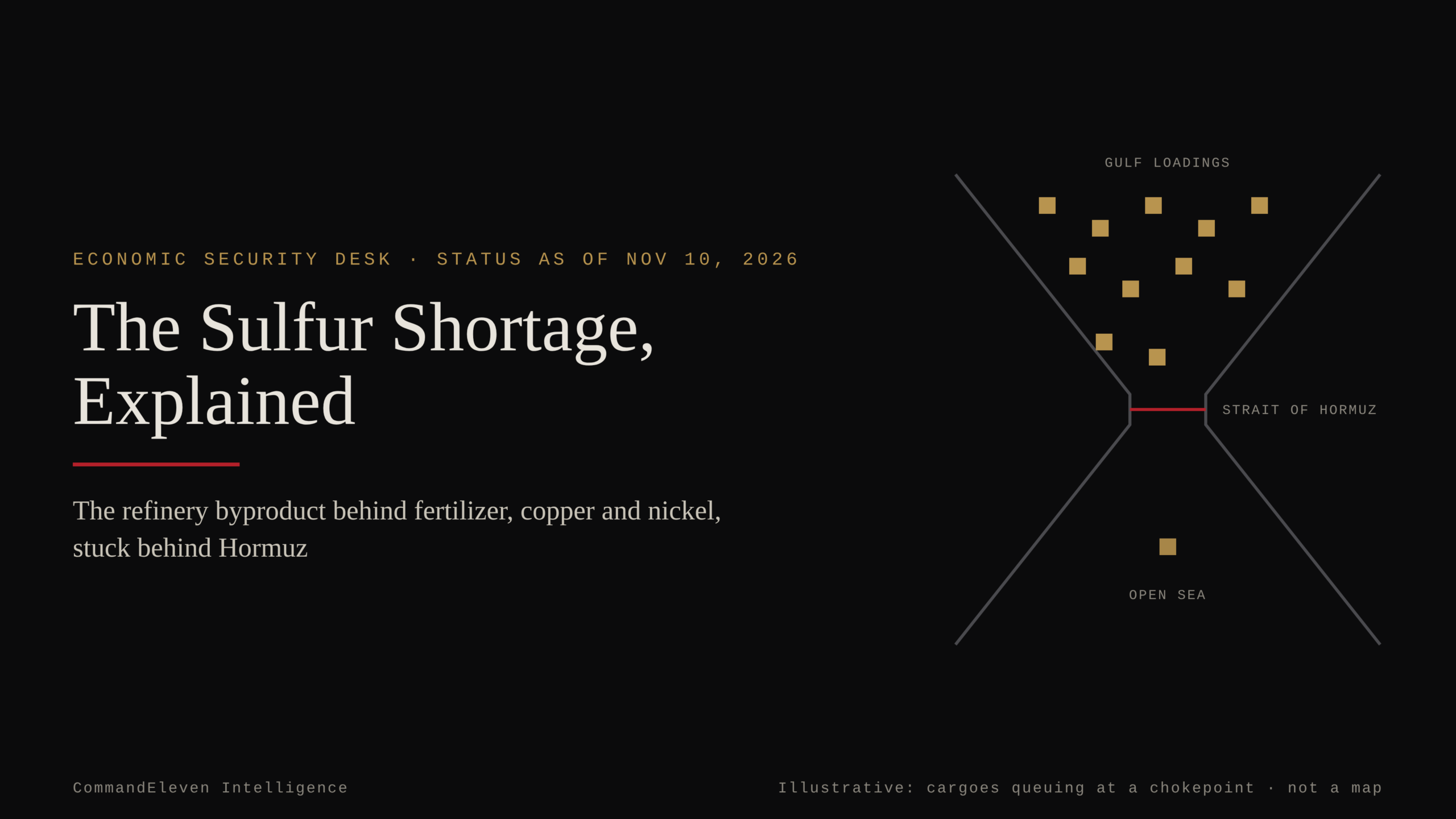
CommandEleven Intelligence Desk · Economic Security Desk, status as of November 10, 2026
Bottom Line Up Front
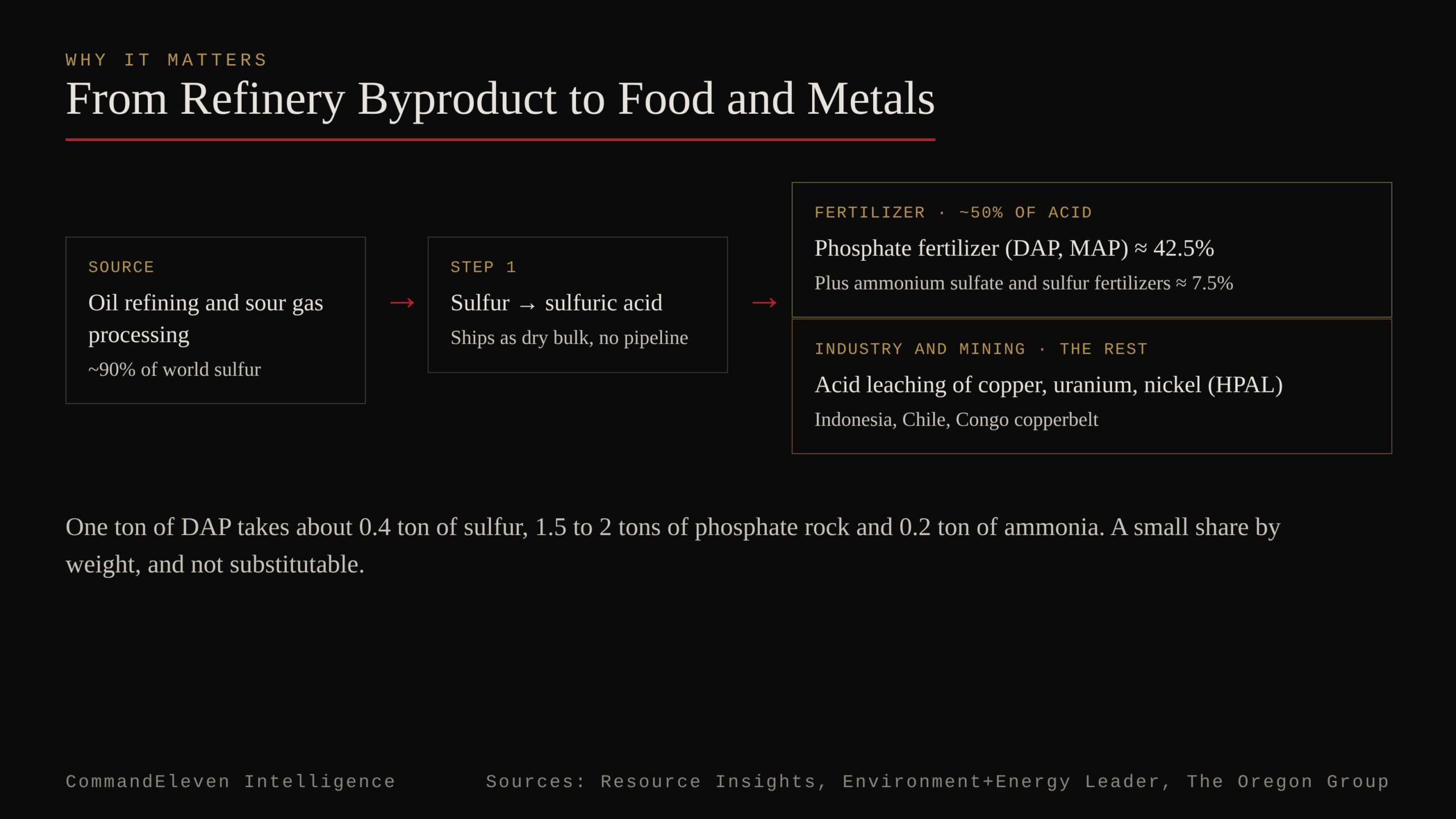
Sulfur is a byproduct of refining oil and processing sour gas, and it is the raw material for sulfuric acid. Sulfuric acid is what turns phosphate rock into phosphate fertilizer, and it is what mines use to leach copper, uranium and nickel from ore. When the Iran war closed the Strait of Hormuz and shut Gulf plants, sulfur exports fell by a third in the first half of 2026. Prices are still about 60% above pre-war levels, and the shock has already idled phosphate plants in Louisiana and squeezed mines in Indonesia, Chile and Congo. Oil found workarounds. Sulfur has no pipeline, so it did not.
Key Judgments
- CONFIRMED: Global elemental sulfur exports fell 33% in the first half of 2026, from 13.5 million to 9 million tonnes, with Gulf suppliers accounting for almost three-quarters of the drop (IFPRI, as cited by The Oregon Group).
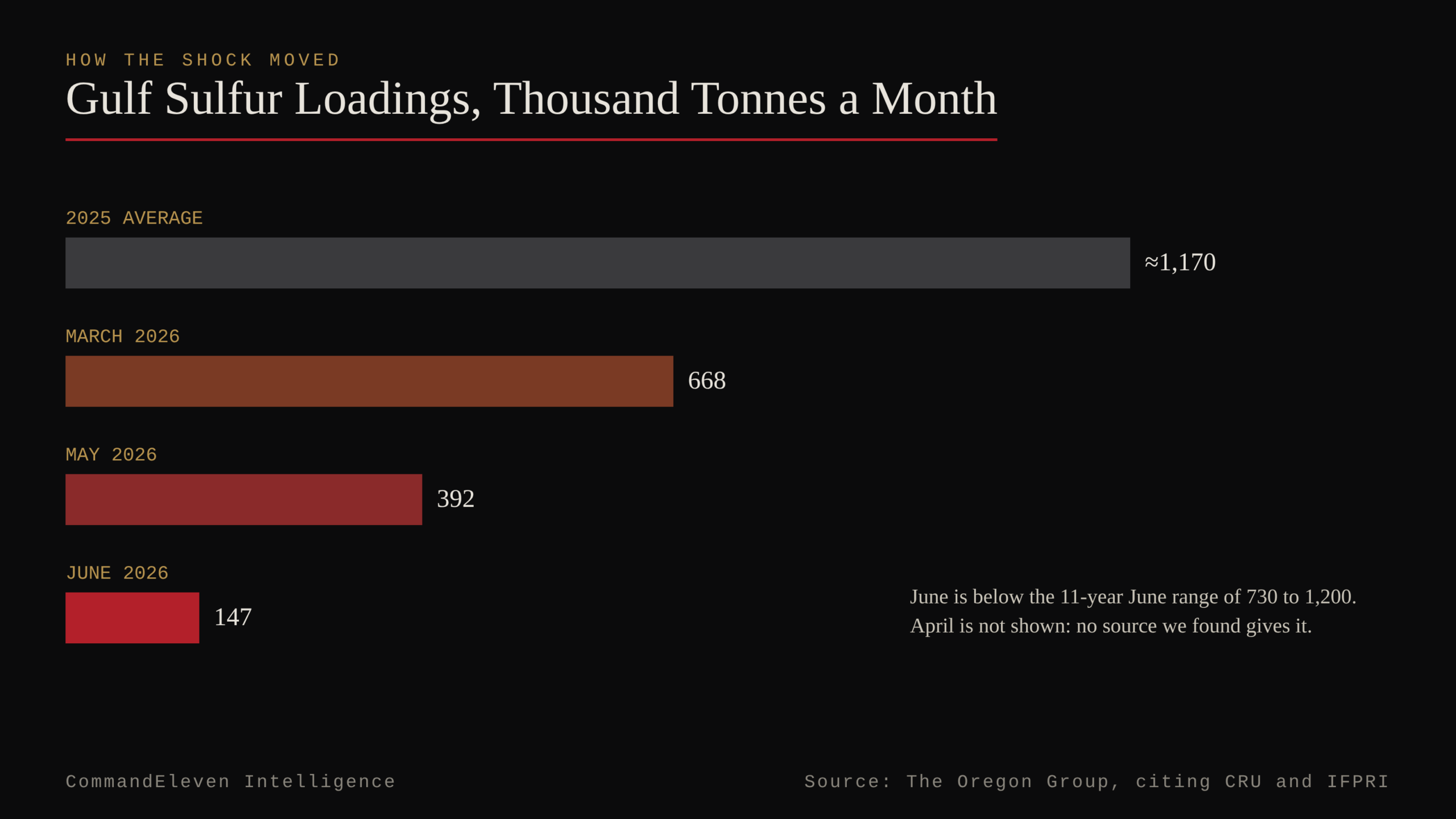
- CONFIRMED: Gulf sulfur loadings fell from about 1.17 million tonnes a month in 2025 to 392,000 in May and 147,000 in June 2026.
- CONFIRMED: Mosaic, a leading phosphate producer, completely idled its Faustina, Louisiana plant and ran its Bartow, Florida plant at about 40% of its target rate.
- REPORTED: Mosaic estimates global phosphate production could fall by as much as 30 million tonnes below last year if constraints persist.
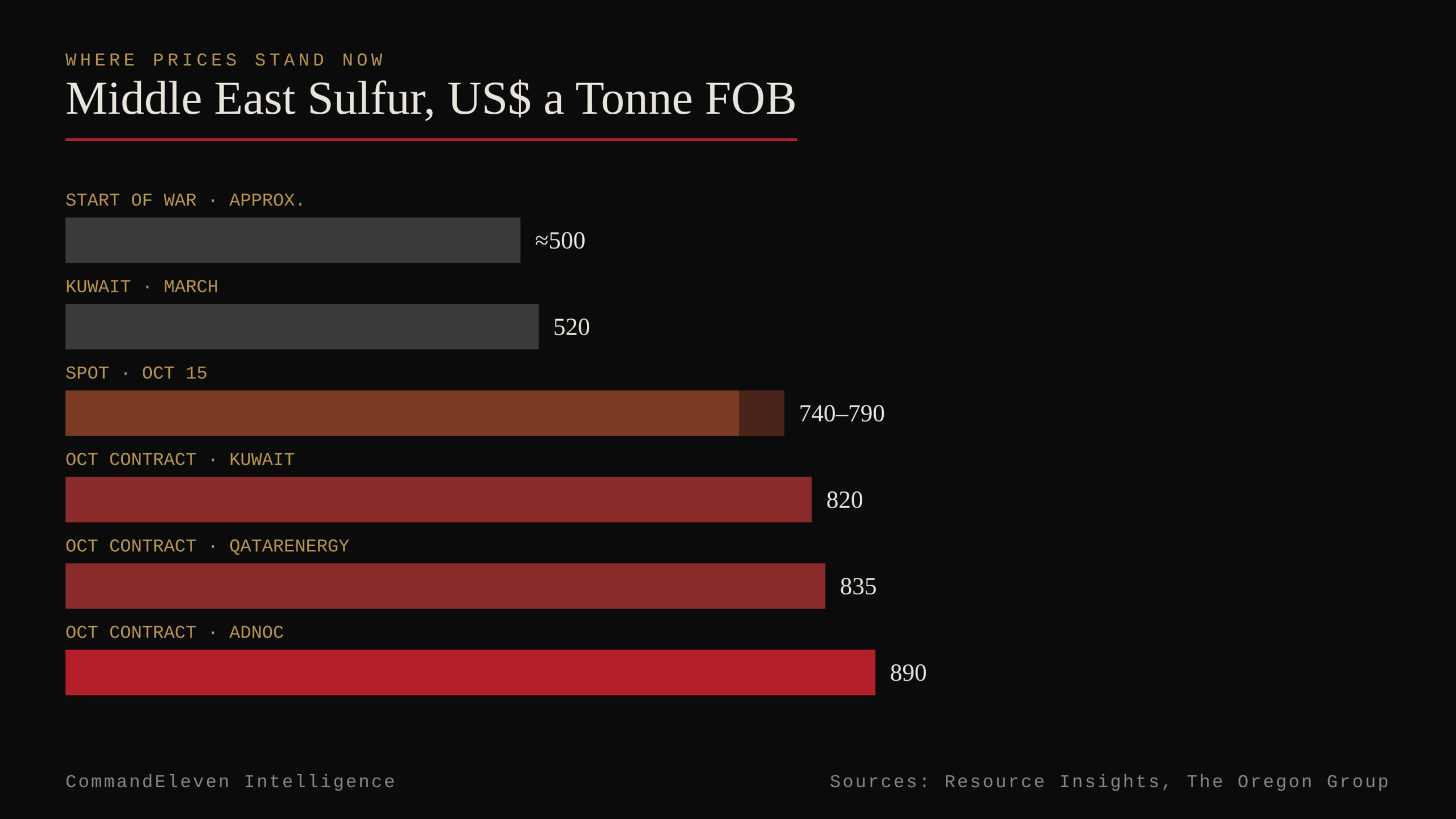
- CONFIRMED: Middle East sulfur was about $500 a tonne at the start of the war and October contract prices ran $820 to $890 FOB, down $45 to $70 from the prior month.
- ASSESSED: The food effect runs through affordability: phosphate producers cannot pass on acid costs, and farmers already facing costly diesel and nitrogen apply less. No source we found quantifies the yield loss.
- ASSESSED: Metals are the second front. Acid-dependent copper, uranium and nickel operations are exposed, and Indonesia’s nickel plants source 76% of their sulfur imports from the Middle East.
- ASSESSED: The next hinge is December 31, when several export curbs expire, including Russia’s sulfur and acid restrictions and China’s sulfuric acid export suspension.
Sourcing and Analytical Confidence
This is an explainer built on public trade, market and press reporting. Many figures come from CRU, IFPRI and Kpler through secondary write-ups, and we say so. Estimates of the Gulf’s share differ because they measure different things (see below). “(Unconfirmed)” is an inline hold tag only.
| Tier | Meaning |
|---|---|
| CONFIRMED | Stated by a primary data source or company, or documented in market data |
| REPORTED | Credible outlet or company estimate, not independently verified by us |
| ASSESSED | Our judgment from the confirmed and reported record |
| SPECULATIVE | Plausible but thinly sourced; not relied on |
What Sulfur Is and Where It Comes From
About 90% of the world’s sulfur is recovered from oil and gas refining and sour gas processing. It is not mined for its own sake; it exists because fuel is produced. That is the first thing to understand about this shock: when Gulf refineries and gas plants stop, sulfur stops with them. QatarEnergy halted sulfur production on March 3, and ADNOC’s Shah plant was suspended after a drone attack on March 16. Russia’s supply was hit too: a Ukrainian strike on August 24 hit the Astrakhan gas plant, which CRU says accounts for over 60% of Russian sulfur output.
Most sulfur is converted to sulfuric acid, and about half of that acid goes to fertilizer, roughly 42.5% to phosphate fertilizer and 7.5% to ammonium sulfate and sulfur fertilizers. The rest goes to industry and mining.
How much of the world’s sulfur depends on Hormuz depends on how you count. One analyst puts the share of total world supply passing through the strait at 24% before the war. Our earlier Global Food Security series, citing trade data, put the Gulf at 40% to 45% of global sulfur exports. Another account says roughly half of seaborne sulfur exports were trapped after February 28. These are different denominators, not contradictions: total supply, exports, and seaborne exports.
Why It Matters: Food and Metals
Food. One ton of DAP, a core phosphate fertilizer, takes roughly 1.5 to 2 tons of phosphate rock, 0.4 ton of sulfur and 0.2 ton of ammonia (University of Illinois economists). Sulfur is a small share by weight and an indispensable one. Tampa molten sulfur for the third quarter settled at a record $705 a long ton, and U.S. Gulf spot export prices reached $1,100 to $1,150 a tonne in July. By the third week of August, DTN retail prices were $916 a ton for DAP and $959 for MAP, up 8% and 6% on the year. Fertilizer prices overall rose 25% to 30% after the strait closed.
That price pressure lands on farmers who already face expensive diesel and nitrogen fertilizer, and who cannot easily absorb more. Mosaic’s idled and slowed plants show where it bites first. We do not claim a specific yield loss; no source we found gives one. The mechanism is that less applied phosphate means lower yields over one to two seasons, and the planting calendar matters, which is why this ties into the El Niño and diesel drivers in our Global Food Security series.
Metals. Miners use sulfuric acid to leach copper and uranium from ore, and nickel producers using high-pressure acid leach (HPAL) depend on it. Indonesia sourced 76% of its sulfur imports from the Middle East last year, and its HPAL plants are reportedly losing money. Chile lost 541,000 tonnes of Chinese sulfuric acid in the first half, and the Central African copperbelt imports about 2 million tonnes a year of Middle East sulfur. Ivanhoe’s average net realized acid price in Congo roughly doubled quarter on quarter to about $900 a tonne in the third quarter.
How the Shock Moved
Gulf sulfur loadings averaged about 1.17 million tonnes a month in 2025. They fell to 668,000 tonnes in March, 392,000 in May and 147,000 in June, against an 11-year June range of 730,000 to 1.2 million tonnes. CRU estimated Middle East production losses at about 2.3 million tonnes by early July, with output at roughly 60% to 70% of pre-conflict levels. As of early September, CRU reported 600,000 tonnes on 13 vessels waiting to transit Hormuz.
Oil adapted; sulfur could not. Saudi Arabia’s East-West pipeline carries crude to the Red Sea, and Kpler data put Hormuz oil clearance at about 82% of the pre-war baseline. Sulfur moves as dry bulk on a limited pool of ships, often with tracking switched off. Two sulfur carriers crossed on October 17 to 19, despite as many as 12 incidents against shipping the week before. Freight for a 30,000 to 50,000 tonne cargo is estimated at the $140s to $200 a tonne because of the risk.
Other countries tried to fill the gap. Kazakhstan lifted its sulfur export ban on August 4, and buyers that normally use Middle East sulfur competed for U.S. Gulf Coast supply, which is why Mosaic, which sources about 80% of its U.S. sulfur from Gulf Coast refineries, felt the squeeze. China halted standard-grade sulfuric acid exports in May, which helped Chinese buyers and hurt Chile.
Where Prices Stand Now
Prices have eased from the summer peak but remain high. Middle East spot sulfur was $740 to $790 FOB on October 15, down from $810 to $850 a week earlier. October contract prices were QatarEnergy $835, Kuwait $820 and ADNOC $890 a tonne, each cut by $45 to $70. Kuwait’s March price was $520. China’s sulfur price fell 21% in a month but was 108% higher than a year earlier. CRU forecasts acid delivered to Chile falling to $215 a tonne by the fourth quarter of 2027 from a record $451 earlier this year. We read that as easing, not a return to normal.
What To Watch
- Monthly Gulf sulfur loadings and the number of cargoes crossing Hormuz.
- December 31 expiries: Russia’s sulfur and acid export restrictions and China’s sulfuric acid export suspension.
- Whether Mosaic restarts Faustina and lifts Bartow output.
- November and December contract prices from QatarEnergy, Kuwait and ADNOC.
- Shipping incidents in and around the strait.
What Would Change Our Assessment
- A sustained rise in Gulf loadings toward 1 million tonnes a month, which would point to a real recovery.
- Contract prices falling below $600 a tonne, which would suggest the supply shock has largely unwound.
- Independent data showing no measurable fall in phosphate application or yields this season.
- New outages at Gulf or Russian plants, which would reverse the easing.
Calls We Will Score
- By December 31, 2026: Gulf elemental sulfur loadings will not return to the 2025 monthly average of about 1.17 million tonnes in any month.
- By December 31, 2026: QatarEnergy’s monthly sulfur contract price will not fall below $600 a tonne FOB.
- By January 15, 2027: China will not have fully lifted its sulfuric acid export suspension; it will be extended or replaced by a licensing or quota regime.
We score each call on its due date and publish the result, hit or miss, on the Foresight Record.
What This Assessment Does and Doesn’t Establish
- Does establish: that sulfur supply fell sharply, that prices remain well above pre-war levels, and that the shock reaches phosphate fertilizer and acid-dependent mining.
- Does not establish: a quantified yield loss, a specific global food price effect, or how long the disruption will last. Many figures are secondary citations of CRU, IFPRI and Kpler data, and estimates of the Gulf’s share differ by definition.
Frequently Asked Questions
What is sulfur used for?
Mostly to make sulfuric acid. About half of that acid goes to fertilizer and the rest to industry and mining, including leaching copper, uranium and nickel from ore.
Why does Hormuz matter for sulfur?
Gulf refineries and gas plants are major sulfur producers, and sulfur moves by ship. With the strait disrupted and Gulf plants shut or damaged, exports fell about a third in the first half of 2026.
Why is there no workaround like there is for oil?
Oil can move through pipelines and ship-to-ship transfers. Sulfur ships as dry bulk through a limited pool of vessels, and it is a byproduct, so its output stops when plants stop.
How does a sulfur shortage affect food?
Sulfur becomes sulfuric acid, which processes phosphate rock into phosphate fertilizer. Higher costs squeeze producers and farmers, who may apply less, which can lower yields.
Are sulfur prices still rising?
Not at the moment. They have eased from the summer peak, with Middle East spot sulfur at $740 to $790 on October 15, but remain well above pre-war levels.
Related CommandEleven Intelligence Reading
- The Global Food Security Crisis
- Global Food Security: The Indian Subcontinent
- Global Food Security: The Middle East and Arab World
- Food Chain Reaction Revisited
- Qeshm, the Qataris and the Post-Midterm Window
- Iran War Update: Confirmed vs. Hype
Sources
- Kurt Cobb, “What Rising Sulfur Prices Signal About the Emerging Food Crisis,” Resource Insights, via Resilience, November 3, 2026
- The Oregon Group, “Oil Is Getting Out of Hormuz, but Gulf Sulphur Is Not” (citing CRU, IFPRI and Kpler)
- Environment+Energy Leader, “Sulfur Shortage Is Forcing Phosphate Production Cuts” (citing Mosaic, DTN, University of Illinois)