
This is Part 8 of The Global Food Security Crisis, CommandEleven Intelligence’s region-by-region assessment of the 2026–27 food shock.
Bottom Line Up Front
The Indian subcontinent is home to about a quarter of humanity and a large share of the world’s hungry, and in 2026 it is being hit by every driver in this series. India’s monsoon ended about 13% below normal, its weakest since 2015, with 43% of districts deficient and the east and northeast recording their lowest rainfall since records began in 1901. In Pakistan, wheat flour is up 32.6% in a year and diesel 42.5%. Bangladesh imports three-quarters or more of its fertilizer, its state urea plants shut for lack of gas, and 1.22 million of its 1.65 million major irrigation pumps run on diesel, which now costs 35% more than before the war.
Two things stop this from becoming a famine story for most of the region: India’s large public grain stocks and Bangladesh’s above-average rice harvest. The risk is the winter. India’s rabi crops depend on reservoirs that are below normal in Punjab and the south, and FEWS NET expects Pakistan’s food stress to peak between January and March 2027. Afghanistan remains the region’s most acute crisis.
Key Judgments
KJ1: The rabi season is the region’s decisive test. Low reservoirs in India’s wheat and rabi-rice belts, and uncertain fertilizer supply, put the 2027 winter harvest at risk. [CONFIRMED on reservoirs; ASSESSED on harvest risk]
KJ2: Pakistan faces the sharpest consumer price shock. Annual inflation in the weekly price index is near 12%, led by flour, onions, electricity and fuel. [CONFIRMED]
KJ3: Bangladesh’s vulnerability is fuel and fertilizer, not rice stocks. Its granaries are above the safe level, but diesel-run irrigation and imported urea drive the next harvest. [CONFIRMED]
KJ4: India’s export policy is a global variable. A weak kharif and rabi could bring back rice and wheat export curbs, which would hit West Africa and other importers. [ASSESSED]
KJ5: Afghanistan’s crisis is driven by aid cuts and returnees as much as weather. Forecast rains may help the 2027 season, but 2.4 million people expelled from Iran and Pakistan and falling aid keep needs high. [CONFIRMED]
Scorecard
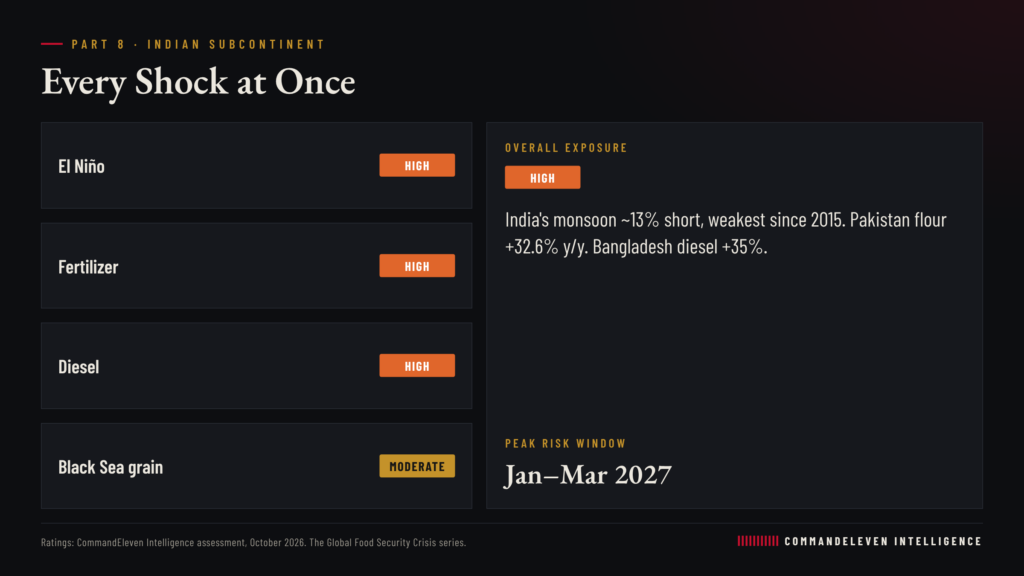
| Driver | Exposure | Why |
|---|---|---|
| El Niño | High | India’s weakest monsoon since 2015; below-average rain in Sindh, Balochistan and southern Punjab |
| Fertilizer | High | Heavy reliance on Gulf urea and LNG; Bangladesh plants shut; India’s emergency tenders |
| Diesel | High | Diesel irrigation pumps; Pakistan diesel up 42.5% in a year; Sri Lanka’s four-day week |
| Black Sea grain | Moderate | Pakistan and Bangladesh import wheat; India largely self-sufficient |
| Overall | High | Severe in Afghanistan |
The Four Drivers
El Niño. India’s southwest monsoon delivered 759.4 mm against a long-period average of about 868.6 mm, the second-lowest since 2001 and the fourth-worst since 1901. The south was 24% short and the east and northeast 26%. Of 741 districts assessed, 316 were deficient or largely deficient. Crisil expects field-crop yields to fall 5% to 6% and paddy yields 4% to 5%; Karnataka, Maharashtra, Andhra Pradesh, Telangana and Rajasthan are worst affected. In Pakistan, June-to-September rainfall was well below average across much of Sindh, Balochistan, southern Punjab and parts of Khyber Pakhtunkhwa. Sri Lanka’s dry zone and parts of Nepal also saw shortfalls. [CONFIRMED]
Fertilizer. South Asia depends heavily on Gulf urea and on imported gas to make its own. IFPRI warned in July that India’s winter-season fertilizer availability was uncertain, and India launched emergency tenders. In Bangladesh, which imports 75% to 80% of its fertilizer, an estimated 25% to 33% of imports pass through Hormuz, and gas shortages shut most major state urea plants at the same time in March. In Pakistan, farmer groups report a 50 kg bag of DAP at about Rs17,500. [CONFIRMED]
Diesel. In Bangladesh, diesel rose from Tk100 a liter in February to Tk135 from September 21, and most irrigation pumps run on it. Pakistan’s diesel is up 42.5% year on year, electricity 58.6% and LPG 68.6%. India cut fuel excise by ₹10 a liter in March and raised export duties on diesel; about 60% of its LPG is imported, and shortages forced some households back to kerosene, coal and wood. Sri Lanka introduced a four-day working week. [CONFIRMED]
The Black Sea. India is largely self-sufficient in wheat, but Pakistan and Bangladesh import it. Bangladesh has also denounced the trade deal under which it agreed to favor US wheat and is seeking to renegotiate. [CONFIRMED]
Country by Country
India. Kharif sowing is only about 1% below last year, but yields will be lower. The bigger worry is rabi: the five southern states, which grow about 98% of rabi rice, received only 76% of normal rain and have much lower reservoir storage, and Punjab (59% of normal storage) and Rajasthan (78%) together grow about 31% of India’s wheat. The Reserve Bank of India has flagged both the monsoon deficit and El Niño as risks to food inflation. [CONFIRMED]
Pakistan. The Pakistan Bureau of Statistics’ weekly index shows annual inflation of 11.97% in early October. Wheat flour is up 32.6% in a year, with a 20 kg bag reaching Rs3,400 in Karachi, Islamabad and Peshawar; onions have doubled. Farmers say their returns on wheat have collapsed even as input costs soar, and have asked for relief on fertilizer, diesel and electricity. FEWS NET expects the most severe needs from January to March 2027, with the rabi wheat harvest partly offsetting losses. [CONFIRMED]
Bangladesh. Government granaries held 1.92 million tonnes in April, above the 1.35 million-tonne safe level, and FAO forecasts a 2026 paddy crop about 5% above the four-year average. But acute food insecurity is projected to rise from 15.3 million people to 18.1 million between September and December, including about 787,000 in emergency conditions, and 62% of households spend at least half their income on food. [CONFIRMED]
Afghanistan. About 17.4 million people, 36% of the population, were projected to be in crisis or worse through March 2026, including 4.7 million in emergency. About 2.4 million undocumented returnees from Iran and Pakistan are expected in 2026, and humanitarian coverage fell from 34% to 24% of households between 2024 and 2025. FEWS NET’s forecast of above-average precipitation is the region’s rare piece of good news for 2027. Tension and periodic closures along the Pakistan-Afghanistan border add a further risk to food trade. [CONFIRMED on figures; ASSESSED on border risk]
Sri Lanka and Nepal. Sri Lanka’s national rainfall was average, with localized dry-zone stress; its fuel shock has been the bigger problem. Nepal’s losses come mainly from floods and landslides. [CONFIRMED]
How Governments Are Responding
- India: fuel excise cuts, diesel export duties, emergency fertilizer tenders and drought assessment teams sent to Maharashtra and Karnataka.
- Bangladesh: fertilizer prices held flat with VAT and advance tax waived on imports, and $1.1 billion in World Bank financing for fertilizer, fuel and food security, even as the new budget cuts subsidies by 5.78%.
- Pakistan: farmers’ demands for input subsidies remain largely unmet under tight fiscal limits. [ASSESSED]
- Sri Lanka: a four-day working week to save fuel.
Flashpoints
- Flour in Pakistan. Flour shortages and price spikes have triggered queues and unrest before. A further jump this winter would land on households already paying far more for electricity and fuel. [ASSESSED]
- Bangladesh. Analysts have warned of possible unrest as fuel shortages forced early closures of shops and universities. [CONFIRMED]
- Indian export policy. Any new rice or wheat export restrictions ahead of state elections would send prices up from West Africa to the Gulf. [ASSESSED]
- Afghan returnees. Mass returns into drought-hit provinces with shrinking aid. [CONFIRMED]
The 12-Month Outlook
CommandEleven Intelligence expects food inflation to rise across the region through the winter, with Pakistan facing the sharpest consumer squeeze and India’s food prices led by pulses and oilseeds. The 2027 rabi harvest, which depends on reservoir water and fertilizer availability over the next three months, will decide whether the region’s stress eases in the spring or carries into a second year. [ASSESSED]
Indicators to watch:
- Rabi sowing area and urea availability in India and Pakistan, November to January.
- Pakistan’s weekly flour prices.
- Any Indian change to rice or wheat export policy.
- Bangladesh diesel prices during the Boro irrigation season.
Frequently Asked Questions
How bad was India’s 2026 monsoon?
It ended about 13% below normal, the weakest since 2015, with 43% of districts deficient and the east and northeast recording their lowest rainfall since 1901.
Why are flour prices rising in Pakistan?
Weak wheat returns for farmers, higher fertilizer, fuel and electricity costs, and below-average rain in key growing areas have combined. Flour was up 32.6% year on year in early October 2026.
Sources
- Monsoon deficit threatens crop output, adds to food inflation risks, Business Standard, October 6, 2026
- Weekly inflation rises 0.57pc, 20kg flour bag jumps by Rs400, Daily Pakistan, October 9, 2026
- Pakistan farmers seek budget relief as Iran conflict drives up fertilizer, fuel costs, Arab News, June 11, 2026
- Is Bangladesh prepared for the next food shock?, The Daily Star, October 4, 2026
- Humanitarian Needs and Response Plan Afghanistan 2026: Food Security and Agriculture, UN OCHA
- 2026–2027 El Niño food security impacts, FEWS NET, October 6, 2026
- Iran war: From fertilizer to food crisis?, IFPRI, July 2, 2026
- 2026 Iran war fuel crisis, Wikipedia (compilation of national measures)
The Global Food Security Series
Start with the United States baseline: Food Chain Reaction Revisited and The 12-Month Fuse.
- Global Food Security: North America – Part 1
- Global Food Security: Central America and the Caribbean – Part 2
- Global Food Security: South America – Part 3
- Global Food Security: Europe – Part 4
- Global Food Security: The Middle East and Arab World – Part 5
- Global Food Security: Africa – Part 6
- Global Food Security: East and Southeast Asia – Part 7
- Global Food Security: The Indian Subcontinent – Part 8 (you are here)
- Global Food Security: Australia and the Pacific – Part 9

