
This is Part 6 of The Global Food Security Crisis, CommandEleven Intelligence’s region-by-region assessment of the 2026–27 food shock.
Bottom Line Up Front
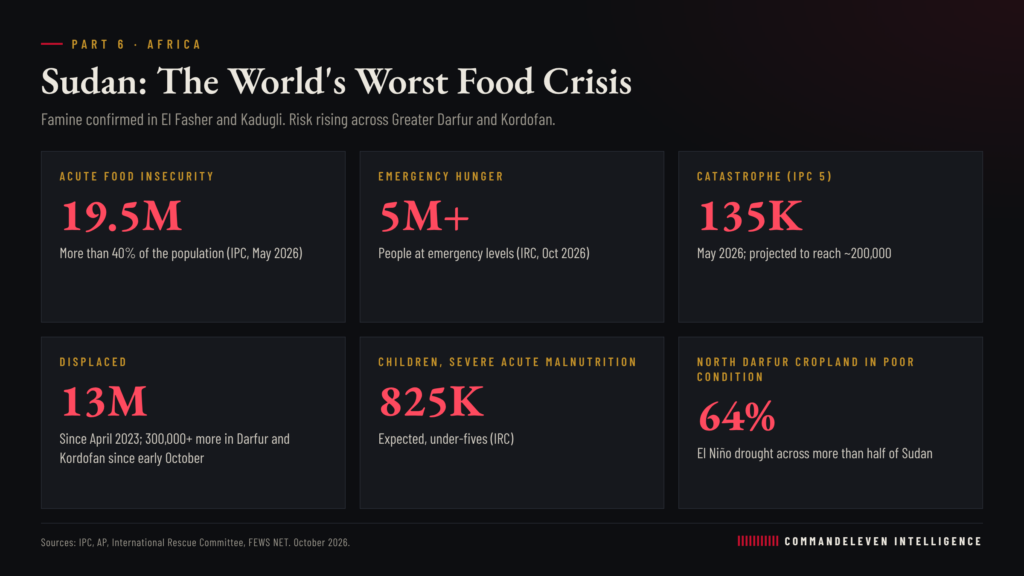
Africa is the only region in this series exposed to all four drivers at a high level, and it holds the world’s worst food crisis. In Sudan, three and a half years of war have displaced about 13 million people. About 19.5 million, more than 40% of the population, faced high levels of acute food insecurity in May, and famine has already been confirmed in El Fasher and Kadugli. Now El Niño has brought one of the worst droughts in decades to more than half the country, and harvests are expected to be near record-poor.
Sudan is not alone. Four of the six countries the UN rates as “highest concern” for hunger are African: Sudan, South Sudan, Nigeria and Somalia, a belt that stretches from the Sahel to the Horn. About 30% of Africa’s fertilizer imports come from or through the Gulf, transport makes up 30% to 50% of food prices in many markets, and poor households spend half or more of their income on food. FEWS NET expects the worst El Niño impacts in East and West Africa between March and September 2027, and in Southern Africa between late 2027 and early 2028.
Key Judgments
KJ1: Sudan is heading into a second famine year. War, El Niño drought and depleted food stocks are combining in Darfur and Kordofan, and the IPC warns that without a rapid increase in aid, hunger, malnutrition and deaths will rise. [CONFIRMED]
KJ2: El Niño will hit Africa in three waves. Floods in the eastern Horn now, drought-driven hunger in the Sahel and the unimodal east in mid-2027, and drought in Southern Africa into early 2028. [CONFIRMED on FEWS NET forecasts]
KJ3: Fuel is Africa’s fastest-moving shock. East Africa imported about 530,000 barrels a day from the Middle East before the war; Ethiopia’s diesel supply was halved, and Kenya, which sources all its oil from the region, saw record price rises. [CONFIRMED]
KJ4: Conflict, not weather, is the decisive variable. Where conflict eases, as the IPC has found in parts of Sudan, hunger eases with it. [CONFIRMED]
KJ5: The money is not there. Global funding for food assistance, emergency agriculture and nutrition fell an estimated 59% between 2022 and 2025. [CONFIRMED]
Scorecard
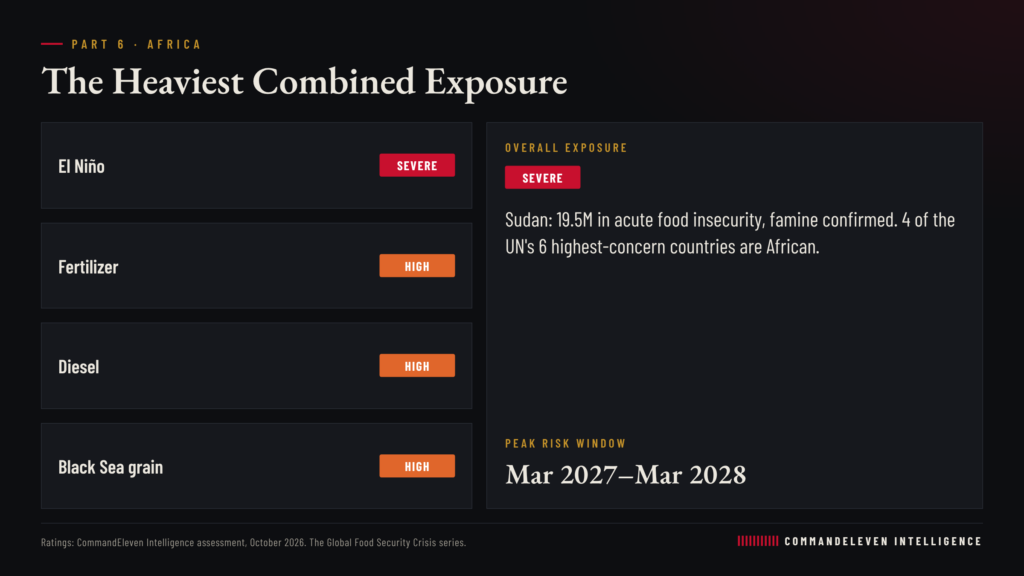
| Driver | Exposure | Why |
|---|---|---|
| El Niño | Severe | Drought in Sudan, South Sudan and the Sahel; floods in Somalia and Kenya; drought ahead in Southern Africa |
| Fertilizer | High | About 30% of imports from or through the Gulf; a third of East Africa’s supply |
| Diesel | High | Heavy reliance on Middle East fuel; transport is 30% to 50% of food prices |
| Black Sea grain | High | North and East Africa rely heavily on Russian and Ukrainian wheat |
| Overall | Severe | The world’s highest concentration of famine risk |
Sudan: The World’s Worst Food Crisis
The war between the Sudanese Armed Forces and the Rapid Support Forces began in April 2023. It has killed at least 150,000 people according to ACLED, a figure aid groups believe understates the toll, and displaced about 13 million. It is sustained by outside backers and by the economic value of what the fighting controls. [CONFIRMED on figures; ASSESSED on drivers]
The latest IPC update, reported on October 12, describes a deteriorating situation in Greater Darfur and Kordofan:
- Drought: a severe El Niño-linked drought affects more than half of Sudan. Crop growth is poor on 64% of North Darfur’s cropland and about half of South Darfur’s and the Kordofans’. West Kordofan is in one of its worst droughts since 2004. Northern Sudan received 45% of normal rainfall or less.
- Malnutrition: acute malnutrition among children in two South Darfur displacement camps is above the famine threshold. In Nyala, the share of children admitted with severe acute malnutrition more than doubled between January and August. The IRC estimates 825,000 children under five will suffer severe acute malnutrition.
- Scale: more than 5 million people face emergency levels of hunger. The number in catastrophe (IPC Phase 5) was 135,000 in May and was projected to rise to about 200,000.
- Displacement: more than 300,000 people have been displaced in Darfur and Kordofan since early October; the town of Tawila already hosts more than 650,000.
FEWS NET expects Sudan’s needs to peak again between June and September 2027, centered on North Darfur and Greater Kordofan and spreading to northern and East Darfur. CommandEleven Intelligence assesses that famine conditions will spread beyond the towns where they are already confirmed unless humanitarian access improves. [CONFIRMED on forecasts; ASSESSED on spread]
The Four Drivers
El Niño. FEWS NET rates the concern “high” for Southern Africa and the unimodal east, “moderate to high” for the bimodal east and “moderate” for West Africa:
- The unimodal east (Sudan, South Sudan, Ethiopia, northern Uganda): June-to-September rains were far below average. South Sudan and Uganda’s Karamoja are having their driest year on record. Needs peak from March to September 2027.
- The bimodal east (Somalia, Kenya, southern Ethiopia): the opposite problem. Rains of 150% of average or more are forecast, with flood risk highest along Somalia’s Shabelle and Juba rivers. FEWS NET flags a risk of famine in southern Somalia if flooding matches 1997–98, though that is not its most likely scenario.
- West Africa and the Sahel: uneven rains, more than 40% below average in places. Needs peak from March to September 2027 in Burkina Faso, Chad, Mali and Niger, where conflict is the main driver.
- Southern Africa: a good 2026 harvest of 43.4 million tonnes, nearly 10% above average, provides a buffer. But drier-than-average planting rains are forecast for Zimbabwe, Mozambique, Malawi, Zambia, Angola, Madagascar and Lesotho, with needs peaking from November 2027 to March 2028.
Fertilizer. About 30% of Africa’s fertilizer imports come from or pass through the Gulf; Iran alone supplies about 7%. In East Africa the share is about a third. The disruption hit during the March-to-May planting season. [CONFIRMED]
Diesel. Ethiopia’s daily diesel supply was halved from 9.2 million to 4.5 million liters and fuel to Tigray was suspended. Kenya, which sources all its oil from the Middle East, saw record price increases and minibus fares up about 25%. South Sudan, which gets 96% of its power from oil, is rationing electricity in Juba. Rerouted shipping adds 10 to 15 days and 20% to 40% to freight costs. [CONFIRMED]
The Black Sea. Many North and East African countries have relied on Russian and Ukrainian wheat. With Black Sea exports cut to a fraction of normal, they must compete for more expensive wheat from elsewhere, and West Africa’s dependence on imported rice from India and Thailand exposes it to Asia’s El Niño losses too. [ASSESSED]
Import Dependence
Africa imported about $100 billion of oil in 2024 and depends on imports for much of its wheat, rice, vegetable oil and fertilizer. Its vulnerability is magnified by household budgets: poorer families spend 50% to 60% of income on food, so every price increase cuts directly into consumption. [CONFIRMED]
How Governments Are Responding
- Fuel measures: Namibia halved fuel levies; Zimbabwe raised ethanol blending from 5% to 20%; Mauritius restricted use when stocks fell to 21 days.
- Refining: Nigeria’s Dangote refinery increased output, though benefits for consumers will take time.
- Humanitarian response: appeals far exceed funding. In Sudan, access to the worst-hit areas remains the main constraint.
Southern Africa has the rare advantage of time: a good 2026 harvest and a year’s warning. Whether governments use it to build stocks and pre-position seed is the region’s key test. [ASSESSED]
Flashpoints
- Darfur and Kordofan: famine, displacement and fighting in the same places. [CONFIRMED]
- South Sudan: 7.8 million people, 55% of the population, in crisis or worse, with about 73,000 in catastrophe and its driest year on record. [CONFIRMED]
- Somalia: about 6 million in crisis or worse, facing floods on top of conflict. [CONFIRMED]
- Northeast Nigeria: about 34.8 million Nigerians in crisis or worse, including about 15,000 in catastrophe in Borno State, where hunger and insurgency feed each other. [CONFIRMED]
- The Sahel: in Mali, Burkina Faso and Niger, jihadist blockades of towns turn food into a weapon. See The Siege That Held: Mali Six Months After the April Offensive. [ASSESSED]
- Eastern DR Congo: conflict, displacement and a resurgence of Ebola. [CONFIRMED]
The 12-Month Outlook
CommandEleven Intelligence expects Africa’s food crisis to worsen steadily through 2027. Sudan and South Sudan are the most likely places for famine to be declared or extended. Somalia faces a flood-driven emergency this winter. The Sahel and the Horn will hit their lean-season peak in mid-2027, and Southern Africa’s turn comes at the end of 2027. With aid budgets down sharply, the gap between need and response is likely to be the widest of any region. [ASSESSED]
Indicators to watch:
- New IPC famine classifications in Sudan and South Sudan.
- River levels on the Shabelle and Juba in Somalia through December.
- Southern Africa’s planting rains in November and December.
- Humanitarian access agreements in Darfur and Kordofan.
Frequently Asked Questions
Is there a famine in Sudan?
Yes. Famine has been confirmed in El Fasher and Kadugli, and the IPC reports a growing risk of famine in other parts of Greater Darfur and Kordofan as war and El Niño drought combine.
How will El Niño affect Africa?
It brings drought to Sudan, South Sudan, Ethiopia and the Sahel, floods to Somalia and Kenya, and a forecast drought in Southern Africa for the 2026–27 season, with the worst hunger expected between early 2027 and early 2028.
Sources
- Sudan’s famine risk worsened by conflict, drought and funding shortages, report says, PBS NewsHour (AP), October 12, 2026
- War and El Niño-driven drought deplete food stocks, pushing Sudan further towards famine, International Rescue Committee, October 13, 2026
- Sudan: Famine confirmed in El Fasher and Kadugli towns, 20 other areas at risk of Famine, IPC
- 2026–2027 El Niño food security impacts, FEWS NET, October 6, 2026
- New FAO-WFP report warns worsening hunger puts 13 hotspots at significant risk, FAO, June 17, 2026
- El Niño drives crop failure in Central America and East Africa and threatens the next season in Southern Africa, European Commission Joint Research Centre, September 3, 2026
- Inflationary Pressure Builds Up as Hormuz Crisis Remains at Standstill, The Reporter (Ethiopia), April 18, 2026
- 2026 Iran war fuel crisis, Wikipedia (compilation of national measures)
The Global Food Security Series
Start with the United States baseline: Food Chain Reaction Revisited and The 12-Month Fuse.
- Global Food Security: North America – Part 1
- Global Food Security: Central America and the Caribbean – Part 2
- Global Food Security: South America – Part 3
- Global Food Security: Europe – Part 4
- Global Food Security: The Middle East and Arab World – Part 5
- Global Food Security: Africa – Part 6 (you are here)
- Global Food Security: East and Southeast Asia – Part 7
- Global Food Security: The Indian Subcontinent – Part 8
- Global Food Security: Australia and the Pacific – Part 9

