
Bottom Line Up Front (BLUF)
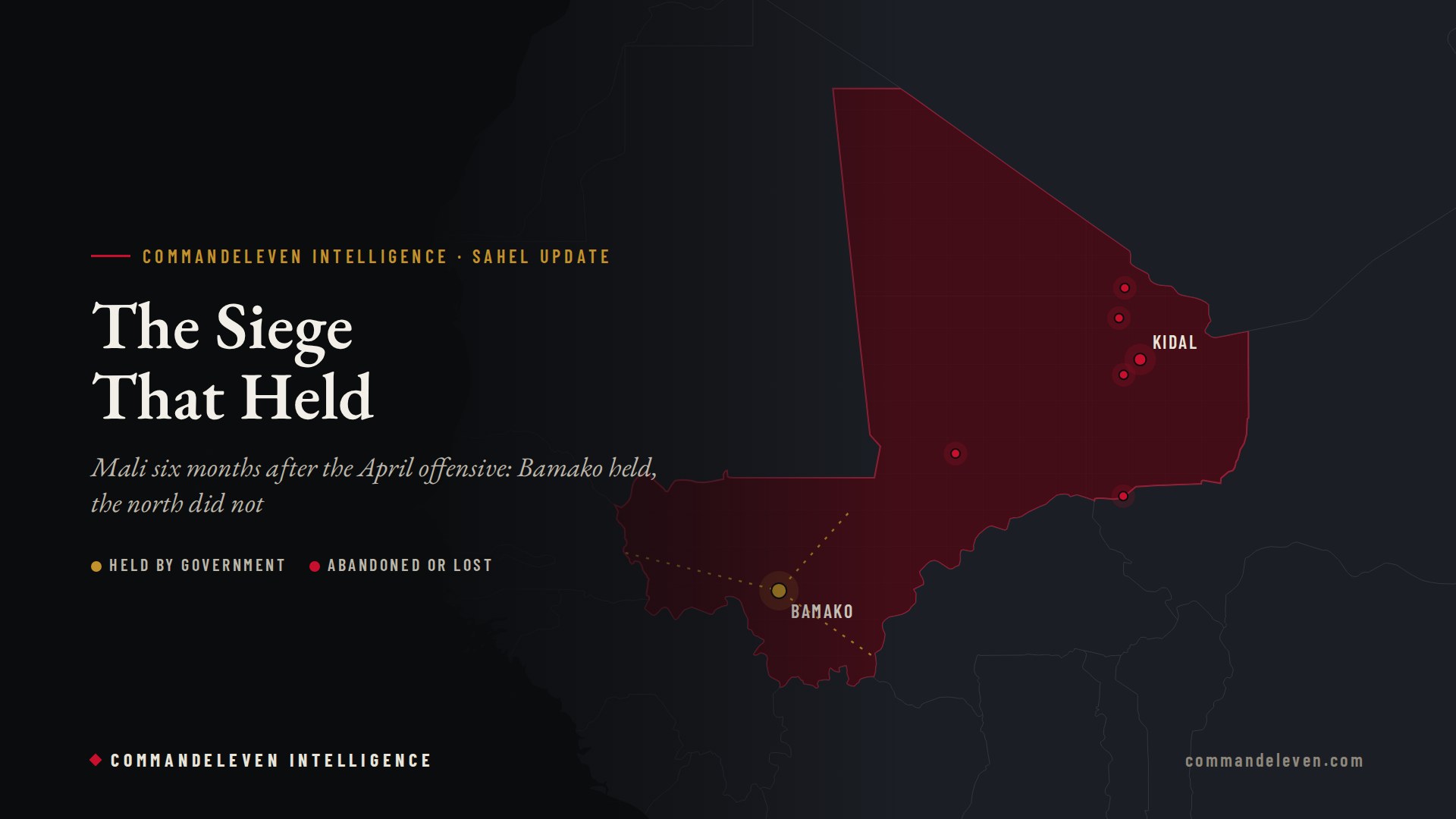
Six months after the coordinated JNIM and Azawad Liberation Front (FLA) offensive of April 25, 2026, Mali’s junta still holds Bamako, but it has lost most of the north and cannot keep the roads into its own capital open without armed escorts. The offensive killed Defense Minister Sadio Camara, drove Malian and Russian forces out of Kidal, Tessalit and a string of northern posts, and was followed by a JNIM blockade of the capital that has strained fuel, power and water without forcing a collapse. The state did not fall. It shrank. This dossier also corrects, on the record, CommandEleven Intelligence’s reporting from April 30 to May 2, which described Bamako as already seized.
Key Judgments
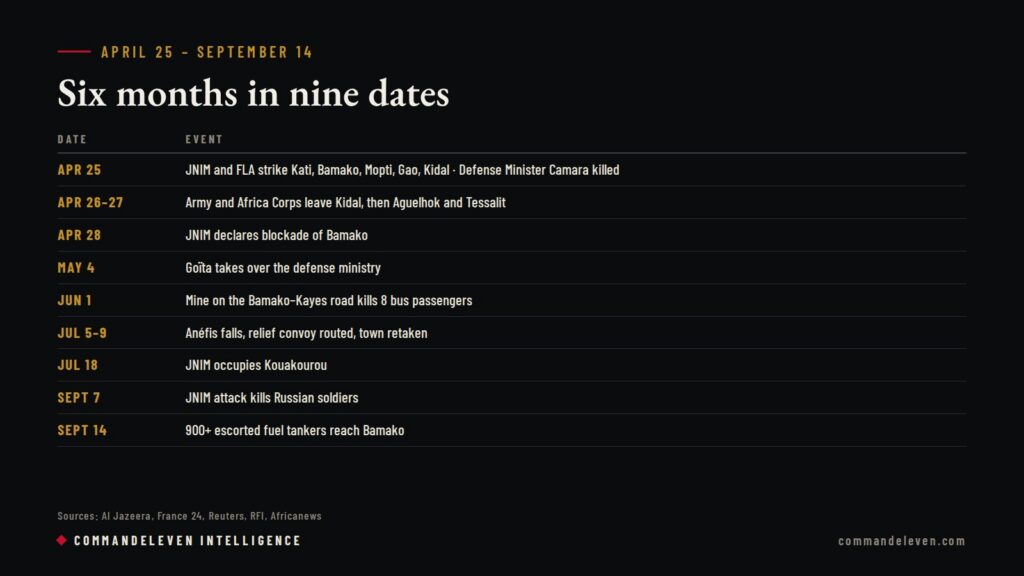
- [CONFIRMED] On April 25–26, 2026, JNIM and the FLA launched simultaneous attacks on Kati, Bamako, Kidal, Mopti, Sévaré and Gao. Defense Minister Sadio Camara was killed by a suicide car bomb at his residence in Kati.
- [CONFIRMED] Malian and Africa Corps forces withdrew from Kidal on April 26–27 and then from Aguelhok, Tessalit, Tessit and Ber, several under negotiated-passage arrangements. Kidal has been under FLA control since.
- [CONFIRMED] JNIM declared a blockade of Bamako on April 28. The capital has suffered fuel, power and water disruptions, but the government has kept control and broke the fuel squeeze with a convoy of more than 900 escorted tankers on September 14.
- [ASSESSED] JNIM’s strategy is to exhaust and isolate the junta rather than take the capital. It lacks the means and, so far, the intent to govern a city of several million, and a siege costs it far less than an assault.
- [ASSESSED] The junta has consolidated control in Bamako by narrowing its ambitions: holding the capital, the southern corridors and the economic core, while effectively ceding the far north. That trade-off is sustainable for months, not years, without a change in the Africa Corps commitment or a negotiated arrangement in the north.
On the Record: A Correction to Our April–May Reporting
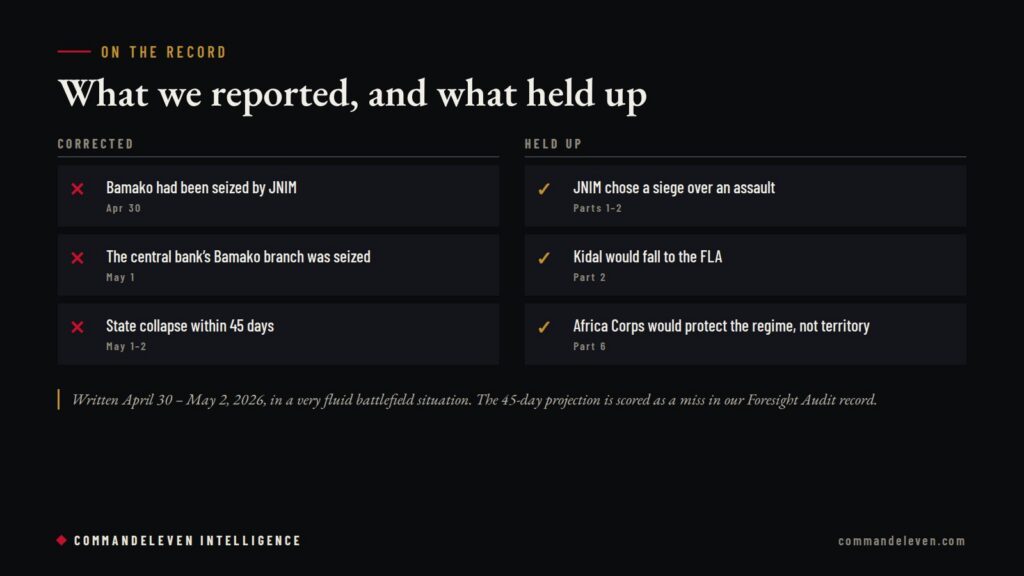
In the first days after the April 25 offensive, the battlefield picture in Mali was extremely fluid. Reports from Kati, Bamako, Mopti, Gao and Kidal arrived at the same time and often contradicted each other, the president’s whereabouts were unknown for three days, and JNIM declared a blockade of the capital on April 28. In that environment, CommandEleven Intelligence published three pieces in its Sahel Collapse series between April 30 and May 2, 2026.
What we reported:
- That JNIM and al-Qaeda in the Islamic Maghreb had carried out an “administrative seizure” of Bamako (Part 1, April 30).
- That the central bank’s (BCEAO) Bamako branch had been seized and that Malian gold and lithium had left legitimate markets (Part 2, May 1).
- That the Malian state would lose effective control of its territory within 45 days (Parts 2 and 3, May 1–2).
What subsequent reporting established:
- Bamako did not fall. The junta under Assimi Goïta has governed the capital throughout, and Goïta took over the defense ministry himself on May 4.
- No seizure of the BCEAO branch was reported, and we withdraw that claim and the related claims about mineral exports as unsupported.
- The 45-day window closed in mid-June without the collapse we projected. We score that projection as a miss in our Foresight Audit record.
What held up from the same series:
- The siege model itself: JNIM chose a blockade of the capital over a frontal assault, as Parts 1 and 2 described.
- The northern collapse: Part 2 anticipated the fall of Kidal to the FLA and the inability of the army to reinforce from the north. Both happened.
- The Africa Corps dynamic: Part 6 described a force focused on regime survival rather than territorial defense. Its withdrawals from the north in late April fit that description.
The three posts remain online with an editor’s note linking here, because a correction is only useful if the original record stays visible beside it.
Twenty-Four Hours That Reshaped Mali
Shortly before dawn on April 25, explosions and heavy gunfire were reported around Kati, the garrison town 15 kilometers from Bamako that houses the junta’s core military command. JNIM fighters drove a car bomb into Defense Minister Sadio Camara’s residence, killing him along with his second wife and two grandchildren. Within hours, fighting was reported near Bamako’s international airport and in Mopti, Sévaré, Gao and Kidal.
The attacks were coordinated across hundreds of kilometers. JNIM led in the center and the south; the FLA, a coalition of Tuareg separatist groups, led in the north. By the end of the first day the FLA said it held most of Kidal, and footage showed its fighters inside the governor’s residence. The army declared the situation “under control” by late morning, while sweeping operations continued for days in Kati.
Goïta did not appear publicly until April 28, when he visited the Russian ambassador and a hospital. The government confirmed Camara’s death on April 26 and declared national mourning.
[ASSESSED] The decapitation strike on Camara was the offensive’s most consequential act. He was the junta’s architect of the Russian partnership and its most capable military manager. Removing him in his own garrison town signaled that no one in the leadership was beyond reach, which is exactly the message a siege strategy needs to send.
The North Changes Hands
The most durable result of the offensive was in the north. On April 26 the FLA announced a deal under which Malian and Africa Corps troops would leave Kidal, where they had been holed up in the former UN base. Africa Corps confirmed the withdrawal the next day and pulled out of Aguelhok and Tessalit as well. Negotiated withdrawals followed at Tessit, Ber, Léré and the Intahaka gold mine. The base outside Tessalit fell to the FLA and JNIM on May 1, and the Islamic State’s Sahel branch occupied Labbezanga on the Niger border.
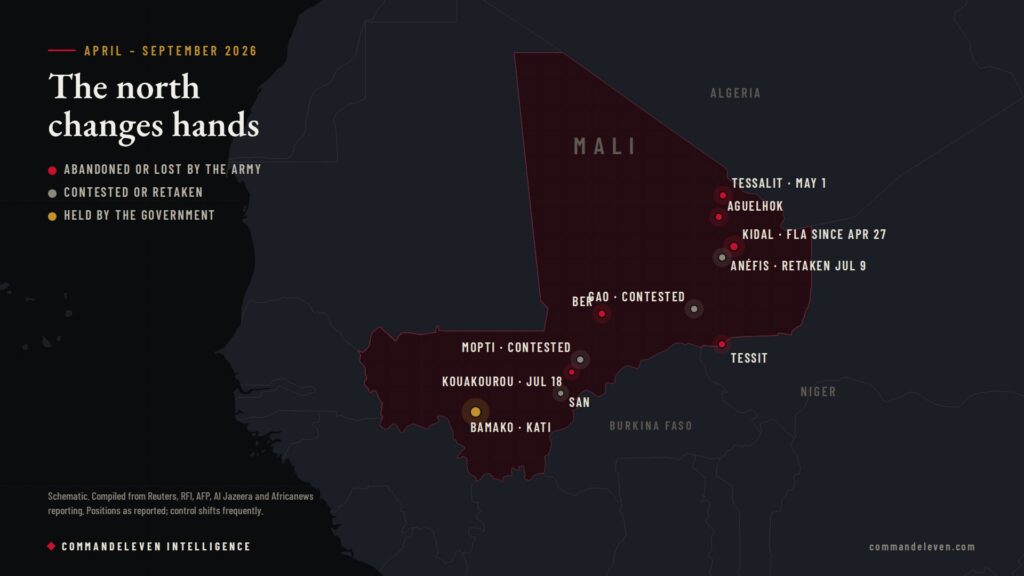
[CONFIRMED] Kidal has been under FLA control since April 27. The army began striking the city with drones and aircraft in late May.
[ASSESSED] The pattern of negotiated exits matters more than the territory itself. Russian and Malian commanders chose to save their forces rather than fight encircled, which preserved combat power for the capital but conceded the north to an armed separatist movement and to JNIM. The junta’s 2023 recapture of Kidal, its signature military achievement, has been reversed.
Fighting resumed in a second wave in early July. JNIM and the FLA took most of Anéfis on July 5 and routed an Africa Corps relief convoy near Tabrichat, shooting down a helicopter. The army retook Anéfis on July 9 but lost a returning convoy on July 17, and JNIM occupied Kouakourou in central Mali the next day. In August JNIM claimed an army barracks at San, and on September 7 it posted footage of an attack that killed several Russian soldiers.
The Siege Without a Fall
JNIM spokesman Bina Diarra announced the blockade of Bamako on April 28. It built on a campaign against fuel tankers on the routes from Senegal and Côte d’Ivoire that had been squeezing the capital since September 2025.
The blockade has hurt. Hundreds of vehicles were stranded outside the city in early May, a landmine on the Bamako–Kayes highway killed eight bus passengers on June 1, and sabotage in early July left the capital with water and power cuts. JNIM attacked the Kenieroba central prison and ambushed commercial trucks on the Bougouni road. The government responded with escorted convoys, operations to reopen two national highways and a ban on the larger motorcycles favored by militants.
[CONFIRMED] On September 14, more than 900 fuel tankers entered Bamako under military escort and the government restored fuel supplies. Armed groups can still disrupt the main routes.
[ASSESSED] The blockade is porous by design. JNIM does not have the forces to seal a city of several million, and it does not need to. Intermittent attacks on convoys raise prices, force the army to commit troops to escort duty and wear down public confidence, all at low cost to the group. The September convoy shows the junta can still break the pressure when it concentrates force, but every convoy is a reminder that the roads now need an army to stay open.
Why Bamako Held
Four factors explain why the capital did not fall, and they set the limits of the junta’s position.
- Concentration of force. By giving up the north, the army and Africa Corps freed troops to defend Bamako, Kati and the southern corridors. The capital was never seriously contested on the ground after the first days.
- JNIM’s own strategy. JNIM has consistently favored strangling cities over storming them. Taking Bamako would make it responsible for millions of people and expose it to air strikes in dense terrain. A weakened junta that cannot leave its capital is a more useful adversary than an empty capital.
- Russian commitment, narrowed. Africa Corps withdrew from exposed northern positions but kept fighting where the regime’s survival was at stake, from the Anéfis relief attempt to the Niono patrols. Its focus is protecting the government, not the territory.
- Political consolidation. Goïta took personal control of the defense ministry, arrests followed among officers suspected of contact with the attackers, and opposition figures were detained, including former minister Mountaga Tall, abducted from his home on May 2. The junta tightened its grip on the capital while it lost the periphery.
[ASSESSED] These factors buy time, not stability. The junta now governs a smaller state, financed by gold from the south and dependent on a Russian force whose own losses are rising. Displacement inside Mali has passed 400,000 by UN estimates, and abuses by all sides since April have been documented by rights monitors.
Outlook: The Next 90 Days
[ASSESSED] CommandEleven Intelligence’s base case through January 2027 is a continued siege of attrition: Bamako held, the north under FLA and JNIM control, periodic convoy fights on the national highways, and further JNIM attacks on army posts in the center. A negotiated arrangement in the north, possibly through Algerian mediation, is the main path to de-escalation, but the junta has shown no sign of accepting it.
Indicators to watch:
- Convoy dependence. Whether fuel can again reach Bamako without military escort.
- Africa Corps posture. Any further drawdown, or reinforcement from Moscow, after rising Russian casualties.
- Southern gold zones. JNIM attacks on the Kayes and Sikasso mining belts would hit the junta’s main revenue source.
- Coastal spillover. Attacks in northern Côte d’Ivoire, Benin or Togo would show JNIM widening the front.
- Junta cohesion. Further arrests of officers, or unexplained changes in command, would signal internal strain.
Frequently Asked Questions
Did Bamako fall to JNIM in 2026?
No. JNIM and the FLA attacked Bamako and Kati on April 25, 2026, and JNIM declared a blockade of the capital three days later, but the junta has kept control of the city.
What happened to Mali’s defense minister?
Sadio Camara was killed on April 25, 2026, when JNIM fighters drove a car bomb into his residence in Kati, the garrison town outside Bamako.
Who controls northern Mali?
The Azawad Liberation Front has held Kidal since late April 2026, after Malian and Russian forces withdrew. Tessalit, Aguelhok and other northern posts were also abandoned, and JNIM is active across the north and center.
Is the blockade of Bamako still in effect?
JNIM still attacks convoys and roads into the capital. The government restored fuel supplies with a convoy of more than 900 escorted tankers on September 14, 2026, but the main routes remain vulnerable.
What did CommandEleven Intelligence get wrong about Mali?
In early May 2026, during a very fluid battlefield situation, we reported that Bamako had been seized and projected the state’s collapse within 45 days. Neither happened. This dossier corrects that record and explains what did happen.
Sourcing Base (Confidence-Tiered, with Links)
CONFIRMED — Primary Reporting:
- Al Jazeera, Mali’s Defence Minister Sadio Camara killed during coordinated attacks, April 26, 2026
- France 24, Mali junta leader vows crackdown after insurgent attacks shake Bamako and north, April 28, 2026
- France 24, Jihadists urge united front against Mali junta as Bamako blockade begins, April 30, 2026
- Africanews, Mali jihadists threaten to impose blockade on Bamako, April 29, 2026
- Al Jazeera, Mali marks independence amid a worsening security crisis, September 22, 2026
ASSESSED — Secondary Reporting and Compilations:
- The New Arab, Is Russia losing influence in Mali after rebel advances in Kidal?
- Wikipedia, 2026 Mali offensives (compiled chronology drawing on Reuters, RFI, AFP, Le Monde, Financial Times and Africanews; used for dating, with individual claims checked against primary reporting where available)
- Wikipedia, 2026 in Mali
CommandEleven Intelligence Prior Work (Corrected or Cross-Referenced):
- The Sahel Collapse: A Nine-Part CommandEleven Intelligence Series
- The Siege of Bamako: A Clinical Audit of Mali’s Administrative Collapse – Part 1
- Mali’s Terminal Collapse: The 45-Day “Dark-State” Projection – Part 2
- The Velocity of Institutional Rupture: Assessing the 45-Day Terminal Window – Part 3
- Africa Corps: Russia’s Institutionalized Footprint in the Sahel – Part 6
Excluded from this dossier: Casualty totals claimed by any party (the Malian army, Africa Corps, the Russian Defense Ministry, JNIM or the FLA), which diverge widely and cannot be independently verified. Claims about the status of Mopti, Sévaré and Gao beyond what primary reporting supports.

