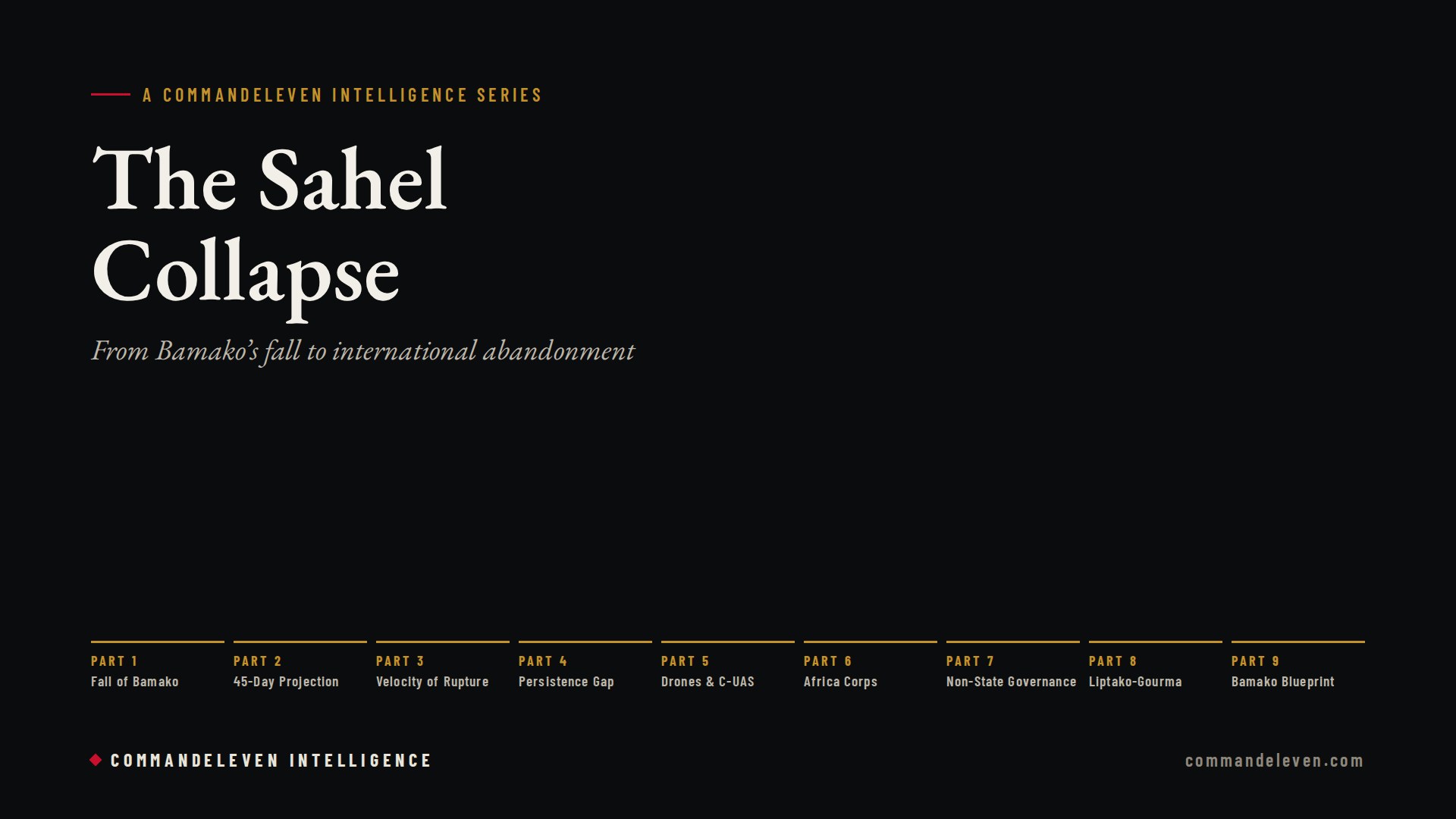
Why This Series, Why Now
In 2026 the central Sahel stopped being a counterinsurgency problem and became a question of state survival. Jihadist coalitions led by JNIM moved from rural insurgency to sieges of capitals, fuel blockades and the capture of mineral supply chains. Western missions left; Russia’s Africa Corps arrived to protect juntas rather than populations; and ISGS and JNIM went to war with each other over the territory the states abandoned.
This series brings together CommandEleven Intelligence’s 2026 reporting on that collapse, from the first audit of Bamako’s administrative failure to the reckoning with international abandonment.
What This Series Covers
- Part 1: The Fall of Bamako: A Clinical Audit of Mali’s Administrative Collapse – how JNIM and AQIM moved on Mali’s capital, the regional contagion risk, and the threat to gold and lithium supply chains.
- Part 2: Mali’s Terminal Collapse: The 45-Day “Dark-State” Projection – JNIM’s siege architecture and a 45-day projection of administrative rupture.
- Part 3: The Velocity of Institutional Rupture: Assessing the 45-Day Terminal Window – logistical asphyxiation, administrative hollowing and how fast a state can fail.
- Part 4: The Persistence Gap: Sahel and East Africa Strategic Audit – why kinetic operations fail against JNIM, IS-Sahel and al-Shabaab, and what holding ground actually requires.
- Part 5: UAV Proliferation & C-UAS in the Sahel: A Technical Audit – the arrival of armed drones on the Sahelian battlefield and the counter-drone problem in desert terrain.
- Part 6: Africa Corps: Russia’s Institutionalized Footprint in the Sahel – Wagner’s successor, the regime-survival model, and mineral rights as payment.
- Part 7: The Evolution of Sahelian Non-State Governance – how armed groups build parallel tax, justice and administration.
- Part 8: Liptako-Gourma Crisis: The Inter-Jihadi War for the Sahel – the ISGS–JNIM war in the tri-border zone.
- Part 9: The Bamako Blueprint Failure: Auditing International Abandonment – what the departure of international missions left behind, and the intelligence blackout that followed.
How to Read It
Parts 1 to 3 are the collapse itself: what happened in Mali and how fast. Parts 4 and 5 explain why military answers have failed. Parts 6 to 8 map the actors filling the vacuum: Russia, the jihadist proto-states and their war with each other. Part 9 closes with the international failure. The Sahel Strategic Baseline Assessment is the reference companion.
A Note on Method
Claims across the series are confidence-tiered as CONFIRMED, ASSESSED or SPECULATIVE. Several parts include projections made in spring 2026; CommandEleven Intelligence will score them in its Foresight Record rather than revise them silently.