
Bottom Line Up Front
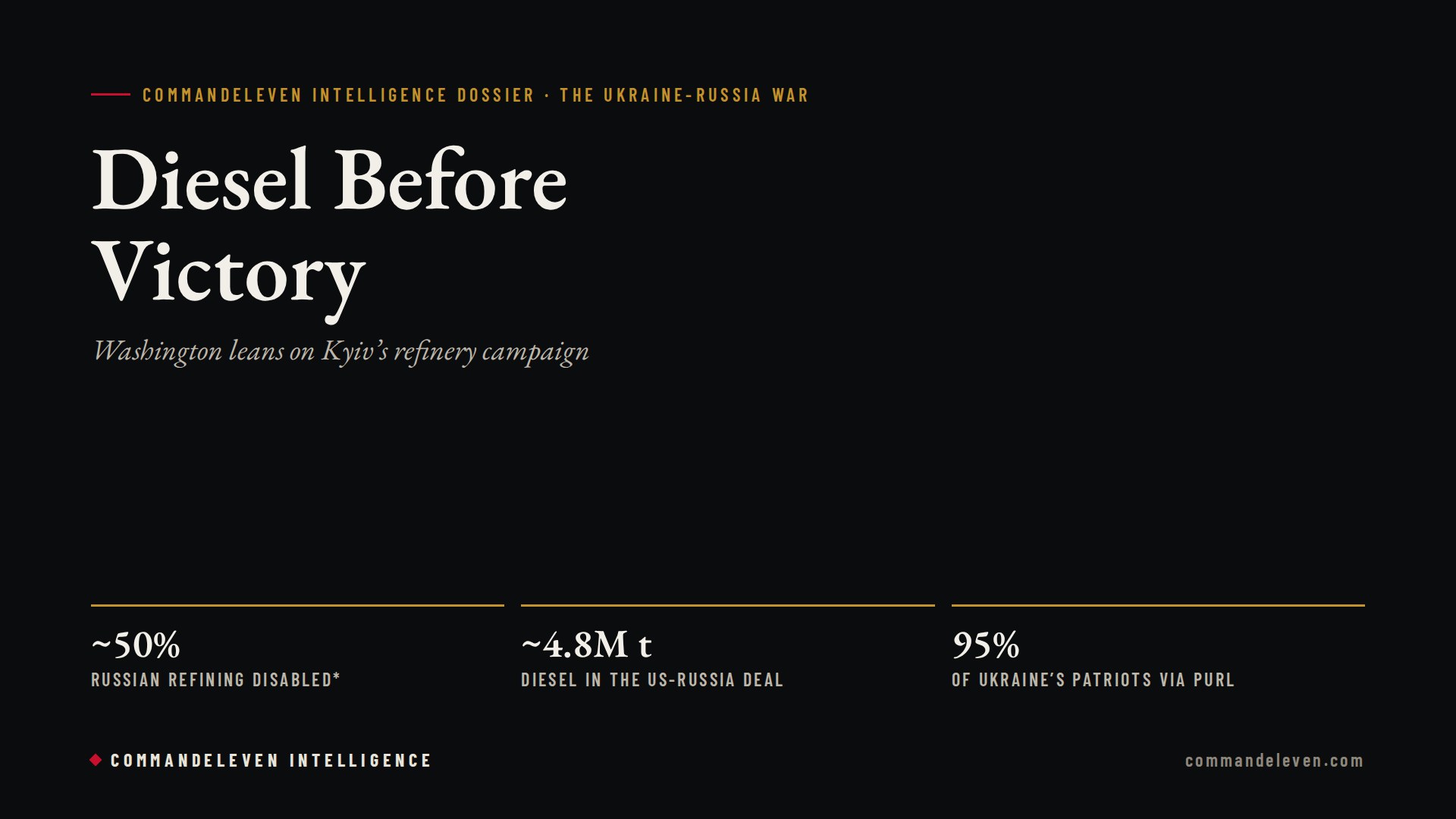
Ukraine’s long-range drone campaign against Russian oil refineries has become the most effective economic weapon of the war, and Washington now wants it stopped. On October 11, the Financial Times reported, citing European officials, that the US has been lobbying Kyiv and European capitals to end the strikes, with threats to halt PURL, the allied-funded channel for US-made weapons, and to cut intelligence sharing. Axios reported that Kyiv had ignored about six US requests and that a Ukrainian official said Steve Witkoff and Jared Kushner raised the intelligence threat; a US source denied it. [CONFIRMED as reported]
The reason is fuel prices. With the Strait of Hormuz disrupted by the Iran war and US midterms weeks away, the White House announced a deal on October 9 for Russia to release up to about 4.8 million tons of diesel onto world markets in exchange for sanctions relief, then declared an “energy ceasefire” on October 11. Russia struck Ukrainian power plants in Kharkiv and Kyiv after the announcement. [CONFIRMED]
CommandEleven Intelligence assesses that Washington is trading Ukraine’s most effective lever against Russia’s war economy for short-term relief at the US pump, and that Moscow gains twice: sanctions relief for diesel it struggles to refine, and a pause in the strikes that caused the shortage. [ASSESSED]
Key Judgments
KJ1: The refinery campaign works. Ukraine’s defense ministry says its strikes have disabled about half of Russia’s refining capacity; independent estimates put Russian refineries at about 60% of capacity. Putin has acknowledged the campaign cost Russia about 1% of GDP. [CONFIRMED on the claims; figures vary by source]
KJ2: The pressure is coercive, not advisory. PURL carries most of the Patriot interceptors Ukraine receives, and intelligence sharing underpins its long-range targeting. Threatening either is leverage over Ukraine’s air defense and deep-strike capability at once. [ASSESSED]
KJ3: The diesel deal rewards Russia for a problem Ukraine created. Russia’s constraint is refining, not exporting. Sanctions relief in exchange for diesel Russia may struggle to supply hands Moscow a political win while protecting the refineries that make the fuel. [ASSESSED]
KJ4: Kyiv’s counteroffer is reciprocity. Zelensky said Ukraine will stop striking refineries if Russia stops striking Ukraine’s energy grid. Russia’s strikes after October 11 test whether Moscow will reciprocate. [CONFIRMED on the offer]
KJ5: The Iran war is now shaping the Ukraine war. Hormuz-driven fuel prices, not battlefield events, are driving US policy toward Kyiv. [ASSESSED]
What Washington Asked For
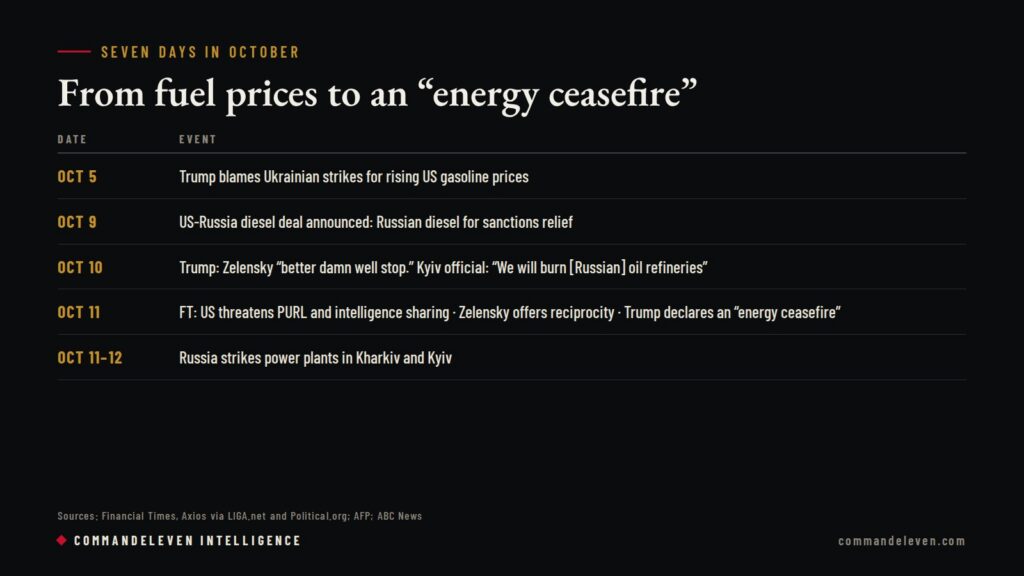
- October 5: Politico reports Trump planning measures to lower diesel prices; Trump blames Ukrainian strikes for rising US gasoline prices.
- October 9: Trump announces the diesel deal: 300,000 tons immediately, 500,000 in November, 1 million soon after, and up to 3 million more depending on the state of Russian refineries.
- October 10: Trump says Zelensky “better damn well stop” and that it is “time for Ukraine to get a new president.” A senior Ukrainian official tells the FT: “We will burn [Russian] oil refineries.”
- October 11: The FT reports US threats to halt PURL and intelligence sharing. Zelensky offers to stop refinery strikes if Russia stops hitting Ukraine’s grid. Trump declares an “energy ceasefire” on Truth Social; Zelensky says it was “news for me.” Russia strikes power plants in Kharkiv and Kyiv.
Why the Refineries Matter
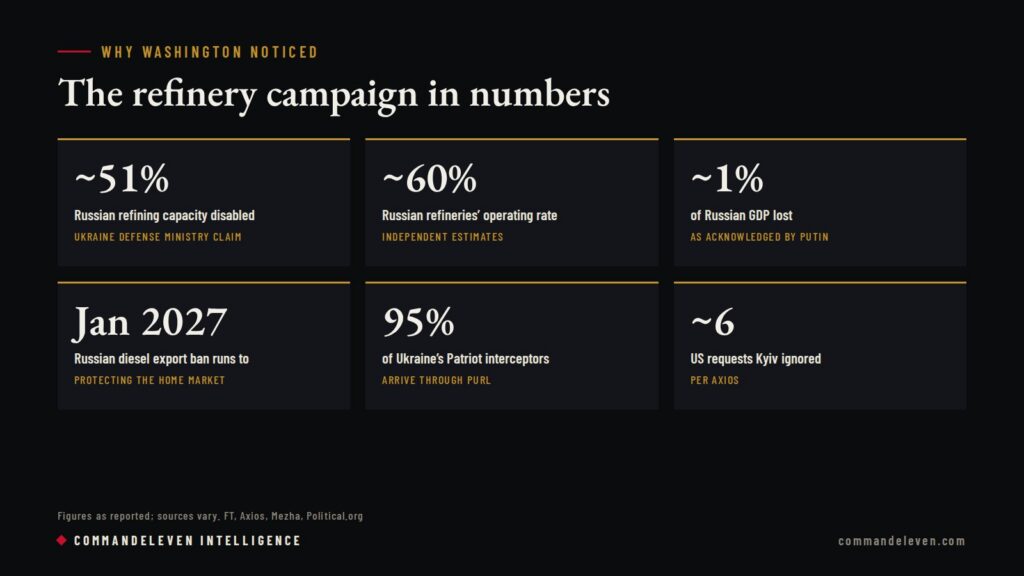
Ukraine’s deep strikes target the part of Russia’s energy economy that sanctions could not reach. Export bans and price caps limit what Russia sells; refinery strikes limit what it can produce, including fuel for its own forces. Russia has banned diesel exports until January 2027 to protect its domestic market. [CONFIRMED]
This dossier series argued in Part 3 that sanctions on Russia were a slow squeeze with a thinner US role, and in Part 4 that drones rewrote the battlefield. The refinery campaign is where the two meet: drones doing the economic work sanctions were meant to do. [ASSESSED]
What Kyiv Risks
PURL. The Prioritized Ukraine Requirements List lets European allies pay for US-made weapons for Ukraine. About 95% of the Patriot interceptors Ukraine receives come through it. Halting PURL would hit Ukraine’s air defense at the moment Russia is striking its grid ahead of winter. [CONFIRMED on PURL’s role]
Intelligence. US intelligence has supported Ukraine’s long-range strike targeting. Its withdrawal would degrade the very campaign Washington wants stopped, which is why the threat is credible. [ASSESSED]
Europe’s position. Germany’s foreign minister said Berlin fully supports Zelensky, and several European allies pledged to increase pressure on Moscow despite the diesel deal. Europe cannot replace US intelligence, but its money keeps PURL running. [CONFIRMED on statements]
What It Means for the Endgame
Part 5 of this series described four clocks running toward no resolution. The energy fight adds a fifth: the US electoral clock. A US administration that blames Ukraine for fuel prices and calls for a new Ukrainian president has shifted from mediator toward pressure on one side. Moscow reads that shift as an incentive to wait. [ASSESSED]
Indicators to Watch
- Reciprocity: whether Russia stops striking Ukrainian energy infrastructure, and whether Ukraine pauses refinery strikes.
- PURL and intelligence: any confirmed suspension or delay of PURL deliveries or US intelligence sharing.
- The diesel deal: whether Russian diesel actually reaches the market on Trump’s schedule, and what sanctions relief is formalized.
- US fuel prices before the November midterms, and whether the White House credits or blames Kyiv.
- Europe: new European funding for PURL or long-range strike capability that reduces dependence on Washington.
What This Dossier Does Not Claim
- It does not claim the US has cut PURL or intelligence sharing. Both are reported threats; a US source denied the intelligence threat.
- It does not claim the energy ceasefire has failed. As of the cut-off it was announced but unconfirmed by Moscow.
Frequently Asked Questions
Why does the US want Ukraine to stop striking Russian refineries?
The White House says the strikes are raising global fuel prices. US gasoline and diesel prices have risen since the Iran war disrupted the Strait of Hormuz, and the midterm elections are weeks away.
What is PURL?
The Prioritized Ukraine Requirements List, agreed in July 2025, lets allies fund purchases of US-made weapons for Ukraine. Most of Ukraine’s Patriot interceptors arrive through it.
What is the US-Russia diesel deal?
Announced on October 9, it would see Russia release up to about 4.8 million tons of diesel onto world markets in stages, in exchange for sanctions relief.
Is there an energy ceasefire between Russia and Ukraine?
Trump announced one on October 11. Ukraine said it is ready to stop striking Russian energy if Russia does the same; Russia had not confirmed it, and struck Ukrainian power plants after the announcement.
Related CommandEleven Intelligence Coverage
- The Ukraine-Russia War: A Five-Part CommandEleven Intelligence Series
- Sanctions and Economic Warfare: The Slow Squeeze – Part 3
- Battlefield Realities: The War Drones Rewrote – Part 4
- Escalation Risk and Endgame Scenarios: Four Clocks, No Resolution – Part 5
- Russian Airspace at War: Ukraine’s Aviation Warning, Explained – Part 1
Sources
- US threatens to cut off Ukraine arms pipeline over Russian refinery strikes, Financial Times reports, Political.org (summarizing the Financial Times), October 11, 2026
- “We will burn Russian oil refineries”: Ukraine to continue strikes despite Trump-Putin deal, LIGA.net (summarizing the Financial Times and Axios), October 10, 2026
- Zelensky says Ukraine ready to halt refinery strikes if Russia stops hitting energy grid, Malay Mail (AFP), October 11, 2026
- Trump says Russia and Ukraine agree to “energy ceasefire”, Khaleej Times, October 11, 2026
- Russia strikes power plant in Ukraine after Trump announces energy ceasefire, ABC News, October 12, 2026

