

Bottom Line Up Front
On September 30, 2026, Secretary Pete Hegseth launched Project Meridian, a 120-day study of the technologies the US military will need for future wars, co-directed by Elon Musk, Palmer Luckey and Newt Gingrich. Its report is due January 28, 2027. Two weeks later, the Wall Street Journal published what happened when the Army actually took new technology to the field: at Project Convergence Capstone 6 at Fort Irwin, California, in July, servers overheated, drone batteries died and could not be recharged, soldiers cooled antennas with ice-water-soaked T-shirts, and drones were flown at half their range to make sure they came back. Earlier this year in Germany, Ukrainian drone operators playing the enemy “eliminated” a US armored brigade.
The two stories describe the same problem from opposite ends. Meridian is a study of what to buy, led by people who build and sell it. Fort Irwin and Germany show that America’s gap is not a shortage of ideas or vendors. It is the ability to field cheap, rugged, attritable systems and train soldiers to use, repair and replace them under fire, at the speed Ukraine now does. CommandEleven Intelligence assesses that a technology-first study will not close a gap that is mostly organizational, industrial and doctrinal. [ASSESSED]
The same week, the US completed its withdrawal from Iraq. That is not a retreat from the region but a reorganization of American force posture around the war with Iran, and it carries its own counter-terrorism risk, set out in the companion dossier After the Last Convoy: ISIS and the US Exit from Iraq.
Key Judgments
KJ1: Project Meridian is a procurement-direction study, not a strategy review. Hegseth said its purpose is to “identify the domains that we must conquer, and capabilities we must master,” across AI, autonomy, directed energy, robotics and biotechnology, from underground to cislunar space. [CONFIRMED]
KJ2: Meridian’s leadership creates a governance risk the Pentagon has not addressed publicly. Palmer Luckey co-founded Anduril, a major supplier of drones and autonomous systems; Elon Musk runs SpaceX, whose Starlink service the military depends on. Neither the announcement nor the reporting describes conflict-of-interest safeguards. This dossier does not allege wrongdoing; it identifies a risk that the study’s findings will be judged against. [ASSESSED]
KJ3: Fort Irwin showed that much of the new technology is not field-ready. In 110°F heat, equipment failed in basic ways, and soldiers described some startup technology as too brittle for practical use. The Army’s own technology chief said the point was to “fact-check all the vendors.” [CONFIRMED on the reported failures]
KJ4: Germany showed the gap is about method, not hardware. Ukrainian operators beat a US armored brigade by spotting the dust of heavy vehicles with cheap reconnaissance drones and striking them with bomb-dropping and first-person-view drones. The decisive factor was combat-tested technique. [CONFIRMED, based on WSJ reporting from US officials]
KJ5: The Iraq withdrawal is a redeployment, not a disengagement. The coalition’s task force headquarters moved to Jordan, counter-ISIS operations continue from Syria, and US leverage over Iraq remains substantial. [ASSESSED]
Project Meridian: What It Is

- Announced: September 30, 2026, by Hegseth in his State of the Force address at Marine Corps Base Quantico, one of six initiatives unveiled that day.
- Co-directors: Elon Musk (Tesla, SpaceX), Palmer Luckey (Anduril co-founder) and Newt Gingrich (former House Speaker), supported by academic, policy and industry experts.
- Commissioned by: Pentagon chief technology officer Emil Michael, through a partner organization the memo does not name.
- Mandate: identify the weapons and technologies troops will need and propose how to develop, test and field them. The Joint Staff and each service are to connect their future-warfare research to the project.
- Scope: every warfighting domain “from underground to the Moon,” with AI, autonomy, directed energy, robotics and biotechnology named as the fields expected to change warfare.
- Deadline: January 28, 2027, as an unclassified public report with a classified annex.
The scope is broad and the timeline short. A 120-day study can produce a direction. It cannot produce the industrial base, training pipeline and acquisition reform that turn a direction into fielded capability. [ASSESSED]
Fort Irwin: The Reality Check

Project Convergence Capstone 6 ran for ten days in July at the National Training Center, with about 9,700 to 10,000 troops from the US, Britain, Australia, Canada and New Zealand. The US 4th Infantry Division led; the 11th Armored Cavalry Regiment played the opposing force, modeled on China’s People’s Liberation Army. More than 90 technologies and concepts were tested.
What the Wall Street Journal reported, through accounts of the exercise:
- Heat. Temperatures reached about 110°F (43°C); other reporting put peaks higher. Servers overheated.
- Power. Batteries died and could not be recharged in the field. One drone, once recharged, took ten minutes to get airborne.
- Improvisation. Soldiers draped ice-water-soaked T-shirts over antennas to keep them working.
- Caution over capability. Some drones were flown at half their maximum flight time to conserve batteries and make sure they came back, and without full autonomy or AI assistance. “All it takes is one gust of wind, and it’s on the side of a mountain,” one sergeant said.
- Brittleness. Soldiers said some startups’ technology was too fragile for practical use, and much of it had never been used in combat.
- Jamming. Heavy electronic warfare showed the limits of systems that depend on reliable communications.
The Army’s position is that this is what experiments are for. Alex Miller, chief technology officer to the Army chief of staff, said the aim was to “fact-check all the vendors that are coming to us,” not to flood the airspace with autonomous weapons. That is a fair point, and it is also the point: the vendors’ claims did not survive the desert intact. [ASSESSED]
Germany: The Lesson from Ukraine
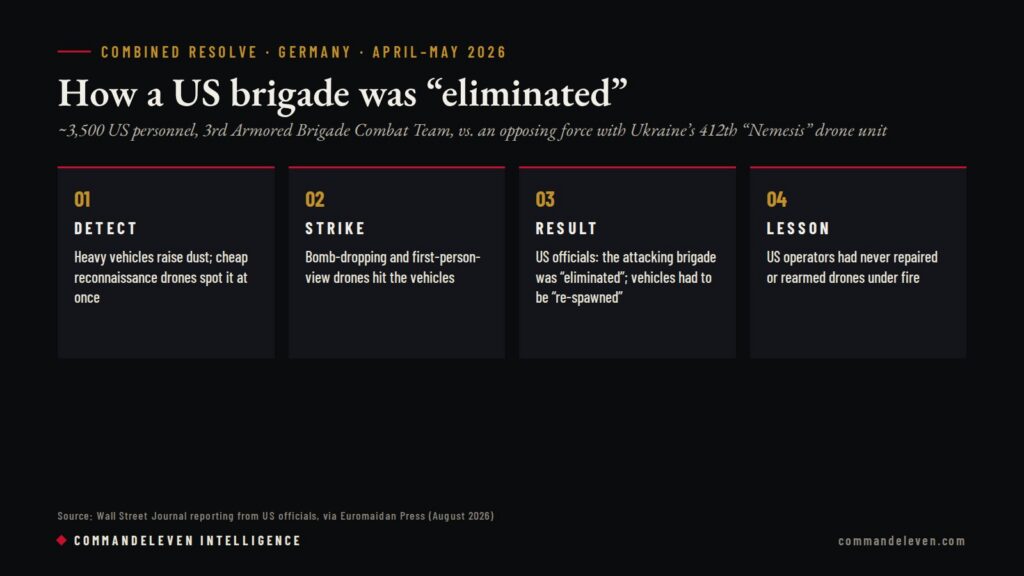
At Combined Resolve in Germany in April and May 2026, about 3,500 US personnel, mostly from the 3rd Armored Brigade Combat Team, tried to seize a position held by an opposing force reinforced with Ukrainian drone troops from the 412th “Nemesis” unit of Ukraine’s Unmanned Systems Forces. According to US officials who spoke to the Wall Street Journal:
- The dust raised by heavy vehicles was spotted at once by Ukrainian reconnaissance drones.
- Bomb-dropping and first-person-view drones then struck the vehicles.
- The Ukrainians “eliminated” the attacking brigade; US vehicles had to be “re-spawned” to continue the exercise.
- Midway through, the Ukrainians switched sides to coach the Americans. US operators had never had to repair or rearm drones under fire.
It was not the first time. Ukrainian drone teams beat NATO forces, including Americans, in a Baltic exercise in May 2025, and outperformed Swedish-led NATO forces on Gotland in spring 2026. By Washington’s own assessment, reported by the Journal, no US manufacturer yet matches Ukraine’s combat-tested drones. CommandEleven Intelligence’s analysis of how drones rewrote the Ukrainian battlefield is in Battlefield Realities: The War Drones Rewrote – Part 4, and the jet-drone threat in Jet Gerans and the Geography of Fear.
Why a Technology Study Won’t Close the Gap

What Ukraine has, and Fort Irwin showed the US lacks, is not a technology:
Project Meridian asks what to buy. The harder questions are how to buy fast, how to build at volume, and how to train. Hegseth has already directed the Pentagon to buy “good enough” off-the-shelf products, and the recently ousted Army secretary, Dan Driscoll, called the Army’s reform effort a “calcified bureaucracy.” A study led by builders and sellers of advanced systems is well placed to describe the frontier. It is less well placed to fix the acquisition and training system that decides whether anything reaches the field in time. [ASSESSED]
The Force Posture: Iraq Is a Redeployment

The last US forces under Operation Inherent Resolve left Iraq on September 30, 2026, ending a mission that began in 2014. Iraq declared “Sovereignty Days.” President Trump called it “a decisive victory over ISIS.”
The posture behind the headline:
- Headquarters moved, not closed. The coalition’s task force headquarters relocated to Jordan, and CENTCOM says forces across the region remain ready to respond to ISIS threats. US forces left al-Tanf in Syria in February, but counter-ISIS operations in Syria continue.
- The war with Iran shapes everything. Iran-backed groups attacked US facilities in Iraq about 600 times after the war began in February, and more than 1,000 Iranian missile and drone attacks hit the Kurdistan Region. Iraq’s foreign minister has confirmed that a recent attack on Saudi Arabia was launched from Iraqi territory near the Iranian border.
- Leverage remains. Iraq’s oil export revenue continues to pass through its account at the Federal Reserve Bank of New York, and Baghdad plans a bilateral security relationship with Washington. US influence over Iraq is economic and political now, rather than military on the ground. [ASSESSED]
- The militias read it as a win. Kataib Hezbollah threatened to shoot down “hostile” aircraft; the deadline for Iran-backed groups to disarm has slipped to June 2027.
The counter-terrorism question is what happens to ISIS now that the US is gone. That is the subject of the companion dossier, After the Last Convoy: ISIS and the US Exit from Iraq.
Indicators to Watch
- Meridian’s partner organization and staff. Who runs the study day to day, and what conflict-of-interest rules apply to the co-directors?
- The January 28, 2027 report. Does it address acquisition speed, industrial capacity and training, or only technology?
- Contracts. Do major autonomy and drone awards go to companies linked to Meridian’s leadership during or after the study?
- Ukrainian drones. Does the US buy Ukrainian combat-tested drones at scale, as the Journal reported it is testing?
- The next Project Convergence. Do the July 2026 failures (heat, power, links) reappear?
What This Dossier Does Not Claim
- It does not allege any wrongdoing or conflict of interest by Musk, Luckey or Gingrich. It identifies a governance risk that has not been publicly addressed.
- It does not claim US forces cannot adapt; the Army’s own officials framed Fort Irwin as a test meant to find failures.
- It does not claim the US has withdrawn its military power from the Middle East.
Frequently Asked Questions
What is Project Meridian?
A 120-day Pentagon study launched on September 30, 2026, to identify the technologies the US military will need for future wars. It is co-directed by Elon Musk, Palmer Luckey and Newt Gingrich, and its report is due January 28, 2027.
What went wrong at the Fort Irwin exercise?
At Project Convergence Capstone 6 in July 2026, the Wall Street Journal reported overheating servers, drone batteries that died and could not be recharged, slow drone launches, and soldiers flying drones at half their range to make sure they came back.
Did Ukrainian drone operators really defeat a US brigade?
According to US officials who spoke to the Wall Street Journal, Ukrainian drone troops playing the opposing force at the Combined Resolve exercise in Germany in spring 2026 “eliminated” an attacking US armored brigade.
Has the US left Iraq?
The last US forces under Operation Inherent Resolve left Iraq on September 30, 2026. The coalition task force’s headquarters moved to Jordan, and counter-ISIS operations continue from elsewhere in the region.
Related CommandEleven Intelligence Coverage
- Battlefield Realities: The War Drones Rewrote – Part 4
- Jet Gerans and the Geography of Fear
- Alabuga: The Axis of Evil’s Drone Assembly Line
- The Ukraine-Russia War: A Five-Part CommandEleven Intelligence Series
Sources
- Musk, Luckey and Gingrich get 120 days to map America’s future wars, The Next Web, October 2026
- Elon Musk, Palmer Luckey and Newt Gingrich to help Pentagon with warfare initiative, Hegseth says, CNBC, September 30, 2026
- Project Meridian to take on major foundational changes for the military, The Washington Times, October 13, 2026
- US Army drone trials expose battlefield challenges, Aerospace Global News (WSJ reporting), October 2026
- 10,000 troops test drones, AI in Mojave exercise, Hürriyet Daily News, August 7, 2026
- Ukraine’s drones crushed a US armored brigade in a war game in Germany, Euromaidan Press (WSJ reporting), August 14, 2026
- US forces complete departure from Iraq as anti-Islamic State mission in Iraq ends, FDD’s Long War Journal, September 30, 2026
- Iraq sounds alarm on terror threat from Syria a day after US troops leave, Fox News, October 2, 2026
- With end of US’s Operation Inherent Resolve in Iraq, counter-ISIS burden shifts, The Jerusalem Post (The Media Line), October 8, 2026

