
Confidence convention:
- [CONFIRMED] (multiple credible, independent sources or primary documents)
- [ASSESSED] (reasoned judgment from credible but incomplete, single-lineage, or interested-party sources)
- [SPECULATIVE] (plausible, but little or no direct evidence)
- [DATA DEFICIT] marks points where public reporting is insufficient. Claims about current military posture, ceasefires, and production rates are time-sensitive and were current as of 19 September 2026
Key Judgments
- KJ-1 | CONFIRMED (existence and use); ASSESSED (volume) – Russia is using jet-powered Geran-4 and Geran-5 one-way attack drones against Ukraine, and use has climbed steeply. Reuters, citing Ukrainian military data, reports that jet-drone use rose roughly sixfold over three months this summer. Ukrainian defense intelligence (HUR/DIU) assessed in mid-August that Russian industry produces about 3,000 Geran-4/5 airframes a month, more than the piston-engine Geran-2 line. Production figures come from an interested party and conflict with other reporting in The Platform: From Shahed to the Geran-5 Jet Drone section of this white paper
- KJ-2 | ASSESSED (high) – The strategic significance of the jet Geran is economic and industrial before it is technical. It is an inexpensive, serially produced, cruise-missile-like munition that forces defenders to spend scarce interceptors in volume. It does not make air defense obsolete. It makes cheap, layered, sensor-rich defense a precondition for survival
- KJ-3 | CONFIRMED (that the report exists); ASSESSED (substance) – The Financial Times reported on 13 September that Iran asked Russia for Geran-4/5 drones for use against Israel and the United States, citing Western security officials and a source close to the Kremlin. Neither government has publicly confirmed the request. Whether Moscow agreed, or delivered anything, is a [DATA DEFICIT]
- KJ-4 | ASSESSED (high) – The set of “target maps” circulating since 17 September is an influence product, not a threat assessment. It attaches one template (maximum range, maximum warhead, no defenses, no stated intent) to six theaters, and hangs each on a real news event. Its functions are deterrence signaling, cost-imposition through fear, and, implicitly, arms marketing
- KJ-5 | ASSESSED (moderate) – Near-term diffusion risk ranks: Iran first, North Korea second, and China, India, and non-state actors well behind. The ranking follows existing supply channels, not the maps’ geometry. In North Korea’s case, knowledge and industrial-experience transfer is more probable than delivery of finished jet airframes
- KJ-6 | ASSESSED (moderate) – Russia’s own consumption is a brake on exports. August jet-drone launches against Ukraine exceeded 2,500 against monthly output of around 3,000, leaving little surplus. Exports to third parties would trade off directly against the Ukraine campaign until the Alabuga expansion matures
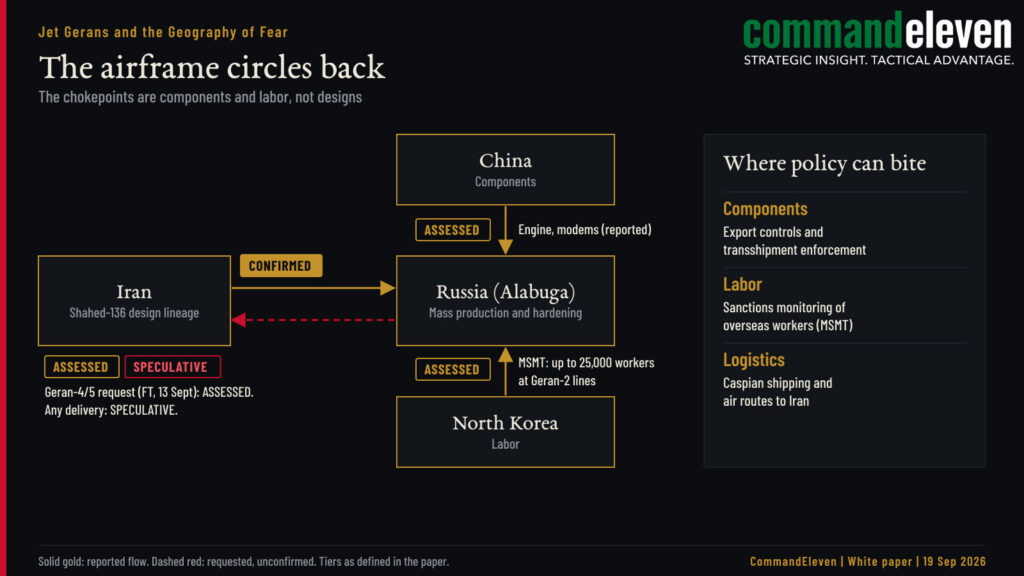
- KJ-7 | ASSESSED (moderate) – The supply chain is circular and multinational: Iranian-origin design, Russian mass production and hardening, Chinese-pattern components, and North Korean labor. The most actionable chokepoints are components, labor, and logistics, not airframe designs
- KJ-8 | ASSESSED (moderate) – The information effect is itself a weapon. Fear of the jet Geran drives interceptor consumption, insurance premiums, and political pressure whether or not a single airframe is ever transferred. The Russian-aligned commentary says as much
Speculative scenarios (deliveries to Iran at scale; acquisition by North Korea, China, or India; use by cartels; a Baltic-launched attack on Poland) are addressed in Section 6. They are deliberately not Key Judgments.
Five Stories in One Week
Between 13 and 18 September 2026, five developments converged, and it is the convergence that makes the moment analytically interesting.
- 13 September: the FT report on Iran’s request for Russian jet Gerans, quickly recirculated by outlets that included the Russian-aligned SouthFront
- 15 September: Reuters reported that a July Ukrainian trial of new high-speed interceptor drones went badly, with many losing control at speeds above 400 km/h, and that Russia’s jet-drone use had grown roughly sixfold in three months. A Ukrainian air-force deputy commander said Ukraine was close to fielding low-cost countermeasures, while another quoted Ukrainian voice conceded that Kyiv does not yet know how to answer mass-produced jet Shaheds
- 16-17 September: the Multilateral Sanctions Monitoring Team (MSMT), an 11-nation body including the United States, South Korea, and Japan, reported that up to 25,000 North Korean workers may be employed in Russia’s drone industry, including at the Alabuga zone in Tatarstan, entering on student visas
- 16 September: Mexico’s Independence Day parade displayed a Shahed-136-pattern drone among a broader debut of unmanned systems
- 17-18 September: Rybar’s regional channels published range-ring “potential targets” maps for the Middle East, the Korean Peninsula and Japan, Mexico and the United States, Taiwan, South Asia, and Poland, each with a commentary post, and allied channels amplified them
The first four are reporting. The fifth is a product built from them. The connective tissue between the events is narrative, not evidence: a Russian-aligned ecosystem took an FT scoop about a request, a sanctions report about labor, and a parade photograph, and stitched them into a global story of imminent jet-Geran proliferation. Part of that story is true and important. Part is manufactured. This paper separates the two.
The Platform: From Shahed to the Geran-5 Jet Drone
Lineage
The Geran family began as Iran’s Shahed-136, supplied to Russia from 2022 and produced domestically by Russia from 2023 as the Geran-2, chiefly at the Alabuga Special Economic Zone. CSIS’s recent history of the program describes a Russian industrial base that treated the airframe as a platform for continuous, battlefield-driven improvement: serializing what worked, discarding what did not, and running parallel production lines whose solutions sometimes diverged and sometimes converged. Its account, and the pace of iteration behind it, is the strongest evidence that Russia has moved from licensed copy to owner-operator of the design.
The jet generation followed the same logic. Reporting alleges that the Geran-3 is a copy of Iran’s jet-powered Shahed-238 and describes the Geran-4 as a deeply upgraded Geran-3 with better aerodynamics. The Geran-5 is a different shape: a conventional straight-wing, cruise-missile-like airframe that Ukrainian intelligence assessed, on first sighting in January 2026, as most likely not an indigenous Russian design given its similarity to Iran’s Karrar, and as using a turbojet of Chinese Telefly pattern. Russian Defense Ministry material published on 9 May gave the Geran-5 a length of about 6 meters, a wingspan of 5.5 meters, a 90 kg warhead, and a range up to 1,000 km.
Declared characteristics
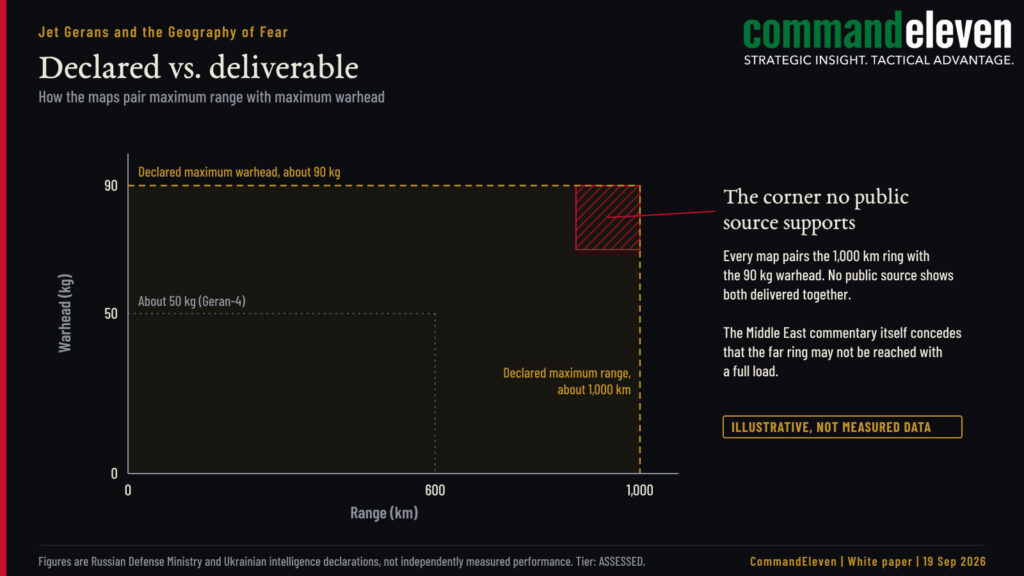
- [ASSESSED] – Sourcing caution: these are Russian Defense Ministry declarations and Ukrainian or Western-official characterizations, not independently measured performance. Treat maximum range and maximum warhead as mutually exclusive in practice; no public source shows both delivered together
Production and cost
Ukrainian military intelligence told the outlet Militarnyi on 12 August that Russia produces about 3,000 Geran-4/5 drones per month alongside roughly 2,800 piston Geran-2s, and that jet output has now overtaken the piston line. Ukrainian data cited by Reuters show jet launches roughly sixfold higher across the summer, and open-source counts put jet launches at about 1,500 in July and over 2,500 in August. Ukrainian officials have said they expect the jet share to rise toward half of all Shahed-type attack drones.
- [ASSESSED] – The picture is not fully consistent. One Ukrainian outlet, citing military sources, put planned output at about 800 Geran-5s and 1,200 Geran-4s a month, which totals 2,000, the figure that Russian-aligned Telegram channels are now repeating. The gap between 2,000 and 3,000 may reflect planned versus actual output, or different counting conventions. Either way, the order of magnitude, thousands per month, is corroborated across several independent-looking sources that likely share a common Ukrainian intelligence origin.
- [DATA DEFICIT] on type-level output and on jet unit cost – Credible cost estimates for the jet variants are thin; CSIS and RUSI-cited estimates for the piston Geran run to tens of thousands of dollars, and reporting consistently places the jet types well below cruise-missile cost.
The industrial center of gravity
[ASSESSED] – Satellite imagery cited by Ukrainian and European outlets shows new construction at Alabuga through the summer, reportedly extending the site beyond 1,000 hectares by early September. Russian-aligned commentators openly celebrate the expansion as a factory floor being built for export demand, and say the drone is becoming a “brand.” Whatever the intent, Alabuga has become the single most consequential node in the jet-Geran ecosystem, and, as the same commentators note with some unease, a plausible future military target.
What the Jet Geran Changes, and What It Doesn’t
What changes
The defensive layer built for the piston Shahed loses much of its value. Ukraine largely contained the slow Geran-2 with mobile gun teams, electronic warfare, and cheap propeller-driven interceptor drones. Speed and altitude erode that layer. Ukraine’s air-force spokesman told the FT that effectiveness against jet drones is around 60 percent, against 90-95 percent for the older types. The July interceptor trial failure reported by Reuters shows the counter is not yet mature.
The cost-exchange problem gets worse, not better. A munition costing a fraction of a cruise missile that must nonetheless be met with a missile or a purpose-built interceptor shifts the economics of defense toward the attacker. This is the mechanism behind the concern that widespread jet-Geran use worsens the global air-defense ammunition shortage.
Note the source: that framing appears in Rybar’s own commentary, where it is presented as a desirable outcome for Russia and its partners.
It blurs the boundary between drone and missile. The FT frames the new Gerans as flying at speeds and altitudes that erase much of the traditional distinction. For doctrine, procurement, and arms-control categories built around that distinction, this matters.
What doesn’t
It is not invulnerable. The jet Geran is still a subsonic, one-way munition with a warhead of tens of kilograms. It is detectable by radar and engageable by fighters, ground-based interceptors, and guns. Ukraine’s 60 percent figure is a Ukrainian number, produced by a theater with thin high-end air defense, enormous raw volume, and a sensor network stressed by simultaneous ballistic-missile attacks. It should not be extrapolated to Gulf states, Israel, or US installations, which field layered integrated air-and-missile defenses. Their vulnerability is a question of magazine depth and interceptor cost, not of physical impossibility.
It is not a strategic-effect weapon on its own. Its effect comes from volume, persistence, and the cumulative degradation of infrastructure, logistics, and morale. As winter approaches, the energy grid is the obvious objective in Ukraine, as commentators on both sides note.
It is not a substitute for ballistic missiles where the latter already exist. In several of the map’s theaters, notably the Korean Peninsula and Iran, the attacker already fields ballistic and cruise missiles with equal or greater reach. The marginal value of the jet Geran there is mass and cost, not reach.
The Map Campaign as an Information Operation
One template, six theaters
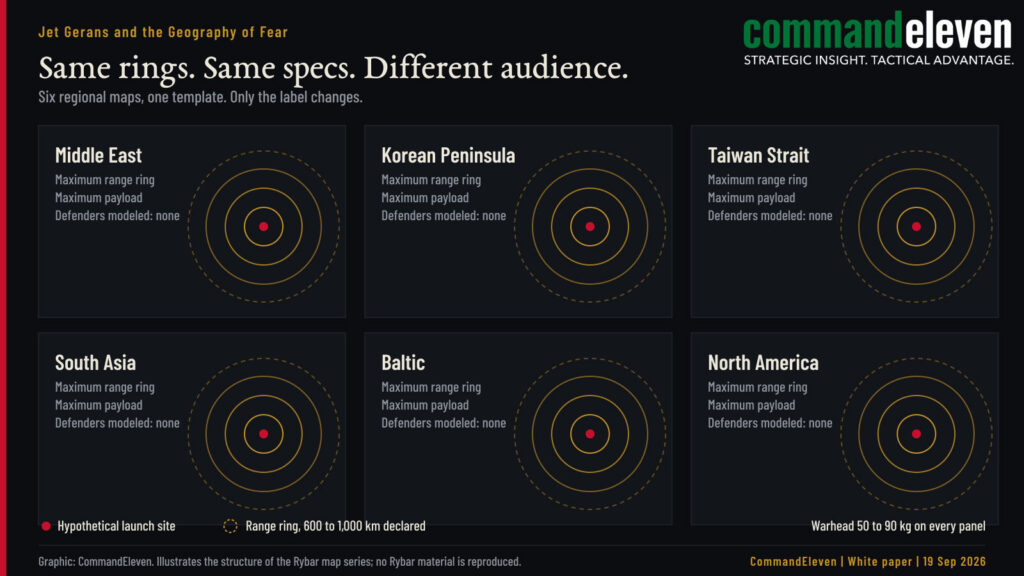
Every map in the series reuses the same visual grammar: a drone silhouette on a specification panel (identical figures: 600 to 1,000 km range, 50 to 90 kg warhead, 350 to 600 km/h), a large arc showing the maximum range (500 km on the Taiwan map), “hypothetical launch sites” drawn wherever convenient, and hexagon icons for category targets: air bases, refineries, ports, data centers, semiconductor plants, and government headquarters. Each carries the branding of a regional channel (Middle East, Pacific, Latin America, Europe) and is paired with a commentary post that localizes the fear: Samsung and Toyota for Asia, data centers and refineries for the United States, Karachi and Baluchistan for South Asia, Gdynia and Rzeszów for Poland.
- [ASSESSED] – This is a production line, not a series of independent analyses.
The technical sleights
Four recurring devices weaken the maps as assessments.
- Maximum range paired with maximum payload – The specification panel lists both. The Middle East commentary itself concedes that at the far ring the drone “risks not reaching its destination with a full load,” and that reliable coverage would require launches from proxy territory. The map’s outer rings therefore depict a capability the text admits is not real.
- Absence of the defender – No map or commentary models detection, engagement, or layered defense, or how a target’s defenders might respond. Shipping-insurance effects are mentioned; interception rates are only cited when they favor the attacker (the Ukrainian 60 percent figure).
- Capability substituted for intent and access – The maps draw the circle first and ask who would fire, why, and with what permission second. Access to the airframes is asserted in the commentary, not demonstrated.
- “Hypothetical” as a shield – Every map is labeled hypothetical or potential, giving the producer deniability while the imagery does the persuading. The launch sites sometimes require heroic assumptions: launch points inside Mexico or on the Chinese coast, and a curved path over “neutral waters” of the Gulf of Finland and Baltic to reach Poland.
The Sourcing Ecosystem
The maps come from Rybar, a large Russian military-blogger operation reported to have close ties to Russian defense-ministry circles. The surrounding amplification comes from SouthFront, which a 2020 US State Department Global Engagement Center report placed within Russia’s proxy-site ecosystem, and from smaller channels that reposted the material within hours. The interplay is characteristic: Western reporting (the FT, Reuters, Bloomberg) is quoted selectively to provide credibility, and the quotations chosen emphasize Ukrainian failure and Western helplessness. Meanwhile, the commentary uses an adversarial vocabulary (“the Kyiv regime,” “so-called Ukraine”) that tells the reader which audience it is really for.
The functions
[ASSESSED] – We assess the series serves four functions at once.
- Deterrence signaling – The Poland post is the clearest case. It ties itself to a statement by Polish Prime Minister Donald Tusk warning of possible Russian hybrid strikes and to tension around Kaliningrad, then sketches how “a few drones” launched over international waters could produce “an effect disproportionate to its cost.” That is coercive messaging aimed at Polish and NATO domestic audiences, dressed as commentary. It follows a real precedent: Russian drones’ incursion into Polish airspace in September 2025, which prompted NATO to scramble aircraft and Poland to invoke consultations
- Cost imposition through fear – The commentary is explicit that mass jet-Geran use would sharply increase air-defense missile consumption and open a “window of vulnerability,” raising insurance costs even without physical damage. Anxiety spent on interceptors, insurance premiums, and defense budgets is the payoff
- Marketing – A pro-Kremlin channel’s claim that the drone is “a brand” and that Iran, China, Cuba, India, and others are “the next market” reads as a product catalog in geopolitical dress. Maps depicting how Indian, North Korean, or Chinese forces could use the drone against their adversaries speak directly to prospective buyers
- Wedge-driving – The Mexico map, aimed at a US audience, points to Mexican cartels as potential recipients and questions whether the Sheinbaum government would resist. The Taiwan post ties Chinese interest in Russian drones to Taiwan-Ukraine cooperation. Each is designed to inflame an existing political fault line
A note on responsible handling
Reproducing the maps carries a real cost: circulation, in a national-security publication, extends the reach of a coercion product. Therefore, CommandEleven Intelligence has cited the series but has not embed the graphics, and, where a visual is required, commission an original capability-envelope graphic that includes the constraints the maps omit and avoids target-by-target detail. This aligns with our standing practice of keeping public output at the strategic and policy level.
Theater Assessments
Iran: the credible case
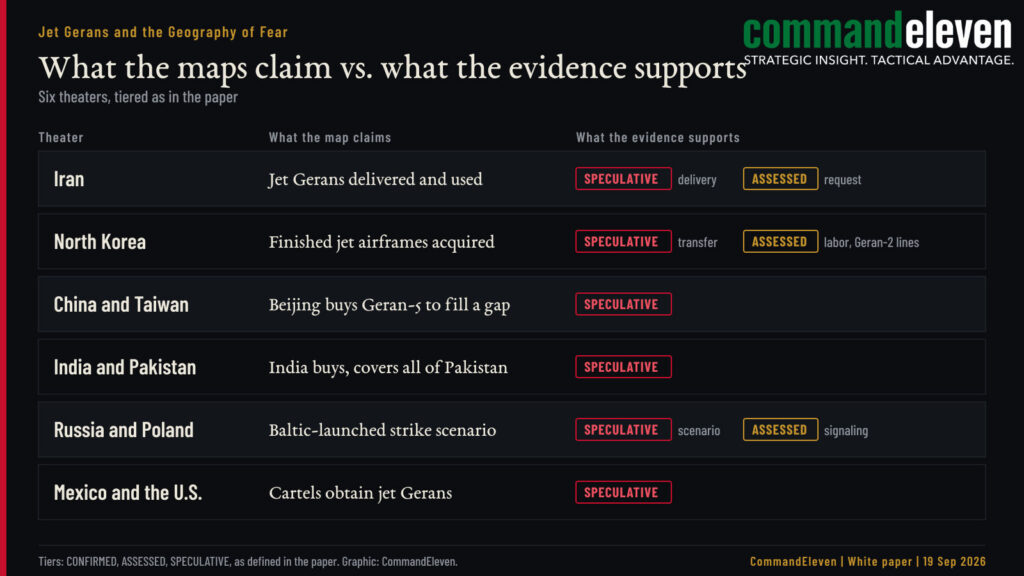
Iran is the theater where the maps sit closest to real evidence. Iran originated the design lineage, has an established supply relationship with Russia, and is emerging from, or still inside, a war that began on 28 February with US and Israeli strikes. As of mid-September, open sources describe a fragile ceasefire posture with the Strait of Hormuz still contested. This posture changes quickly and must be re-verified at publication.
Iran’s stated incentive, per the FT, is to gain the Russian-hardened, combat-tested versions after four years of Russian iteration, including improved targeting, communications, and electronic-warfare resistance. Iran has its own jet-drone line, but Russian experience in mass production and in defeating a specific defensive ecosystem is precisely what Tehran cannot generate alone. The Rybar commentary highlights the possibility that a complete package would include software, control protocols, and operator training, which is more valuable than airframes. We agree that this is the transfer that matters most.
- [ASSESSED] – Against that, three constraints apply. First, Russia is consuming nearly all of its own output (KJ-6). Second, Moscow has relationships to protect with Gulf producers and cannot be indifferent to how Riyadh and Abu Dhabi react to Russian-made drones hitting their territory. Third, the FT reporting leaves Moscow’s response unclear. The likeliest near-term path is smaller, deniable, and component-oriented: Iranian access to Russian know-how, not a visible mass shipment. Note also the reported Caspian shipping channel, which our New Axis of Evil dossier examines, as the most probable logistical route.
North Korea: labor is real, the jet Geran is not (yet)
The MSMT report is a serious source: an 11-nation body citing intelligence and field data. It supports the finding that North Korean labor is embedded in Russian drone production and that Pyongyang is earning hard currency and, critically, assembly experience. But the report concerns the Geran-2 factories, not jet-variant lines, and the leap from labor to delivered Geran-5s is Rybar’s, not the MSMT’s. Pyongyang also fields ballistic and cruise missiles with reach across the whole peninsula, so the marginal contribution of a 1,000-km drone is saturation and cost, not range.
- [ASSESSED] – The realistic risk is that North Korea’s indigenous drone program gains from Alabuga experience, a knowledge transfer that is hard to detect and impossible to reverse. That risk is greater than that of a finished airframe transfer and is worth stating plainly to Seoul, Tokyo, and Washington
Taiwan and China: an inverted narrative
- [SPECULATIVE] – The Rybar post suggests Russia can fill a gap in Chinese combat-tested kamikaze drones. The evidence points the other way. China has the world’s largest drone manufacturing base, and the reporting on the Geran-5 itself describes a Chinese-pattern engine and Chinese mesh-radio modems. If anything, the jet Geran is a product of Chinese components flowing to Russia, not the reverse. The map’s 500-km ring from a hypothetical launch site on the Chinese coast is arithmetically fine and strategically beside the point: Beijing has no need of a Russian airframe to threaten Taiwan’s energy and semiconductor infrastructure.
South Asia: sales pitch and mirror
- [SPECULATIVE] – The India map is the most revealing about audience. It is titled as “likely targets in Pakistan for Indian forces,” and presents mobile launch, deep rear-area launching, and energy-infrastructure targets in Baluchistan, with an inset image of Gwadar port, a flagship China-Pakistan Economic Corridor asset. Read as an assessment, it is thin: there is no evidence India has ordered jet Gerans; an Indian official quoted by The Hindu (as relayed by The National Interest in April) said New Delhi showed little interest in the equipment Russia offered around Putin’s visit, a comment about the wider package rather than Gerans specifically; and ISW has noted that Moscow’s more concrete aim is Indian labor and production capacity for its own war.
- Read as marketing, it is coherent: it tells a prospective customer what the product would do to its principal adversary and to that adversary’s Chinese patron, while ignoring Pakistan’s layered, Chinese-origin air defenses.
Poland: signaling, not forecast
- [SPECULATIVE] – scenario, [ASSESSED] – signaling: We assess the Poland map as the most escalatory item and the least evidentiary. It describes a deliberate Russian launch at a NATO member and treats it as a clever geometry problem. The post’s reference to Ukraine’s own tactics (“thanks to the AFU for the tip”) is an attempt to normalize the idea. The measured judgment is that the map is messaging aimed at Polish resolve and at Western debates over aid to Ukraine, not a warning of an operational plan. But the September 2025 incursion shows that Moscow does probe NATO airspace with drones, and a hybrid campaign of sabotage and drone incidents remains a live risk.
Mexico and the cartels: the weakest link
Multiple outlets report that the 16 September parade displayed a Shahed-136-pattern drone, though whether it is an Iranian-origin airframe, a domestic copy, or a display piece is a [DATA DEFICIT] (Rybar itself dismisses the Mexican items as poor copies). Everything after that is inference: that Mexico could acquire jet Gerans, that cartels could buy them “through intermediaries,” and that the airframes could be used against US infrastructure. A jet Geran is a state-manufactured, logistically demanding system whose acquisition and employment would create a large signature, and no evidence links any cartel to it.
- [SPECULATIVE] – The credible cartel-drone concern is different and already the subject of our earlier work: cheap commercial and FPV-class systems, and skill acquisition through exposure to the Ukraine war. Misdirecting attention to a spectacular but unlikely acquisition risks under-weighting the mundane, present threat.
Strategic Implications
[ASSESSED] – Interceptor scarcity is a shared, global constraint. Ukraine, Gulf states, Israel, and US forces draw on overlapping industrial bases and stockpiles. Any drain in one theater is felt in the others. The jet Geran, by forcing higher expenditure per engagement, tightens that constraint and makes defense-industrial capacity, not only tactical prowess, a determinant of outcomes.
Cheap, layered, networked defense is now the price of admission. Reuters’ reporting suggests the promising direction is not one better interceptor but networks of sensors and effectors, including low-cost interceptors adapted to meet jet drones head-on and electronic measures that degrade navigation. This remains unproven, and we take no position on specific technologies in public output. The policy point is that a defense built against the piston generation must be rebuilt, not tweaked.
Supply-chain interdiction is the lever with the best cost-benefit. If the FT and Ukrainian intelligence are right that Chinese-pattern engines and communications modems sit inside Russian jet Gerans, the chokepoints are export controls, transshipment enforcement, and labor. Sanctions monitoring of the kind the MSMT performs is undervalued relative to its importance, and the fact that it exists at all is a product of the 2024 Russian veto that ended the UN Panel of Experts.
Alabuga is an escalation question. The site’s growing role invites discussion of strikes against it. Any such action carries escalation risks, including with North Korean personnel on site, and deserves scrutiny.
Critical infrastructure planning should assume mass one-way attack as a design case, not an edge case. The target categories on the maps (energy, ports, fuel storage, communications, data centers) are exactly those addressed in our Critical Infrastructure series. Organizational resilience planning, including redundancy, spares, and continuity of operations, matters more than any prediction about who fires first.
Information hygiene is a defensive discipline. Editors, analysts, and clients should treat capability-envelope graphics as messaging until proven otherwise, and avoid amplifying them uncritically.
Considerations for Government and Business Clients
- Treat the maps as messaging – Brief leadership that the graphics show maximum theoretical reach, not a warning, and that the reporting behind them is what warrants attention.
- Watch the second-order effects – For shipping, energy, and Gulf-exposed businesses, the near-term measurable impact of jet-Geran anxiety is insurance pricing, route decisions, and contingency costs, well before any physical event.
- Stress-test continuity, not prediction – Data-center operators, refiners, port and logistics firms, and utilities should test resilience against sustained, mass one-way attack, not against a single named actor.
- Track components, not just airframes – Compliance teams in electronics, engines, and communications should treat unexplained demand for dual-use modules as a potential diversion signal.
- Do not amplify – Public-facing teams should avoid reposting range-ring graphics without context; doing so does the producer’s work for it.
Related CommandEleven Intelligence Coverage
This paper sits alongside our New Axis of Evil dossier (the Russia-Iran-China-North Korea coordination picture, including the Caspian channel), the grey-zone warfare series, the Critical Infrastructure series, and our work on the criminal-terror nexus and cartel drone-skill acquisition (The Criminal-Terror Nexus, Asymmetric Proxies on the Border).
Indicators and Warnings
The following would materially update our assessments. None is operational in nature; all are open-source observables.
Upward revisions (increased diffusion risk):
- Credible imagery or debris identification of jet-powered Geran-type airframes in Iranian hands or in a Middle Eastern theater.
- Independent evidence of Russia-to-Iran airlift or Caspian shipments of a scale beyond components.
- Official Iranian, Gulf, or Israeli statements citing new jet-type threats.
- North Korean displays of new jet-powered UAVs with Alabuga-consistent design features.
- Russian arms-fair marketing of jet Gerans to named foreign customers.
- Evidence of production or assembly outside Russia.
Downward revisions (reduced risk):
- Effective, fielded Ukrainian counter-jet capability with published intercept rates.
- Western enforcement actions that demonstrably cut Chinese-origin components.
- Official denial or refusal by Moscow of the Iranian request, or disruption of Caspian logistics.
- Evidence that Alabuga output is entirely absorbed by the Ukraine campaign.
Information-operation indicators:
- Further map releases for additional theaters (Africa, Latin America, the Balkans) following the same template.
- Escalation in the language of the accompanying posts from “hypothetical” to conditional or named-actor threats.
Data Deficits and Method
[DATA DEFICIT] – whether Russia agreed to Iran’s request; type-level jet output and jet unit cost; the actual (versus declared) range-payload envelope of the Geran-4 and Geran-5; independent Gulf, Israeli, and US interception data against jet Gerans; whether North Korean workers are on jet lines or only Geran-2 lines; and any Indian, Chinese, or Mexican interest in the jet variants beyond commentary.
Method: this paper draws on reporting by the Financial Times, Reuters, Bloomberg, CSIS, and Ukrainian, European, and defense-trade outlets, together with the Rybar map series and associated commentary as primary objects of analysis. Ukrainian intelligence and Russian ministry material are both interested-party sources and are tiered accordingly. Tiers reflect our judgment as of 19 September 2026.
What this paper does not claim: it does not claim that jet Gerans are harmless, that the Iranian request is fabricated, or that diffusion will not occur. It claims that the public conversation is running ahead of the evidence, and that the gap is being exploited.
Sources (principal)
- Financial Times report on Iran’s request for Geran drones (13 Sept 2026), as summarized by JPost, The Defense News, UA.News, and SouthFront.
- Reuters, “Ukraine races to counter Russia’s jet-powered drone attacks” (15 Sept 2026).
- Multilateral Sanctions Monitoring Team report on DPRK overseas labor (16 Sept 2026), via Bloomberg, Meduza, SBS, Ukrainska Pravda.
- Militarnyi / Kyiv Post / Meta-Defense (HUR production figures, 12 Aug 2026); RBC-Ukraine / BattlePolicy Geran-5 profile (updated 18 Sept 2026).
- CSIS, “From Shahed to Geran: How Russia Continues to Reinvent the One-Way Attack Drone.”
- CSIS Beyond Parallel, “A Closer Look at the Yelabuga UAV Factory” (Mar 2026); Missile Defense Advocacy Alliance Geran issue brief (June 2026); bne IntelliNews (Apr 2026).
- Mexican coverage of the 16 Sept 2026 parade (Crónica, Infodefensa).
- The National Interest (Apr 2026) and ISW via RBC-Ukraine (Dec 2025) on India.
- Rybar, DDGeopolitics, Medmannews, and TheIslanderNews posts (analyzed as objects, not as sources of fact).
What is the Geran-5?
A jet-powered, cruise-missile-shaped one-way attack drone that Russia has fielded against Ukraine since January 2026. Declared figures are up to about 600 km/h, a 90 kg warhead, and a range up to about 1,000 km. These are declarations, not independently measured performance.
Has Russia given Iran jet-powered Gerans?
The Financial Times reported on 13 September that Iran asked Russia for Geran-4/5 drones. Neither government has confirmed the request, and there is no public evidence of delivery.
Are the Geran-5 “target maps” credible threat assessments?
No. They apply one template (maximum range, maximum warhead, no defenders, no stated intent) to six theaters. CommandEleven assesses them as influence products serving deterrence signaling, fear-driven cost imposition, and arms marketing.
Is North Korea building jet-powered Gerans?
The Multilateral Sanctions Monitoring Team reports up to 25,000 North Korean workers in Russian drone production, including at Alabuga’s Geran-2 lines. There is no public evidence of jet-airframe transfer.