Key Judgments
- Hezbollah’s Business Affairs Component, an arm of its External Security Organization founded by Imad Mughniyah, has operated as the primary interface between IRGC-QF financing needs and Latin American cartel logistics since at least the early 2000s (CONFIRMED).
- The Ayman Joumaa network laundered an estimated $200 million per month in drug proceeds for Los Zetas and Colombia’s La Oficina de Envigado, with a documented commission structure returning a share to Hezbollah (CONFIRMED, DOJ indictment and Treasury designation).
- Direct contact between an IRGC-QF-linked operative and what was believed to be a Los Zetas representative occurred in the 2011 plot to assassinate Saudi Arabia’s ambassador to the United States, establishing a documented instance of attempted direct tasking rather than financial proxy relationship alone (CONFIRMED).
- Venezuela’s PSUV-governed state, though its founding patron Nicolas Maduro was removed from power in January 2026, retains substantial continuity in the mid-level officials and security services that historically enabled IRGC-QF and Hezbollah facilitation, leaving the state sponsorship layer in a genuinely uncertain rather than clearly diminished posture (ASSESSED, moderate confidence).
- Renewed reporting in 2026 alleging a dedicated IRGC-QF ‘Mukhtar unit’ coordinating directly with Mexican cartels on border-logistics penetration originates from a single outlet and lacks independent corroboration; it is treated in this assessment as an unverified claim requiring continued monitoring rather than an established fact (SPECULATIVE / SINGLE-SOURCE).
Executive Summary
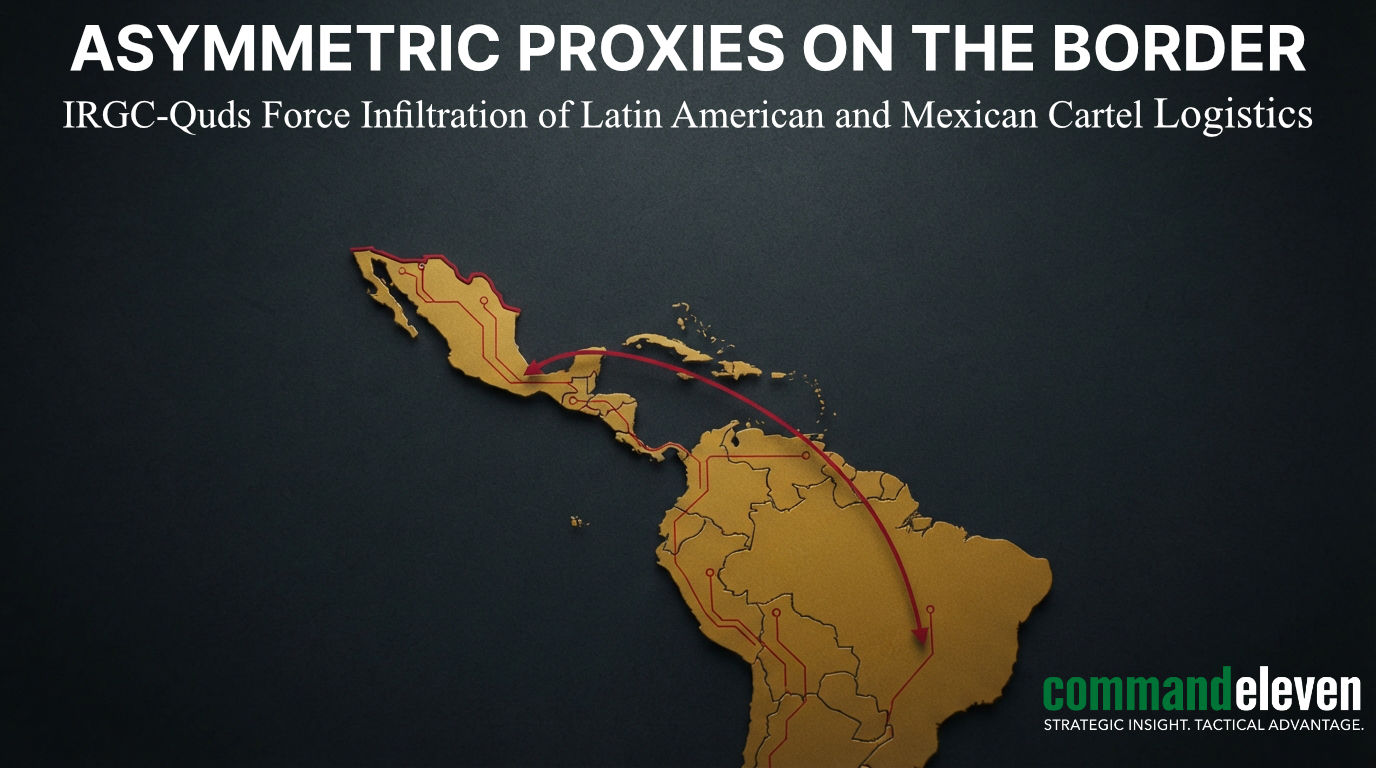
This assessment examines the three-decade relationship between Iran’s Islamic Revolutionary Guard Corps-Quds Force, IRGC-QF, its Lebanese proxy Hezbollah, and criminal logistics networks spanning Latin America and Mexico. It traces the evolution from diaspora-based fundraising in the Tri-Border Area during the 1990s, through the institutionalized narco-trafficking partnerships exposed by DEA Project Cassandra and Project Titan, to the direct operational contact demonstrated by the 2011 assassination plot involving Los Zetas, and concludes with an assessment of contemporary risk indicators amid the intensified cartel militarization observed in Mexico through 2026.
The infrastructure connecting Iranian state proxies to Latin American and Mexican cartel logistics is not a recent development responding to current tensions between Washington, Tehran, and Mexican security forces. It is a mature financial and logistical architecture built over three decades, tested and refined through successive law enforcement campaigns, and still functionally intact. What has changed by 2026 is the operating environment around it: renewed US military posture toward Mexican cartels through the newly stood-up Joint Interagency Task Force-Counter Cartel, the killing of CJNG leader El Mencho in February 2026, and the resulting wave of cartel instability all create both new interdiction opportunities and new incentives for Hezbollah-linked financial facilitators to deepen relationships with whichever cartel factions emerge from the current realignment.
IRGC-QF does not operate cartel logistics directly. It operates through a layered proxy structure, principally Hezbollah’s Business Affairs Component, that has embedded itself so deeply within Latin American narco-trafficking financial infrastructure that the distinction between terrorist financing and organized crime has become functionally meaningless at the operational level. This is not a partnership of ideological convenience. It is a durable commercial integration, sustained across changes in cartel leadership, changes in Iranian government, and periods of intense law enforcement pressure, because it serves the same function for both sides: laundering capacity and smuggling infrastructure for the cartels, hard currency and logistics access for Hezbollah and, through it, for the IRGC-QF’s broader external operations budget.
Sourcing and Analytical Confidence
This assessment draws on US Department of Justice indictments, Treasury OFAC designations, DEA public reporting on Project Cassandra and Project Titan, congressional testimony, and analysis from established Middle East and counter-terrorism finance research institutions, cross-referenced against Latin American financial intelligence unit reporting where available. Historical claims, particularly those concerning the Joumaa network and the Business Affairs Component, rest on a well-documented public record spanning multiple prosecutions and designations across more than a decade. Contemporary claims concerning 2025-2026 developments rest on a comparatively thinner and more mixed reporting base, and are graded accordingly.
| Tier | Definition | Application in This Assessment |
| CONFIRMED | Established through DOJ indictment, Treasury OFAC designation, or corroborated multi-outlet reporting on a specific named individual, network, or incident. | Used for the Joumaa network, the BAC designation, the 2011 assassination plot, and named designations throughout. |
| ASSESSED | Analytical judgment on organizational relationships, revenue-sharing, or intent, drawn from pattern analysis and corroborating but incomplete reporting. | Used for the degree of direct IRGC-QF command influence over cartel-facing operations versus Hezbollah-proxy autonomy. |
| SPECULATIVE / SINGLE-SOURCE | Claims from a single outlet without independent corroboration, included only where materially relevant to current risk framing. | Applied specifically to the ‘Mukhtar unit.’ |
A specific sourcing caution applies to this dossier given the subject matter’s popularity within both legitimate counter-terrorism finance research and lower-quality alarmist commentary. Several outlets covering the IRGC-cartel relationship in 2026 blend well-documented historical fact with speculative or theologically motivated framing not suited to a professional intelligence product. This assessment has deliberately excluded such material from its evidentiary base while retaining awareness of its circulation, since analysts should expect client and public audiences to have encountered the more sensational version of this narrative.
Historical Foundations: IRGC-QF Strategy in the Western Hemisphere
IRGC-QF’s Western Hemisphere presence was never built around ideological outreach or recruitment in the way its Middle Eastern proxy relationships were constructed. Instead, it exploited pre-existing Lebanese Shia diaspora communities established across Latin America since the early twentieth century, with the largest concentration in the Tri-Border Area where Paraguay, Argentina, and Brazil meet. The free trade zone centered on Ciudad del Este offered a combination of weak financial oversight, high cash-transaction volume, and an established Lebanese business community that provided natural cover for fundraising, and later, more direct financial facilitation on Hezbollah’s behalf.
The 1992 bombing of the Israeli embassy and the 1994 bombing of the AMIA Jewish community center, both in Buenos Aires and both attributed to Hezbollah with Iranian state direction, demonstrated the region’s utility as an operational theater well before its narco-trafficking role matured. These attacks established the operational precedent that Hezbollah, and by extension its IRGC-QF sponsors, viewed Latin America as more than a passive fundraising base. The subsequent two decades saw a gradual shift in emphasis from diaspora donation and extortion within Lebanese business communities toward direct participation in the region’s most lucrative illicit economy: cocaine trafficking to the United States and Europe.
Demographic scale matters to this picture as well. Lebanese and broader Levantine diaspora communities across Latin America number well into the hundreds of thousands, concentrated not only in the Tri-Border Area but in commercial hubs across Colombia, Venezuela, Brazil, and parts of Central America. The overwhelming majority of this diaspora has no connection whatsoever to Hezbollah or IRGC-QF activity, a point this assessment stresses explicitly given the risk that broad-brush characterization of diaspora communities can itself become a harmful and analytically lazy shorthand. The networks examined in this dossier represent a narrow, specifically identified subset of individuals operating within or adjacent to these communities, not a characteristic of the communities themselves.
Operational Architecture: The Business Affairs Component
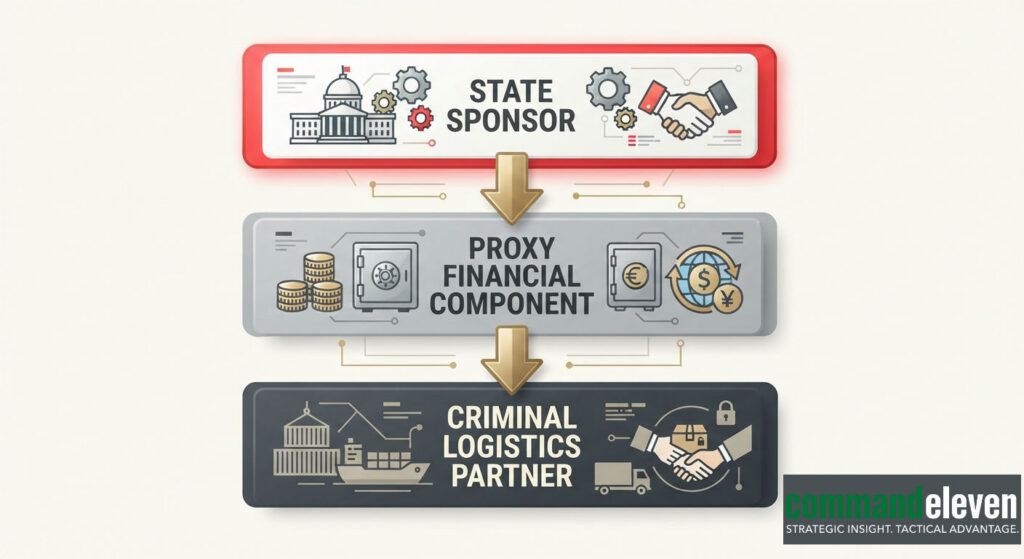
The organizational vehicle through which this shift occurred is Hezbollah’s Business Affairs Component, BAC, an arm of the group’s External Security Organization, also known as the Islamic Jihad Organization, founded by Hezbollah’s late operational mastermind Imad Mughniyah. The DEA formally identified and named the BAC in 2015 reporting, though its activities predate that public naming by well over a decade. The BAC’s function is best understood as a commercial division operating with the security discipline of a terrorist support apparatus: compartmented cells, dedicated financial specialists, and a structure designed to insulate senior Hezbollah leadership from direct exposure to narcotics prosecution risk.
BAC-linked operatives established business relationships with major Latin American criminal organizations, most significantly Colombia’s La Oficina de Envigado, historically the successor network to Pablo Escobar’s Medellín infrastructure, which supplies substantial cocaine volume to European and United States markets. Through these relationships the BAC positioned itself not merely as a money launderer for hire but as an integrated logistics participant, coordinating multi-ton cocaine shipments across Central America into Mexico, where Mexican cartel partners assumed responsibility for the final transport leg into the United States.
Case Study: The Ayman Joumaa Network
The most extensively documented instance of this integration is the network run by Ayman Saied Joumaa, a dual Colombian-Lebanese national who relocated his operational base to Lebanon after Colombian law enforcement pressure intensified in the late 1990s. DEA’s decade-long Project Cassandra, alongside the related Project Titan targeting Colombian-Lebanese money laundering alliances, ultimately exposed a network responsible for laundering an estimated 200 million dollars per month in drug proceeds through bulk cash smuggling and a web of Lebanese money exchange houses and used-car businesses spanning the United States, Latin America, Africa, and Southeast Asia.
Joumaa’s organization coordinated the smuggling of at least 85 tons of Colombian cocaine through Central America and into Mexico in direct partnership with Los Zetas, one of Mexico’s most violent cartel formations, itself founded by former Mexican special forces personnel. The US Department of Justice indicted Joumaa in 2011; Treasury designated his network the following year, explicitly naming him a key Hezbollah supporter in South America. Joumaa took a commission of eight to fourteen percent on laundering operations, a portion of which is assessed to have flowed back into Hezbollah’s broader financing structure. Joumaa himself has never been apprehended and remains outside US custody.
The Joumaa case is significant for this assessment not primarily as an isolated prosecution but as documentary proof of concept: it establishes, through court-admissible evidence rather than analytical inference, that a Hezbollah-linked financial network operated as an embedded commercial partner within a major Mexican cartel’s trafficking operations for well over a decade, generating laundering volume at a scale that would have required sustained institutional cooperation rather than opportunistic one-off transactions.
The corporate architecture Joumaa built also merits attention as a template that has since been replicated by other facilitators identified in Section VII. Rather than operating a single laundering channel, his organization ran a portfolio of nominally independent commercial enterprises, used-car dealerships, money exchange houses, and import-export firms, spread across multiple jurisdictions specifically so that the disruption of any single business line would not compromise the network’s overall laundering capacity. This structural redundancy, more characteristic of a resilient commercial holding company than a conventional criminal cell, is a large part of why the network survived over a decade of active DEA investigation before producing an indictment, and why its principal figure remains at large today.
The Colombia-Venezuela Corridor

A parallel and overlapping network operated through the Colombian border town of Maicao and extended into Venezuela. Chekry Harb established trafficking relationships with La Oficina de Envigado in the early 2000s, moving cocaine toward Syria via Jordan and demonstrating that the Latin American cocaine pipeline fed Hezbollah-linked markets well beyond the Western Hemisphere. The Nassereddine brothers operated across both Colombia and Venezuela, at points trading directly with the Revolutionary Armed Forces of Colombia, FARC, exchanging cocaine for weapons in a transaction structure that further blurred the line between narco-trafficking profit and armed insurgent logistics support. Ali Mohamad Saleh, a former Hezbollah fighter, ran a parallel Maicao-based operation spanning drugs, weapons, contraband, and bulk cash smuggling.
This corridor’s persistence through multiple changes in Colombian government, the FARC’s eventual demobilization, and sustained US law enforcement pressure is itself an analytically important data point. Networks built around family and clan relationships within the Lebanese diaspora business community have proven considerably more durable than networks built around any single cartel leadership structure, since removing a cartel kingpin does not disrupt the financial facilitation layer operating alongside and, in important respects, independently of any single criminal organization’s chain of command.
The 2011 Inflection Point: Direct Contact With Los Zetas
In 2011, US federal prosecutors charged Manssor Arbabsiar, an Iranian-American, alongside an IRGC-QF-linked co-conspirator, with attempting to arrange the assassination of Saudi Arabia’s ambassador to the United States on US soil. The plot’s operational core involved recruiting individuals Arbabsiar believed to be affiliated with Los Zetas to carry out the killing, offering substantial payment for their services. Those individuals were in fact undercover DEA informants, and the plot was disrupted before any attack occurred. Arbabsiar pleaded guilty; the case remains one of the only publicly documented instances of an IRGC-QF-linked actor attempting to directly recruit cartel-affiliated operatives for an act of lethal violence rather than for financial or logistics facilitation.
The significance of the 2011 case for this assessment is structural rather than incidental. It demonstrates that IRGC-QF planners viewed Mexican cartel networks as a plausible operational resource for tasking beyond narcotics logistics, specifically for deniable violence against a hardened target on US soil, a capability set fundamentally different from money laundering or smuggling-route access. Whether that assessment of cartel operational reliability for lethal tasking has since been revised, expanded upon, or abandoned by IRGC-QF planning cells is not established in open-source reporting, and this assessment does not speculate beyond the documented 2011 case.
State Sponsorship Layer: Venezuela’s Fractured Transition

For nearly two decades, Venezuela’s alignment with Tehran under successive Chavista and Bolivarian governments provided a state-level force multiplier that individual criminal networks could not replicate on their own. Iranian state and IRGC-linked entities benefited from Venezuelan diplomatic cover, document facilitation including passport issuance to non-Venezuelan nationals, and financial infrastructure access that operated with a degree of legal protection unavailable to purely criminal actors. Then-Vice President Tareck El Aissami, sanctioned by the US Treasury as a drug kingpin and later indicted on narco-terrorism charges, is the figure most closely associated with this facilitation role, alongside Hezbollah-linked diplomatic and clan networks including Ghazi Nasr al Din and the Nassereddine family, both separately designated by OFAC as global terrorists for their roles bridging Venezuelan state functions and Hezbollah financing.
This picture changed fundamentally in January 2026. Following a sustained US military campaign designated Operation Absolute Resolve, US forces captured Nicolas Maduro and extracted him from Venezuela, ending his presidency after more than a decade in power. Delcy Rodriguez, Maduro’s vice president, assumed the presidency in an acting capacity, and the ruling PSUV party structure has continued to govern, meaning the Chavista political apparatus that enabled the IRGC-QF and Hezbollah facilitation network described above remains substantially intact even as its founding leadership has been removed. A devastating pair of earthquakes in June 2026, which killed more than 6,100 people, has further complicated the US-backed stabilization effort and diverted both Venezuelan governmental and international attention away from security and transition priorities.
The practical implication for this assessment’s subject matter is genuine uncertainty rather than a clear directional judgment. Maduro’s removal eliminates the specific senior patron most closely tied to the network’s state-level protection, and ongoing US pressure on the acting government to curtail ties with adversarial states creates at least the possibility of reduced official tolerance for Hezbollah-linked activity going forward. Against that, the underlying PSUV governing structure, security services, and mid-level officials who built and sustained these facilitation relationships over two decades remain largely in place, and a government focused on earthquake response, political legitimacy, and US-mediated transition negotiations may have limited capacity or incentive to prioritize dismantling a criminal-terror financing architecture that predates the current crisis. Analysts should treat Venezuela’s state sponsorship role as currently in flux rather than either terminated or unchanged, and should watch the outcome of the transition negotiations that began in August 2026 as the clearest forward indicator.
This state sponsorship layer matters analytically because it explains the network’s resilience against purely law-enforcement-driven interdiction. A criminal network operating without state protection can be degraded through arrests, asset seizure, and financial designation. A network operating with even partial state protection retains access to diplomatic channels, official documentation, and financial systems that remain outside the practical reach of foreign law enforcement, regardless of how well-resourced the investigating agency’s evidentiary case may be. Whether Venezuela’s post-Maduro transition ultimately strengthens or weakens that protective layer is likely to be one of the more consequential open variables shaping this network’s trajectory over the next twenty-four months, and merits its own dedicated monitoring track independent of the broader US-Venezuela political transition question.
Financial Architecture: Laundering Mechanisms and Evolution
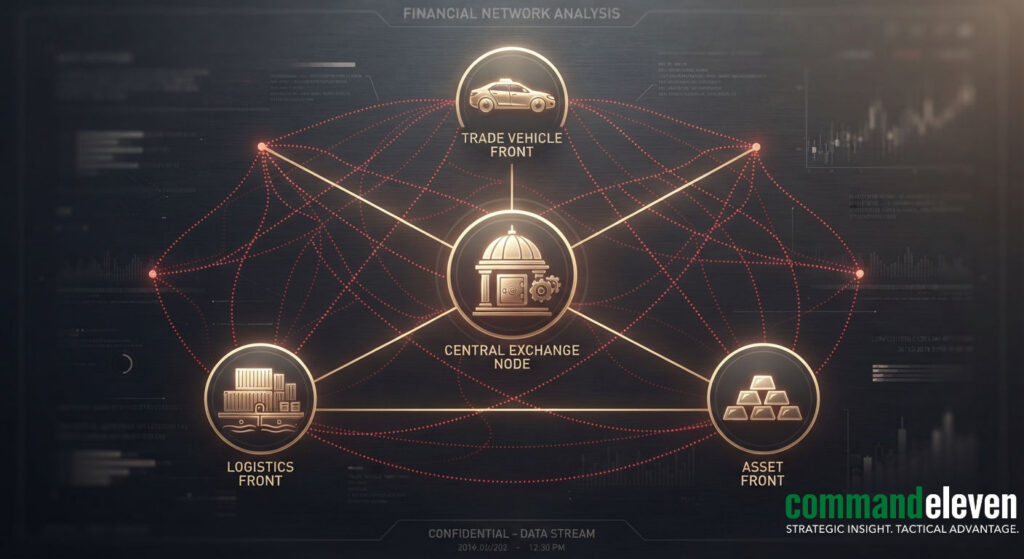
The Black Market Peso Exchange has served as a foundational laundering mechanism throughout this network’s operation, allowing drug proceeds generated in US dollars to be converted into usable Colombian or regional currency through trade-based money laundering schemes that disguise financial transfers as legitimate commercial import-export activity. Free trade zones, most prominently Ciudad del Este in the Tri-Border Area, have offered a physical environment where high cash volume and comparatively weak customs oversight allow this laundering to occur at scale with reduced detection risk relative to formal banking channels.
More recent reporting indicates continued evolution of this financial architecture toward gold markets, shell company structures, and cryptocurrency exchanges, mirroring the broader trend toward decentralized settlement documented across other criminal-terror financing contexts. This evolution does not represent abandonment of legacy mechanisms; the Black Market Peso Exchange and free trade zone laundering remain active, but are now supplemented rather than replaced by digital settlement layers that offer faster cross-border movement of value with a correspondingly higher burden on financial intelligence units attempting to trace it.
A further complicating trend involves the growing use of professional Chinese underground banking networks as a laundering intermediary layer across the broader Latin American narco-trafficking ecosystem, a development documented primarily in relation to Mexican and Colombian cartel proceeds rather than Hezbollah-linked flows specifically. Where these Chinese money-laundering organizations intersect with Hezbollah-linked facilitators, whether through shared cartel clients, shared free trade zone infrastructure, or direct service arrangements, remains poorly documented in open-source reporting and represents a meaningful analytical gap. Given both networks’ demonstrated sophistication in trade-based money laundering, and their shared incentive to minimize detection risk by diversifying laundering channels, this assessment judges continued convergence between the two ecosystems as plausible and worth dedicated future monitoring, while stopping short of asserting an established operational relationship absent stronger evidence.
Contemporary Indicators: Cartel Militarization Through 2026
The operating environment surrounding this network shifted materially in early 2026. The Joint Interagency Task Force-Counter Cartel, established in January 2026 under US Northern Command and headquartered at Davis-Monthan Air Force Base, was created specifically to coordinate US intelligence-sharing and operational support for Mexican counter-cartel efforts. That task force’s intelligence support contributed to the February 2026 operation in which Mexican armed forces killed CJNG leader El Mencho and six others in Tapalpa, Jalisco. The killing triggered a significant wave of retaliatory cartel violence across at least twenty Mexican states, including roughly 250 documented roadblocks, arson attacks, and a car bombing that killed a Mexican Army officer coordinating security operations.
This period of cartel instability and leadership contest is analytically relevant to the IRGC-QF relationship discussed in this assessment because periods of cartel fragmentation historically create openings for external financial facilitators to renegotiate or deepen relationships with emerging factional leadership. A Hezbollah-linked financial network with decades of institutional relationship-building experience in the region is well positioned to offer continuity of laundering and logistics services to whichever CJNG successor faction or rival organization ultimately consolidates control, regardless of that faction’s specific leadership or branding.
Assessing an Unverified Claim: The ‘Mukhtar Unit’ Reporting
A single outlet report circulating since mid-2026 alleges the existence of a dedicated IRGC-QF entity, described as the ‘Mukhtar unit,’ tasked with establishing covert coordination directly with Mexican cartels to build border-adjacent logistics pipelines inside the United States, reportedly connected to broader intelligence concerns about threats to senior US officials. This assessment treats this specific claim as unverified. It has not been independently corroborated by the established reporting chains, government designations, or research institutions that underpin the historical sections of this dossier, and it originates from an outlet without a demonstrated track record of exclusive, subsequently-verified counter-terrorism finance reporting.
The appropriate analytical posture toward this claim is neither dismissal nor incorporation as fact. The underlying premise, that IRGC-QF might seek to formalize or upgrade its historically indirect, proxy-mediated relationship with Mexican cartel logistics into something more directly tasked and controlled, is consistent with the broader trajectory documented throughout this assessment and would not represent a significant doctrinal departure from the 2011 Zetas plot precedent. Absent independent corroboration, however, this assessment declines to treat the specific ‘Mukhtar unit’ designation or its reported activities as an established fact, and flags it for continued monitoring as new reporting emerges.
Regional Tension as an Activation Variable
Direct US and Israeli military action against Iranian nuclear and IRGC-linked targets during 2026 raises a distinct analytical question from the historical financing relationship documented in this assessment: whether heightened confrontation between Iran and Western states increases the probability that IRGC-QF activates its Latin American proxy infrastructure for retaliatory operational purposes rather than continuing to use it purely for financial facilitation. The 2011 Zetas plot demonstrates that IRGC-QF planners have, at least once, assessed cartel-adjacent networks as a viable resource for exactly this kind of retaliatory tasking, which is the strongest available precedent for judging current risk.
This assessment does not find open-source evidence of a current, specific plot analogous to the 2011 case. It does judge that the underlying capability, an established, financially entrenched relationship with cartel logistics networks capable of moving people and material across the US southern border with a demonstrated degree of operational security, would provide IRGC-QF a meaningfully faster path to retaliatory action inside the United States than building comparable access from a standing start. Homeland security planners should treat the financing relationship documented throughout this dossier not only as a counter-narcotics and terrorism-finance concern but as a latent operational capability whose activation risk rises and falls with the broader trajectory of US-Iran confrontation, independent of whether that capability has been exercised for lethal purposes since 2011.
Strategic and Homeland Security Implications
The persistence of this financial and logistics infrastructure across three decades, multiple changes in cartel leadership, and sustained law enforcement pressure indicates that any interdiction strategy premised on disrupting a single network, individual, or cartel relationship is addressing a symptom rather than the underlying structure. The Business Affairs Component and its associated facilitators have demonstrated repeated capacity to reconstitute relationships with new criminal partners following the removal or prosecution of previous ones, a resilience pattern directly analogous to the extraction-economy continuity discussed in CommandEleven’s broader criminal-terror nexus research.
For US homeland security planning specifically, the documented 2011 precedent of attempted direct cartel tasking for lethal operations, combined with the current period of cartel fragmentation following El Mencho’s death, warrants continued vigilance regarding the potential for IRGC-QF to view a destabilized and realigning cartel landscape as an opportunity to establish new or deepened operational relationships, independent of whether the specific ‘Mukhtar unit’ claim proves accurate.
Policy and Interdiction Recommendations
- Prioritize financial intelligence resources against the facilitation layer, money exchange houses, free trade zone commercial fronts, and gold and crypto settlement points, rather than concentrating primarily on individual cartel or Hezbollah-linked figures, given the demonstrated durability of facilitation infrastructure relative to any single named operative.
- Expand JIATF-CC’s intelligence-sharing mandate explicitly to include financial intelligence on Hezbollah-linked laundering networks operating within Mexican cartel logistics, ensuring counter-cartel and counter-terrorism finance efforts are not run as separate, uncoordinated tracks.
- Sustain and expand Treasury OFAC designation authority against Venezuelan officials and state-adjacent entities providing document facilitation or financial cover to IRGC-QF and Hezbollah-linked actors, treating the state sponsorship layer as a distinct target set from the criminal networks it protects.
- Maintain rigorous sourcing standards when public-facing analysis addresses this topic, explicitly distinguishing well-documented historical prosecutions and designations from single-source or unverified contemporary claims, given this subject area’s demonstrated vulnerability to sensationalized and theologically or politically motivated commentary.
- Monitor the post-El Mencho cartel realignment specifically for indicators of renewed or deepened Hezbollah-linked facilitator engagement with emerging CJNG successor factions, using the historical pattern of facilitator continuity across cartel leadership changes as the primary analytic frame.
- Track the outcome of Venezuela’s political transition negotiations as a distinct forward indicator for the state sponsorship layer, recognizing that removal of Maduro personally does not equate to removal of the PSUV governing apparatus that historically enabled IRGC-QF and Hezbollah facilitation.
- Build dedicated analytical capacity examining potential convergence between Hezbollah-linked and Chinese underground banking laundering channels serving Latin American cartel clients, an emerging and currently under-documented risk area distinct from the legacy Black Market Peso Exchange architecture.
Strategic Outlook
Expect the underlying financial and logistics architecture connecting IRGC-QF, Hezbollah’s Business Affairs Component, and Latin American cartel networks to persist through the remainder of 2026 regardless of the outcome of the current CJNG leadership contest, given its demonstrated resilience across previous periods of cartel instability. The more consequential open question is whether the currently unverified reporting on a dedicated direct-tasking unit gains independent corroboration in the coming months; if it does, it would represent a meaningful doctrinal shift from the historically indirect, financially-mediated relationship this assessment has documented toward something closer to the direct operational tasking attempted, and disrupted, in 2011.
Absent such corroboration, the most probable trajectory remains continuity: a facilitation network that has outlasted individual cartel leaders, Iranian government administrations, and successive US law enforcement campaigns is unlikely to be substantially degraded by the current period of Mexican cartel instability, and is more likely to adapt to whatever leadership structure emerges from it, as it has consistently done since the network’s documented origins in the early 2000s.
Venezuela’s transition represents the single variable most capable of altering this trajectory in either direction over the coming eighteen months. A genuine political transition that installs a government less permissive of Hezbollah and IRGC-QF activity would remove the state sponsorship layer that has historically insulated this network from the full weight of law enforcement pressure, a development this assessment would treat as the most significant structural shift in the network’s operating environment since the network’s documented origins. Conversely, a stalled or reversed transition that leaves the current PSUV apparatus consolidated in power, particularly if post-earthquake reconstruction priorities crowd out security-sector reform, would likely preserve the network’s access largely intact. CommandEleven will continue monitoring both tracks and will issue a dedicated follow-on assessment should the Venezuelan transition reach a clearer resolution.