Technical Takeaways
- Angled Geometry Deflects Conventional Kinetic Mass: Hardened subterranean networks decouple survival from surface defensive mass. By utilizing angled blast-deflection doglegs and reinforced masonry overhead arches within stable granite formations, irregular networks naturally dissipate the overpressure waves of surface-level bunker-buster munitions, requiring state forces to transition from flat-trajectory ballistics to multi-spectral subsurface targeting.
- Multi-Spectral Arrays Close the Structural Blindness Gap: Pinpointing deep bunker complexes requires fusing airborne quantum gravimetric sensors with ground-penetrating radar grids. Cross-referencing real-time subsurface density variations against baseline geological profiles allows technical units to reconstruct uncorrupted underground blueprints and calculate the exact structural weak points for targeted structural interdiction.
- Robotic Scouting Insulates High-Risk Entry Stacks: Executing tactical penetration within constrained subterranean enclaves demands autonomous technical synchronization. Deploying tracked ground rovers and micro-aerial tunnel drones allows tactical teams to scout narrow shafts, map localized threat vectors, and locate ambush cells before human entry stacks commit to the physical clearance loop.
Executive Summary
The systematic construction and tactical exploitation of subterranean asymmetry by irregular militant networks defines the primary operational challenge facing state interdiction forces within topographically complex frontier sectors. Hostile proxy formations systematically deploy hardened tunnel networks along the Pakistan-Afghanistan border to insulate core command infrastructures, weapons storage depots, and cross-border logistical channels from conventional surface surveillance and precision kinetic strikes. This subterranean paradigm integrates physical mountain geomorphic friction with decentralized engineering configurations to nullify the state’s qualitative technological superiority in airborne reconnaissance and flat-trajectory ballistic weaponry. Traditional militarized counter-insurgency doctrines fail to achieve long-term containment because static perimeter defenses prioritize visible ground-level features over multi-layered subterranean logistics grids. Countering this entrenched threat profile demands an aggressive operational transition toward a unified, data-driven interdiction architecture that pairs multi-spectral structural mapping with localized physical sanitization. Reclaiming sovereign dominance along the frontier depends entirely on the state’s capacity to execute real-time subterranean tracking and isolate underground supply lines at their surface intersection nodes. This dossier evaluates the technical engineering specifications, structural mapping mechanics, and decentralized tile defense frameworks required to neutralize hardened tunnel architectures permanently.
Geomorphic Ingress and Tunnel Structural Specifications
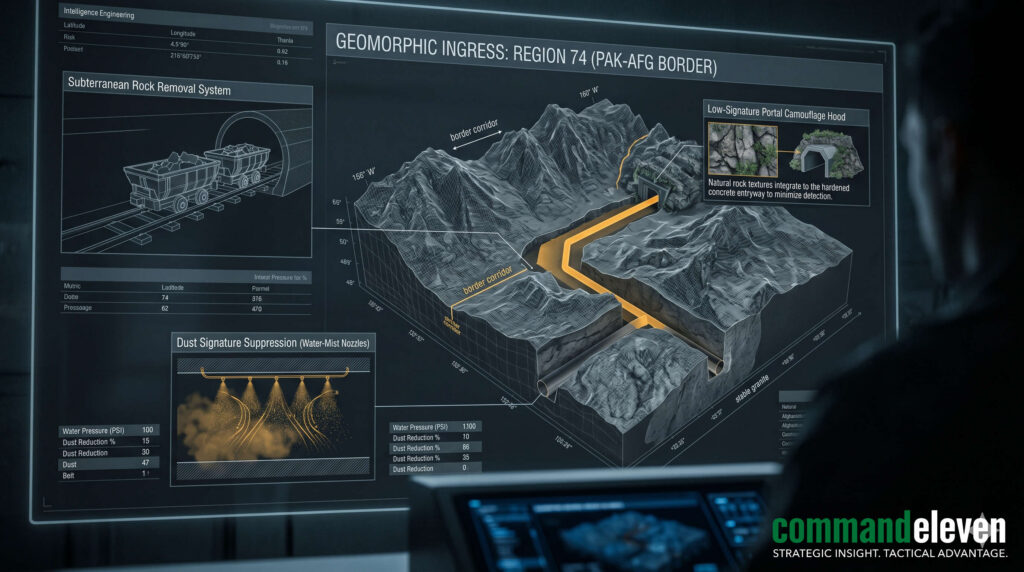
Irregular militant networks exploit specific geomorphic friction points inside the vertical mountain structures of the Pakistan-Afghanistan border to conceal tunnel entry nodes. Engineering cells utilize advanced geological mapping tools to select stable granite formations and deep rock fissures that naturally dissipate the impact energy of state bunker-buster munitions. These subterranean complexes avoid straight geometric corridors, using a series of sharp, angled offsets to limit the blast wave propagation from surface kinetic impacts. The internal dimensions remain tightly constrained to restrict light signatures and prevent the efficient deployment of heavy militarized clearing equipment by state entry stacks. This structural configuration establishes a resilient physical sanctuary that protects insurgent command elements and advanced weapon payloads from conventional detection arrays.
- Angled blast-deflection doglegs execute instantaneous horizontal direction shifts within the initial tunnel entry sector, neutralizing the overpressure waves generated by conventional surface detonations.
- Reinforced masonry overhead arches distribute structural weight evenly across unstable fault zones, preventing localized tunnel cave-ins during prolonged seismic or kinetic activity.
- Low-signature portal camouflage hoods mimic local geomorphic rock faces using indigenous composite materials, blinding the optical identification sensors of high-altitude reconnaissance aircraft.
- Decentralized air ventilation shafts route internal exhaust fumes through complex subterranean rock fractures, cooling emission signatures to evade airborne thermal imaging detection.
The physical installation of these hardened geomorphic corridors directly insulates the proxy network’s logistical loop from state air superiority assets. Concurrently, operational analysis indicates that the engineering cells coordinate tunnel construction with localized surface water drainage patterns to prevent seasonal structural flooding. The structural integrity of the underground grid remains dependent on the network’s capacity to maintain hidden access entries within remote frontier ravines. Once an entry sector achieves structural stability, the adversary transitions the complex into an active logistical staging hub. This functional evolution requires the immediate integration of secure, internal communication and command assets.
The insurgent formations deploy man-portable tunneling machinery to expand these networks beneath active state border tracking grids without generating distinct acoustic or seismic signatures on ground monitors. These localized excavation activities occur during periods of high ambient environmental noise, such as localized thunderstorms or low-altitude commercial transit operations, to mask construction vibrations. The resulting subterranean pathways extend directly across international administrative lines, establishing unmonitored material transit corridors. This spatial expansion bypasses state-managed border terminal installations completely, creating a persistent crisis of territorial integrity.
- Low-vibration electric jackhammers process hard rock materials without transmitting high-frequency acoustic waves into regional geophone surveillance lines.
- Subterranean rock removal cars utilize non-metallic rubber-coated wheels to transport excavated debris silently through deep underground transit tracks.
- Portable pneumatic shoring jacks stabilize newly cut rock faces instantly, eliminating the loud structural impacts associated with legacy wooden timber driving.
- Localized water-mist suppression nozzles precipitate airborne silica dust within the excavation workspace, neutralizing visual emission clouds at the primary exit portals.
The application of low-signature excavation mechanics ensures that the moving cells construct massive underground sanctuaries without triggering automated frontier defense alerts. This engineering buffer allows the proxy alliance to pre-position heavy weapon components and foreign tactical advisors directly inside contested operational zones. Once the tunnel network links separate border valleys, the adversary gains the capacity to execute rapid kinetic maneuvers with zero warning signatures. The state cannot counter this subterranean expansion through legacy surface-level border guarding frameworks. Reclaiming sovereignty requires deploying advanced subsurface mapping technologies.
Multi-Spectral Subsurface Mapping and Structural Geometry Analysis
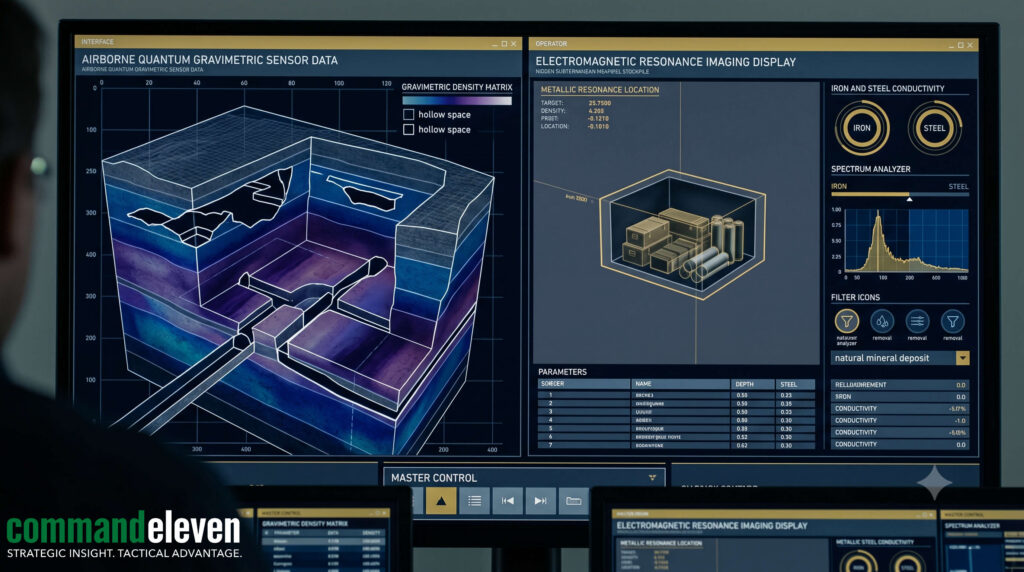
The state counters subterranean asymmetry by deploying advanced multi-spectral subsurface mapping arrays to locate and analyze hidden tunnel networks. Technical intelligence units utilize ground-penetrating radar systems and airborne gravimetric sensors to detect density anomalies inside the vertical mountain rock faces. These advanced diagnostic tools cross-reference live subsurface telemetry against baseline geological models, automatically flagging hollow cavities and reinforced underground structures. This automated data fusion eliminates the visual blindness that historically protected deep bunker complexes from state strategic interdiction. The resulting digital model provides tactical commanders with complete structural visibility before launching physical clearance operations.
- Airborne quantum gravimetric sensors measure micro-gal density variations in regional mountain geometry, mapping the exact structural path of deep subterranean voids.
- Ground-penetrating radar arrays transmit low-frequency electromagnetic pulses into the earth, recording signal reflection delays to reconstruct underground tunnel blueprints.
- Distributed acoustic sensor strings monitor regional micro-seismic waves, using automated filtering algorithms to triangulate active underground construction and personnel movements.
- Multi-spectral borehole camera pods drop into vertical geomorphic fractures to capture high-definition internal visuals of hidden insurgent weapon caches.
The digital reconstruction of the subterranean layout closes the persistent intelligence gap exploited by militant networks to execute surprise cross-border incursions. Concurrently, operational tracking data indicates that this subsurface mapping capability directly accelerates the targeting velocity of state precision kinetic strike platforms. With uncorrupted geometric blueprints uploaded to command centers, analysts calculate the exact structural weak points where kinetic mass will cause maximum tunnel collapse. This technical advantage neutralizes the protective utility of deep granite overhead cover, exposing the core leadership nodes to targeted elimination.
The technical units pair subsurface mapping arrays with portable electromagnetic resonance imaging systems to detect hidden metallic stockpiles inside the tunnel corridors. These specialized ground sensors identify concentrated deposits of ammunition boxes, weapon barrels, and electronic communication hardware through multiple meters of solid rock. By pinpointing the exact coordinates of underground logistics caches, the state prevents the adversary from executing covert resource rotation maneuvers during active engagements. This sensing network strips the tunnel architecture of its utility as a secure storage repository.
- Electromagnetic resonance imaging pods read the unique metallic conductivity signatures of hidden weapons caches, separating tactical materials from natural iron ore deposits.
- High-power inductive loop locators scan shallow cave floors to map the path of buried electronic command wires and power distribution lines.
- Portable magnetometers log local magnetic field anomalies triggered by the presence of reinforced steel doors and subterranean structural columns.
- Radio-frequency spectrum sniffing nodes intercept weak electromagnetic leaks escaping from unshielded internal communication hardware inside the entry vaults.
The systematic mapping of the tunnel’s internal material composition transforms the underground fortress into a highly transparent operational grid. The state utilizes this technical data to plan targeted structural interdictions, sealing high-value assets inside their geomorphic vaults before they can deploy to the surface. This diagnostic capability serves as the operational precursor for high-velocity physical penetration and structural sanitization campaigns. Once the geometric and material profiles are stabilized, the state initiates active tactical entry protocols to clear the network.
Subterranean Tactical Penetration and Robotic Exploration Protocols
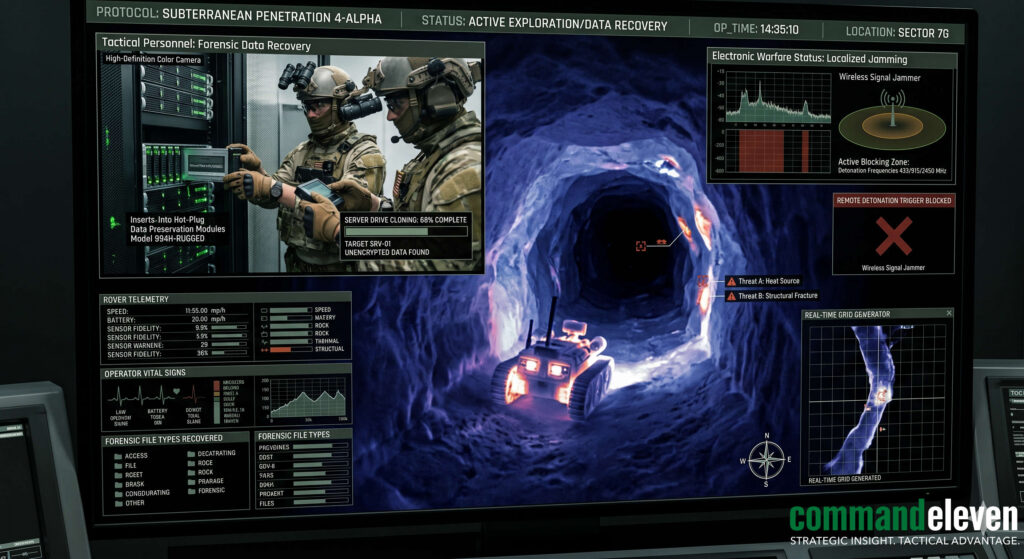
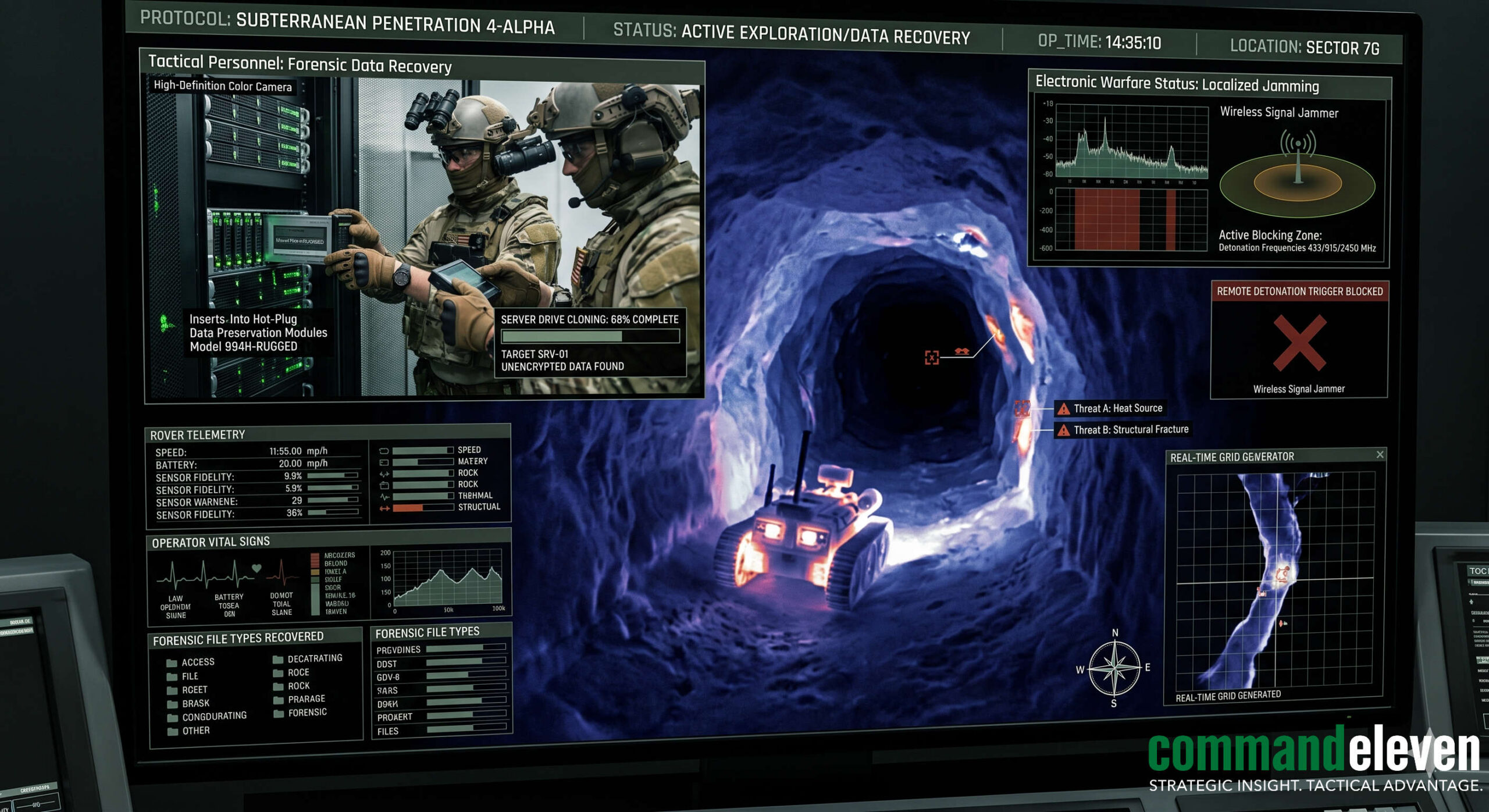
Specialized counter-terrorism task forces execute high-velocity penetration operations inside fixed tunnel networks to collapse the insurgent command structure permanently. These tactical maneuvers operate within extreme physical constraints, characterized by total darkness, unbreathable atmospheres, and pre-positioned explosive booby traps. The penetration teams deploy autonomous robotic exploration platforms ahead of the human entry stack to scout narrow subterranean shafts and map localized threat vectors in real time. This technological synchronization preserves state manpower while ensuring the systematic sanitization of the underground enclave.
- Autonomous tracked ground rovers navigate rugged tunnel floors independently, utilizing synchronized laser scanners to transmit real-time 3D tactical maps to entry teams.
- Micro-aerial tunnel drones execute low-altitude flight runs through narrow shafts, using acoustic obstacle avoidance sensors to locate hidden insurgent ambush cells.
- Thermal imaging weapon sights slice through absolute underground darkness, allowing tactical operators to identify hostile thermal signatures with absolute precision.
- Closed-circuit rebreather breathing apparatuses insulate entry personnel from toxic gas pockets and synthetic smoke agents deployed by defenders to cause sensory rupture.
The physical penetration of the tunnel network directly neutralizes the geographical insulation historically enjoyed by frontier militant factions. Concurrently, operational data reveals that these tactical sweeps prevent the enemy from executing automated data destruction commands on internal command servers. The speed of the robotic-led entry sequence allows the state to capture uncorrupted communication hardware, satellite transceivers, and code books before the defensive cell can activate self-destruct scripts. The tunnel transitions from a secure sanctuary into a primary intelligence harvesting node for national tracking centers.
The entry teams coordinate physical tunnel clearance with the immediate deployment of specialized electronic extraction kits to secure enemy operational data onsite. Technical operators isolate recovered computing devices from external communication frequencies, blocking remote handlers from executing data-wiping commands via hidden secondary relays. This rapid digital harvesting provides state intelligence with instant visibility into transnational financial channels, upcoming operational timelines, and corrupted actors within domestic customs registries. The captured data flows directly into provincial analytical networks to guide subsequent interdiction vectors.
- Hot-plug data preservation modules bypass standard operating system login locks, freezing active processes to secure unencrypted data partitions instantly.
- Portable high-speed storage duplicators execute exact bit-stream forensic copies of recovered hard drives, generating verified replicas for immediate database integration.
- Automated software decryption platforms process recovered digital credentials and cryptographic key files harvested from physical notebooks found at the scene.
- Localized wireless signal jammers saturate the internal tunnel spectrum, blocking remote activation triggers from detonating pre-positioned electronic improvised explosive devices.
The recovery of uncorrupted digital ledgers and cross-border operational maps provides the state with complete visibility into the structural infrastructure of the irregular alliance. This intelligence windfall allows tracking cells to map out the complete downstream distribution matrix of the network, including active safehouses inside high-density metropolitan zones. By converting the subterranean node into an information source, the state ensures that every physical engagement accelerates the systemic collapse of the wider organization. Once the internal data is harvested, the entry teams initiate permanent structural sanitization protocols.
Structural Sanitization and Permanent Tunnel Elimination Mechanics
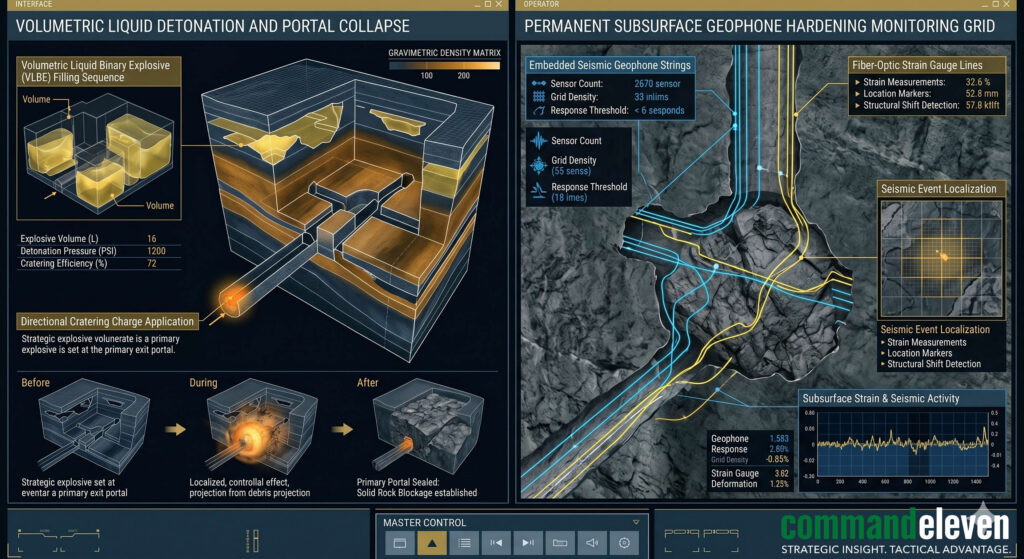
The permanent neutralization of the subterranean threat requires the total physical destruction of the tunnel architecture to prevent future re-occupation by insurgent cells. Engineering corps units deploy specialized liquid explosive mixtures and thermite cutting charges to cause systemic structural collapse across all identified underground sectors. This sanitization process avoids legacy mechanical demolition models, which often fail to damage deep granite complexes permanently. By executing precision volumetric detonations, the state converts the underground transit lines into solid rock blockages, permanently erasing the corridor from the frontier theater.
- Liquid binary explosive mixtures flow into the lowest levels of the tunnel network, filling deep storage cavities before remote electronic detonation to maximize structural displacement.
- High-temperature thermite cutting bars slice through reinforced steel internal columns and structural shoring jacks, triggering immediate overhead ceiling failure.
- Directional cratering block charges detonate with precise focus at primary exit portals, triggering massive rockslides that seal the entry nodes permanently.
- Industrial foaming concrete pumps inject fast-hardening composite materials into shallow tunnel shafts, transforming the transit corridor into an solid block.
The execution of automated structural sanitization permanently removes the physical logistics pipelines that sustained long-term cross-border proxy operations. Concurrently, structural analysis indicates that this permanent elimination model stops the adversary from utilizing legacy networks as staging bases for asymmetric incursions. The geomorphic friction zones are returned to an impassable state, forcing the surviving militant cells to operate across exposed surface terrain. This exposure directly multiplies the tracking utility of state airborne surveillance and precision strike assets.
The engineering units coordinate these physical demolitions with the installation of localized subsurface monitoring grids across the sanitized zone. These automated sensor arrays utilize permanent seismic geophones and acoustic listening nodes embedded directly into the sealed tunnel shafts to detect any subsequent re-excavation attempts by proxy networks. Any physical vibration anomaly or mechanical drilling frequency triggers an immediate, automated alert flag at regional command installations. The state maintains permanent structural oversight over the dead corridor, denying the enemy the opportunity to reclaim the sanctuary.
- Embedded seismic geophone strings log micro-vibrations within the sealed rock mass, utilizing automated pattern matching to identify manual excavation signatures.
- Subsurface acoustic listening nodes monitor internal rock fractures for the distinctive high-frequency sounds associated with pneumatic tool usage.
- Fiber-optic strain gauge lines track minute structural movements inside the sealed shafts, alerting command elements to unauthorized entry attempts.
- Automated portal surveillance arrays integrate facial recognition and motion-tracking sensors to protect the outer perimeter of the collapsed nodes.
The implementation of permanent subsurface monitoring ensures that the sanitized corridor remains closed to hostile exploitation indefinitely. The cartel’s engineering assets can no longer execute stealth tunneling operations to penetrate the state’s frontier defense lines. This physical lockdown isolates the remaining irregular cells operating within adjacent sectors, preparing the environment for the final deployment of decentralized governance and defense models. The state transitions from localized tunnel elimination to the establishment of permanent spatial hardening frameworks.
The Mosaic Defense Architecture and Subterranean Spatial Hardening
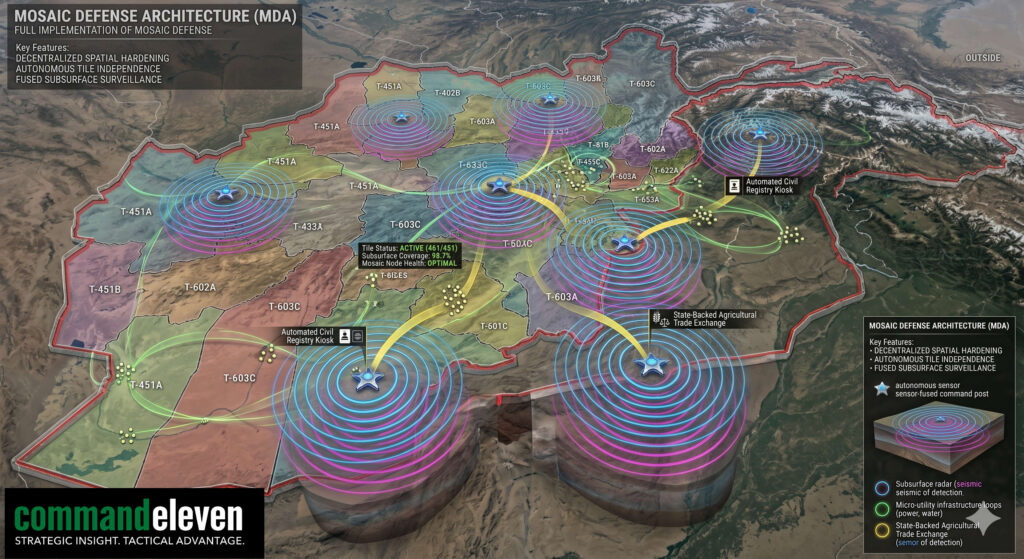
The final stabilization of the frontier perimeter requires the permanent deployment of the CommandEleven Mosaic Defense architecture to lock in state administrative persistence. The military institution replaces fragile centralized border guard footprints with a dense network of autonomous administrative tiles along the entire Pakistan-Afghanistan border. Each independent tile functions as a self-contained security and municipal node, managed by an authorized Tile Guardian equipped with fused subsurface and surface sensing arrays. This structural decentralization ensures that the local population receives superior logistical oxygen and verified information exclusively from the legitimate state apparatus, permanently breaking the social appeal of parallel militant governance structures.
- Autonomous sensor-fused command posts integrate real-time subsurface radar, thermal tracking, and seismic sensor networks into a unified local surveillance feed.
- Localized micro-utility infrastructure loops distribute independent solar power and water filtration services directly to border village households within the tile.
- Automated civil registry kiosks issue digital sovereignty tokens and biometric identity documents to local populations to regularize administrative tracking records.
- Mobile tactical intervention cells execute high-velocity pre-emptive strikes against any irregular subterranean assembly identified within the tile boundary.
The deployment of autonomous administrative tiles permanently hardens the frontier against the re-emergence of foreign reflexive control networks and underground transit channels. Concurrently, structural analysis reveals that this decentralized model eliminates the single-trigger threat vector that historically crippled centralized border defense grids. If a foreign cyber cell or insurgent sapper unit executes a localized network intrusion or sensory rupture against one tile, the adjacent nodes remain fully operational. This systemic insulation ensures that the state maintains permanent administrative persistence across the frontier during high-velocity asymmetric crises.
The Tile Guardians use their localized utility networks to permanently dismantle the digital echo chambers and shadow support systems built by foreign information warfare cells. By providing superior logistical oxygen alongside transparent, verified local reporting systems, the state renders proxy disinformation campaigns entirely ineffective. The local population transitions from a passive facilitator of subterranean militancy into an active component of the state’s sovereign defensive matrix. This societal realignment seals the border zone, preventing the re-infiltration of transnational criminal elements.
- State-backed agricultural trade exchanges guarantee local farmers secure access to domestic markets, bypassing cartel extortion rings entirely.
- Biometric employment verification registries link local infrastructure development jobs directly to verified compliance with national security frameworks.
- Localized dispute resolution councils deliver fast, transparent mediation services based on statutory law, replacing informal proxy tribunals.
- Community-integrated communications networks provide secure, direct digital links between village elders and the local Tile Guardian command center.
The stabilization of these decentralized administrative and economic frameworks cements the state’s victory over parallel sovereign systems. The territory is no longer an ungoverned evasion hub; it is a highly integrated, self-defending segment of the national grid. By combining physical border hardening with superior utility delivery, the state achieves long-term structural persistence along its frontier. This comprehensive reclamation doctrine permanently neutralizes the capacity of transnational syndicates to monetize instability and compromise national sovereignty.
Doctrinal Synthesis and the Preservation of Subsurface Sovereignty
The definitive neutralization of subterranean asymmetry demonstrates that frontier sovereignty is preserved through absolute subsurface verification and decentralized administrative persistence rather than conventional military mass. Modern asymmetric threats operating within topographically complex border corridors cannot be contained through legacy surface-level containment models. To achieve permanent territorial stabilization, the state must implement a unified operational architecture that treats multi-spectral subsurface mapping, robotic tactical penetration, and the Mosaic Defense model as interdependent layers of a single defensive shield. Implementing the #72/48 Protocol is mandatory to insulate national monitoring engines from the digital manipulation and sensory ruptures executed by sophisticated proxy electronic warfare units. Furthermore, the state must aggressively eliminate internal structural vulnerabilities by enforcing strict biometric verification protocols across all administrative and customs registries. Reclaiming sovereign authority requires replacing reactive enforcement postures with persistent, automated verification protocols across all physical and digital transit lanes. This structural competition represents the definitive standard for modern counter-terrorism and frontier defense execution within degraded signaling environments. Victory requires the uncompromising application of hardware truth to permanently dismantle the parallel economic and tactical ecosystems that threaten national survival.