
Key Judgments
- [CONFIRMED] – On September 24, 2026, the RCMP charged Louay Angoud, 24, of Quebec City with terrorism offences for allegedly planning an ISIS-directed attack, including claims he intended to build a chemical agent to poison Canadian civilians. Police confirmed he lacked the material means to execute the plot at time of arrest.
- [CONFIRMED] – The Angoud case is not an isolated event. Canada has recorded at least eight ISIS-linked attacks and a steady cadence of disrupted plots since 2014, sustained across a decade despite the territorial defeat of the Islamic State’s caliphate in Syria and Iraq.
- [ASSESSED] – A recurring targeting logic favors Jewish community institutions and personnel, evident in at least three of the last four major disruptions (2024 Ottawa-area youth plot, 2024 Ormstown/Brooklyn plot, December 2025 Project Neapolitan).
- [ASSESSED] – The Angoud case represents a qualitative escalation in stated ambition – from edged-weapon and firearm plots toward CBRN aspiration – though it remains uncorroborated whether the suspect possessed genuine technical capability.
- [PENDING] – CommandEleven Intelligence field reporting (whistleblowers & HUMINT) has flagged indicators of extremist sympathizer presence in specific Canadian population centers, including within institutional settings. Source protection considerations preclude further detail at this time; the item is carried here for pattern-tracking purposes only and will be revisited
The September 2026 Incident
Federal Policing Eastern Region (RCMP) announced charges against Louay Angoud on September 24, 2026, following an Integrated National Security Enforcement Team (INSET) investigation opened in April. Angoud, who holds no legal status in Canada and has no prior criminal record, is accused of communicating online with Islamic State members (mobile records proved this to be true) and taking steps toward an attack. RCMP spokesperson Cpl. Martina Pillarova stated Angoud claimed knowledge of chemical weapon construction with intent to poison Canadian citizens, but confirmed police found no evidence he possessed the necessary materials – assessed here as an aspirational rather than operationally mature threat at time of arrest.
Charges:
- using/possessing property for terrorist purposes
- commission of an offence for a terrorist group
- participating in the activity of a terrorist group
- fourth charge – possession of a weapon for a dangerous purpose – was dropped
Angoud remains detained pending a Monday court date; the Crown opposed release.
A Decade of Disrupted and Successful Plots
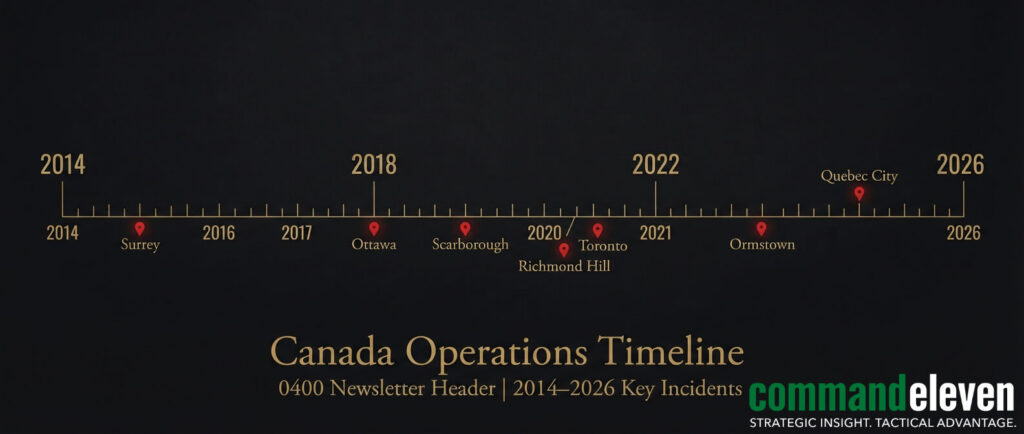
The Angoud case sits within a well-documented pattern rather than as an outlier:
- 2014–2015 – Ottawa recruiting cell – Awso Peshdary arrested; Khadar Khalib and John Maguire charged in absentia after traveling to Syria. Twin brothers Ashton Carleton Larmond and Carlos Larmond charged separately; Carlos arrested at Montreal’s airport
- 2020 – Burlington hoax case – Shehroze Chaudry charged under Canada’s terrorism hoax provisions after fabricating an ISIS affiliation – a reminder that not every claimed nexus survives investigation, and a caution against over-attribution
- 2020 – Scarborough hammer killing – A woman bludgeoned to death on a Scarborough sidewalk in an ISIS-linked attack
- April 2023 – Surrey, BC – A bus passenger stabbed in an ISIS-linked attack
- December 2023 / February 2024 – Ottawa-area youth plot – Arrests of minors linked to a plot targeting Ottawa’s Jewish community
- July 2024 – Richmond Hill, ON – Ahmed Fouad Mostafa Eldidi, 62, and his son Mostafa Eldidi, 26 – both Canadian citizens – arrested at a hotel in “advanced stages” of planning a mass-casualty attack in Toronto; axe and machete seized. The father was separately linked to a 2015 assault abroad on behalf of ISIS
- September 2024 – Ormstown, QC / Brooklyn, NY – Muhammad Shahzeb Khan (a Pakistani national residing in Canada) arrested en route to the US, accused of planning a mass shooting at a Jewish center in Brooklyn timed to the October 7 anniversary
- December 2025 – Toronto, “Project Neapolitan” – Waleed Khan, Osman Azizov, and Fahad Sadaat charged with nearly 80 offences combining hate-motivated crimes against women and the Jewish community with a parallel terrorism track: Khan alone faced seven terrorism charges, including conspiracy to commit murder for ISIS, operating a pro-ISIS Telegram channel, and providing cryptocurrency to the group
- September 2026 – Quebec City – Louay Angoud (above)
The record shows disruption operating effectively at the plot stage – nearly every case above was interdicted before execution – but also shows no meaningful decline in plot frequency a decade after the caliphate’s territorial defeat. Online radicalization pipelines, not physical foreign-fighter networks, are now the dominant vector.
Additionally, CommandEleven Intelligence assets on-ground and whistleblowers have identified active cells in Montreal, Toronto, Calgary, and Ottawa, where whistleblowers have provided solid, verifiable intelligence on ISIS infiltration into institutions.
Targeting Logic and Escalation Assessment
Jewish community institutions and individuals feature as the stated or apparent target in at least three of the four most recent major disruptions. This is consistent with global ISIS messaging (the group’s March 2026 audio address explicitly called for “lone wolf” attacks against Christians and Jews) and with the broader post-October 7 threat environment cited by Canadian security officials.
The Angoud case’s chemical-weapon claim, even though unmet by actual material capability, marks a rhetorical escalation worth tracking rather than dismissing: aspirational CBRN framing in lone-actor cases has historically preceded more credible attempts elsewhere as radicalization ecosystems mature and technical information becomes more accessible online.
CommandEleven Intelligence assesses this as an early-indicator worth monitoring, not a capability judgment.
Institutional Vulnerability: An Open Question
Public reporting to date addresses civilian-population radicalization exclusively; there is no open-source reporting establishing extremist infiltration of Canadian institutional structures, including the Canadian Armed Forces. CommandEleven Intelligence is separately tracking field indicators bearing on this question. Consistent with source-protection practice for ongoing HUMINT collection, this line is held at PENDING and will not be elaborated in public-facing material until independently corroborated. Its presence in this dossier reflects an analytic flag.
Strategic Implications
- Canadian CT disruption capability (INSET, RCMP Federal Policing) continues to perform well at the pre-attack interdiction stage; the resourcing and coordination model is not the primary vulnerability
- The binding long-term risk is the online radicalization pipeline itself – increasingly resistant to the kind of physical-network detection that broke up the 2014 Ottawa cell
- Community-specific targeting (Jewish institutions in particular) should inform protective-security prioritization independent of any single case’s outcome
- The Angoud case’s CBRN rhetoric, even unrealized, argues for continued attention to online accessibility of weapon-construction information as a radicalization-pipeline issue – a policy-level concern, not a call for operational detail in public analysis
CommandEleven Intelligence maintains ongoing HUMINT and OSINT collection on this threat vector. Assessments will be revised as the Angoud case proceeds through court and as additional corroboration becomes available on unresolved lines of reporting.