Key Judgments
- Mexico’s National Intelligence Center formally warned Ukraine’s SBU in early-to-mid 2024 that cartel-linked nationals had joined foreign-fighter units specifically to acquire FPV skills, triggering a joint SBU-HUR counterintelligence investigation (CONFIRMED).
- The investigation centers on Spanish-speaking sub-units of the International Legion, most prominently a clandestine formation known as Tactical Group Ethos operating in Donetsk and Kharkiv oblasts (CONFIRMED as the named focus of the probe; ASSESSED regarding the extent of actual infiltration within it).
- At least one identified case, an individual using the alias Aguila-7 and fraudulent Salvadoran documentation, was traced to Mexico’s GAFE special forces lineage, a pipeline historically associated with cartel recruitment, most notably Los Zetas (CONFIRMED identity discrepancy and background; ASSESSED cartel linkage).
- Cartel FPV tactics observed in Mexico since late 2025, including a multi-drone explosive attack on a Baja California prosecutor’s office and a drone ambush in Chihuahua, are consistent with techniques taught in Ukrainian FPV training pipelines, though a direct causal chain from any specific Legion infiltrator to any specific Mexican attack has not been publicly established (CONFIRMED incidents; ASSESSED causal linkage).
- A Russian-aligned outlet’s claim that Ukrainian military intelligence knowingly armed Sinaloa, Clan del Golfo, and MS-13 with Javelins and Stingers is unsupported by any independent reporting and bears the hallmarks of an information operation exploiting the infiltration story (DISPUTED / PROPAGANDA).
Executive Summary
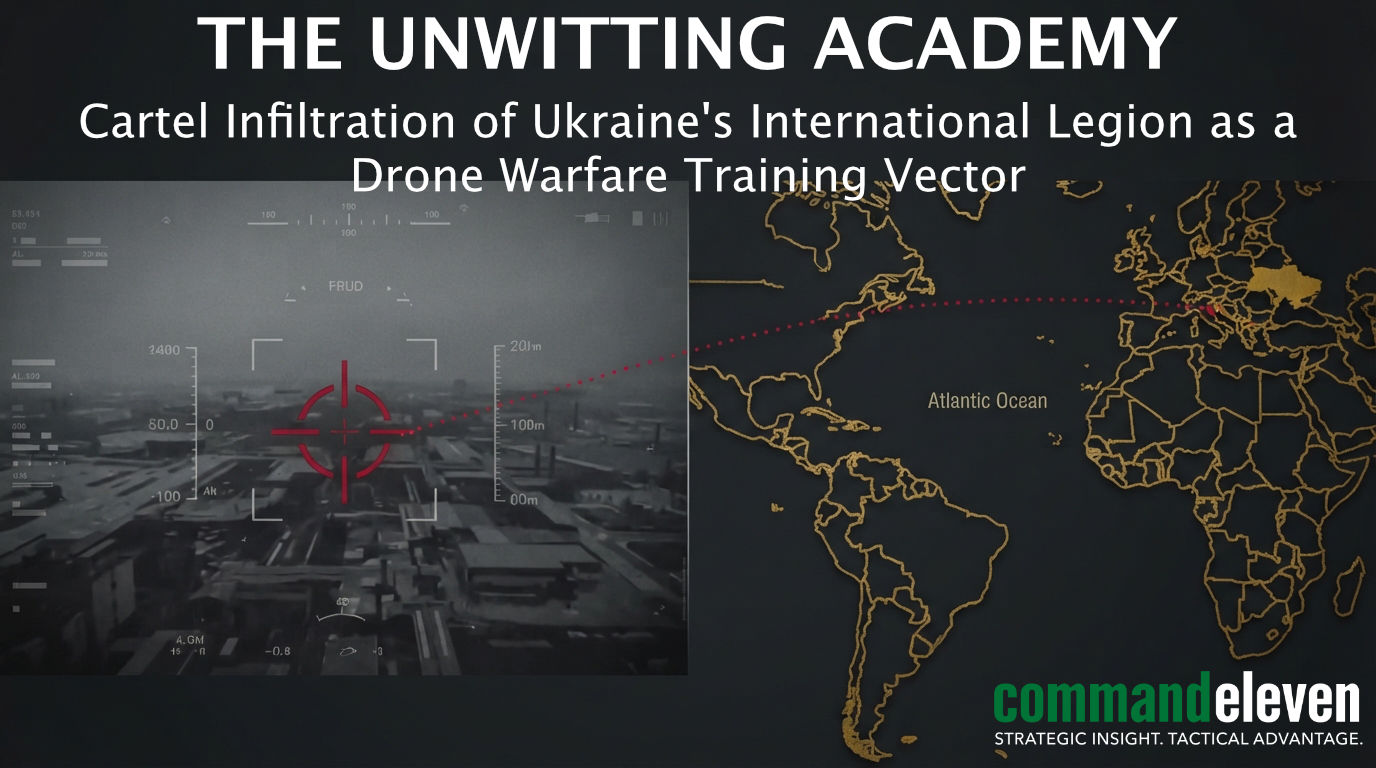
This assessment examines credible reporting that operatives linked to Mexican and Colombian criminal organizations infiltrated Ukraine’s International Legion and affiliated foreign-fighter units, using forged documentation, to acquire first-person view (FPV) drone combat skills for transfer to cartel operations in the Americas. It covers the mechanics of the infiltration, the joint Ukrainian-Mexican counterintelligence response, observed downstream effects in cartel tactics, and a distinct Russian-aligned disinformation narrative that has attempted to reframe the story as state-sponsored Ukrainian arms transfers to cartels, a claim this assessment treats as unsubstantiated.
An open volunteer system built to defend against a state invasion has become a proving ground for transnational organized crime, not through Ukrainian intent but through a screening gap that cartel-linked facilitators identified and exploited using forged Central and South American documentation. Ukrainian and Mexican authorities have acknowledged the problem and opened a joint investigation; the near-term risk is not that this will happen again in Ukraine specifically, since scrutiny there has now increased, but that the same exploitation model will be replicated against the next open conflict zone offering comparable drone-warfare experience.
Ukraine has not trained Mexican cartels as a matter of policy. What the evidence supports is narrower and, in some respects, more concerning from a proliferation standpoint: individuals with cartel ties exploited an open, volunteer-based foreign legion system, built for legitimate territorial defense, as an unintended finishing school for the most combat-tested drone warfare techniques in the world. The distinction matters. A state-sponsored program would be a bilateral political failure with a clear point of accountability. An exploited open system is a structural vulnerability inherent to any large volunteer force operating in a high-intensity drone conflict, and it will recur wherever the next such conflict occurs unless screening practices change.
Sourcing and Analytical Confidence
The core reporting chain for this assessment originates with the French investigative outlet Intelligence Online, whose initial report was independently picked up and, in its central facts, corroborated by Defense News, Kyiv Post, The War Zone, and Ukraine’s own English-language outlet NV. Ukrainian and Mexican government bodies have not issued full public statements detailing investigation findings, which is consistent with an active counterintelligence probe, but SBU and HUR involvement is acknowledged across multiple independently reported accounts. Where this assessment departs from that consensus reporting, specifically regarding claims of official Ukrainian arms transfers to cartels, it is flagged explicitly as disputed.
| Tier | Definition | Application in This Assessment |
| CONFIRMED | Acknowledged by named government bodies (SBU, HUR, Mexico’s CNI) or corroborated across two or more independent reporting chains. | Used for the existence of the investigation, the identity of implicated units, and confirmed incidents on Mexican soil. |
| ASSESSED | Analytical judgment drawn from pattern analysis and single-sourced but plausible reporting, primarily originating with Intelligence Online and repeated by Defense News, Kyiv Post, and TWZ. | Used for facilitation-network structure, operative counts, and forward projection. |
| DISPUTED / PROPAGANDA | Claims originating from sources with a documented history of state-aligned disinformation, contradicted by or unsupported in independent reporting. | Applied specifically to the Russian-aligned claim of Ukrainian state weapons transfers to cartels; see Section IX. |
A caution for downstream readers: this topic sits at an unusually high risk of narrative capture. The infiltration story is analytically newsworthy on its own, which makes it an attractive vehicle for actors seeking to attach a more damaging and unsubstantiated secondary claim, namely that Ukraine’s government is knowingly and materially supporting Latin American organized crime. Analysts should treat any claim of state-level Ukrainian complicity as requiring a materially higher evidentiary bar than the underlying infiltration reporting, which itself remains at the ASSESSED rather than CONFIRMED tier in several particulars.
Background: The International Legion as an FPV Training Ecosystem
Ukraine’s International Legion was established in the earliest days of the 2022 invasion to absorb foreign volunteers into Ukraine’s territorial defense. Administratively split between formations under the Ground Forces and a separate legion under the Main Directorate of Intelligence, HUR, the system was built for speed and volume rather than deep background vetting, a reasonable tradeoff during an existential defensive war but one that created a durable screening gap. Over the following three years, Ukraine’s front lines became the world’s most intensive live-fire laboratory for small FPV drone warfare, producing a generation of operators, instructors, and doctrine covering drone manufacturing, electronic warfare resistance, thermal signature avoidance, and coordinated multi-drone strike employment, skills that scale down efficiently to any organization capable of acquiring commercial-grade hardware.
This combination, an under-vetted volunteer intake process and a uniquely dense concentration of transferable combat expertise, is what made the Legion attractive to organizations seeking to accelerate their own capability development years faster than trial-and-error learning would allow. Ukrainian officials interviewed in subsequent reporting have been candid about the structural nature of the exposure, characterizing the country’s emergence as a de facto global dissemination node for FPV tactics as an unintended byproduct of fighting the specific war it is fighting.
It is worth noting that the Legion was never a homogenous single organization in the way outside reporting sometimes implies. At peak strength during 2022 and 2023, its ranks are estimated to have run from roughly fifteen hundred to as many as thirty thousand personnel across dozens of distinct sub-units with varying command relationships, some directly under Ground Forces control, others operating in a semi-autonomous relationship with HUR that afforded them a degree of operational secrecy well suited to concealing an infiltration effort. That structural fragmentation is itself part of the explanation for why a coordinated cross-unit vetting failure was possible: no single command authority held complete visibility over intake decisions across every sub-unit simultaneously, and the more clandestine formations, valued precisely for their operational secrecy, were the ones least subject to routine external scrutiny.
The Infiltration Pattern: Case Findings
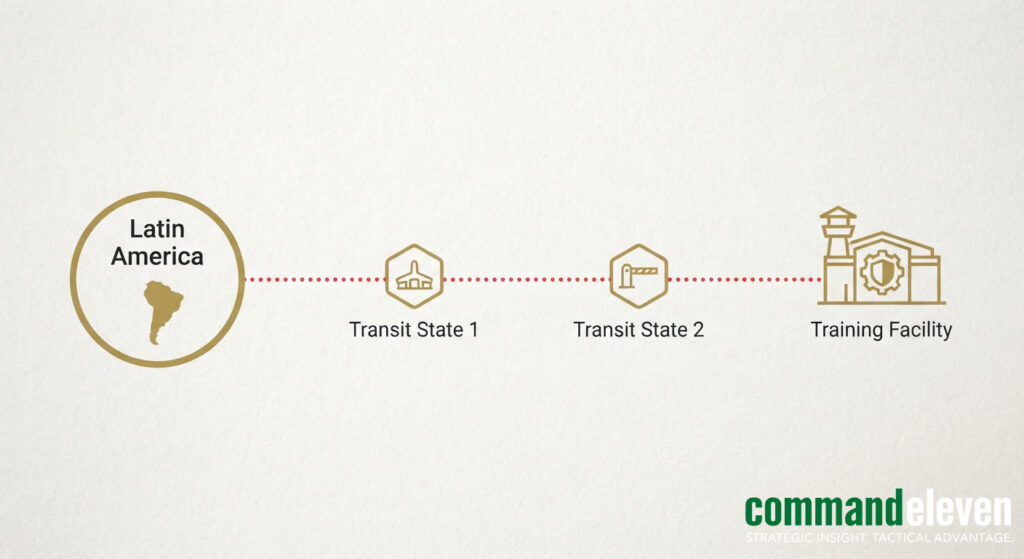
Reporting identifies a recurring operational pattern among suspected cartel-linked infiltrators rather than a single method. Volunteers entered using forged identity documents from third countries, most commonly Salvadoran, Panamanian, and Venezuelan papers, which allowed Spanish-speaking operatives to blend into the broader population of Latin American volunteers without immediately triggering nationality-based scrutiny of Mexican or Colombian applicants specifically. Once enrolled, several of the suspected individuals reportedly sought assignment specifically to drone operator roles and to the more clandestine, less publicly documented sub-units, notably Tactical Group Ethos, rather than to conventional infantry postings, a preference investigators flagged as inconsistent with typical ideologically motivated volunteer behavior.
The Aguila-7 case. The most detailed individual case in open reporting involves an operative using the callsign Aguila-7, who registered in March 2024 under fraudulent Salvadoran documentation and posed as a humanitarian volunteer. Instructors in Lviv reportedly grew suspicious after he demonstrated technical proficiency, including familiarity with electronic warfare countermeasures and thermal detection avoidance, well beyond what would be expected of a first-time volunteer. Background checks subsequently linked him to Mexico’s GAFE airmobile special forces group, a unit whose alumni have a documented history of transitioning into cartel employment, most notably the founding cadre of Los Zetas.
The FARC document network. A separate strand of the investigation identified at least three former Revolutionary Armed Forces of Colombia, FARC, fighters who entered the International Legion using forged Panamanian and Venezuelan identification. One was identified by SBU personnel at a drone training facility in Dnipro after inconsistencies in his accent and visible gang-affiliated tattoos prompted closer scrutiny. Their relocation is assessed to have been organized by cartel-linked facilitation entities rather than arranged independently, pointing to a degree of institutional planning behind individual infiltration attempts.
The presence of former FARC personnel alongside Mexican GAFE alumni within the same suspected network is analytically significant. It suggests the facilitation apparatus behind this infiltration effort is not narrowly tied to a single Mexican cartel but functions as a regional service available to multiple transnational criminal organizations willing to pay for access, consistent with the broader pattern of criminal-service specialization documented elsewhere in Latin American organized crime, where document forgery, logistics, and access-brokering are frequently outsourced to specialist facilitators rather than run in-house.
A further pattern worth flagging is behavioral rather than documentary. Investigators reportedly noted that several suspected infiltrators showed limited interest in the broader political or ideological dimensions of the war, avoiding the kind of engagement, language study, community integration, or expressed motivation, typically associated with genuinely ideologically committed foreign volunteers. Instead, their focus remained narrowly instrumental: acquiring specific technical proficiencies as efficiently as possible and, in some cases, seeking early rotation out once a given skill set had been sufficiently mastered. This behavioral signature, a volunteer who trains intensively but declines opportunities to embed further into the unit’s broader operational life, is now reportedly being incorporated into Ukrainian counterintelligence screening as a secondary indicator alongside document verification.
The Facilitation Network
Investigators in Poland, Slovakia, and Bulgaria have separately opened inquiries into Latin American private military and security contracting firms suspected of facilitating placement of these volunteers into Ukrainian units. Reporting indicates that legalization of forged documents and travel routing frequently ran through Slovakia and Moldova, both offering practical entry pathways into Ukraine and comparatively lighter document-verification friction than direct routes through better-resourced Western European hubs. Some of the implicated firms are described as legitimate security contractors with a criminal offshoot or corrupted subset of staff, rather than criminal fronts from inception, which complicates any straightforward interdiction approach based on blacklisting named companies.
This facilitation layer represents the more durable long-term threat relative to any single infiltrator. Individual operatives can be identified, expelled, or prosecuted once flagged, as appears to have occurred in the Dnipro case. A functioning document-forgery and logistics network capable of moving operatives from Latin America through European transit states into a live combat training environment is a reusable asset that will persist and can be redirected toward the next comparable opportunity even after specific personnel are compromised.
The financing behind this facilitation effort also merits attention. Moving an operative from Mexico or Colombia to a European transit hub, securing convincing forged documentation from a third country, and sustaining that individual through weeks or months of training before extraction represents a non-trivial expenditure per person, particularly at the volumes implied by reporting that names multiple confirmed and suspected cases across at least two criminal organizations. That level of sustained investment indicates the sponsoring organizations view FPV capability acquisition as a strategic priority comparable to, rather than incidental to, their existing weapons and logistics procurement, a judgment that should inform how seriously counter-narcotics agencies weight this vector relative to more conventional arms trafficking concerns.
Downstream Effects: Tactical Evolution in Mexico

Cartel use of weaponized drones predates this infiltration story by several years; Cartel Jalisco Nueva Generacion, CJNG, has been documented using improvised explosive-laden commercial quadcopters against rival sicarios, security forces, and government targets since at least the early 2020s. What has changed more recently is the sophistication and coordination of the tactics observed. A November 2025 attack in Tijuana used three drones in a coordinated strike against a state prosecutor’s office targeting an anti-kidnapping unit, and an earlier incident in Chihuahua involved a drone ambush against Mexican military and police personnel that hospitalized three security personnel. Both incidents are consistent, in coordination pattern and payload configuration, with tactics refined on Ukrainian battlefields, though open reporting has not established a confirmed direct chain of custody between any specific Legion-trained individual and either attack.
This assessment does not detail the technical construction of the devices involved in these attacks, since doing so would provide no meaningful analytical value beyond what is already public in incident reporting and would carry an unacceptable risk of operational uplift. The relevant analytical point is organizational rather than technical: cartels that previously relied on trial-and-error weapons development are now credibly assessed to have access, however indirect, to combat-refined tactical doctrine, which shortens their capability-development timeline regardless of the specific hardware involved in any given attack.
Multilateral and Governmental Response
Ukraine’s SBU and HUR have coordinated a joint counterintelligence investigation targeting the suspected infiltration network since mid-2025, following the initial CNI warning. Ukrainian officials have publicly acknowledged strengthening cooperation with Interpol and the US Drug Enforcement Administration to cross-reference volunteer intake data against criminal records, a meaningful policy shift from the earlier, faster-throughput vetting model that made the initial infiltration possible. European authorities in Poland, Slovakia, and Bulgaria have opened parallel inquiries into the facilitation firms identified above, reflecting recognition that the vulnerability extends beyond Ukraine’s own intake process into the broader European logistics chain supporting foreign volunteer travel.
Mexico’s response has been comparatively less publicly visible, consistent with the sensitivity of ongoing intelligence-sharing arrangements and the domestic political delicacy of acknowledging that serving or former special forces personnel have a documented pipeline into cartel employment. The CNI’s original warning to Ukraine nonetheless represents a notable instance of proactive threat-sharing on a transnational security issue, and the resulting joint investigation stands as a rare example of effective bilateral counterintelligence cooperation between two states with no significant prior security relationship.
The broader multilateral dimension also deserves note. This case has surfaced at a moment when several European states are separately reassessing the legal and security frameworks governing foreign volunteer participation in the Ukraine conflict more generally, an ongoing policy conversation touching questions of veteran reintegration, war crimes accountability, and the security risk posed by combat-experienced individuals returning to civilian life. The cartel infiltration issue adds a distinct and largely separate strand to that conversation, since the operative concern here is not a returning volunteer radicalized or traumatized by combat, but one who entered specifically to weaponize a discrete technical skill for transfer to an organization entirely unrelated to the conflict itself. Policymakers engaging with foreign-volunteer reintegration frameworks should treat this as a distinct risk category requiring its own screening logic rather than folding it into more general veteran-reintegration security planning.
Disinformation Vector: The Weapons-Transfer Narrative

Since early 2026, Russian-aligned media, including outlets tied to the self-styled Foundation to Battle Injustice, have circulated a materially different and considerably more serious claim: that Ukrainian military intelligence, under General Kyrylo Budanov, knowingly established working relationships with major cartels including Sinaloa, Clan del Golfo, and MS-13, supplying them with American and European-origin weapons including Javelin anti-tank systems and Stinger man-portable air defense systems in exchange for unspecified consideration. This claim is not corroborated by any of the independent reporting chains underpinning the rest of this assessment and departs sharply from the consistent, better-sourced narrative of unauthorized infiltration and forged documentation.
The claim carries clear strategic utility for its likely originators. It recasts a genuine vulnerability, exploitable gaps in an under-resourced volunteer vetting system during wartime, into an allegation of deliberate Ukrainian state complicity in arming some of the hemisphere’s most violent criminal organizations, a narrative well suited to undermining Western support for Ukraine and to reinforcing existing information operations targeting Ukrainian military intelligence leadership specifically. Absent independent verification, this assessment treats the weapons-transfer claim as a probable disinformation vector built opportunistically on top of a real and separately documented infiltration problem, and flags it for continued monitoring rather than incorporation into the threat picture as fact.
Strategic and Policy Implications

The structural lesson of this case extends beyond Ukraine and beyond cartels specifically. Any large-scale, volunteer-intake foreign fighter formation operating in a technologically intensive conflict is a latent proliferation risk for whatever combat skill that conflict happens to be generating fastest, whether FPV drone operation, urban breaching techniques, or electronic warfare tradecraft. States hosting such formations face a persistent tension between the operational value of rapid volunteer throughput and the counterintelligence cost of that speed, and adversarial or criminal actors with sufficient resources to build forged-document facilitation networks will continue probing for the same gap in future conflicts.
For counter-narcotics and homeland security planners specifically, the more actionable implication is that cartel capability assessments should now treat combat-refined FPV doctrine as an available input rather than a hypothetical future risk. Interdiction planning premised on cartels remaining reliant on improvised, trial-and-error drone weaponization is already outdated for at least the more capable organizations, CJNG chief among them, and should be revised accordingly.
There is also a border-security dimension distinct from the counter-narcotics angle. US and Mexican agencies monitoring the southern border have separately flagged concern over weaponized drone tactics migrating toward use against border security infrastructure and personnel, not only in inter-cartel violence. A capability set refined for use against a state’s military in an active war zone transfers with minimal adaptation to use against domestic law enforcement and border patrol assets, which have historically operated without the counter-drone systems fielded by conventional militaries. This suggests domestic counter-UAS investment, not only international interdiction of the training pipeline, should be treated as a parallel and equally urgent priority.
Recommendations
- Ukraine and partner states should extend the enhanced Interpol and DEA data cross-referencing already applied to volunteer intake toward retroactive review of personnel who transited through flagged facilitation firms in Poland, Slovakia, and Bulgaria, not only forward intake.
- Mexican and Colombian security services should treat identified facilitation firms and document-forgery networks as priority targets independent of any specific individual infiltrator, given the reusable nature of that infrastructure.
- US and regional counter-narcotics agencies should update cartel capability baselines to assume access to combat-refined FPV doctrine for organizations with demonstrated financial capacity to fund overseas training access, rather than treating such access as speculative.
- Analysts and public communicators should explicitly distinguish the confirmed infiltration narrative from the unsubstantiated Ukrainian state-complicity narrative in all public-facing material, to avoid inadvertently amplifying a disinformation vector while covering a genuine security story.
- Future foreign-legion or volunteer-force vetting frameworks, in Ukraine or in any comparable future conflict, should incorporate biometric and cross-national criminal-database screening at intake rather than relying on document authenticity checks alone, given the demonstrated sophistication of the forgery networks involved here.
Strategic Outlook
Expect continued scrutiny of the International Legion’s Spanish-speaking sub-units through the remainder of 2026 as the joint SBU-HUR investigation matures, with a realistic possibility of further identified cases beyond Aguila-7 and the FARC network given the scale of volunteer throughput during the conflict’s peak years. The more consequential trend to monitor, however, sits outside Ukraine: whether cartel organizations that gained access to Ukrainian-refined FPV doctrine can institutionalize that knowledge internally, through internal training cadres built around returning operatives, or whether it remains concentrated in a small number of individuals whose removal from operations would meaningfully degrade the capability. Early indicators, including the coordination level observed in the Tijuana and Chihuahua incidents, are consistent with at least partial institutionalization already underway within CJNG.
Separately, expect the Russian-aligned disinformation narrative addressed in Section IX to persist and potentially expand regardless of its evidentiary weakness, since its utility to information operations targeting Western support for Ukraine does not depend on factual accuracy. Analysts and communications teams engaging with this topic publicly should be prepared to address that narrative directly rather than simply omitting it, since silence on a circulating claim is often read as an inability to rebut it.