
A dossier in the Sahel series. Status as of November 2, 2026. It rests on leaked documents published by a journalist consortium and on analyst commentary, and it tiers every claim accordingly. Companion reading: Africa Corps: Russia’s Institutionalized Footprint in the Sahel and The Siege That Held.
Bottom Line Up Front
Russia runs two separate machines in the Sahel. The visible one is the Africa Corps, a Defense Ministry force that has been losing ground in Mali since April. The hidden one is an influence network of about 100 consultants that, according to 1,431 pages of leaked internal documents published in February 2026, Russia’s foreign intelligence service (SVR) has supervised since the end of 2023. It works on media, local elites and political access, at a reported cost of about $750,000 a month. The files say it helped create the Alliance of Sahel States (AES) and push Western firms out of Mali and Niger. Outside analysts dispute most of those claims. The documents are real enough for a six-outlet consortium to publish. Their boasts are not independent evidence of results.
Key Judgments
- [CONFIRMED] On February 14, 2026, a consortium led by Forbidden Stories published 76 internal documents (1,431 pages, in Russian) from an influence network called “the Company,” also known as Africa Politology. An anonymous source sent the files to the editor of The Continent. The consortium says it authenticated them through open-source research, comparison with earlier investigations and European security sources.
- [REPORTED] The network began under Yevgeny Prigozhin and has been supervised by the SVR since the end of 2023, according to European security sources cited by the consortium. A direct financial trail to the SVR is hard to establish, because budgets appear partly handled in cash.
- [REPORTED] The network’s Sahel goal, set out in a 2023 paper called “Confederation of Independence,” is a belt of governments friendly to Moscow running from the Atlantic toward the Red Sea. Mali, Burkina Faso and Niger are its core.
- [DISPUTED] The files credit the Company with helping create the AES, rewriting Mali’s mining code and triggering the revocation of Orano’s Imouraren uranium licenses in Niger. Analysts cited by Africa Confidential and by the consortium’s own Sahel review say these outcomes had local causes. The files are self-promotional.
- [ASSESSED] The two arms are diverging. The Africa Corps carries the cost and the casualties of Russia’s military bet, and it has retreated from the Malian north. The influence network is cheap, deniable and durable. Moscow’s staying power in the Sahel depends more on the second than the first, and the second is harder to measure.
- [SINGLE-SOURCE] Two newer reports from the consortium’s All Eyes On Wagner project, that the network used paid AI chatbot accounts in the Central African Republic and that the GRU is pushing for a foothold in Madagascar, rest on one outlet each.
What the Files Are, and What They Are Not
The documents are the network’s own paperwork: strategy papers, staff biographies, operational reports, accounting records and summaries of disinformation campaigns from January to November 2024. They cover 2023 and 2024 and reach roughly 30 countries on three continents. The consortium is made up of Forbidden Stories, The Continent, All Eyes On Wagner, the Dossier Center, openDemocracy, iStories and independent Russian-speaking journalists. It reported that neither the SVR nor any of the individuals it named responded to requests for comment.
[ASSESSED] Treat the files as authentic and as advocacy. The consortium itself warns that the documents are internal and self-promotional, that they claim credit for other actors’ achievements and leave out failures, and that reach figures are the network’s own estimates. A network that must justify its budget to its sponsor has every reason to overstate results. We read the files for what Moscow intends and how it works, and we hold the claimed results to a higher bar.
From Prigozhin to the SVR
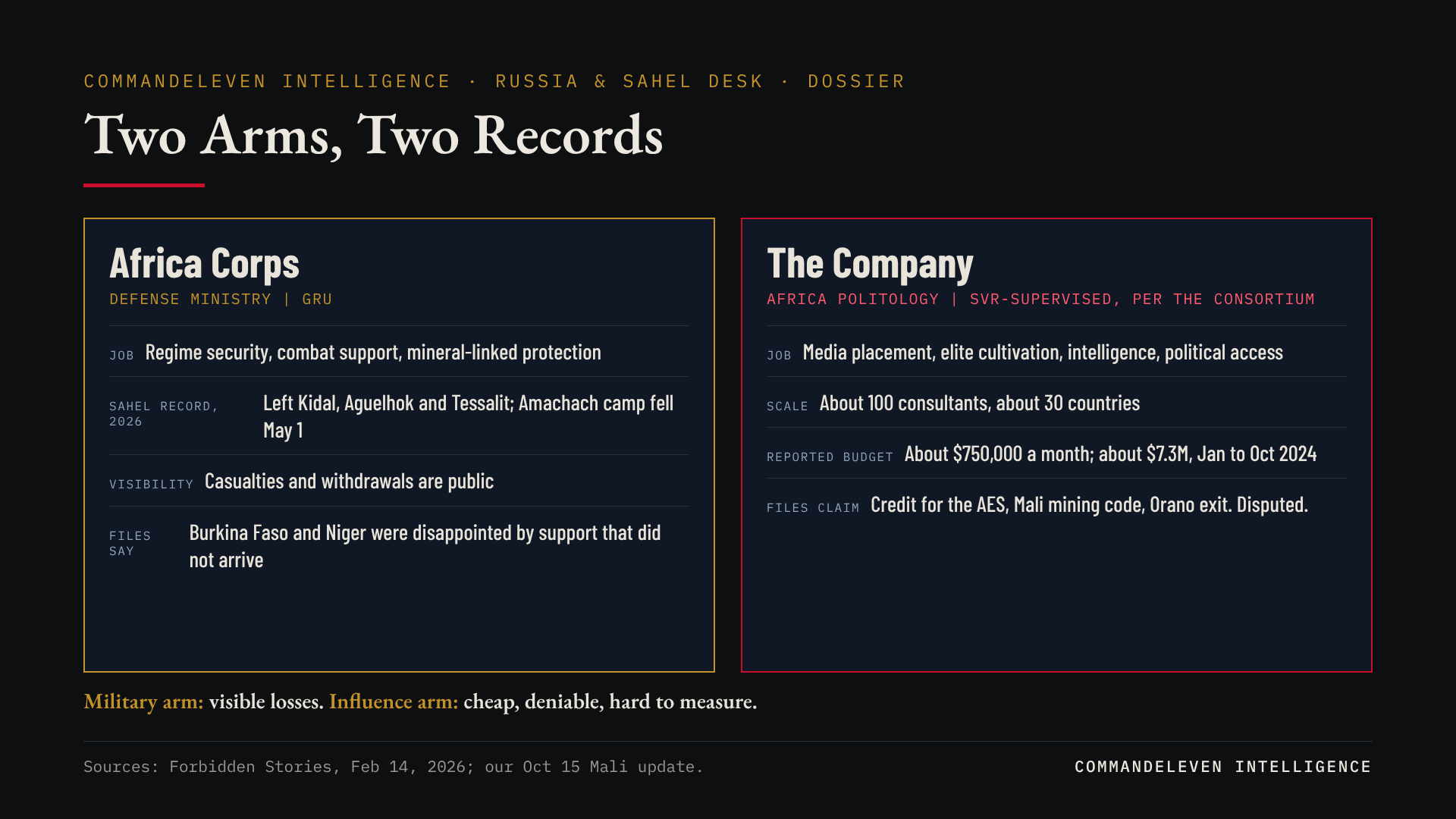
Prigozhin died in a plane explosion on August 23, 2023, and the Wagner empire was broken up. The Defense Ministry took over the military side, which became the Africa Corps. The influence side followed a different path. According to the consortium, the SVR moved from supporting the network to supervising it directly by the end of 2023, and the project managers did not change. An earlier joint technical report by the EU’s diplomatic service, France’s VIGINUM agency and the UK Foreign Office on a related outlet, African Initiative, described the same ecosystem from the public side: fictitious news sites, inauthentic accounts, local associations used to recruit influencers and journalists, and AI-generated content. That report, and the sanctions on African Initiative’s editor-in-chief, are government findings. The SVR link in the leaked files is the consortium’s.
| Africa Corps | The Company (Africa Politology) | |
|---|---|---|
| Parent | Defense Ministry and the GRU | Supervised by the SVR, per the consortium |
| Job | Regime security, combat support, mineral-linked protection | Media placement, elite cultivation, intelligence gathering, political access |
| Scale | Thousands of personnel (estimates vary widely) | About 100 consultants; reported budget of about $7.3 million for January to October 2024 |
| Exposure | Casualties, withdrawals and defeats are visible | Deniable, low-cost, results hard to measure |
| Sahel record | Left Kidal, Tessalit and other northern posts in April and May 2026 | Claims influence over the AES, mining policy and Western exits; disputed |
The two arms do not always move together. In the Central African Republic, the consortium reports that the Defense Ministry took over Wagner’s operations in Mali but did not bring the contractors in the CAR under its control, and that the SVR is asked to help the ministry avoid getting in Wagner’s way there. In Mali, the SVR’s tasks include intelligence for the network on French and US military and political plans, and diplomatic support for a new military and political union of Mali, Burkina Faso, Niger and Guinea.
The Sahel Plan
The 2023 “Confederation of Independence” paper, dated around August, calls for a corridor of independence-minded governments running from Senegal and Guinea toward Sudan and Eritrea. Its stated aims are to weaken Western security partnerships, open markets for Russian arms and hydrocarbons, and secure diplomatic backing at the United Nations. The three Sahel coups, in Mali (2021), Burkina Faso (2022) and Niger (2023), are described as opening the door once French forces left. The paper sets out three phases: map a country’s grievances, recruit local journalists and place material through co-opted outlets, then cultivate opposition figures, military officers and intelligence officials.
Country by country
- Mali. The files call Mali the locomotive of the Sahel and propose boosting Assimi Goïta’s legitimacy through a media plan with an information center under the presidency. They describe campaigns against foreign mining companies and critics of the junta, and they claim a role in revising the mining code in 2024.
- Burkina Faso. Goals mirror Mali’s: discredit France, support Ibrahim Traoré and improve Russia’s image. The consortium’s Sahel review says the files’ description of Burkinabe propaganda networks proved accurate, while the extent of Russian consultants’ involvement in them is unknown.
- Niger. The brief is to keep the junta away from Washington and tied to Moscow through media pressure. The files claim a campaign built on a fake Orano contract clause helped bring about the June 2024 revocation of Orano’s Imouraren licenses.
- Chad, Senegal and others. The files name Chad, Guinea, Senegal, Togo, Benin and Côte d’Ivoire as targets. They also claim access to the circle around Chad’s president.
[REPORTED] The Senegal material is the most serious on paper and the least developed. An August 2023 document outlined a scenario in which local military figures would take power with SVR support, with options either to suppress or to encourage street protests. The consortium describes the Senegal effort as one of the less successful ones. We found no report of a coup attempt or of any Senegalese government response, and no detail on whom the plan targeted. Treat it as a planning document, not an operation.
Claimed Results Against the Outside Record
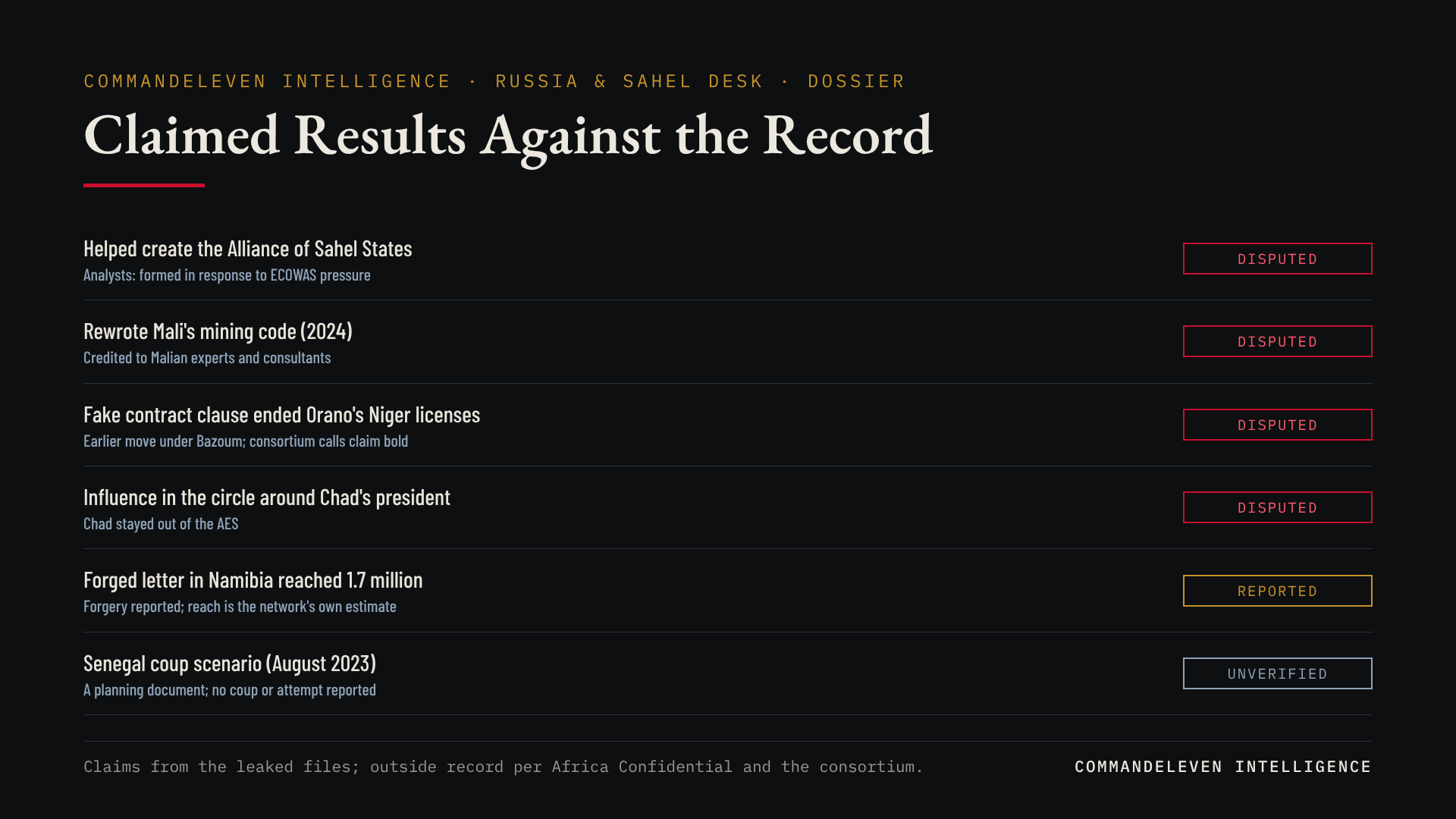
| The files claim | The outside record | Our read |
|---|---|---|
| The Company helped create the AES (September 2023). | Analysts say the AES formed independently, in response to ECOWAS pressure and building on the older G5 Sahel framework. An analyst cited by the consortium argues Malian authorities prepared it and that sanctions and the Niger coup were catalysts. | [DISPUTED] |
| The Company lobbied successfully for Mali’s mining code revision (2024). | Africa Confidential and the consortium’s Sahel review attribute the reform to Malian mining experts and consultants, not Kremlin direction. | [DISPUTED] |
| A campaign built on a fake contract clause helped end Orano’s Niger licenses (June 2024). | The consortium calls the claim bold, since the clip appeared in a national-channel documentary. Africa Confidential links the cancellation to an earlier move under the ousted president, Bazoum. | [DISPUTED] |
| Influence over the circle around Chad’s president. | Chad stayed out of the AES. Africa Confidential cites clan politics, the army’s existing training and the UAE’s role in Sudan’s war. | [DISPUTED] |
| A fabricated letter in Namibia’s 2024 election reached 1.7 million people. | The 1.7 million is the Company’s own estimate. British diplomats publicly denied the letter’s content. | [REPORTED] forgery; reach is the network’s own number |
| A Senegal coup scenario (August 2023). | A planning document. No coup, attempt or official response reported. | [UNVERIFIED] beyond the paper |
[ASSESSED] The pattern is consistent. Where the network describes a local outcome that other actors were already driving, such as the AES, the mining code or the Orano dispute, the claim of credit does not stand up. Where it describes its own methods, such as paid articles, social-media pages and fabricated documents, the files are more credible, because those are acts it controlled. Russia’s real gain from the Sahel’s turn away from the West is probably larger than the network’s real contribution to it.
The Ground Test: Where Moscow’s Bet Stands
The files themselves record the gap between promise and delivery. A mid-2024 presentation notes disappointment in Burkina Faso and Niger that the Africa Corps support they expected had not arrived, and the consortium says Russia struggled to turn memorandums into profitable business. A gold refinery project stalled, and sanctions hampered sales of resources.
The events of 2026 sharpen this. In our October 15 update, we recorded that Malian and Africa Corps forces left Kidal, Aguelhok, Tessalit and other northern posts after the April 25 offensive. The consortium’s project reported on July 24 that the Amachach camp at Tessalit fell to the Azawad Liberation Front and JNIM on May 1, with handwritten Russian notes left behind. Africa Confidential adds that by April the US had lifted sanctions on junta leaders, including defense minister Sadio Camara (killed on April 25), that Angola had pivoted back toward the West, and that Chad stayed out of the AES. Its verdict is that Moscow’s grand plans for the Sahel may turn to dust.
[ASSESSED] That verdict is a fair test of the military arm and a weaker test of the influence arm. Narratives that cast Russia as an anti-colonial partner and France and the United States as toxic do not need Russian troops to win. They need the juntas to keep finding them useful, and a junta that has lost half its territory has more reason to keep looking for outside patrons and for someone to blame, not less.
The Newer Edge: AI Accounts and a GRU Push in Madagascar
[SINGLE-SOURCE] On July 7, 2026, the consortium’s All Eyes On Wagner project reported invoices for basic paid subscriptions to ChatGPT and Claude, dated April and May 2026, that it linked to a Politology coordinator in the Central African Republic. OpenAI told the outlet the linked accounts were mainly used for translation, summarizing and open-source research and suspended them. Anthropic said it had received the report and was investigating. The attribution rests on cross-referencing email addresses and linked accounts, and the outlet notes that the tasks it describes would not obviously trigger safeguards. Nothing published shows harmful output. The point for analysts is cost and detection: everyday AI tools lower the price of running a content operation, and they are hard to tell from ordinary use.
[SINGLE-SOURCE] On September 23, 2026, the same project reported that four Russian nationals, whom it says include GRU officers, were named to the Republic of the Congo’s Order of Merit on October 30, 2025, and that two of them are central to a Russian effort to gain a foothold in Madagascar. If accurate, this is the Defense Ministry’s intelligence arm running its own influence track alongside the SVR’s, in a country the SVR network is also reported to have worked. We could not verify it independently.
Responses and Denials
- Russia and the SVR. The consortium says neither the SVR nor any named individual answered its requests for comment. We found no public Russian denial of the specific findings. An absence of denial is not confirmation.
- Namibia. British diplomats publicly denied the substance of the forged letter attributed to a British lawmaker.
- Mali Media+223. The administrator of a Facebook page with more than 830,000 followers, which the files document at length, denied being paid by or having contact with Russian consultants, per the consortium’s Sahel review.
- South Africa. A Mail & Guardian commentary reports that a deputy minister of international relations dismissed allegations raised in Parliament in March 2026 as “farcical.” That commentary is opinion, not news reporting.
How This Refines Part 6 of the Sahel Series
Our May 2026 dossier on the Africa Corps described a force that supplied regime security and also “active support” for state-aligned information campaigns. The leaked files place the information work in a separate, SVR-supervised structure rather than in the Defense Ministry’s Africa Corps. The Africa Corps’ GRU and Defense Ministry oversight, which Part 6 reported, stands. What changes is who runs the narrative work. Readers should take this dossier as the more precise account of the influence function.
Outlook and Two Dated Calls
[ASSESSED] Our base case through January 2027 is that the influence network keeps running and keeps leaking. The consortium has published from the files in February, March, April, May and July, and the Sahel juntas, squeezed on the battlefield, will keep leaning on the anti-Western narrative the network promotes. The main pressure on the network comes from outside: further exposure, sanctions, and platform and AI-provider enforcement.
Call 1 (by January 31, 2027). A Western government or the European Union announces sanctions or a formal attribution that names Africa Politology, “the Company” or the SVR’s role in African influence operations. The FDD policy brief urges Treasury sanctions on the network’s individuals, and the EU already sanctions African Initiative’s editor. A new action naming this network is the test.
Call 2 (by January 31, 2027). None of Mali, Burkina Faso or Niger announces an end to Russian military cooperation or orders Russian forces out. A junta that cannot hold its own north has little room to lose its only outside military backer, whatever the Africa Corps’ record.
Indicators to watch.
- New publications from the consortium on the Sahel, Chad or Guinea.
- Any AES leader publicly distancing from Moscow, or praising Washington’s outreach.
- Platform or AI-provider disclosures of takedowns tied to African influence operations.
- Changes in Africa Corps posture after further losses, or reinforcement from Moscow.
- Evidence of the GRU track in Madagascar, such as agreements or visits.
What This Dossier Does and Doesn’t Establish
- It establishes that a six-outlet consortium published internal files describing an SVR-supervised Russian influence network active in the Sahel, and what the files and outside analysts say about its results.
- It does not establish that any specific coup, election result, licensing decision or policy change was caused by Russia. The strongest claims of credit are disputed.
- It does not establish the identity or conduct of any named individual beyond what the consortium reported, and it does not name individuals of its own.
- It does not rely on any CommandEleven Intelligence source or asset. Everything here is from published reporting.
Frequently Asked Questions
What did the leaked files say about the SVR and Wagner?
They describe an influence network created under Yevgeny Prigozhin that Russia’s foreign intelligence service has supervised since the end of 2023, according to a consortium led by Forbidden Stories.
What is Africa Politology?
It is the name the consortium gives the network also called “the Company,” which employs about 100 consultants to place media content, cultivate local elites and gather intelligence in about 30 countries.
Did Russia create the Alliance of Sahel States?
The leaked files claim the network helped create it. Analysts say the alliance formed independently of Moscow, in response to ECOWAS pressure, and that Russian influence was a later addition.
How is the Africa Corps different from the Wagner Group?
The Africa Corps is run by Russia’s Defense Ministry and the GRU. Wagner was a private company. The influence work Wagner once ran now sits, according to the files, with a separate network supervised by the SVR.
Has Russia responded to the leak?
The consortium says neither the SVR nor the named individuals answered requests for comment. We found no public Russian denial of the specific findings.
Sources
- Forbidden Stories, Propaganda Machine: Secret documents reveal Russia’s foreign influence strategy across three continents February 14, 2026
- Africanews (with AFP), Investigation: Russian spy agency takes over Wagner operations in Africa February 21, 2026
- United24 Media, Leaked documents reveal Russia’s plot to stage coup in Senegal February 2026
- Foundation for Defense of Democracies, How Russia used an influence operation to undermine U.S. interests in Africa February 25, 2026
- All Eyes On Wagner, Beyond the Sahelian Illusion March 27, 2026
- North Africa Post, Leaked files detail Russian role in expanding Sahel alliance April 6, 2026
- Africa Confidential, Propaganda swamps social media but Moscow fails to sway the juntas April 16, 2026
- Mail & Guardian, Africa’s new information war: the leaked files that expose a manufactured solidarity May 19, 2026 (opinion)
- All Eyes On Wagner, The SVR arms Politology with ChatGPT and Claude in the Central African Republic July 7, 2026
- All Eyes On Wagner, Remains of the Africa Corps presence at Camp Amachach July 24, 2026
- All Eyes On Wagner, Madagascar: The GRU’s all-out push for the Western Indian Ocean gateway September 23, 2026
- EUvsDisinfo, African Initiative: Russian FIMI operation disguised as a news agency (reports the joint EEAS, VIGINUM and UK FCDO technical report)
Related CommandEleven Intelligence Reporting
- The Sahel Collapse: A CommandEleven Intelligence Series
- Africa Corps: Russia’s Institutionalized Footprint in the Sahel
- The Siege That Held: Mali Six Months After the April Offensive
- Liptako-Gourma Crisis: The Inter-Jihadi War for the Sahel
- The Bamako Blueprint Failure: Auditing International Abandonment
