
A Foresight Audit of CommandEleven Intelligence’s October 20 brief, Acte II: The October 24 Mobilization and the 101-Group Claim, our October 26 brief, Acte III: The European Spread, and the remaining October 14 indicators from France and Belgium Before October 17. Status as of November 2, 2026.
Bottom Line Up Front
Seven dated calls fell due on November 2. We were right on five, partly right on one and wrong on one. The turnout calls held: France’s Interior Ministry counted about 550,000 on October 17, about 410,000 on October 24 and about 320,000 on October 31. The violence call for October 24 did not: we expected arson and looting in at least two major cities under curfew, and we found no report of a building or business set on fire anywhere in France that day. Violence came back on October 31, in the form of Molotov cocktails thrown at police in Paris, and in Germany, where the first nationwide youth protests produced looting in Frankfurt and burning barricades in Hamburg.
The seven October 14 indicators are now all closed. Three were met, one is partly met, and three were not met. The pattern is the one we described on October 19: the movement escalated in violence without escalating in political demands, and no evidence of foreign money has emerged.
Key Judgments
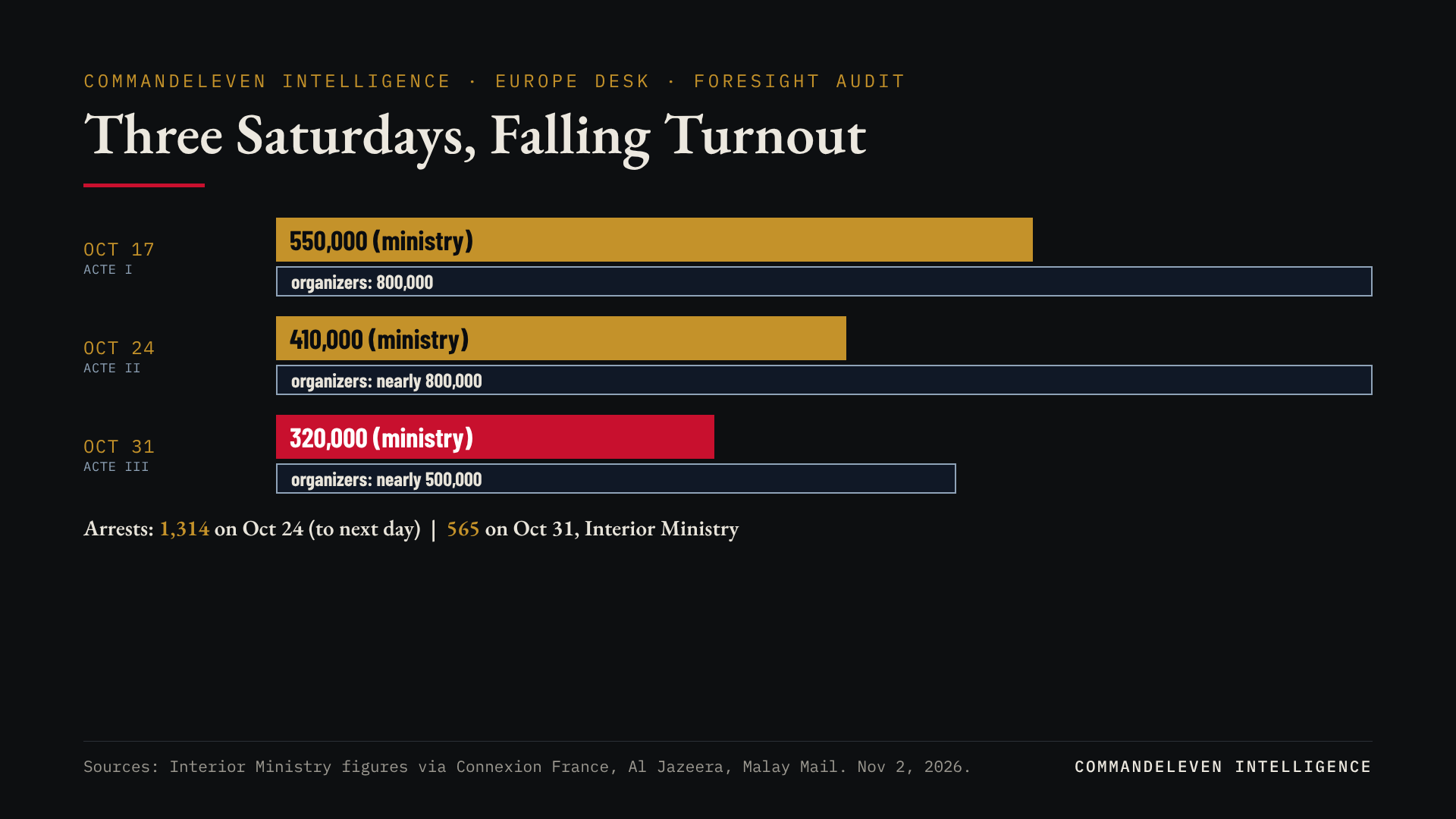
- [CONFIRMED] The movement is shrinking in France but not ending. Ministry turnout fell from about 550,000 to about 410,000 to about 320,000 across three Saturdays. Organizers claimed about 800,000 on October 24 and nearly 500,000 on October 31.
- [CONFIRMED] The state held its line short of emergency powers. France used targeted curfews, protest bans and a deployment of about 70,000 police and gendarmes, but declared no state of emergency and dissolved no group in the window.
- [ASSESSED] The violent core adapted rather than disappeared. After a quiet October 24 under heavy policing, October 31 brought Molotov cocktails thrown at officers in Paris, barricades and paving stones, with the ministry reporting 565 arrests. The target shifted from property to police.
- [CONFIRMED] The spread to Germany happened, and it turned violent on the first day. Frankfurt saw looting and Molotov cocktails thrown at emergency workers, Hamburg saw burning barricades and 120 arrests reported by public broadcaster NDR, and Berlin police reported 27 officers injured.
- [ASSESSED] We missed on the form of violence on October 24. We recorded this as a miss on the same terms as our October 17 on-air warning of a bombing, which also did not happen.
What Happened, October 24 to 31
France, October 24 (Acte II)
The Interior Ministry counted about 410,000 marchers, below the 550,000 of October 17. Organizers claimed nearly 800,000. By 1 p.m. Interior Minister Laurent Nuñez reported about 35,000 people in the streets, against 60,000 at the same hour on October 17, and 136 protest actions against 264. Paris police posted that the capital was calm. Arrests rose to 1,314 by the next day, and 53 police and gendarmes were injured. Tear gas and water cannon were used in Lyon, Nantes, Nice, Marseille, Strasbourg and Clermont-Ferrand, and police seized Molotov cocktails in Grenoble. Nuñez said there had been no major incident. We found no report of a public building or business set on fire in any French city.
France, October 31 (Acte III)
The ministry counted about 320,000, with 70,000 in Paris. The youth organizations and unions claimed nearly half a million, with 200,000 in Paris. The ministry reported 565 arrests. Four police officers and one gendarme were injured in Paris, three of them burned by Molotov cocktails. Nuñez called one of the attacks on a riot officer attempted murder. Masked groups pried up paving stones and threw them at police, and bins and street furniture were set alight. The ministry said radical elements in Bordeaux, Toulouse and Marseille tried to enter city centers to vandalize and loot. A night curfew applied in central Paris from October 31 to November 2, Marseille banned gatherings and Lyon banned protests in its center. Nantes, Strasbourg and Lille were peaceful.
Germany, October 31
The Gen Z regelt campaign, which called protests in 21 cities and later in more than 30, said about 120,000 people took part, below the roughly 180,000 it expected. Authorities in Frankfurt, Munich and Berlin reported as many as 18,000 combined, about half the organizers’ estimate. The day was largely peaceful until evening. In Frankfurt, rioters smashed windows and looted shops on the main shopping street, and Molotov cocktails were thrown at emergency services. A gun shop was targeted, and police seized two weapons after one arrest. Hesse’s interior minister, Roman Poseck, said about 100 left-wing extremists had infiltrated the protest, which is his own assessment. In Hamburg, protesters in black set off fireworks and set barricades on fire, and the organizers ended the march early after police were pelted with stones. In Berlin, police reported 27 officers injured and up to 56 people briefly detained. In Cologne, police were attacked near the main station, although a Cologne police spokesperson linked later incidents more to Halloween activity than to the protest.
Our Seven Calls, Scored
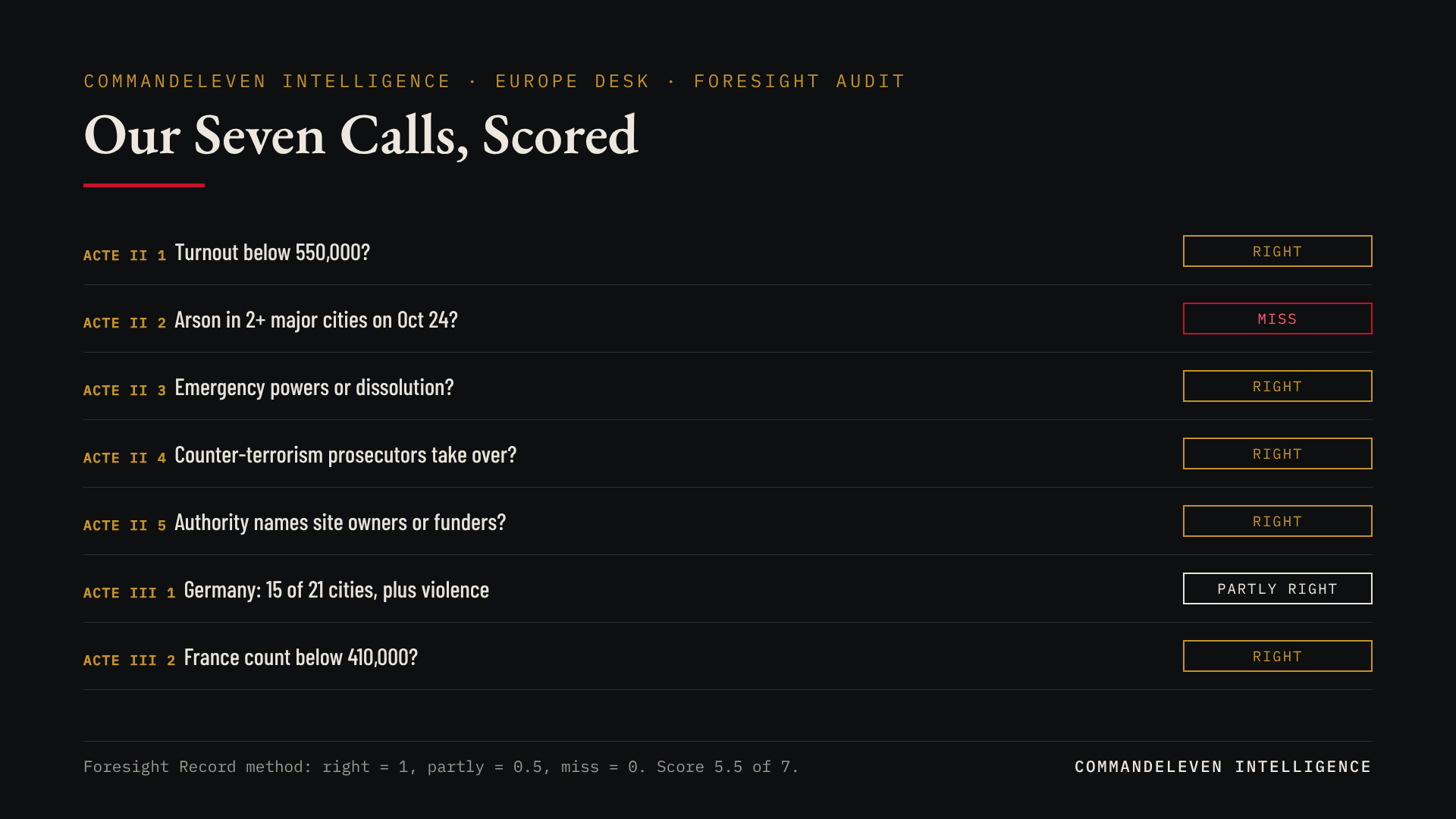
These are the five Acte II calls and the two Acte III calls, scored by the Foresight Record method: a confirmed call counts as 1, a partial call as 0.5, and a miss as 0.
| Call | Record | Score |
|---|---|---|
| Acte II 1. Is the Interior Ministry’s October 24 count below October 17’s 550,000? | About 410,000. | Right |
| Acte II 2. Are public buildings or businesses set on fire in at least two major cities on October 24? | We found no report of any. Evening clashes occurred in Paris, and the heavy police posture appears to have held. | Miss |
| Acte II 3. Does the government declare a state of emergency or dissolve a group before October 31? | Neither. Curfews and bans only. | Right |
| Acte II 4. Do national counter-terrorism prosecutors take over the Limoges case or another protest-related case? | No. The police counter-terrorism sub-directorate (SDAT) was called in, but the Limoges prosecutor kept the case. Two suspects were charged with attempted homicide of public officials, organized destruction and criminal association. No terrorism charge was reported. | Right |
| Acte II 5. Does a French authority or court filing identify who registered the October 17 and youth-strike websites, or trace foreign funding to French organizers? | No such finding has been published. | Right |
| Acte III 1. Germany: demonstrations in at least 15 of the 21 announced cities, and violence in at least one of Berlin, Hamburg, Cologne or Frankfurt. | Violence clause met in all four cities. The organizers expanded the call to more than 30 cities, but we have not verified a count of cities where demonstrations took place. | Partly right, city count pending |
| Acte III 2. Is the Interior Ministry’s Acte III count below Acte II’s 410,000? | About 320,000. | Right |
Score: 5.5 of 7 on the Record’s method. Acte II scores 4 of 5. Acte III scores 1.5 of 2, and the Germany call moves to a full point if a count confirms demonstrations in at least 15 cities.
How we scored the questions. Acte II calls 3, 4 and 5 were published as questions rather than as statements. We score all three by one rule: the answer is Right when it matches the expectation our published assessment carried. The brief’s base case expected emergency powers to stay in reserve, and our Key Judgments recorded no evidence of foreign funding. Call 4 is the weakest of the five, because the brief said only that prosecutors would decide whether to take the case and did not say which way. We score it the same way rather than leave it out, and we note that it is the least committal call in the set.
On the miss. Our base case for October 24 was a smaller turnout and continued targeted arson and looting in at least two of Paris, Marseille, Lyon and Bordeaux. The turnout half was right. The violence half was wrong. [ASSESSED] The likeliest reasons are the 70,000-strong police deployment, the curfews and bans, and the fall in protest actions, but we cannot separate their effects. The violent core did not stand down. It reappeared a week later with Molotov cocktails aimed at officers, and the October 17 miss we recorded, a warning of a bombing, also stands.
The October 14 Indicators, Closed
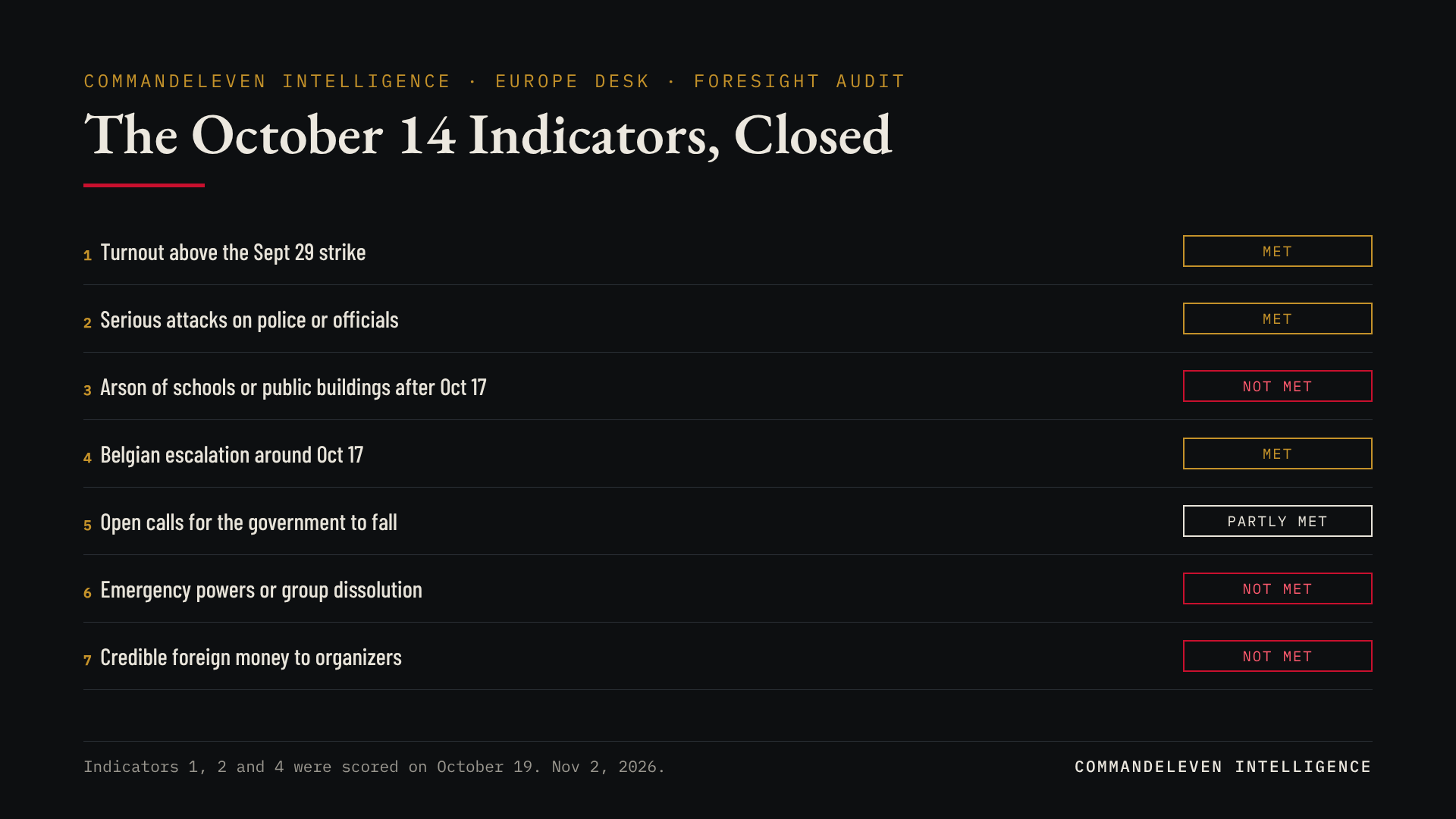
| Indicator | Final record | Score |
|---|---|---|
| 1. Turnout above the September 29 strike | About 550,000 on October 17, against about 206,000. | Met (October 19) |
| 2. Serious attacks on police, teachers or officials | More than 500 police, gendarmes and firefighters injured on October 17. | Met (October 19) |
| 3. Arson of schools or public buildings continuing after October 17 | We found no school or public-building arson after October 17 in the reporting reviewed. The October 17 fires at Limoges City Hall and Lyon’s tourist office fall on the day itself. The Nelson Mandela lycée fire in Nantes was on October 1, before the window. | Not met |
| 4. Belgian escalation around October 17 | 195 arrests in Brussels and Liège. | Met (October 19) |
| 5. Open calls for the fall of the Lecornu government | The Acte II organizers’ slogan was “Macron must leave,” and protesters in Orléans chanted “Macron, step down.” The target was the president’s position, not the Lecornu government. | Partly met |
| 6. Emergency powers or dissolution of a group | Targeted curfews and bans only. No state of emergency and no dissolution in the window. | Not met |
| 7. Credible evidence of foreign money reaching organizers | None published. US amplification is documented; funding of French organizers is not. | Not met |
A note on indicator 3. The Nelson Mandela lycée in Nantes lost its entrance hall to fire on October 1. The deputy principal told AFP the fire was deliberate, and the regional education authority linked it to a violent gathering. We found no public finding on who set it, and the date puts it outside the window this indicator measures, so it does not change the score. We record it here so that the question is answered in the open.
[ASSESSED] The three indicators not met and the one partly met say the same thing as on October 19. The unrest escalated in violence without escalating in political demands, and its slogans aimed at a president, not a cabinet. That is a large protest carrying an organized violent edge, not a movement aimed at bringing down a government.
What Comes Next
- November 5. The French unions’ day of action. A test of whether the labor movement keeps the street mobilization going after three weekends.
- November 14. The next announced action by French organizers.
- November 20. The International Youth Strike across Belgium, Germany, Italy, the UK, Ireland and Spain. Two Acte III calls remain open and are scored on November 21: at least one more country making a terrorism-related arrest linked to the wave, and demonstrations in at least four of the six named countries.
- Germany. A verified city count for October 31, and whether the Frankfurt and Hamburg violence repeats on November 20.
- Limoges. Whether the case is transferred to the national anti-terrorism prosecutors as the investigation develops.
What This Audit Does and Doesn’t Establish
- It establishes what France’s ministry and the cited outlets reported on October 24 and 31 and how our published calls compare with it.
- It does not establish who set any individual fire or threw any individual Molotov cocktail, or that any group or state directs the violence.
- It does not establish that the movement is over. Three Saturdays of falling turnout is a trend, not an end.
- Figures are as reported and come from different times of day and different counters. Where the ministry and organizers differ, we give both.
Frequently Asked Questions
How many people protested in France on October 31?
The Interior Ministry counted about 320,000 nationwide, including 70,000 in Paris. The youth organizations and unions claimed nearly half a million.
Was there a state of emergency in France?
No. France used targeted curfews and protest bans, including a night curfew in central Paris from October 31 to November 2. The prime minister has said a state of emergency could follow if necessary.
What happened in Germany on October 31?
The Gen Z regelt campaign held rallies in cities across Germany. They were largely peaceful by day. Evening violence included looting in Frankfurt, burning barricades in Hamburg and attacks on police in Berlin and Cologne.
What did CommandEleven Intelligence get wrong?
We expected arson and looting in at least two major French cities on October 24, and found no report of it. We also warned on air before October 17 of a bombing, which did not happen.
Who burned the Limoges City Hall?
Two suspects have been charged by the Limoges prosecutor, including with attempted homicide of public officials. They have not been convicted. Reporting links the main suspect to the radical far left, and no terrorism charge has been reported.
Sources
- Al Jazeera, Tension and clashes as hundreds of thousands protest again in France October 31, 2026
- Malay Mail, Halloween costumes, tear gas and 565 arrests: France’s protests take a violent turn November 1, 2026
- Al Jazeera, Photos: Youth-led rallies sweep Germany November 1, 2026
- Business Standard, Germany protests: Shops looted in Frankfurt as Gen Z rallies turn violent November 1, 2026
- Open Magazine, Germany’s Gen Z Protests: Unpacking the Anger, Demands, and Violence Behind the Movement November 2026
- Connexion France, October 24 protest turnout falls by almost half as France appears calm October 24, 2026
- Connexion France, France protests: 410,000 march as arrests near 1,000 October 25, 2026
- Euronews (French edition), Manifestations en France : 1 314 interpellations, 53 membres des forces de l’ordre blessés samedi October 25, 2026
- Public Sénat, Mobilisation du 31 octobre : à quoi faut-il s’attendre ? October 2026
- Club des juristes, Incendie de Limoges : mise en examen du principal suspect pour tentative de meurtre sur des policiers municipaux October 26, 2026
- Club des juristes, Incendie de la mairie de Limoges : possible saisine du Parquet national antiterroriste ? October 20, 2026
- Times of Israel, France arrests man, calls in counterterror police over burning of town hall October 20, 2026
- Sud Radio, Mairie de Limoges incendiée : les deux suspects mis en examen et placés en détention provisoire October 24, 2026
- Wikipedia, 2026 French student protests (secondary; used for the October 1 school fires, which cites AFP and franceinfo)