CommandEleven Intelligence // South Asia Desk. Dossier, status as of November 1, 2026. The public record on the October 22 Kandahar session is thin, so this dossier separates what is documented from what comes from our own field reporting, and labels each.
Bottom Line Up Front
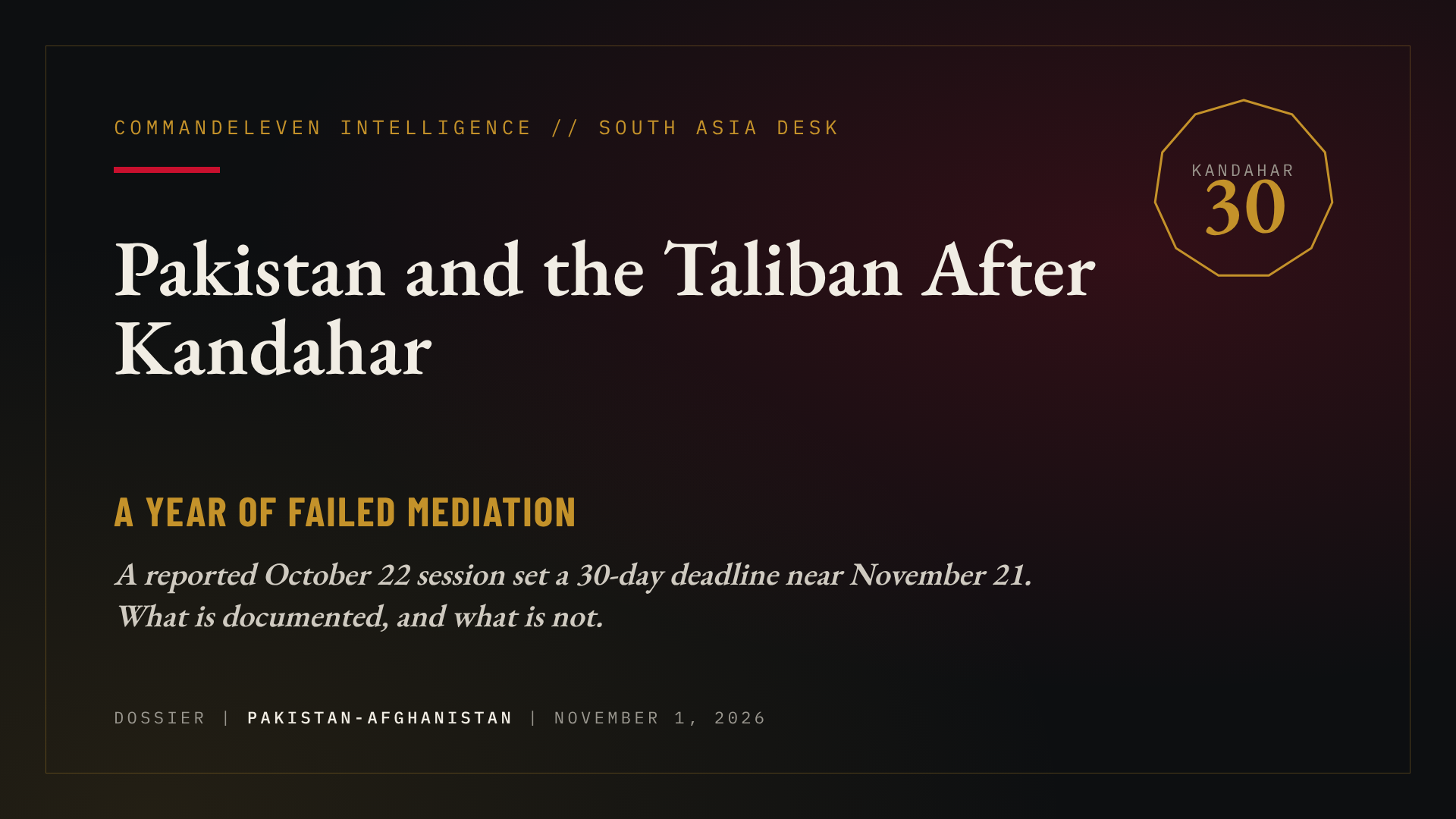
Pakistan and the Afghan Taliban have now been through a year of outside mediation, and every round has produced a pause, not a settlement. Qatar and Turkey, Saudi Arabia and China have each tried since October 2025, and a Russian-hosted regional forum ended on October 5 without a joint statement. The latest effort, a Pakistani security delegation’s day-long session in Kandahar on October 22, reportedly ended in deadlock with a 30-day clock that runs out around November 21. That session is known to us from CommandEleven field reporting. We found no public report of it.
Our assessment is that the 30-day window is more likely to end in escalation than in agreement. The core positions have not moved: Pakistan wants action against the Pakistani Taliban (Tehrik-e-Taliban Pakistan, TTP), and Kabul denies sheltering it. Border fighting has continued through the window, and Pakistan is reported to have opened a second track with the Taliban’s armed opponents, which Islamabad denies. The U.S. Embassy’s October 31 warning about Moscow is a separate matter. Nothing we found ties it to these talks.
Key Judgments
KJ1: Outside mediation has produced pauses, not settlements. Ceasefires were agreed in October 2025 and again in March 2026, and each collapsed or lapsed. The underlying dispute over the TTP was never resolved in any round. [CONFIRMED]
KJ2: The October 22 Kandahar session rests on one source. Our field reporting describes a five-member Pakistani team, five Pakistani demands, Taliban counter-conditions and a 30-day deadline. We found no public report of the session, so every detail of it is single-source. [REPORTED, single source, not independently corroborated]
KJ3: The core dispute is unchanged. Pakistan’s public line is that the Taliban evade the question of TTP sanctuaries. Taliban spokesman Zabihullah Mujahid rejected on October 23 Islamabad’s claims that the Taliban are involved in Pakistan’s insecurity. [CONFIRMED on the stated positions]
KJ4: Fighting continued while the talks were being held. Clashes were reported along the Paktika border on October 19, in Lower South Waziristan on October 27 and at Torkham on October 28. [CONFIRMED that clashes occurred; casualty figures DISPUTED]
KJ5: Pakistan is reported to be hedging. The New York Times reported on October 22 that Pakistani military and intelligence officials met anti-Taliban resistance groups over recent months. Pakistan’s information ministry called the claims baseless on October 24. No outlet we read names who met whom. [REPORTED; DISPUTED]
KJ6: We do not tie the Moscow warning to Afghanistan. The U.S. Embassy warned of a credible mass-casualty threat at the Tsaritsyno Museum Reserve on October 31, and Russia’s FSB said U.S. services had passed it a warning. The reports we read name no source and no perpetrator. We attach no CommandEleven call to it. [CONFIRMED on the warning; source and perpetrators UNVERIFIED]
KJ7: Three dated calls are set below. They will be scored on the Foresight Record. [METHOD]
What Our Field Reporting Says Happened on October 22
Everything in this section is [REPORTED, single source]. A five-member Pakistani team, four senior security officials and a Foreign Ministry representative, joined by consular heads from Kabul and Kandahar, reportedly crossed at Spin Boldak around 09:00 and returned to Quetta by 22:00 after a day-long session with the office of Taliban leader Hibatullah Akhundzada and his circle. Our field intelligence suggests the following Taliban attendees. This is a suspected list based on field intelligence, not a confirmed one: Mullah Shirin (governor of Kandahar), Sadr Ibrahim (deputy interior minister), Zabihullah Mujahid (central spokesman), Mufti Lutfallah Hakimi (chief inspector, Ministry of Defense), Mullah Abdul Qadus (head of Taliban military intelligence) and Mullah Talib. We have not found a public report naming the delegation’s leader.
Pakistan’s five demands
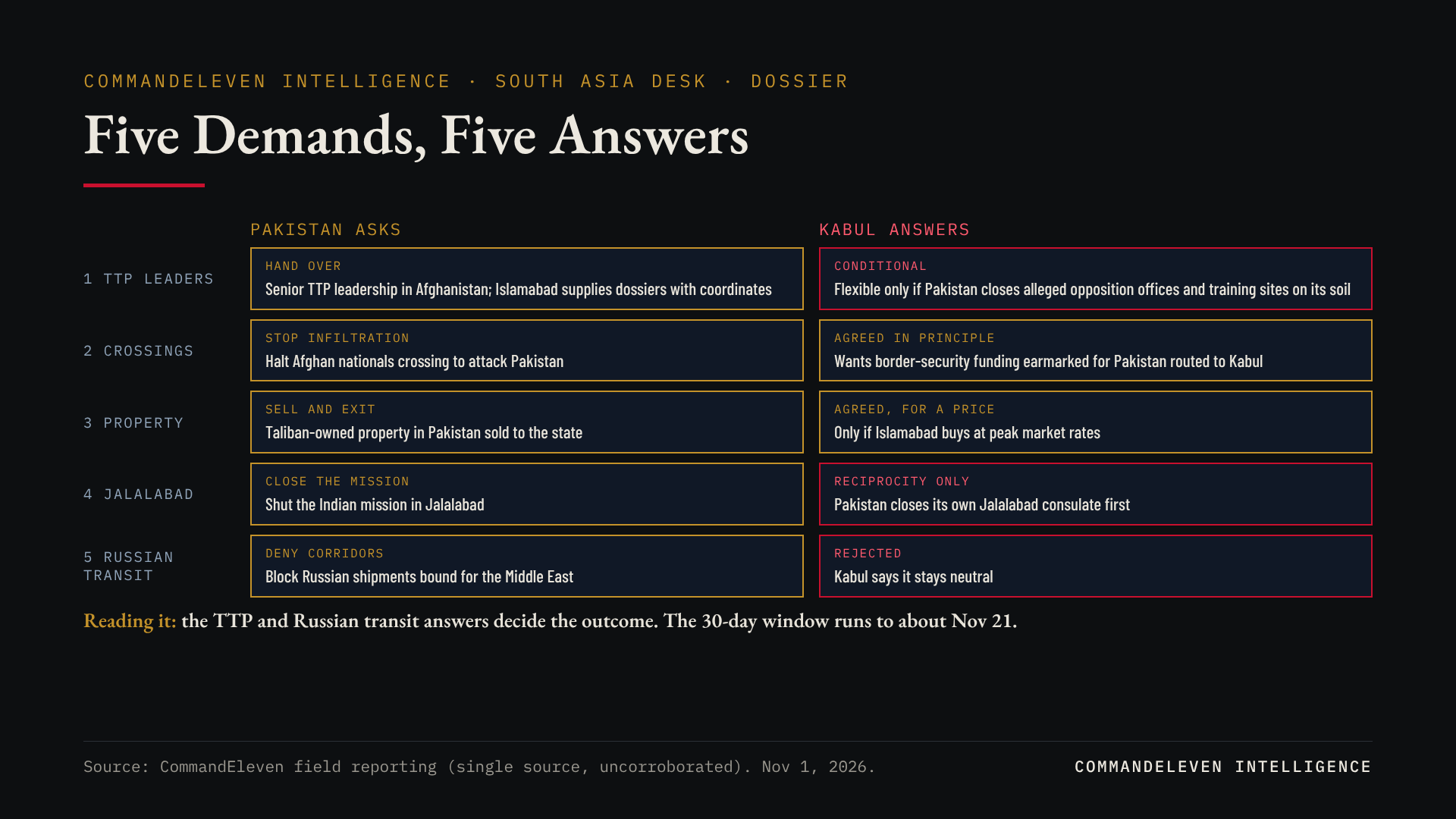
- Hand over senior TTP leaders living in Afghanistan. Islamabad reportedly provided dossiers with physical coordinates.
- Stop Afghan nationals from crossing to carry out attacks in Pakistan.
- Sell off Taliban-owned property in Pakistan to the state and end the owners’ presence there.
- Close the Indian consulate in Jalalabad. Our field reporting says India’s Jalalabad mission operates covertly, as do other Indian posts near the Pakistan border. We could not confirm this from public sources.
- Deny Afghan land and air corridors to Russian shipments bound for the Middle East.
What Kabul reportedly answered
- TTP leaders: conditional flexibility, but only if Pakistan closes alleged opposition offices and training sites on its soil. Kabul handed over its own dossiers citing recent skirmishes in Nuristan.
- Border infiltration: agreed in principle, but asked that international border-security funding earmarked for Pakistan go to Kabul.
- Property: agreed, if Islamabad buys the assets at peak market rates.
- Jalalabad: agreed only on reciprocity, meaning Pakistan closes its own Jalalabad consulate.
- Russian transit: rejected outright. Kabul said it will stay neutral.
Both sides reportedly set a 30-day window to show verifiable progress, which runs to about November 21. [ASSESSED] The two answers that matter are the first and the last. Kabul’s reply on the TTP is a trade, not a concession, and Pakistan has no reason to accept it. The Russian transit demand reaches past the bilateral dispute into the Iran war and Moscow’s role in the region, which is not something Kabul can or will deliver. Public statements after the session point the same way. Pakistan’s information ministry reportedly said on October 31 that the Taliban were evading the TTP question, and Mujahid reportedly said Kabul had exhausted its diplomatic options.
One detail is worth noting. Pakistan’s army said in early October that the Kandahar governor, Mullah Shirin, hosted a meeting of al-Qaeda, TTP and Baloch militant representatives, which is Pakistan’s claim and unverified. Our suspected attendee list places the same governor in the room on October 22. [ASSESSED] Islamabad is negotiating with an official it publicly accuses.
[ASSESSED] Kabul can afford to wait, because the closed crossings have pushed it toward Iran and India. NPR reported in February that the Taliban asked India to help move Afghan goods through Iran’s Chabahar port, and that Afghan exports to Pakistan were about $300 million lower in a year. We found no figures on how much trade the Iranian route now carries. The relationship among the Taliban, India and Iran also helps explain why the Jalalabad and Russian transit demands are on Pakistan’s list, and why Kabul will not meet them while Pakistan’s crossings stay shut. We do not expect any of the five demands to move until the Taliban deal with the TTP.
A Year of Mediation, Round by Round
The record below is drawn from public reporting. Dates are as reported, and the sources differ on some details.
- October 2025, Doha. Qatar and Turkey broker a ceasefire after the largest clashes since the Taliban took power in 2021, with Pakistani strikes in Kabul and Kandahar and heavy fighting at Spin Boldak. [CONFIRMED]
- Late October to early November 2025, Istanbul. A joint statement on October 30 extends the ceasefire and promises a monitoring mechanism. A principal-level meeting in early November ends in deadlock, and Pakistan says the Taliban gave no assurances on the TTP. [CONFIRMED]
- Saudi Arabia. A limited result: the Taliban released three Pakistani soldiers held since the October clashes. [REPORTED]
- February 2026. The truce fails. Pakistan carries out airstrikes in eastern Afghanistan on February 21, and the sides trade cross-border raids days later. The conflict is described in the press as open war. [CONFIRMED]
- February to March 2026, China. A special envoy shuttles between the capitals, and the effort falters when the sides refuse face-to-face dialogue. [REPORTED]
- Mid-March 2026. Qatar, Turkey and Saudi Arabia secure a temporary Eid al-Fitr ceasefire after the Kabul hospital strike. [REPORTED]
- Mid-April 2026, Urumqi. China hosts week-long talks. The outcome is a commitment to explore a comprehensive solution, with no ceasefire and no joint statement. [REPORTED]
- September 2026. A senior Pakistani official says relations have reached a point of no return, and Turkish and Qatari efforts reportedly collapse after an attack in Kohat. [REPORTED]
- October 5, 2026, Moscow. The eighth Moscow Format consultations end without a joint statement. The Taliban objected to repeated references to Afghanistan in connection with terrorism, and Russia’s envoy said Moscow is not there to settle bilateral disputes but would help if both sides asked. [CONFIRMED]
[ASSESSED] The pattern is consistent. Each round fixed a ceasefire and left the TTP question for a later meeting, and each ceasefire failed over that same question. The October 22 session, as our source describes it, is the first in this record to put demands about Russia and India on the table beside the TTP, which widens the list of things that can go wrong.
The Fighting While the Talks Ran
- September 18. A suicide attack in Pakistan kills 31 people and is claimed by Ittehad-ul-Mujahideen Pakistan. Pakistan blames Taliban sheltering of the TTP. [CONFIRMED]
- October 11. President Asif Ali Zardari declares a state of emergency in Khyber Pakhtunkhwa and suspends the provincial government. [CONFIRMED]
- October 19, 27 and 28. Clashes along the Paktika border, between Paktika and Lower South Waziristan, and at Torkham. A mortar round kills one civilian and wounds five in Pakistan on October 27. The Taliban say Pakistani drones struck security facilities in Paktika and that they retaliated, and Pakistan called their account a fabrication. No military casualty figures are given by either side. [CONFIRMED that clashes occurred; figures DISPUTED]
- The economy. Pakistan’s Trade Development Authority reports bilateral trade fell 95 percent in fiscal 2026 from the year before, and crossings have been mostly closed for more than a year. [REPORTED]
Pakistan’s Other Track
The New York Times reported on October 22, citing an unnamed Pakistani intelligence official and an unnamed senior member of the resistance, that Pakistani military and intelligence officials had met Afghan armed opposition groups in recent months to discuss possible support. Pakistan’s information ministry denied it on October 24 as baseless and misleading. The reports we read give no names, dates or locations for the meetings and say nothing on what was offered. The Taliban’s October 23 statement that Pakistan is spending money on projects to destabilize Afghanistan addressed other accusations, but it fits the same argument. [REPORTED; DISPUTED]
[ASSESSED] If the report is right, Pakistan is keeping the talks open while building leverage against the movement it is talking to. The groups it approached face a hard choice, because Pakistani backing would cost them credibility inside Afghanistan, and no other backer has offered sanctuary or material support. We cover the Taliban’s internal armed opposition in a separate dossier.
The Moscow Warning, and Why We Make No Call
On Saturday, October 31, the U.S. Embassy in Moscow warned Americans of a credible threat of a mass-casualty event at the Tsaritsyno Museum Reserve in southern Moscow, advised them to avoid the area and crowds, and said Washington was coordinating with Russian authorities. Russia’s FSB said U.S. intelligence had warned it through partner channels and that measures were being taken. [CONFIRMED] The reports we read do not identify the source of the threat or any group behind it. [UNVERIFIED]
There is a precedent. The embassy issued a similar warning on March 7, 2024, and the Crocus City Hall attack followed on March 22. The Islamic State Khorasan Province (ISKP) claimed it, U.S. officials said they had intelligence confirming ISKP’s responsibility, and the suspects arrested were Tajik nationals. A precedent is not evidence about this warning. We have seen no claim, no arrest and no published intelligence behind the October 31 alert, and we have no basis to say what lies behind it or whether it is accurate.
[ASSESSED, low confidence] Islamic State-linked plots have featured in Russia’s recent threat picture, so an attribution to ISKP or Islamic State Central Asia would be plausible if an attack followed. That is a reason to watch, not a forecast. We would revise this judgment on any of three events: a claim of responsibility, arrests that name a group, or release of the intelligence behind the warning. Nothing so far links the alert to the Pakistan-Taliban talks.
What to Watch
- About November 21. The end of the 30-day window, and whether either side says anything formal about it.
- The TTP question. Any announced handover, relocation or arrest of senior TTP figures. Nothing of the kind is reported.
- Torkham and Chaman-Spin Boldak. Whether either reopens for regular trade.
- Pakistani strikes inside Afghanistan and Taliban retaliation, particularly around Paktika, Khost and Kandahar.
- The resistance. Whether any named group confirms or rejects contact with Pakistan.
- Moscow. Any claim, arrest or official statement tying the Tsaritsyno alert to a group.
Calls We Will Score
- By November 30, 2026, no handover of senior TTP leaders by the Taliban to Pakistan will have been publicly announced or confirmed by either government.
- By November 30, 2026, neither Torkham nor Chaman-Spin Boldak will have reopened for regular commercial trade.
- By December 31, 2026, Pakistan and the Taliban will not have announced a jointly agreed border monitoring or verification mechanism.
Each is scored confirmed, partly confirmed or missed on the Foresight Record’s method, with the date and sources in the entry.
What This Dossier Does and Doesn’t Establish
It establishes the public record of mediation since October 2025, the stated positions of both governments, the recent border fighting, the New York Times report and Pakistan’s denial, and the U.S. Embassy’s October 31 warning. It does not establish what was said in Kandahar on October 22, which rests on our field reporting alone. It does not establish who met whom in Pakistan’s reported outreach, who is behind the Moscow alert, or any link between that alert and these talks. Casualty figures from the border clashes are claims by the parties. Some mediation dates come from a single summary article and may be refined. Al Jazeera, France 24 and The Washington Post could not be retrieved.
Frequently Asked Questions
What happened in Kandahar on October 22?
According to our field reporting, a five-member Pakistani security team met Taliban leaders for a day, put five demands and left with a 30-day deadline and no breakthrough. We found no public report of the session.
Are the Pakistan-Taliban talks over?
Not formally. Both sides say they are open to diplomacy, but the core dispute over the TTP is unchanged and the fighting continues.
What does Pakistan want from the Taliban?
Publicly, action against the TTP. Our field reporting adds four more demands: stopping Afghan crossers, property sales, closing an Indian consulate and denying Russian transit.
Is Pakistan arming the Taliban’s opponents?
The New York Times reported meetings to discuss possible support. Pakistan denies arming anyone. We found no report of weapons delivered.
Is the Moscow warning connected to Afghanistan?
We found nothing that says so. The warning names no source or group. Past attacks in Russia were claimed by ISKP, which is background and not evidence.
Sources
- FDD’s Long War Journal, Taliban-Pakistan border clashes continue after Moscow talks end without agreement
- FDD’s Long War Journal, Afghanistan-Pakistan border clashes continue amid reported Pakistani outreach to anti-Taliban groups
- FDD’s Long War Journal, Pakistani outreach presents a dilemma for Afghanistan’s anti-Taliban resistance
- Afghanistan International, Pakistani Military, Intelligence Officials Met Anti-Taliban Leaders, Says NYT
- Afghanistan International, Pakistan Denies Arming Afghans Against Taliban
- Afghanistan International, Kandahar Hosted Meeting Of Al-Qaeda, TTP And Baloch Militants, Says Pakistan
- South Asian Voices, Between Islamabad and Kabul: How Far Can Mediators Go?
- Ali Adili (Substack), A Breakthrough After A Breakdown: An update on the Taliban-Pakistan talks
- NPR, Pakistan-Afghanistan border closures paralyze trade along a key route
- The Jerusalem Post, US Embassy in Russia warns of Moscow terror attack
- NBC News, U.S. warns of imminent Moscow attack by ‘extremists,’ urges citizens to avoid crowds (March 2024 background)
- CommandEleven field reporting, Kabul and Kandahar, October 22 to November 1, 2026 (single source; not independently corroborated)