
CommandEleven Intelligence // South Asia Desk. Dossier, status as of November 1, 2026. Nearly every casualty and territorial figure in this dossier is a claim by an armed group. We label each claim as one, and we say where the Taliban’s own account differs.
Bottom Line Up Front
The Taliban are losing control at the edges of Afghanistan, and the edges are widening. They are not losing it at the center. Armed opposition attacks have risen sharply since spring. One district center fell to a new group in July, and the Taliban confirmed it. A local commander in Badakhshan fought Taliban special forces for a week in August over gold mines. Fighting in Nuristan and Badakhshan is now sustained enough that the Taliban describe it as an incursion from Pakistan, while the groups say they hold ground. At the top, the Taliban’s leadership is reported to be split between Kandahar and Kabul.
Our assessment is that this is erosion, not collapse. No group holds a district, a sanctuary or a state sponsor. The UN assessed the opposition as no significant threat to Taliban territorial control, the Taliban killed a senior resistance commander and forced a dissident commander to surrender within days of each other in August, and the Taliban still govern every provincial capital. The thing that would change this assessment is outside help. Pakistan is reported to have opened contact with resistance groups, which Islamabad denies, and that is the development we are watching most closely.
Key Judgments
KJ1: Armed opposition activity has risen sharply in 2026. The UN counted 18 attacks claimed by four groups between February 1 and April 13, and assessed 16 as having occurred. For May 1 to July 31 it counted 88 claimed attacks in 21 provinces, and its investigators verified 55. The weekly rate of attacks the UN could confirm more than doubled. More groups are also claiming attacks, so part of the rise is wider reporting. [CONFIRMED on the UN counts; the size of the real increase is ASSESSED]
KJ2: The northeast is the center of the fighting. ACLED recorded 22 anti-Taliban armed events in Badakhshan from January to July 2026, against four from June to December 2025. Sustained fighting is also reported in Nuristan. [CONFIRMED on the ACLED counts]
KJ3: A district center fell for the first time since 2021, and the Taliban confirmed it. A new group, the Homeland Soldiers Front, overran the Yaftal-e Sufla district center in Badakhshan overnight into July 17. The Taliban acknowledged that armed attackers briefly took control, called them “irresponsible individuals” and said they fled when forces arrived. Local sources say the group held the center for several hours. [CONFIRMED that the center was taken; duration REPORTED]
KJ4: The Taliban are still winning the direct contests. On August 17 a dissident commander, Juma Khan Fateh, surrendered after nearly a week of fighting in Badakhshan. On August 19 the Taliban ambushed and killed the National Resistance Front commander Hasib Panjshiri in Parwan. [CONFIRMED]
KJ5: Claims in Nuristan conflict and we cannot settle them. The Afghanistan Freedom Front says it took villages in Kamdesh and Nari in late September and killed 37 Taliban. The Taliban say they killed 28 infiltrators and captured 32 who crossed from Pakistan. Pakistan rejects the Taliban account. [DISPUTED]
KJ6: The Taliban leadership is reported to be divided, on thin sourcing. Reports describe a rift between the Kandahar circle around Hibatullah Akhundzada and Kabul ministers, including Interior Minister Sirajuddin Haqqani. The Taliban deny it. The most specific claims rest on unnamed sources. [REPORTED; DISPUTED by the Taliban]
KJ7: The resistance is fragmented, with no sanctuary and no declared sponsor. At least eight groups regularly claim attacks. We found no public evidence of a unified command or of open state backing. [ASSESSED]
KJ8: Four dated calls are set below. They will be scored on the Foresight Record. [METHOD]
Why the Evidence Supports Erosion, Not Collapse
The headline question, whether the Taliban are losing control, depends on what is meant by control. The Taliban still hold the instruments that decide it: they run every provincial capital, and no force in Afghanistan can march on Kabul. Will Selber, a retired U.S. Central Command foreign area officer writing for FDD’s Long War Journal, judges the resistance not an existential threat and unlikely to become one in the near to medium term. The Asia Times analyst Saima Afzal reaches a similar view from a more critical starting point: the Taliban do not appear close to losing Kandahar or Helmand, and the evidence does not yet show a slide into nationwide civil war.
What has changed is the Taliban’s ability to say that nothing is happening. Taliban authorities deny that organized armed opposition exists. Their own confirmation of the July district loss, and their description of the Nuristan fighting as a Pakistani incursion, show that claim no longer holds.
Who Is Fighting
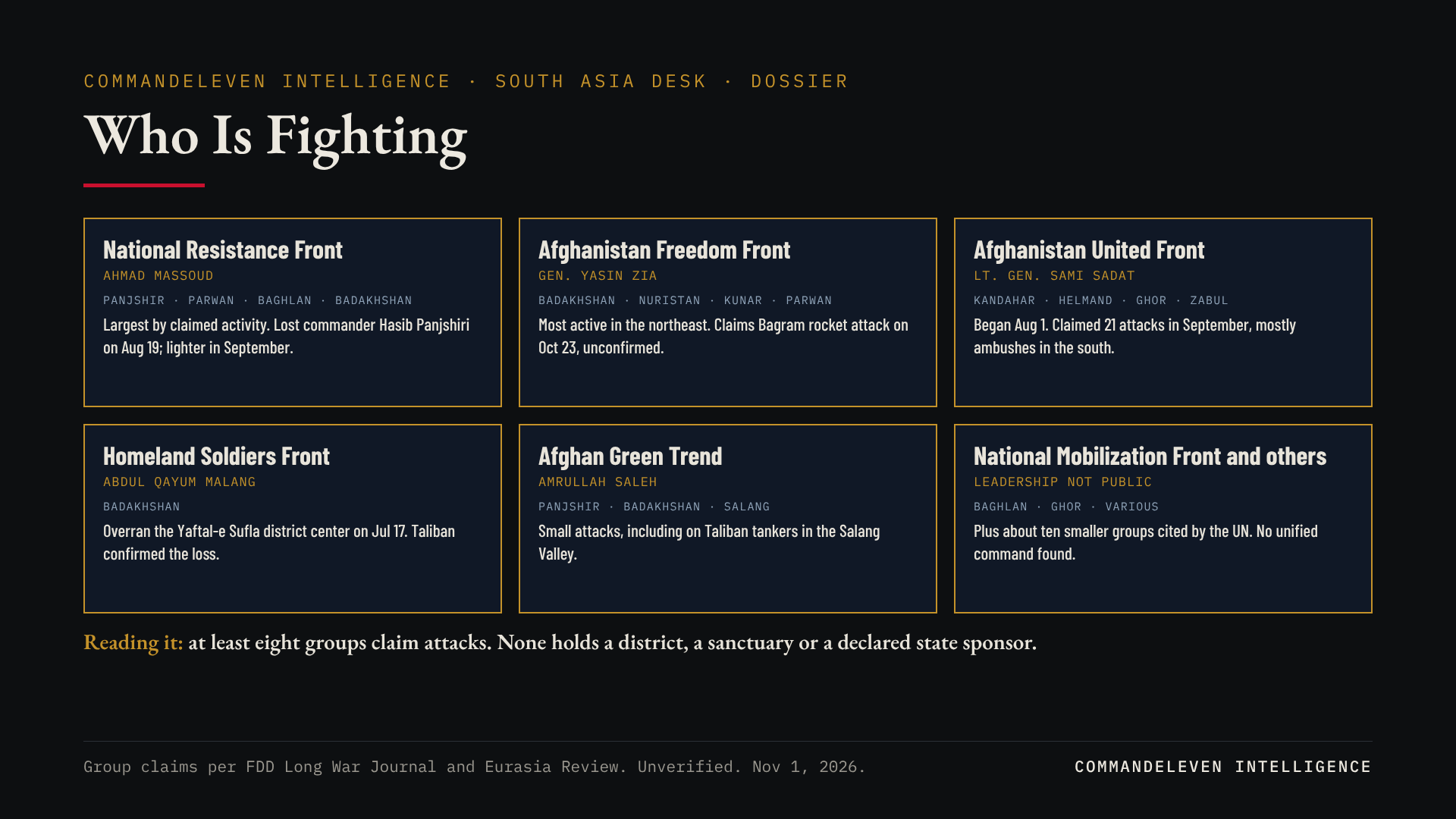
| Group | Leader | Where it is active (as claimed) | What we can say |
|---|---|---|---|
| National Resistance Front (NRF) | Ahmad Massoud | Panjshir, Parwan, Baghlan, Badakhshan, Herat | Largest by claimed activity. Lost senior commander Hasib Panjshiri on August 19. Activity lighter in September. |
| Afghanistan Freedom Front (AFF) | Gen. Yasin Zia, former chief of the General Staff | Badakhshan (Zebak), Nuristan, Kunar, Parwan, Kapisa, Kabul | Most active in the northeast. Claims territorial gains in Nuristan and Zebak. Claims a rocket attack on Bagram airbase on October 23, with no casualty figures and no Taliban comment. |
| Afghanistan United Front (AUF) | Lt. Gen. Sami Sadat, former 215th Corps commander | Kandahar, Helmand, Ghor, Zabul | Began operations on August 1. Claimed the most attacks in September (21), mostly ambushes and assassinations in the south. |
| Homeland Soldiers Front | Abdul Qayum Malang, former special forces | Badakhshan | Overran Yaftal-e Sufla on July 17. Reportedly rejected a Taliban offer to end its fight. |
| Afghan Green Trend | Amrullah Saleh, former first vice president | Panjshir, Badakhshan, Salang Valley | Claims small attacks, including on Taliban tankers in Salang. |
| National Mobilization Front | Leadership not public | Baghlan, Ghor | Claims attacks. Attribution of the September 29 Ghor attack between it and the AUF is unclear. |
| Others | Various | Various | Afghanistan Republican Front, Afghan Liberation Movement, Andarab Resistance Front and about ten smaller groups cited by the UN. |
The totals depend on who is counting. The Institute for Conflict Management, an Indian think tank, put the total at 691 attacks and 1,957 Taliban fighters killed through October 21, with the NRF at 424 incidents and the AFF at 203. Those numbers are the groups’ own claims, compiled from partial data, and the NRF’s own claim of more than 2,000 operations since 2021 is far higher than the roughly 300 attacks visible on its X account. We treat the casualty totals as unverified. The UN’s verified counts, though smaller, are the better measure of the trend.
The Northeast: Badakhshan, Nuristan and Parwan
Badakhshan
Badakhshan is the sharpest example. It sits on the Tajikistan border, holds gold mines and has an ethnic mix that cuts across the Taliban’s Pashtun-led leadership. Two separate things happened there in the summer, and there is no credible evidence that they were coordinated.
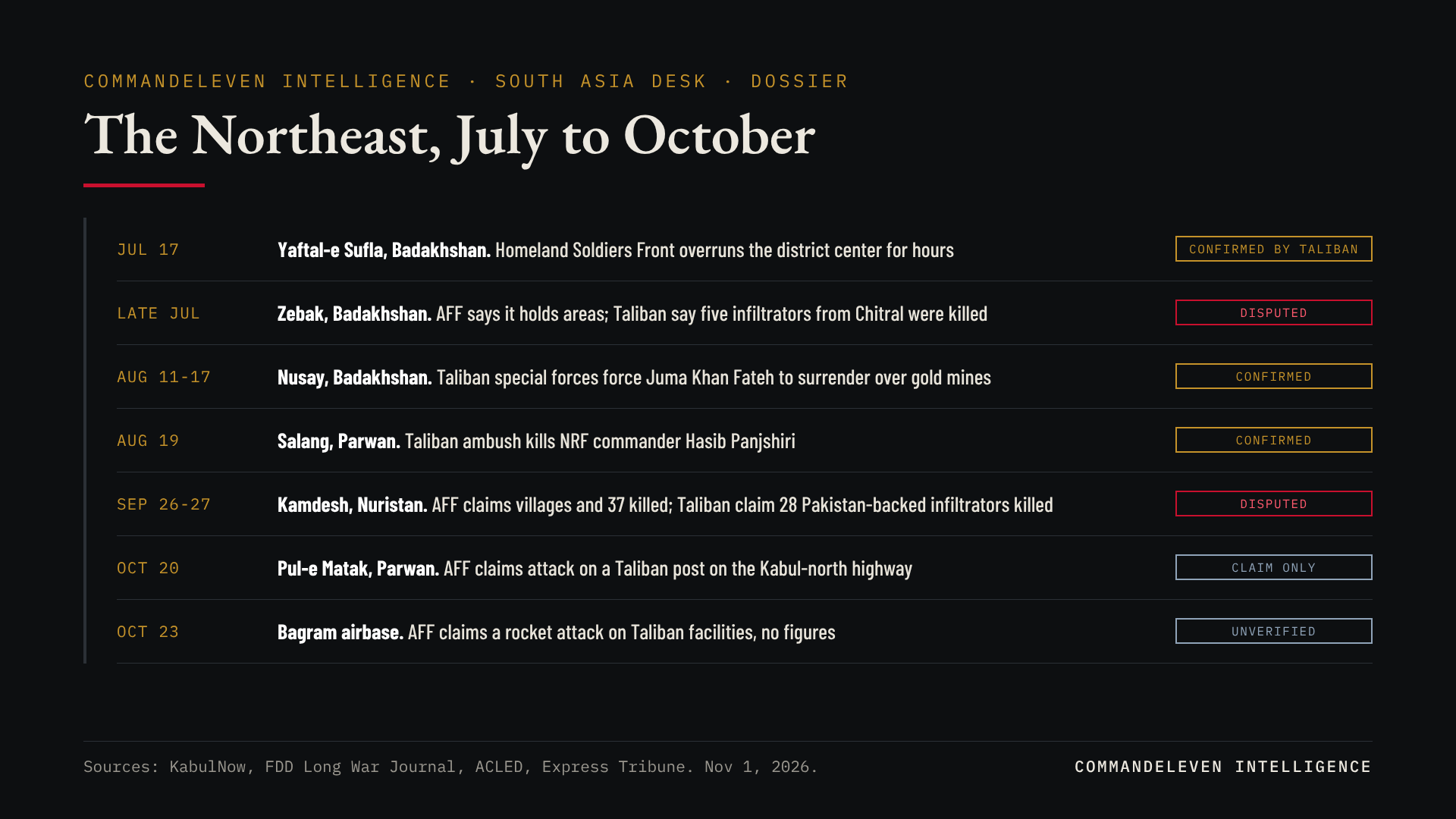
- July 17, Yaftal-e Sufla. The Homeland Soldiers Front, a group that had never before claimed an attack, attacked the district administration, police command and intelligence office. The Taliban acknowledged the attackers briefly took control, and police spokesman Ehsanullah Kamgar called them “irresponsible individuals.” Taliban army chief Qari Fasihuddin Fitrat visited the district and said most participants had been arrested. The group’s own statement claimed coordinated attacks on three districts.
- Late July onward, Zebak. The AFF says it has been fighting in Zebak since late July, claims to have seized several areas and claims 21 Taliban killed and 35 wounded. A Taliban division said it killed five “insurgents” who entered from Pakistan’s Chitral region and that the rest retreated. The Taliban have not confirmed continued clashes in the district.
- August 11 to 17, Nusay. Taliban special forces fought followers of Juma Khan Fateh, a mid-level Taliban commander and former deputy governor of Zabul who also served as an administrator in Darwaz. The dispute followed the Taliban’s May suspension of gold mining in parts of the province. Fateh surrendered on August 17 and was moved to Kabul for trial. He never joined a resistance group. ACLED counts at least eight armed clashes between local commanders and Taliban forces over mines since 2021.
The Fateh episode matters because it shows a threat that is internal to the Taliban’s own ranks. ACLED’s reading is that the Taliban’s efforts to consolidate control over powerful local commanders are likely to create resentment and raise the risk of further infighting. Spillover has already reached Tajikistan: on August 13 gunfire from the Afghan side killed a woman in her home in Darvoz district, and Dushanbe lodged a formal protest. Taliban reinforcements reportedly moved into Badakhshan from Kunduz, Balkh, Kabul and Takhar.
Nuristan
Two accounts of the late September fighting in Kamdesh cannot both be right. The AFF said it repelled assaults and, on September 27, took villages in Kamdesh, in Nuristan, and Nari, in Kunar, killing 37 Taliban and wounding 24. It rejects Taliban videos that claim its fighters surrendered. The Taliban’s Ministry of Defense, in a document dated September 27, said Daesh-affiliated groups and “elements of subversion” entered Kamdesh from Pakistan with Pakistani backing, that Taliban forces killed 28 and captured 32. Pakistan’s Ministry of Information answered on September 28 that the allegation was baseless and the Taliban video a staged shoot. The Institute for Conflict Management lists a further AFF attack in Kamdesh on October 7 that it says killed 11. Both sides agree there was serious fighting. They disagree on who the fighters were and who sent them.
Parwan and the Kabul approaches
The AFF claimed an attack on a Taliban post at Pul-e Matak in Parwan, on the main Kabul-to-north highway, on the evening of October 20, with three Taliban killed and two wounded. On October 23 it claimed a rocket attack on Bagram airbase, naming Taliban military and training facilities and giving no figures. We found no Taliban statement on either. Neither claim is confirmed. If true, they show reach toward the capital’s approaches, which is the type of activity that would worry Kabul more than distant district fighting.
Where the Taliban Are Winning
An honest assessment has to count the Taliban’s August results. On August 17 they ended the Fateh fight without a prolonged campaign. Two days later they ambushed the NRF’s Hasib Panjshiri and seven others on the way to an operation in Baghlan, killing him in northern Salang. He was a prominent figure who posted from inside Afghanistan, and the NRF’s activity was lighter in September, reportedly in part because of his loss. Mukhtar Shoresh was named his replacement on September 4, and the former parliamentarian Saleh Mohammad Registani was named general operational commander on September 25. Selber’s reading is that the two results show the Taliban can concentrate force against internal challengers and exploit security lapses in the resistance, even though neither ends the armed opposition.
The Rift at the Top
This section is [REPORTED], and several claims rest on unnamed sources. Reports describe a split between the Kandahar circle around Taliban leader Hibatullah Akhundzada and pragmatic ministers in Kabul. In March 2025 Amu TV reported that Sirajuddin Haqqani, the interior minister, had not been seen at his ministry for two months, and that Akhundzada was reassigning police commanders without him and had deployed a 2,000-strong special force, according to Amu’s sources. Foreign Minister Amir Khan Muttaqi denied any power struggle, saying there would be no bloodshed over power.
In January 2026 Afghanistan International reported that Akhundzada had repeatedly warned that internal divisions are the greatest threat to the survival of the Islamic Emirate. A separate piece on Military.com says Kabul ministers reversed a nationwide internet shutdown ordered in late 2025. It attributes that to unnamed observers and an unnamed BBC investigation we could not locate, so we treat it as [UNVERIFIED]. The girls’ secondary education ban is in its fifth year. We include these reports because rifts matter to the northeastern picture: a divided center is slower to answer local defiance. We do not claim they show the leadership is breaking apart.
Other Insurgents and Pressures
- Islamic State Khorasan Province (ISKP). The European Union Agency for Asylum estimates about 2,000 members, scattered across the northern and northeastern provinces. Taliban counter-operations reportedly weakened it, and a 2025 UN assessment found it posed no significant challenge to Taliban territorial control. It is a separate and ideologically opposed threat to the resistance groups, and the NRF and AFF have condemned it. The same northeastern provinces are where its support is reported to be growing.
- Tehreek-e-Taliban Pakistan (TTP) and the Pakistan front. The war with Pakistan, covered in our dossier on the October 22 Kandahar session, pulls Taliban forces toward the southeast while the northeast heats up. See our Pakistan and the Taliban After Kandahar dossier.
- The Pashtun south. The AUF’s attacks in Kandahar and Helmand are ambushes and assassinations. Asia Times says they do not amount to a Pashtun uprising and that the Taliban are not close to losing either province. We agree, and note that a Taliban bastion being attacked at all is itself new.
What Would Change Our Assessment
- A district held for more than a day. The July loss lasted hours. A second district lost and held would be a clear step.
- Outside backing. Any confirmed delivery of weapons or money from a state, including the reported Pakistani contact. The groups lack this today.
- A unified command. The NRF, AFF and AUF have issued a joint warning about ISKP, but we have seen no joint command or shared operations plan.
- A second Fateh. Another Taliban commander openly defying Kabul over mines, revenue or disarmament.
- A public break at the top. The removal or open defection of a senior minister.
Calls We Will Score
- By December 31, 2026, no anti-Taliban group will have held a district center for 24 hours or longer, as confirmed by the Taliban or by at least two independent outlets.
- The next UN Secretary-General report on Afghanistan, due in December 2026, will record more anti-Taliban armed-group attacks than the 88 claimed in the report covering May to July.
- By December 31, 2026, Sirajuddin Haqqani will still be the Taliban’s interior minister.
- By December 31, 2026, the NRF, AFF and AUF will not have jointly announced a unified command.
Each is scored confirmed, partly confirmed or missed on the Foresight Record’s method, with the date and sources in the entry.
What This Dossier Does and Doesn’t Establish
- It establishes the UN’s attack counts, the Taliban’s confirmation of the July district loss, the Fateh surrender and the Panjshiri killing, ACLED’s counts for Badakhshan, and the existence of conflicting Taliban and AFF accounts of Nuristan.
- It does not establish the casualty figures any group claims, the Bagram and Pul-e Matak attacks, which nobody has confirmed, or the extent of Pakistani support for the fighters in Nuristan, which the Taliban allege and Pakistan denies.
- It does not establish a leadership split.
- It does not prove that the Taliban are “losing control” in the sense of being close to losing power, and our assessment is that they are not. Radio Pakistan’s reports on the resistance are from a state broadcaster with a stake in the Taliban’s weakness, and we use them only to show what is being claimed. The Diplomat’s January report on Taliban rifts could not be retrieved.
Frequently Asked Questions
Are the Taliban losing control of Afghanistan?
At the edges, yes, and the edges are growing, mostly in the northeast. At the center, no. The Taliban govern every provincial capital and no group can threaten Kabul.
Has any district fallen to the resistance?
One, briefly. The Homeland Soldiers Front overran Yaftal-e Sufla in Badakhshan on July 17, and the Taliban confirmed it. Local sources say the group held it for hours.
Who leads the Afghanistan Freedom Front?
General Yasin Zia, a former chief of the General Staff of the Afghan army. The group announced itself in March 2022 and is most active in the northeast.
Is Pakistan backing the fighters in Nuristan?
The Taliban say so. Pakistan denies it, and we found no independent confirmation either way.
Is the Islamic State part of the resistance?
No. Islamic State Khorasan Province is an enemy of both the Taliban and the resistance groups, and it should not be counted in their totals.
Sources
- FDD’s Long War Journal, Anti-Taliban resistance claims attacks across Afghanistan in September
- FDD’s Long War Journal, Resistance to Taliban rule persists in Afghanistan
- FDD’s Long War Journal, Taliban force surrender of dissident commander, kill senior anti-Taliban resistance leader
- ACLED, Is the Taliban losing control of northern Afghanistan? (Indrajit Sharma, August 20, 2026)
- Times of Central Asia, Badakhshan fighting raises risks for Tajikistan and Uzbekistan
- KabulNow, Taliban confirms brief loss of control over district in Afghanistan’s Badakhshan
- KabulNow, Afghan anti-Taliban resistance groups claim deadly attacks in northern and western Afghanistan
- Asia Times, Bit by bit, the Taliban is losing control of Afghanistan (Saima Afzal, October 2026)
- Eurasia Review, Afghanistan: Fragmented Resistance (Sanchita Bhattacharya, Institute for Conflict Management, October 27, 2026; group claims, partial data)
- Afghanistan International, Anti-Taliban Groups Claim 88 Attacks Across 21 Provinces, Says UN
- Afghanistan International, Rocket Attack on Bagram Airbase Causes Taliban Casualties, says AFF (AFF claim)
- Afghanistan International, AFF attack in Parwan (AFF claim, October 21, 2026)
- Afghanistan International, Taliban Leader Signals Fear Of Collapse From Internal Discord
- Amu TV, Taliban’s Muttaqi dismisses reports of internal power struggles (March 2025)
- The Express Tribune, Islamabad rejects Taliban’s Nuristan allegations
- Military.com, Taliban Regime Cracking: Leadership Feud Fuels Resistance Surge in 2026 (weakly sourced; used with caution)
- European Union Agency for Asylum, Islamic State Khorasan Province (ISKP) (country guidance, June 2026)
- Radio Pakistan, Armed resistance against Taliban regime continues in several Afghan provinces (Pakistani state broadcaster; interested party, used only for claims)
