
CommandEleven Intelligence // Pakistan-Afghanistan Desk. A standalone dossier, status as of November 2, 2026. It rests on official statements, UN reporting based on member states, and published analysis, and it tiers every claim accordingly. It does not repeat our ground coverage. For the attack record, read The Baloch Insurgency Uptick.
Bottom Line Up Front
The fight in Balochistan has three layers. The ground war is visible: coordinated assaults, highway and rail attacks, and large official kill counts. The other two layers are contested and rest on claims. One is sanctuary: a UN monitoring report based on member-state information says the Balochistan Liberation Army (BLA) shares facilitation networks with ISIL-K and al-Qaeda trainers in Afghanistan, and Kabul denies hosting anti-Pakistan groups. The other is the narrative: Pakistan calls the militants “Fitna al-Hindustan” and alleges Indian sponsorship, and India denies it. Each side’s casualty figures are unverified. The US designated the BLA a foreign terrorist organization in August 2025. That settles how Washington classifies the group. It does not settle who supports it.
Key Judgments
- [CONFIRMED] On August 11, 2025, the US State Department designated the BLA a Foreign Terrorist Organization and added the Majeed Brigade as an alias to its existing terrorist listing. The BLA had been listed as a Specially Designated Global Terrorist group since 2019. State cited the Jaffar Express hijacking, which it said killed 31 people and held more than 300 hostages.
- [REPORTED] A UN Monitoring Team report (S/2026/651), as covered in August 2026 by The Express Tribune, says the BLA shares “illicit logistical and facilitation networks” with ISIL-K, has been linked to al-Qaeda trainers in Afghanistan, and trained alongside the Tehreek-e-Taliban Pakistan (TTP). It also lists US-origin M4 and M16 rifles, drones and night-vision and thermal gear. The report draws on member-state information, not independent UN verification.
- [DISPUTED] Pakistan says senior BLA leaders operate from Afghanistan. Balochistan’s chief minister told CBS News that some of the dead militants were Afghan nationals. Kabul rejects the claim that it harbors anti-Pakistan groups.
- [UNVERIFIED] Pakistan attributes the attacks to Indian sponsorship. We found no public evidence in the sources reviewed that substantiates the claim, and India denies it. The same applies to Pakistani military statements on militants killed in recent operations, such as the nine “Indian-sponsored” militants reported dead on October 26. The BLA’s own casualty claims are likewise unverified.
- [ASSESSED] The UN wording, “facilitation networks,” describes shared logistics. It is narrower than a technical partnership or a joint command, and our earlier reading of the BLA-ISKP link should be taken at that level.
- [ASSESSED] Military action alone has not ended the insurgency. West Point’s CTC Sentinel counted 302 BLA-J attacks claimed in 2024, and its authors concluded that force alone cannot resolve the conflict. The 2026 record points the same way.
- [DATA DEFICIT] We could not retrieve the primary material behind several claims in circulation, including a reported “Chamalang model” of local governance and reporting by Amu TV and Oxus Watch on BLA operations. We do not rely on them.
Three Layers of One Fight
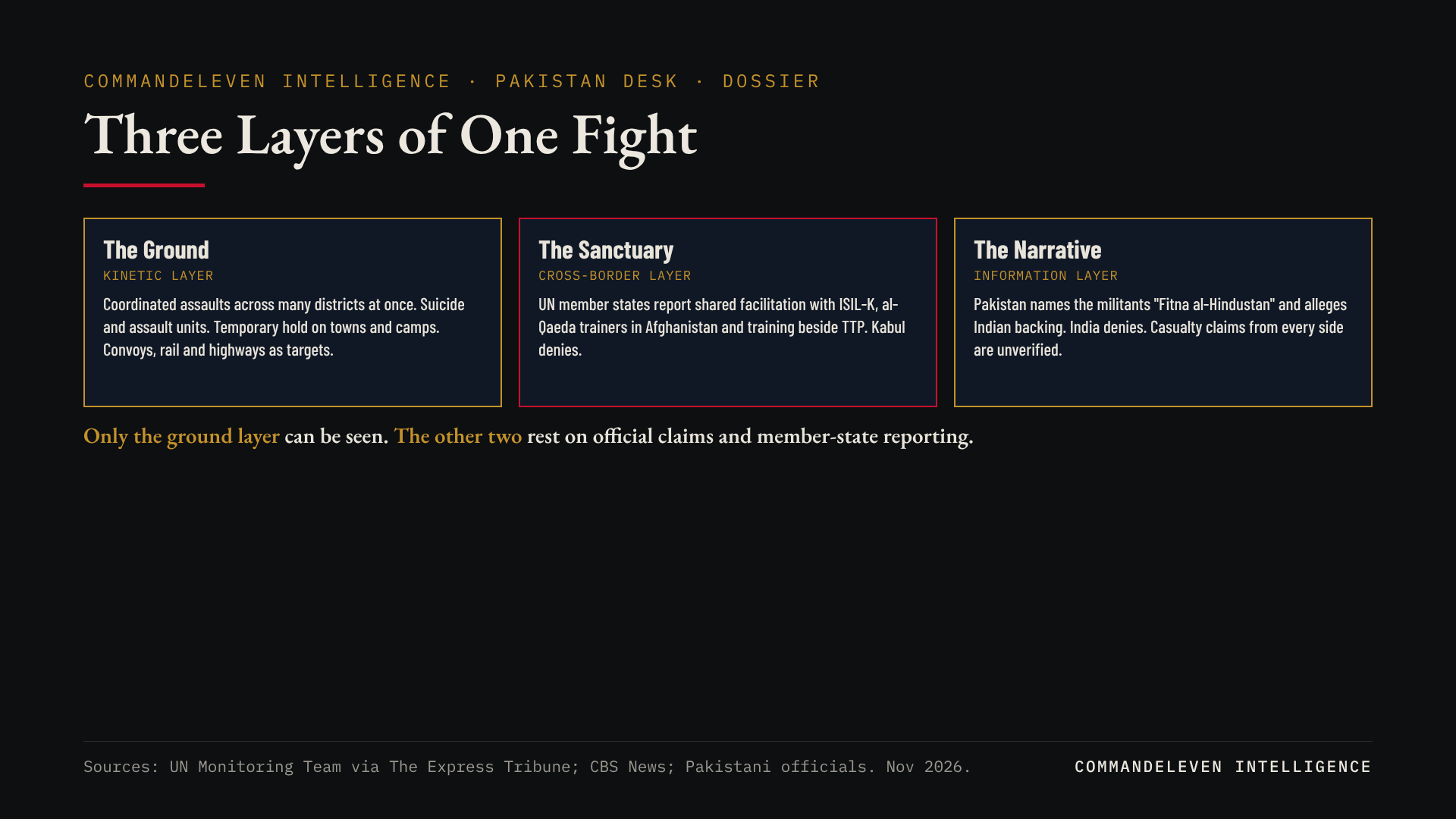
Most coverage of Balochistan merges three different kinds of claim. Separating them is the first job of analysis.
- The ground layer is what can be seen and counted: attacks, deployments, closures and funerals. It is documented by journalists, officials and the militants’ own channels, and even here casualty numbers are contested.
- The sanctuary layer is cross-border: who shelters, trains or supplies the fighters. It rests on state intelligence, passed through UN member-state reporting. The evidence is not public.
- The narrative layer is how each government names the fight. Pakistan frames it as foreign-sponsored terrorism. The BLA frames it as national liberation. Both framings are strategy as much as description.
The Ground Layer, Briefly
We cover the ground record in Part 4 of the series. Three points matter for this dossier.
First, the scale of the early-2026 offensive. Pakistan’s military said it killed 216 militants in an operation that ran from January 29 to February 5, according to reporting republished by the University of Maryland’s MCAC. Balochistan’s chief minister told CBS News that 18 civilians and 15 security personnel were killed in the first wave, along with 145 militants. Both militant totals come from the state. Later counts in Part 4 put security-force deaths at 22 and civilian deaths at 36, and the BLA admitted at least 92 of its own losses. The figures differ, and none has independent confirmation.
Second, the pattern. The attacks are coordinated across many districts at once, use suicide and assault units, and target towns, camps, convoys, rail and highways. That is an organized insurgency with planning capacity, not scattered raiding.
Third, the tempo. KabulNow reported on October 28 that Pakistan’s military said nine “Indian-sponsored” militants were killed on October 26 in Kachhi and Wadh, a claim the outlet could not verify. It also cited the PICSS think tank as saying September violence intensified. Violence has not eased.
The Sanctuary Layer: What the UN Report Says
The Express Tribune reported in August 2026 on the UN Monitoring Team’s report S/2026/651, which flags what the paper calls the BLA’s tactical collaboration with Afghan-based groups. The report is built from member-state reporting, and the outlet and UN documents attribute the claims to those states. The reported findings are:
- the BLA shares illicit logistical and facilitation networks with ISIL-K;
- BLA personnel have been linked to al-Qaeda trainers in Afghanistan;
- BLA fighters trained alongside the TTP;
- the group has used US-origin M4 and M16 rifles, drones and night-vision and thermal equipment.
[ASSESSED] Read narrowly, this is a finding about shared logistics and access, not about command or common cause. The BLA is a secular ethno-nationalist group and ISIL-K is a jihadist one. They have opposed ends. A shared smuggler, a shared safe house or a shared supplier does not make an alliance. Our earlier post on the BLA and ISKP “technical handshake” should be read inside that limit.
[DISPUTED] Kabul rejects the premise. Pakistan says Afghan soil shelters senior BLA figures. The two accounts cannot both be right, and no public evidence resolves them. The three-front synthesis in our series explains why this question has become central to the wider Pakistan-Taliban rupture. The US-origin weapons point also deserves care. It appears in the UN reporting as an observation about equipment, and it says nothing in itself about how the weapons arrived.
The Narrative Layer: Who Says What
Pakistan’s official name for the Baloch militants, “Fitna al-Hindustan,” fuses the militants with India in the language itself. Chief Minister Sarfraz Bugti has said India is behind the attacks and that senior BLA leaders operate from Afghanistan, according to CBS News. India and the Taliban government both deny involvement.
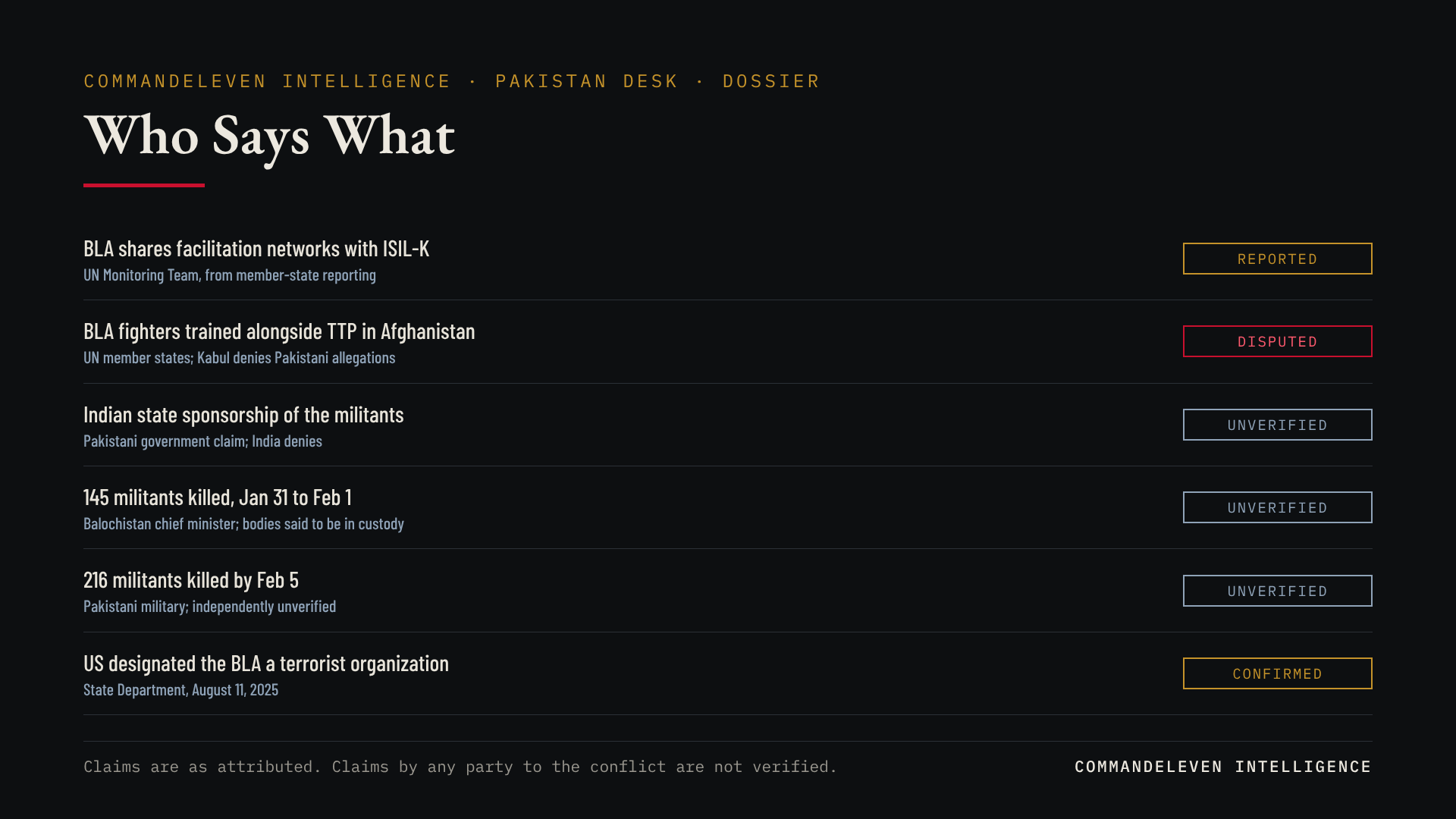
| Claim | Source | Our read |
|---|---|---|
| BLA shares facilitation networks with ISIL-K | UN Monitoring Team, from member states | [REPORTED] |
| BLA fighters trained alongside the TTP in Afghanistan | UN member states; Kabul denies | [DISPUTED] |
| Indian state sponsorship of the militants | Pakistani government; India denies | [UNVERIFIED] |
| 145 militants killed, January 31 to February 1 | Balochistan chief minister | [UNVERIFIED] |
| 216 militants killed by February 5 | Pakistani military | [UNVERIFIED] |
| US designated the BLA a foreign terrorist organization | State Department, August 11, 2025 | [CONFIRMED] |
[ASSESSED] The attribution war has a practical function for each government. For Islamabad, it lets a domestic grievance be treated as an external attack, which supports a military response and frames negotiation as appeasement. For the BLA, publicizing large attacks and casualty numbers supports a story of strength. A third audience, Washington, has been courted by Pakistan on minerals: CBS reported a $500 million US metals deal in September 2025, and the same month State’s terrorism designation of the BLA aligned with Islamabad’s preferred label. We make no claim that one caused the other, and the sequence is only context.
An op-ed in Eurasia Review on October 30 shows how the Pakistani framing travels. It ties the Balochistan fight to the Angoor Adda dispute and information warfare and cites the 2025 UN reports on shared BLA and TTP camps. It is a pro-Pakistan argument, not evidence, and we treat it as an example of the narrative layer.
The State’s Response and Its Limits
CTC Sentinel’s April 2025 analysis of the Baloch insurgency reached a conclusion that 2026 has not overturned: military action alone cannot resolve the conflict. Operations remove commanders and fighters but leave the grievances that feed recruitment, including enforced disappearances, uneven resource sharing and the security footprint around the China-Pakistan Economic Corridor. The BLA’s use of female suicide units, covered in Part 4, shows how the group adapts to pressure. The state’s counter-narrative, in turn, risks making every critic an Indian agent, which narrows the political space for the Baloch moderates who might otherwise negotiate.
[ASSESSED] The closure of the Iran border to trade, covered in our October 19 post, adds a western pressure point. Balochistan borders both Afghanistan and Iran, and a government fighting on three frontiers has less room for the political track that the insurgency’s roots demand.
What Is at Stake Economically
Balochistan holds Gwadar port, the CPEC’s southern outlet, and the mineral deposits Pakistan has offered US investors. That makes the insurgency a bargaining problem for investors as much as a security problem for the state. Chinese-linked targets have been attacked before. A foreign partner weighing exposure will read the sanctuary and attribution claims differently from a political analyst, because for an insurer or a mining firm the question that matters is whether attacks will continue, and not who sponsors them.
Outlook and Two Dated Calls
[ASSESSED] Our base case through early 2027 is continued high-tempo violence, more official attribution claims, and no independent verification of the sanctuary or sponsorship claims. The next UN Monitoring Team report is the most likely source of new public evidence.
Call 1 (by February 28, 2027). The BLA, the Balochistan Liberation Front or the Baloch Raji Aajoi Sangar claims a coordinated attack across five or more Balochistan districts within 48 hours, and at least two independent outlets report it. This would confirm that the early-2026 capability has survived a year of operations.
Call 2 (by January 31, 2027). The US does not designate the Balochistan Liberation Front or any other Baloch group as an FTO or SDGT. Washington moved on the BLA after a mass-casualty hijacking. A second designation would need a comparable event or a stronger public case.
Indicators to watch.
- The next UN Monitoring Team report and any public member-state evidence on BLA sanctuary.
- Any public evidence, from any party, for or against the Indian sponsorship claim.
- Independent counts of casualties from journalists or monitoring groups such as PICSS.
- Attacks on CPEC-linked personnel or Gwadar infrastructure.
- Any Pakistan-Taliban talks that name the BLA, and any Kabul action against Baloch figures.
What This Dossier Does and Doesn’t Establish
- It establishes what the State Department designated, what the UN report is reported to say, and who has made which claim.
- It does not establish that India or the Afghan Taliban government sponsors, shelters or arms the BLA. Those claims are unverified or disputed.
- It does not establish any casualty total. Every figure here is an official or militant claim.
- It does not rely on any CommandEleven Intelligence source or asset. Everything here is from published reporting.
Frequently Asked Questions
Is the BLA a terrorist organization under US law?
Yes. The State Department designated the BLA a Foreign Terrorist Organization on August 11, 2025. It had been an SDGT since 2019, and the Majeed Brigade was added as an alias.
Does India support the BLA?
Pakistan says so. India denies it. We found no public evidence in the sources reviewed that substantiates the claim, so we tier it as unverified.
Does the Taliban government shelter the BLA?
A UN Monitoring Team report, based on member-state information, says BLA personnel have links to groups in Afghanistan. Pakistan says senior BLA leaders operate there. Kabul denies hosting anti-Pakistan groups. The matter is disputed.
Is the BLA allied with ISIL-K?
The UN report describes shared logistical and facilitation networks, which is narrower than an alliance. The groups hold opposing ideologies, and the public record shows no joint command.
How many militants has Pakistan killed in Balochistan in 2026?
Pakistan’s military said it killed 216 in an operation from January 29 to February 5. The chief minister cited 145 in the first phase. No independent source has confirmed either figure.
Sources
- CBS News, At least 145 people killed in multiple attacks in southwestern Pakistan February 1, 2026
- MCAC (University of Maryland), republishing news reports, Pakistan military says it concludes week-long fight against Baloch separatists February 2026
- The Express Tribune, UN report flags BLA’s tactical collaboration with Afghan-based groups August 2026
- U.S. Department of State, Terrorist Designation of The Majeed Brigade August 11, 2025
- KabulNow, Pakistan army says nine militants killed in operations in Balochistan October 28, 2026
- CTC Sentinel (West Point), The Baloch Insurgency in Pakistan: Evolution, Tactics and Regional Security Implications April 2025
- Eurasia Review, From Balochistan to Angoor Adda: Militancy and information warfare October 30, 2026 (opinion)
