A follow-up to CommandEleven Intelligence’s October 9 dossier, The Makkah Pact’s First Test: Operation Yemen Dawn, Pakistan’s Role, and Iran’s Shrinking Map – Part 1.
Key Judgments
- [CONFIRMED] Pakistan has suspended trade with Iran at the Taftan and Gabd-Rimdan crossings. It has not sealed the border. Passenger traffic continues, and both governments call the step temporary. No reopening date has been given.
- [CONFIRMED] Islamabad and Tehran describe the measure as security-driven and coordinated. Pakistani officials cite smuggling and militancy; Iran’s Foreign Ministry calls it “technical.” Neither side has framed it as a dispute.
- [CONFIRMED] The claim that the US Navy is operating against Iran from Pakistani territory is false. Pakistan’s Information Ministry called it “fabricated propaganda,” and no evidence supports it.
- [ASSESSED] The suspension confirms the core of our October 9 assessment: the transit corridors are Pakistan’s lever over Iran, but pulling it hurts Pakistan almost as much. Within 48 hours, the cost showed up in Karachi’s LPG supply, rice exports and Quetta’s traders.
- [ASSESSED] That cost is the best predictor of what happens next. CommandEleven Intelligence expects trade to resume within weeks under tighter controls rather than a prolonged closure. A closure lasting past mid-November would be the signal that something larger, including US pressure, is in play.
What Happened
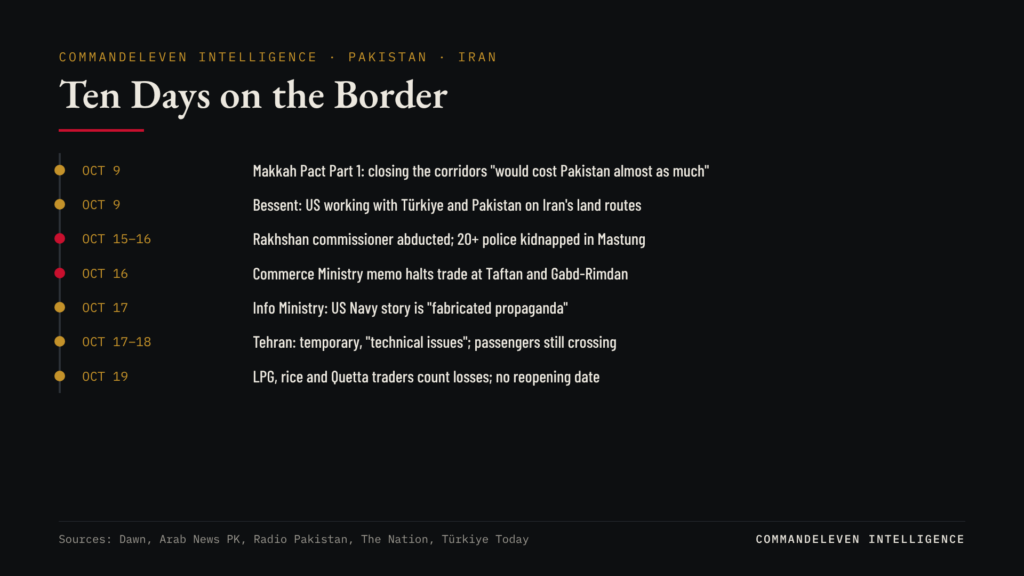
On Friday, October 16, Pakistan’s Ministry of Commerce issued a memorandum withdrawing an October 3 order that governed trade with Iran, effective immediately. The suspension became public on Saturday, October 17. It covers the two main commercial crossings in Balochistan: Taftan in Chagai district and Gabd-Rimdan near Gwadar.
[CONFIRMED] What stopped and what did not:
- Commercial traffic has stopped. Iran’s Transit Office director general, Syed Hossein Hosseini, confirmed that commercial operations at Rimdan-Gabd have halted.
- Passenger traffic continues through Rimdan-Gabd, according to Iran’s Wana news agency.
- Freight is stranded. Hundreds of trucks carrying LPG, rice, fresh fruit and onions are stuck on both sides. Some reports put stranded containers in the thousands. [DATA DEFICIT] The “over 2,000 containers” figure in some headlines is unsourced in the reporting behind it.
- Traders are on hold. The Quetta Chamber of Commerce and Industry told members to stop placing new import and export orders with Iran until further notice.
Chagai Deputy Commissioner Bakhtiar Ismail said the decision was taken “for security reasons,” to support counter-terrorism through better border management. Shahid Rind, adviser to the Balochistan chief minister, said the closure was meant to “address security concerns, prevent smuggling, and make the border system more effective,” and that the border is “likely to reopen soon.” In Tehran, Foreign Ministry spokesperson Esmaeil Baghaei told IRNA the closure is temporary, caused by “technical issues,” and that the two sides are consulting to restore normal operations.
Why Now
Three pressures converged in the week before the memorandum.
Militancy on both sides of the line. The Nation, citing official sources, tied the measures to a rise in attacks in Iran’s Sistan-Baluchestan province and to an attack involving the Pakistan Coast Guard on the Makran coast. In the 48 hours before the memorandum, armed men abducted Asad Ullah Kakar, commissioner of Rakhshan Division, on Thursday, October 15, and at least 20 police constables were kidnapped in Mastung district on Friday, October 16. No group has claimed either kidnapping. [CONFIRMED]
Smuggling. Officials on both sides name smuggling as a target, and the same sources told The Nation that smuggling networks, the Balochistan Liberation Army and Jamaat-ul-Ahrar were amplifying the “closure” story because the controls cut into their business. [ASSESSED] That claim comes from unnamed officials and serves the government’s framing, but it is consistent with what we know about the border economy: the informal fuel trade alone runs to millions of litres a day.
Washington. On October 9, US Treasury Secretary Scott Bessent told Newsmax that Washington was working with Türkiye and Pakistan to close Iran’s land routes. Islamabad did not comment. A week later, trade at the two main crossings stopped.
[ASSESSED] CommandEleven Intelligence does not attribute the suspension to US pressure. Both governments describe it as joint, Iran’s response has been conciliatory rather than angry, and there is no public evidence of a US link. Pakistan’s record points the same way: in August, when Iranian media quoted the Foreign Office as saying Pakistan was not bound by US sanctions, Islamabad called the remarks “misconstrued” and said it does not comment on the US sanctions regime. Islamabad keeps its distance from both readings. The timing is still worth recording, and the duration of the suspension is how it will be tested (see indicators below). Our Economic D-Day scorecard tracks Bessent’s land-route claim.
The Warship Story
As the suspension became public, X accounts claimed the US Navy was operating against Iran from Pakistani territory with Islamabad’s approval, and some tied the border measure to that claim. Late on October 17, Pakistan’s Ministry of Information and Broadcasting rejected it on X as “fabricated propaganda,” “baseless,” and “part of wider agenda of sowing confusion, misperceptions and chaos.” The ministry attributed the claim to a North America-based account.
[CONFIRMED] No imagery, ship-tracking data or official statement supports the claim. Pakistani officials also said forged letters attributed to Iranian and Pakistani authorities were circulating alongside it.
[ASSESSED] The rumour fits the pattern our October 9 dossier anticipated: Iran’s most effective tools against Pakistan are indirect and deniable, and the information space is the cheapest of them. A story that Pakistan is hosting US warships is built to inflame Pakistani domestic opinion, put Islamabad’s mediator role in doubt in Tehran, and turn a routine security measure into a crisis. It did not need to be believed for long to do some of that work. Our Information & Cognitive Warfare coverage tracks the same technique in other theatres.
Who Pays for a Closed Crossing
Our Part 1 dossier described the border as a mutual-hostage structure: the six transit corridors Pakistan opened in April are its lever over Iran, but Makran depends on Iran for power, fuel and food, so “closing them would cost Pakistan almost as much.” The first 48 hours bear that out.
- Energy. More than 4,000 tonnes of LPG reportedly cross at Gabd-Rimdan every day. Traders warn the halt will deepen LPG shortages in Karachi and push up open-market prices. [CONFIRMED] as reported; the shortage itself is [ASSESSED].
- Exports. Iran is one of Pakistan’s largest rice buyers. The Rice Exporters Association of Pakistan warned of “huge losses” and said moving the trade to sea through Bandar Abbas is hard because freight costs are very high while the Strait of Hormuz is contested.
- The border economy. Quetta’s traders had already paid Iranian counterparts for goods now stuck at the line. Perishable fruit and onions are spoiling on trucks. The informal trade that sustains Balochistan’s border districts is the part of this economy most exposed.
- Iran. Iran loses an import route it has relied on since the US blockade of its ports, and a market for its LPG. [ASSESSED] With seaborne trade already choked, the overland routes through Pakistan matter more to Tehran now than at any point before the war.
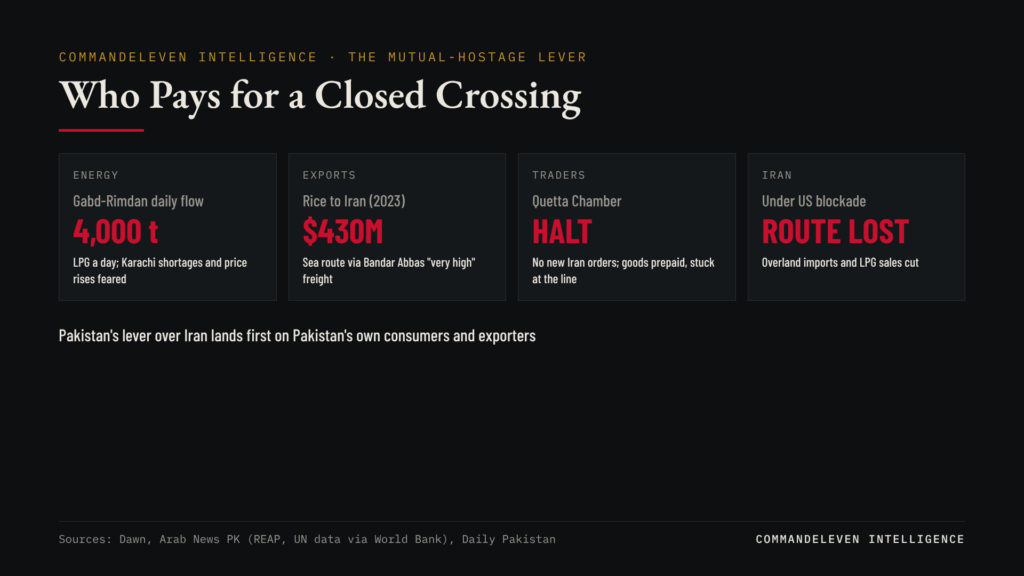
[ASSESSED] The costs land on both sides, and they land fastest on Pakistan’s own consumers and exporters. That is why both governments are talking about reopening and neither is talking about escalation. It is also why we expect this lever to be used briefly and for leverage over smuggling and militancy, not as a lasting cut.
[DATA DEFICIT] The memorandum withdrew an October 3 trade order. It is not yet clear whether the April 25 Transit of Goods Order, which designated the six corridors to Gabd and Taftan, has been suspended, or only bilateral trade under the October order. Transit cargo is reported to be stranded as well.
Scoring Our October 9 Calls, Ten Days In
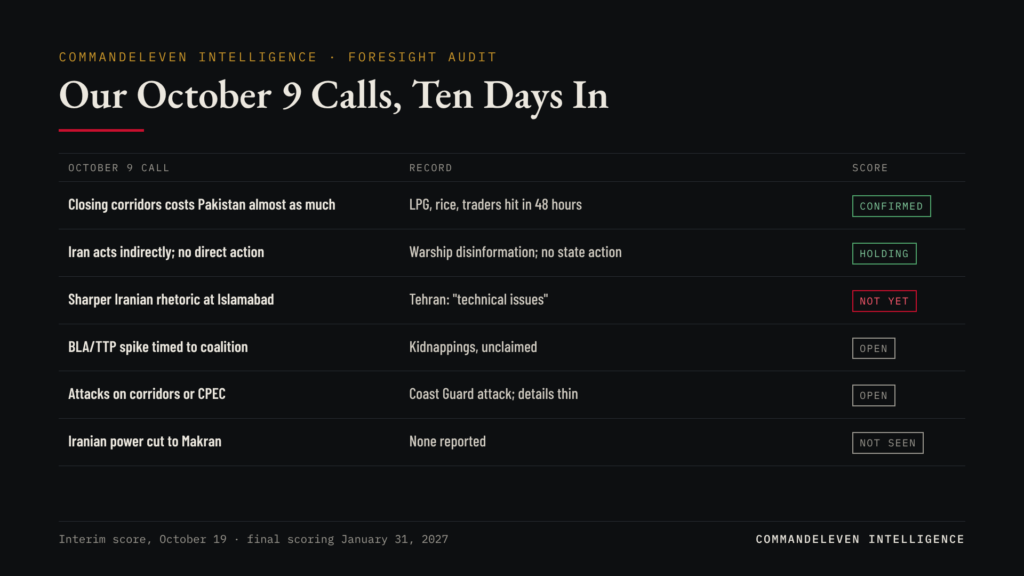
The Part 1 dossier set 30- and 90-day indicators. Ten days in, this is where they stand. Most remain open, and these are interim scores, not final ones.
| October 9 call | Record since | Interim score |
| Closing the transit corridors would cost Pakistan almost as much as Iran (the mutual-hostage brake). | LPG, rice and Quetta traders hit within 48 hours; both governments signal a quick reopening. | Confirmed |
| Iran’s response to Pakistan will be indirect and deniable; direct state action is unlikely in 90 days. | No state-on-state action. A deniable information operation (the warship story) ran alongside the suspension. | Holding |
| Expect sharper Iranian rhetoric toward Islamabad (30 days). | Tehran’s line on the suspension is conciliatory: “technical issues,” joint consultations. | Not borne out so far |
| Watch for a BLA or TTP spike timed to coalition milestones (30 days). | Kidnappings in Mastung and of the Rakhshan commissioner; a Coast Guard attack on the coast. No claims and no clear link to coalition milestones. | Open |
| Watch for attacks on the transit corridors or CPEC sites (90 days). | The coastal attack on the Coast Guard is the closest event; details are thin. | Open |
| Watch for any interruption in Iranian electricity to Makran (90 days). | None reported. Power supply to Gwadar, Kech and Panjgur continues. | Not observed |
[ASSESSED] One thing our Part 1 framing did not anticipate: the first use of the corridor lever came from Pakistan, in coordination with Iran, and was aimed at smugglers and militants rather than at Tehran. We modelled the corridors as a lever Pakistan might pull against Iran under retaliation. In practice it was used as a joint border-management tool. That distinction matters for how future closures should be read. The wider Makkah Pact series, including Part 2, Part 3 and Part 4, follows Pakistan’s position across the coalition.
Outlook and Indicators (Foresight Entry)
[ASSESSED] The base case is a reopening within weeks under a tighter joint control system, with stricter documentation and smuggling enforcement, and Pakistan and Iran continuing to describe the measure as cooperative. CommandEleven Intelligence will score these indicators on the Foresight Record on January 31, 2027:
- Duration. Does commercial trade at Taftan and Gabd-Rimdan resume before November 15? A suspension beyond that date would weaken our base case.
- Terms. Does reopening come with a new published control mechanism (joint inspections, new documentation, restricted hours)?
- Transit. Is the April 25 transit order formally suspended or amended, separately from bilateral trade?
- Washington. Does the US government publicly credit Pakistan with restricting Iranian overland trade?
- Tehran’s tone. Does Iran’s public line shift from “technical issues” to criticism of Islamabad?
- Makran. Is there any interruption of Iranian electricity or fuel supply to Gwadar, Kech or Panjgur?
Frequently Asked Questions
Has Pakistan closed its border with Iran?
No. Pakistan suspended commercial trade at the Taftan and Gabd-Rimdan crossings on October 16–17, 2026. Passenger traffic continues, and both governments call the measure temporary.
Why did Pakistan suspend trade with Iran?
Pakistani officials cite security and smuggling, after attacks in Iran’s Sistan-Baluchestan province, an attack on the Pakistan Coast Guard and kidnappings in Balochistan. Iran calls the suspension “technical” and says both sides are consulting.
Is the US Navy operating against Iran from Pakistan?
No. Pakistan’s Information Ministry called the claim “fabricated propaganda,” and no evidence supports it.
Is the suspension linked to US sanctions pressure?
There is no public evidence of a link. Treasury Secretary Bessent said on October 9 that the US is working with Pakistan and Türkiye on Iran’s land routes, but Pakistan and Iran both describe the suspension as a joint security measure.
When will the crossings reopen?
No date has been given. Balochistan officials say the border is “likely to reopen soon.”
Sourcing Base (Confidence-Tiered, with Links)
CONFIRMED — Official Statements and Reporting:
- Dawn, Pakistan suspends Iran trade corridors over ‘security, smuggling concerns’, October 18, 2026
- The Star / Dawn, Pakistan suspends Iran trade at two border crossings over security concerns, October 18, 2026
- Radio Pakistan, MoIB rejects claim of US Navy operating against Iran from Pakistan, October 18, 2026
- Arab News Pakistan, Pakistan calls claims of US Navy using its territory against Iran ‘fabricated propaganda’, October 18, 2026
- Arab News Pakistan, Pakistan rice exporters warn of costly sea route after Iran border trade suspended, October 19, 2026
- ProPakistani, Pakistan Suspends Trade With Iran Through Taftan, Gabd Border Crossings, October 18, 2026
- Türkiye Today, US working with Türkiye, Pakistan to seal Iran’s land routes, October 11, 2026
- Geo News, Remarks attributed to Pakistan regarding US sanctions on Iran are ‘misconstrued’, August 27, 2026
ASSESSED — Official-Source Framing and Context:
- The Nation, Pakistan tighten border controls in joint counterterrorism move, October 17, 2026 (unnamed official sources)
- Daily Pakistan, Over 2,000 Containers stranded as Pakistan shuts Iran Border amid ‘Security Fears’, October 18, 2026 (headline figure unsourced)
- CommandEleven Intelligence, The Makkah Pact’s First Test – Part 1, October 9, 2026
Excluded from this dossier: Any claim that the US Navy is operating from Pakistani territory or waters. Letters attributed to Pakistani or Iranian authorities circulating on social media, which officials describe as forged. The “border sealed” framing used by some accounts. Any claim that the suspension was taken at US request.
The Makkah Pact Series
This dossier is companion reading to CommandEleven Intelligence’s Makkah Pact series.
- The Makkah Pact’s First Test: Operation Yemen Dawn, Pakistan’s Role, and Iran’s Shrinking Map – Part 1
- The First Test, Tested: Riyadh’s Airport War and the Makkah Pact – Part 2
- Strong in the Air, Weak on the Ground: Why Riyadh Needs the Makkah Pact – Part 3
- Diamond vs. Hexagon: Where Pakistan Sits on Netanyahu’s Map – Part 4