Part 4 of CommandEleven Intelligence’s Makkah Pact series. Read Part 1: The Makkah Pact’s First Test, Part 2: Riyadh’s Airport War and Part 3: Strong in the Air, Weak on the Ground.
Key Judgments
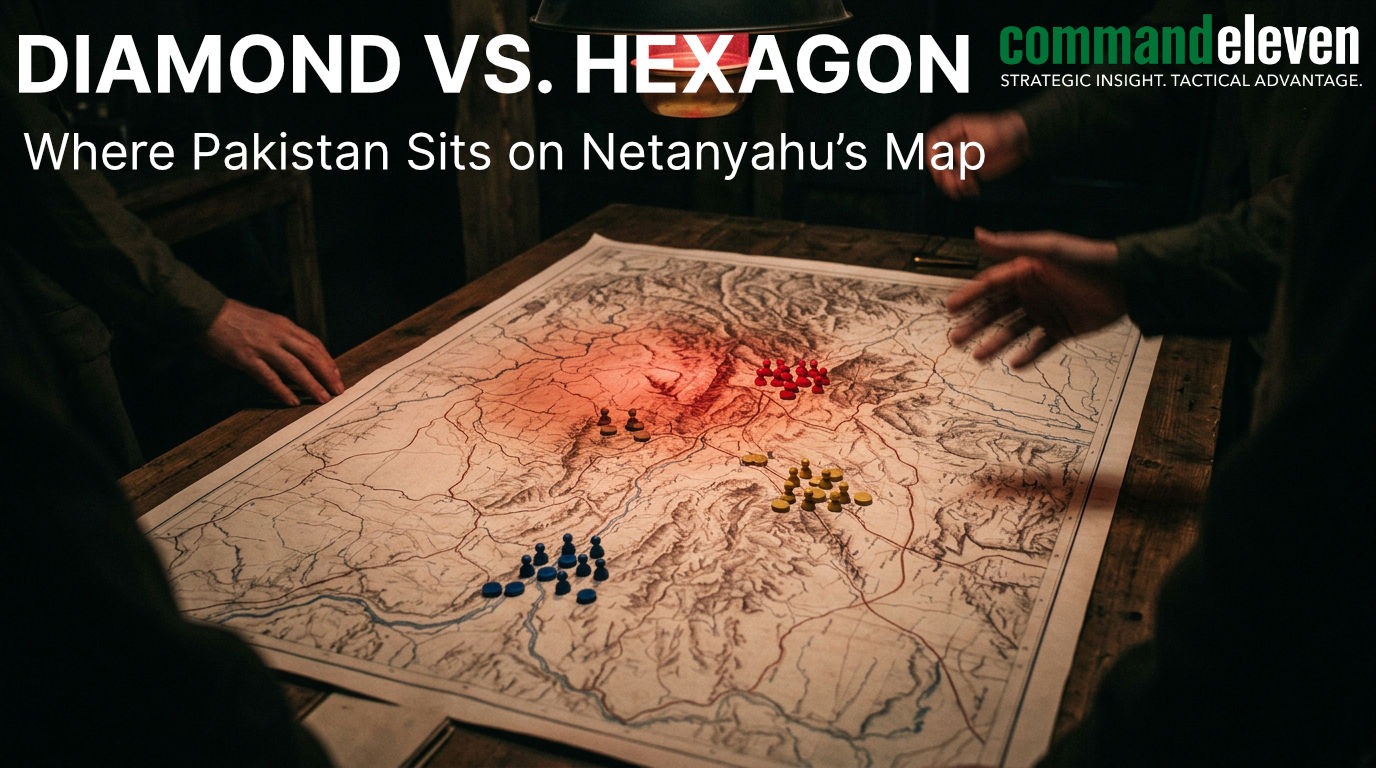
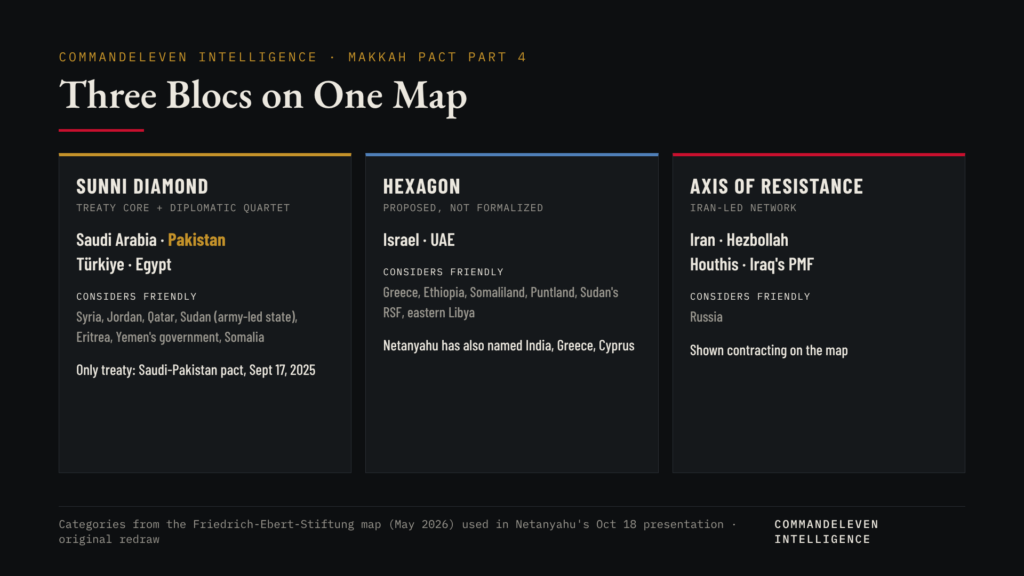
- [CONFIRMED] On October 18, 2026, nine days before Israel’s October 27 election, Prime Minister Benjamin Netanyahu presented a new national security doctrine. The accompanying presentation used a Friedrich-Ebert-Stiftung (FES) map that groups Türkiye, Saudi Arabia, Egypt and Pakistan as a “Sunni Diamond,” Israel and the UAE as a “Hexagon,” and Iran’s network as the “Axis of Resistance.”
- [CONFIRMED] Netanyahu warned that “in two years, a President, man or woman, could come to power who is very hostile to Israel,” and called for alliances beyond Washington, naming India: “India is not a small country, and there are many others.”
- [ASSESSED] Most coverage left Pakistan out of the Diamond. The map does not. That puts Pakistan, the only nuclear-armed state on either side, inside the bloc Israel’s leader now presents as a strategic counterweight, opposite a Hexagon in which Netanyahu places India. The India-Pakistan rivalry is being written into the Middle East’s new bloc map.
- [ASSESSED] Neither bloc is a formal alliance. The Diamond is a diplomatic quartet built on one real treaty, the Saudi-Pakistan defense pact, while Türkiye’s push for a four-way pact has stalled on Saudi and Egyptian reservations. The Hexagon is still more a label than a structure. The map describes alignment, not obligation.
- [ASSESSED] The map’s real value for Pakistan is as a picture of where the two camps already compete: Sudan, the Horn of Africa and Yemen. Those are the same theaters where CommandEleven Intelligence has tracked the Saudi-UAE split, and where Pakistan’s Makkah Pact commitments now sit.
The Doctrine and the Map
The doctrine is a three-page document of ten principles, published on the Israeli government’s website and reportedly prepared with the National Security Council. As reported, it puts preemptive strikes ahead of containment, calls for buffer zones along Israel’s borders “when deemed necessary,” stresses deterrence, early warning and military superiority, and calls for more domestic arms production to reduce reliance on foreign suppliers. It lists Iran, Hezbollah, the Houthis, precision missiles, drones, cyberattacks and international isolation as the main threats.
The map came from elsewhere. FES, the German foundation linked to the Social Democratic Party, published it in May 2026 in an analysis by Marc Saxer and Marcus Schneider. In their framing, Israel and Iran compete for regional dominance while middle powers balance against both. The FES text calls the Israel-UAE relationship a “silent axis” that “may evolve into” a Hexagon, and says the Sunni Diamond “has begun to coalesce.”
The FES map sorts the region into six categories:
- Israel-UAE Hexagon: Israel and the UAE.
- Israel and UAE consider friendly: including Greece, Ethiopia, Somaliland, Puntland, Sudan’s Rapid Support Forces and eastern Libya.
- Türkiye-Egypt-Pakistan-Saudi Arabia Sunni Diamond.
- Sunni Diamond considers friendly: including Syria, Jordan, Qatar, Sudan (the army-led state), Eritrea, Yemen’s government and Somalia.
- Iran and the Axis of Resistance: Iran, Hezbollah, the Houthis and Iraq’s Popular Mobilization Forces.
- Iran considers friendly: Russia.
[CONFIRMED] Netanyahu did not say whether he regards every state in the Diamond as an adversary, and the labels do not describe formal military alliances. When he first floated the “hexagon” on February 22, he framed it as a group of states standing against a “radical” Shia axis and an emerging “radical” Sunni one, and named India, Greece and Cyprus as partners. No government has publicly endorsed that framing.
[ASSESSED] The document is a campaign product as much as a strategy. Opposition leader Yair Lapid called it “superficial” and “bizarre.” Former army chief Gadi Eisenkot called it “empty pages filled with slogans” and promised an opposition government would adopt a formal national security strategy within 150 days. Whether the doctrine survives October 27 is one of the indicators below.
The Country Most Coverage Left Out
Much of the coverage, and many of the posts circulating since Sunday, describe the Diamond as Türkiye, Egypt and Saudi Arabia. The FES map, Newsweek’s August reporting and Anadolu’s account of the presentation all include Pakistan. That omission matters more than any other detail on the map.
Why Pakistan is in the Diamond. The bloc rests on one real treaty. Saudi Arabia and Pakistan signed their Strategic Mutual Defense Agreement on September 17, 2025, under which an attack on one is treated as an attack on both. That agreement is the Makkah Pact this series has followed from its activation through Operation Yemen Dawn. Around it, the four foreign ministers have built a habit of meeting: in Islamabad on March 29–30, 2026, on de-escalation during the Iran war, and in Antalya on April 17, their third meeting, hosted by Türkiye’s Hakan Fidan.
[ASSESSED] Pakistan’s inclusion turns a regional map into a South Asian one. Netanyahu’s Hexagon names India as a partner, and his doctrine speech singled India out again. Placing Pakistan and India in opposing Middle Eastern blocs maps the subcontinent’s rivalry onto the Gulf’s. It also sharpens a link Pakistan already sees: the Israeli-made Harop loitering munitions that Pakistan’s military said it shot down during the May 2025 conflict with India.
[ASSESSED] Pakistan’s position is more crowded than the map’s colors suggest. It sits inside the Diamond, but it shares a long border with Iran, the core of the Axis, and its single largest Gulf economic partnership outside Saudi Arabia is with the UAE, the other half of the Hexagon. A map of three blocs flattens that. In practice, Pakistan has ties to all three.
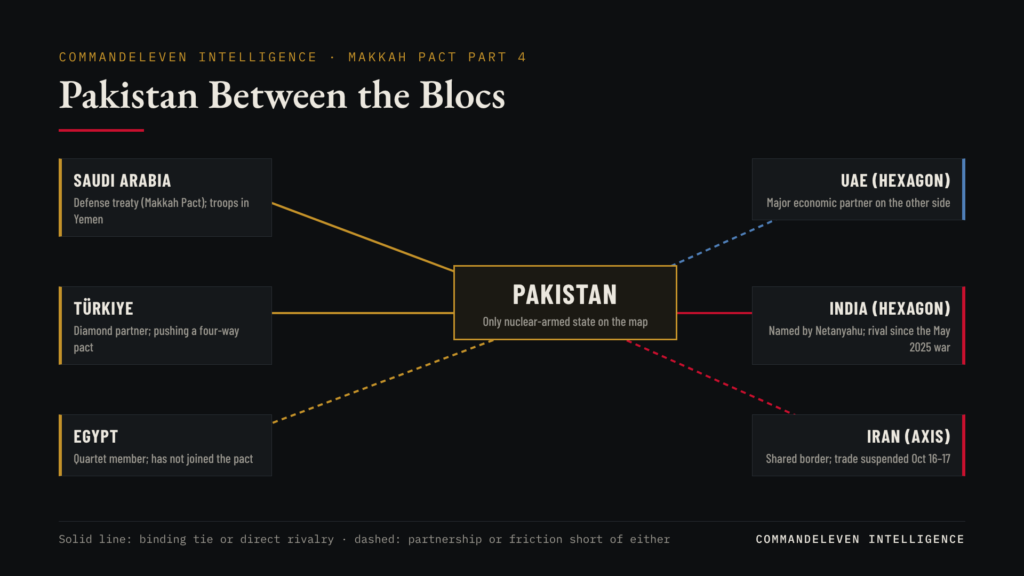
[DATA DEFICIT] As of October 19, Islamabad, Riyadh, Ankara and Cairo had not publicly responded to being shown as a single bloc. CommandEleven Intelligence will update this dossier if they do.
How Real Is the Diamond?
Türkiye has pushed for a four-way security alliance with Saudi Arabia, Egypt and Pakistan since the Iran war began, and Turkish officials have said they expect Egypt to join the Saudi-Pakistan pact. It has not happened. Al-Monitor’s April reporting lists the obstacles: differing threat perceptions, political disagreements over regional conflicts, Türkiye’s NATO commitments, Israeli opposition and uneven military interoperability.
[ASSESSED] CommandEleven Intelligence reads the Diamond as three layers of different strength:
- A treaty core. Saudi Arabia and Pakistan, bound by the Makkah Pact and now fighting side by side in Yemen.
- A diplomatic quartet. Regular four-way foreign ministers’ meetings and coordinated positions on Gaza, Syria, Somaliland and the Iran war.
- An unrealized alliance. Türkiye’s proposed four-way defense pact, which Riyadh and Cairo have not signed.
Analysts quoted by Al Jazeera made the same point about the Hexagon from the other side. Andreas Krieg of King’s College London called it a “branding exercise” and a hedge. Omer Ozkizilcik of the Atlantic Council said cooperation among the Sunni-majority states is geopolitical rather than ideological. Neither bloc is what its label implies. Both describe real alignments.
Where the Blocs Already Compete
The most useful thing the map does is show where the two Sunni-majority camps already face each other. It matches the fault lines CommandEleven Intelligence has documented this month.
- Sudan. The map shades the army-led state as Diamond-friendly and the RSF as Hexagon-friendly. That is the split traced in Sudan’s Proxy War, where a UN mission found a UAE-linked network supplying the RSF and Saudi Arabia backs the army.
- The Horn of Africa. Somaliland and Puntland are shaded Hexagon-friendly, Somalia Diamond-friendly. Israel recognized Somaliland on December 26, 2025, which Mogadishu rejects. The UAE’s ports at Berbera and Bosaso anchor its position, and Bosaso appears in the UN findings as a transit point to the RSF.
- Yemen. The government is shaded Diamond-friendly, the Houthis are in the Axis, and the former UAE-backed Southern Transitional Council has its own shading. That is the map of the Gulf split, in which Saudi-backed forces pushed UAE-backed ones out of Hadramawt and al-Mahra, and of the war Pakistan’s troops are now part of.
[ASSESSED] For Pakistan, this is where bloc labels could turn into obligations. Its Makkah Pact commitment is to Saudi Arabia, but Saudi Arabia’s rivalries with the UAE run through Sudan, Somalia and Yemen. If those contests sharpen, Pakistan’s role in the Diamond becomes harder to keep separate from its economic relationship with the UAE, and from its long effort to stay out of intra-Gulf disputes.
What the Map Leaves Out
- The United States. The FES legend has two US categories, “NATO and Major Non-NATO US allies” and “US considers friendly,” and they cut across all the Sunni blocs. Pakistan, Egypt and Saudi Arabia are in them as much as Israel and the UAE are. Netanyahu’s own warning about a hostile US president in two years shows how much the blocs still depend on Washington.
- China. The FES text mentions only Beijing’s “quiet mediation” between Riyadh and Tehran. China is the largest trading partner of most states on the map, on every side of it.
- Afghanistan. The map leaves it uncolored. For Pakistan, the Taliban government and the TTP sanctuary on the other side of the Pakistan-Afghanistan border are a larger daily threat than anything on the Gulf map.
A note on the second map. A separate graphic circulating since Sunday, credited to Geographic Enigma, labels India, Greece and Cyprus as proposed Hexagon members and colors Pakistan, Türkiye and Iran as “targeted states.” It is not from Netanyahu or FES, and CommandEleven Intelligence does not adopt its categories. The idea that the Hexagon is aimed at Pakistan is an inference from the February remarks, not a stated Israeli position.
Outlook and Indicators (Foresight Entry)
[ASSESSED] The base case is that neither bloc formalizes before mid-2027. The Diamond stays a treaty core plus a diplomatic quartet, and the Hexagon stays a set of bilateral relationships under one name. The variables are the Israeli election, Egypt’s decision on the Saudi-Pakistan pact, and how far the Saudi-UAE contests in Sudan and the Horn escalate.
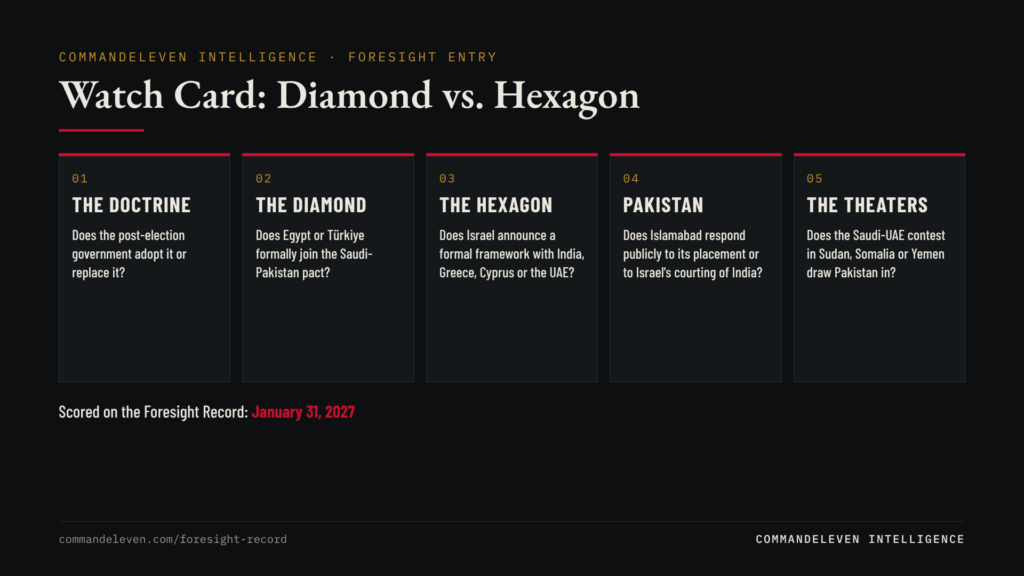
CommandEleven Intelligence will score these indicators on the Foresight Record on January 31, 2027:
- The doctrine. Does the government formed after October 27 adopt the doctrine or replace it with a new national security strategy?
- The Diamond. Does Egypt or Türkiye formally join the Saudi-Pakistan defense pact, or sign a four-way agreement?
- The Hexagon. Does Israel announce a formal multilateral framework with India, Greece, Cyprus or the UAE?
- Pakistan’s answer. Does Islamabad respond publicly to being placed in the Diamond, or to Israel’s courting of India?
- The contested theaters. Does the Saudi-UAE contest escalate in Sudan, Somalia or Yemen in a way that draws Pakistan in?
Frequently Asked Questions
What is the “Sunni Diamond”?
A label used by the Friedrich-Ebert-Stiftung for an emerging alignment of Türkiye, Egypt, Pakistan and Saudi Arabia. It is not a formal alliance. Its only treaty is the September 2025 Saudi-Pakistan defense pact.
What is Netanyahu’s “Hexagon”?
A proposed grouping of Israel and partners around and beyond the Middle East. Netanyahu has named India, Greece and Cyprus. The FES map shows only Israel and the UAE in it. No government has endorsed it.
Is Pakistan part of the Sunni Diamond?
On the FES map Netanyahu used, yes. Pakistan’s defense treaty with Saudi Arabia is the bloc’s only binding agreement.
Did Netanyahu call these countries enemies?
No. He did not say whether he regards every state in the Diamond as an adversary, and the map’s labels do not describe military alliances.
Why does Netanyahu want new alliances?
He said a US president “very hostile to Israel” could take office in two years, and that Israel must build alliances beyond Washington, including with India and in Latin America.
Sourcing Base (Confidence-Tiered, with Links)
CONFIRMED — Primary and Direct Reporting:
- Friedrich-Ebert-Stiftung Asia, Map: Geopolitical Alliances in the Middle East, May 19, 2026 (Marc Saxer and Marcus Schneider)
- Business Today, Netanyahu says Israel must prepare to deal with a potentially hostile US president, October 19, 2026
- A News (Anadolu), Israeli opposition slams Netanyahu’s new security doctrine as ’empty slogans’ ahead of elections, October 19, 2026
- The Eastern Herald, Netanyahu’s Security Doctrine Draws Scorn Nine Days Before Israel Votes, October 19, 2026
- VINnews, Netanyahu Displays Map Showing Iran Losing Regional Influence and Proxies, October 18, 2026
- Qatar News Agency, Pakistan to Host Quadrilateral Meeting with Saudi Arabia, Turkiye and Egypt on De-escalation, March 28, 2026
ASSESSED — Analysis and Context:
- Newsweek, This Map Shows Iran, Israel and Saudi Arabia’s Allies in a New Middle East, August 6, 2026
- Al Jazeera, What’s Netanyahu’s planned ‘hexagon’ alliance – and can it work?, February 23, 2026
- Al-Monitor, Why Saudi Arabia, Egypt are wary of Turkey’s proposed 4-way defense pact with Pakistan, April 2026
- TARSAM, Netanyahu’s security doctrine map grouping Türkiye, Saudi Arabia, Egypt and Pakistan as the “Sunni Diamond” (Turkish), October 2026
- Kaab TV, Netanyahu’s map adds Puntland and Somaliland to the Israel-UAE allies (Somali), October 2026
Excluded from this dossier: Any claim that Israel regards Pakistan as a target state, which Netanyahu has not said. The Geographic Enigma graphic’s categories. Any claim that the Diamond or the Hexagon is a formal military alliance. The FES map itself, which is reproduced here only as an original CommandEleven Intelligence redraw of its categories.
The Makkah Pact Series
- The Makkah Pact’s First Test: Operation Yemen Dawn, Pakistan’s Role, and Iran’s Shrinking Map – Part 1
- The First Test, Tested: Riyadh’s Airport War and the Makkah Pact – Part 2
- Strong in the Air, Weak on the Ground: Why Riyadh Needs the Makkah Pact – Part 3
- Diamond vs. Hexagon: Where Pakistan Sits on Netanyahu’s Map – Part 4 (you are here)