Sourcing and Confidence Key
- [CONFIRMED] – Established by multiple independent public sources, or by an official on-record statement
- [CONFIRMED-P] – Established by CommandEleven Intelligence proprietary collection (HUMINT or direct observation); not publicly corroborated. Identifying detail withheld for source protection
- [ASSESSED] – CommandEleven Intelligence analytic judgement drawn from public and proprietary reporting
- [SPECULATIVE] – Plausible scenario with limited direct evidence; included for planning purposes
- [DATA DEFICIT] – A gap in available reporting that limits the judgement
Single-source and proprietary claims are tiered in the body and kept out of the Key Judgments, in line with CommandEleven Intelligence tradecraft. Battlefield claims were re-verified against reporting dated 5-6 October 2026 at the time of drafting.
Bottom Line Up Front
On 5 October 2026, Saudi Arabia, Pakistan and Türkiye turned the Makkah Joint Defence Agreement from a signed text into a deployed alliance. In an emergency session in Riyadh, Ankara and Islamabad announced the rapid deployment of forces to the Kingdom. The same day, Yemen’s government and the Saudi-led coalition launched Operation Yemen Dawn against the Houthis, with the coalition claiming 100 fighter jets in action and 324 “high-value” Houthi targets destroyed.
Pakistan’s role is real, large and deliberately understated. Between 30,000 and 40,000 Pakistani troops are now in the Kingdom. Pakistan has also flown air defence, artillery and counter-drone systems to Aden and placed military advisers alongside Saudi officers. Islamabad has not advertised any combat role, and this dossier does not attribute specific strike figures to it.
What matters most is what the campaign does to Iran. Since March, Tehran’s maritime strategy has rested on two chokepoints: Hormuz, which it has held closed, and Bab el-Mandeb, which it designated a “second front” for the Houthis to close on command. If the coalition’s gains around Bab el-Mandeb hold, Iran loses its second lever just as pressure mounts on its southeast (Baluch militancy) and northwest (Iranian Kurdish groups). That leaves Hormuz as Iran’s last maritime card against the US.
Iran will look for a way to make Pakistan pay. Its most credible tools run through Baluchistan, Kabul, Kurram and the Maran energy grid. Pakistan’s counter-lever is the six transit corridors that now carry Iran’s third-country imports, but closing them would cost Pakistan almost as much. Each side’s cheapest weapon lands on the other’s most fragile region. That mutual-hostage structure is the most likely brake on escalation.
Key Judgments
- [CONFIRMED] The Makkah Pact is now operational, not declaratory – The 5 October Riyadh session produced the alliance’s first force-deployment decision, two months after signature.
- [CONFIRMED] Pakistan is the pact’s center of military mass in the Kingdom – A 30,000-40,000-strong Pakistani presence makes Islamabad, not Ankara, the member Iran must weigh first.
- [ASSESSED] Pakistan is deliberately keeping its combat role out of view – Officials confirm troops, equipment and advisers while declining to confirm any part in air strikes. CommandEleven Intelligence assesses this ambiguity is intentional and serves Islamabad’s domestic politics, its mediator role with Tehran, and its parliamentary history on Yemen.
- [ASSESSED] The Saudi-led campaign closely mirrors Pakistan’s Operation Ghazb lil-Haq – Seven observable signatures match. Three diverge in ways explained by theatre, not doctrine. CommandEleven Intelligence assesses the match reflects doctrinal convergence through the Pakistani advisory channel. The evidence supports convergence; it does not prove authorship.
- [ASSESSED] Iran’s two-chokepoint strategy is under direct threat – Loss of the Bab el-Mandeb lever would shrink Iran’s maritime coercion to Hormuz alone.
- [ASSESSED] Iran faces convergent, not coordinated, pressure on three fronts: Yemen, its Baluch southeast and its Kurdish northwest.
- [ASSESSED] Iran will retaliate against Pakistan indirectly and deniably – The likeliest channels are militancy in Baluchistan and Karachi/Sindh, pressure through the Taliban on the TTP, and energy leverage over Maran. Direct state-on-state action is unlikely in the next 90 days.
- [ASSESSED] Pakistan’s transit-corridor lever is real but double-edged – Closing the corridors would hurt Iran’s sanctions-era supply lines, but would invite an Iranian cut to Makran’s electricity and fuel and forfeit Pakistan’s own Central Asian route.
The Trigger: From Houthi Escalation to Yemen Dawn
The Houthis spent the summer of 2026 widening their war from Yemen into Saudi Arabia. Two days after the Makkah Agreement was signed on 7 August, they claimed a drone strike on Saudi Aramco’s Jazan refinery. In early September, a wave of missile and drone attacks hit civilian and economic targets in the Kingdom, and Saudi authorities reported fires and suspended operations at energy facilities. The Houthis also announced a blockade of Saudi-linked shipping in the Red Sea.
Their ground advance was just as consequential. In early September the Houthis took the port city of Mokha and several Red Sea islands, giving them control of the Yemeni side of the Bab el-Mandeb Strait, through which roughly 12% of global trade passes. Coalition reporting also notes the capture of Perim Island in the strait itself. For the first time in the war, the Houthis held both the coast and the chokepoint.
Riyadh’s answer came on 5 October. Rashad al-Alimi, head of Yemen’s Presidential Leadership Council, announced Operation Yemen Dawn, with stated aims extending to the recapture of Sanaa [3]. Coalition spokesman Maj Gen Turki al-Malki said 100 fighter jets were supporting government forces, the coalition had secured “air protection” of Bab el-Mandeb, and 324 high-value Houthi targets had been destroyed.
On the ground, the Giants Brigades and Homeland Shield Forces pushed along the coast. Yemeni officials reported the recapture of Dhubab, Bab and Hadeid, and government forces claimed control of Mokha and positions around Dhubab airport.
Confidence note – The 100-jet and 324-target figures are coalition claims and have not been independently verified. They describe the coalition as a whole. They are not attributed to any single member in this dossier. [CONFIRMED as claims; outcomes ASSESSED]
The Makkah Pact’s First Test
The architecture
The Makkah (Mecca) Joint Defence Agreement was signed by Saudi Arabia, Pakistan and Türkiye on 7 August 2026. It states that an attack on any one signatory is an attack on all three. It built on the bilateral Saudi-Pakistani Strategic Mutual Defence Agreement of 17 September 2025. At the time of signing, Pakistan already had a substantial force in the Kingdom, put at over 8,000 troops plus fighter jets and air-defence systems.
Six weeks of hesitation
The pact was tested almost immediately and, at first, did not move. After the September attacks, Pakistan’s Defence Minister Khawaja Asif said the pact would “definitely” become operational in the event of spillover from Yemen. Yet in mid-September, Pakistani and Turkish officials told the Associated Press they had received no Saudi request for support, and analysts openly questioned whether the pact was “dead on arrival”.
The pace then quickened:
- Late September – Asif said Pakistan would defend Saudi Arabia “by whatever means are available,” while declining to confirm or deny any part in air strikes.
- Early October – the chiefs of staff of the three militaries met in Riyadh and committed to the “immediate implementation” of the agreement through intelligence sharing, coordination and capability integration.
Activation
On 5 October, the pact’s Strategic Political and Defence Committee met in emergency session in Riyadh. Pakistan was represented by Deputy Prime Minister and Foreign Minister Ishaq Dar, Defence Minister Asif and Chief of Defence Forces Field Marshal Asim Munir. Türkiye and Pakistan then announced they would undertake a “rapid deployment” of troops to Saudi Arabia. The communiqué condemned attacks on the Kingdom, particularly those targeting Mecca and Medina, but notably did not name the Houthis [12]. The committee also kept political engagement on the table, echoing the de-escalation language of its first meeting in Istanbul on 31 August.
- [ASSESSED] – The activation sequence matters as much as the outcome. The pact moved only after Riyadh had a ground offensive ready to launch, and it activated on the same day the offensive began. CommandEleven Intelligence assesses that the deployment decision was timed to give Riyadh visible “international buy-in” for Yemen Dawn and to deter Iran from escalating on the Houthis’ behalf. Middle East Eye’s reporting supports the first point.
Pakistan’s Role: Large, Real, and Deliberately Quiet
What is confirmed
- [CONFIRMED] Troops – A Pakistani official told Reuters that 30,000-40,000 Pakistani troops are now in the Kingdom to defend its land borders and support the interception of drones and missiles. They arrived in waves from 2025 onward and after the recent escalation. Islamabad has not decided to send troops into Yemen in a combat capacity. The figure is a cumulative build-up, not a single deployment.
- [CONFIRMED] The earlier package – Reuters reported in May 2026 that Pakistan had deployed around 8,000 troops, a jet squadron, drone units and a Chinese-made HQ-9 air-defence system, operated by Pakistani personnel and financed by Riyadh.
- [CONFIRMED] Materiel to Yemen – Pakistan delivered air-defence systems, light artillery, drones and anti-drone systems to Aden.
- [CONFIRMED] Advisers – Pakistani military advisers are working alongside Saudi counterparts in support of Yemeni forces.
- [DATA DEFICIT] Strike participation – Not confirmed. Defence Minister Asif has repeatedly declined to say whether Pakistani forces have taken part in air strikes.
Tehran noticed
Iran’s Foreign Ministry spokesman Esmaeil Baghaei said on 4 October that Tehran hoped reports of 40,000 Pakistani troops were false, warning that any action in Yemen would complicate the situation. That is the first public Iranian signal aimed at Islamabad in this crisis, and the clearest indicator so far of where Tehran’s attention has turned.
The precedent: Pakistani crews in Saudi service
Pakistan’s quiet presence in Saudi wars is not new.
- 1969 – During the al-Wadiah border war with South Yemen, Pakistan Air Force pilots on deputation flew Royal Saudi Air Force aircraft in combat. The episode is recorded in PAF accounts, and CommandEleven Intelligence has corroborated it directly with PAF officers who served in Saudi-related deployments.
- The 1980s – After the Iranian revolution, General Zia ul-Haq sent an elite armored brigade to the Kingdom at King Fahd’s request. It stayed for a decade, and some 40,000 Pakistani soldiers rotated through it.
The number is striking. Today’s reported presence matches the total that passed through the 1980s brigade, except that it is in the Kingdom at the same time rather than over ten years.
- [ASSESSED] – The model has always been the same: Pakistani skill and manpower inside Saudi structures, under Saudi flags, with Pakistani political deniability preserved. CommandEleven Intelligence assesses that Islamabad is running that model again. That is why public discussion of Pakistan’s role is about troops on Saudi soil, not sorties over Yemen. This dossier keeps to that line and attributes no strike figures to Pakistan.
Why the quiet: the 2015 precedent
Pakistan has been asked this question before, and the answer shaped everything since.
The request – When the Saudi-led coalition launched Operation Decisive Storm in March 2015, Riyadh asked Pakistan for jets, ships and ground troops. The government confirmed the three-service request to a joint session of parliament.
The army’s position – Before Prime Minister Nawaz Sharif’s March 2015 visit to Riyadh, he had already consulted army chief General Raheel Sharif, and the two had concluded that committing brigades was not possible, according to a Pakistani military official speaking to Reuters. The army’s reasoning was that it was stretched thin by its counterterrorism campaign against the Pakistani Taliban and by tensions with India. That campaign was Operation Zarb-e-Azb, launched in North Waziristan in June 2014. Pakistan had already gone kinetic at home and could not open a front abroad.
The prime minister’s exposure – Nawaz Sharif’s own position was more ambiguous. After a call between King Salman and Sharif, the Saudi state news agency said Pakistan had promised its military potential, and one analyst judged it near certain Sharif had given that understanding. His ties to the royal family were deep: the Saudis had sheltered him in exile after his 1999 overthrow. US diplomatic cables published in 2010 recorded that the Saudis clearly viewed him as “their man” in Pakistani politics. A Saudi prince put it bluntly: Sharif was Saudi Arabia’s man in Pakistan.
The vote – Sharif took the decision to parliament. On 10 April 2015, after five days of debate in which no speaker supported sending ground troops, parliament voted unanimously that Pakistan should remain neutral.
The aftermath – In 2017, the now-retired Raheel Sharif was appointed to command the Saudi-led Islamic Military Counter Terrorism Coalition. CommandEleven Intelligence assesses that the appointment served the Sharif government’s interests as much as Riyadh’s: it moved a popular former army chief, who had resisted the 2015 commitment, out of Pakistan’s domestic political arena and into a Saudi-financed command. *(ASSESSED)*
Why it matters in 2026 – Pakistan’s prime minister today is Shehbaz Sharif, Nawaz Sharif’s brother, and the pact’s political face in Riyadh is Ishaq Dar, a long-standing Sharif family confidant. The “Saudi’s man” question that shadowed Nawaz in 2015 now attaches to the same political house. Two things have changed:
- There is no parliamentary vote this time – The pact substitutes a treaty obligation for a debate.
- The army has flipped from brake to engine – In 2015, GHQ was the reason Pakistan stayed out. In 2026, under Field Marshal Munir, the military is driving the commitment, and its spokesman has said Pakistan will go “to any extent” to defend the Kingdom.
- [ASSESSED] – The vulnerability that remains is the one the 2015 army identified: a Pakistani force committed abroad while the TTP war at home is still running. That is exactly the seam Iran’s options in Iran’s Retaliation Options Against Pakistan are built to exploit.
The Playbook: Ghazb lil-Haq and Yemen Dawn
Pakistan has spent the past year refining an air-led campaign model against the TTP, its affiliates and the Afghan Taliban. In 2025, Pakistan struck inside Afghanistan for the first time, hitting TTP strongholds in Khost and Paktika. In late February 2026, after a wave of TTP attacks, that escalated into Operation Ghazb lil-Haq.
The Inter-Services Public Relations (ISPR) briefings on that operation are detailed enough to establish its signatures:
- Scale and depth – On the opening night, strikes hit 22 locations across Kabul, Kandahar, Paktia, Nangarhar, Khost and Paktika.
- Target set – Corps, brigade, battalion and sector headquarters, ammunition depots, logistics bases, and sanctuaries for militants and their facilitators.
- Selection – Every target was “carefully selected based on intelligence,” according to the DG ISPR.
- Integration with ground forces – The air campaign was matched on the ground: 73 posts destroyed and 18 captured by the opening briefing.
- Counter-drone layer – Anti-drone systems brought down the Taliban’s retaliatory drones.
- Running battle-damage tallies – Within days, Pakistan reported 56 locations struck from the air, including a drone storage facility in Jalalabad.
The Saudi-led campaign now shows the same features. Coalition reporting describes a “high-value targeting operation” in Sanaa, 11 targets struck in Saada, and 27 strikes on an “integrated military system” in Taiz. These are parallel strikes on command, logistics and weapons infrastructure in support of a partner ground advance, announced through cumulative tallies.
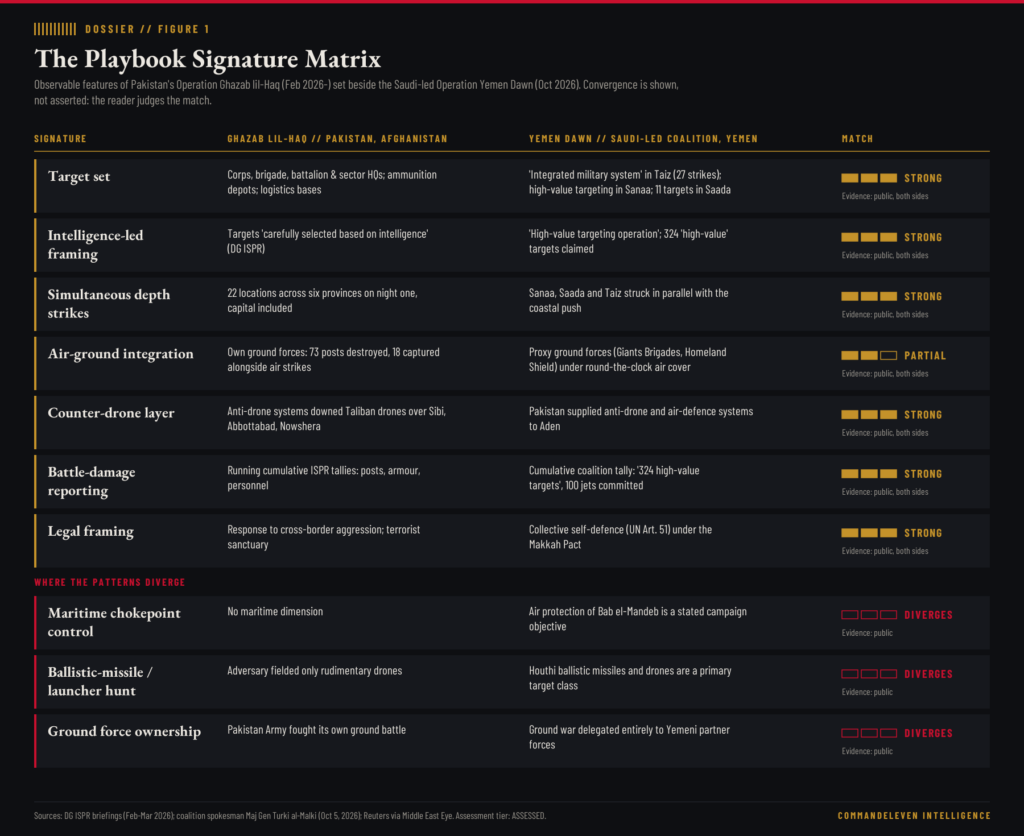
Figure 1: The Playbook Signature Matrix. A side-by-side comparison of Pakistan’s Operation Ghazb lil-Haq and the Saudi-led Operation Yemen Dawn across ten signatures, seven matching and three diverging.
Where the patterns diverge
The divergences are as important as the matches, because they show the convergence is not being forced.
- Maritime – Yemen Dawn has a chokepoint objective. Ghazb lil-Haq had no maritime dimension.
- Missile hunt – Ghazb lil-Haq faced an adversary with rudimentary drones. Yemen Dawn must hunt a mature ballistic-missile and long-range drone arsenal.
- Ground force – Pakistan fought its own ground battle. The Saudis have delegated theirs entirely to Yemeni partner forces.
Each of these differences is explained by theatre and political choice, not by a different doctrine.
What we judge, and what we do not
- [ASSESSED] – The Saudi-led air campaign reflects doctrinal convergence with Ghazb lil-Haq. The confirmed transmission channel is the Pakistani advisory presence alongside Saudi officers and the Pakistani air-defence and counter-drone systems already integrated in the Kingdom and in Aden.
Not claimed – This dossier does not claim that Pakistan planned, commanded or flew Yemen Dawn. Any such decision would have been taken at GHQ and ISI headquarters, and it cannot be confirmed from open or proprietary sourcing available to CommandEleven Intelligence.
The reader should judge the pattern from the matrix.
Iran’s Encirclement: Three Convergent Pressures
Iran is being squeezed on three sides at once. CommandEleven Intelligence assesses these pressures as convergent: they serve overlapping interests but show no evidence of a shared command. Treating them as a single coordinated plan would overstate the evidence.
The south: Yemen and Bab el-Mandeb
This is the front where Iran’s losses are most direct.
The southeast: Sistan-Baluchestan
The Baluch insurgency inside Iran has reached a high operational tempo:
- 23 September – Brigadier General Hossein Zarifi, commander of the IRGC’s Shahid Sajjad base in Saravan, was killed in clashes with an armed group.
- 1 October – The IRGC said it killed six members of a “terrorist” group in Zahedan, the provincial capital.
- 3 October – The IRGC said it broke up a cell that had killed one of its members and attacked a checkpoint in Rask, recovering weapons and a Starlink terminal.
Most of these incidents are reported through IRGC statements that often do not name the group responsible. Jaish al-Adl, the Sunni Baluch militant group most active in the province, is the principal suspect but is not attributed to every incident here. [CONFIRMED incidents; attribution ASSESSED]
The northwest: Iranian Kurdish groups
- The coalition – On 22 February 2026, several Iranian Kurdish parties formed a coalition aimed at bringing down the Islamic Republic.
- Fighting inside Iran – Since the US-Israeli war on Iran began on 28 February, PJAK fighters have reportedly taken positions inside Iranian territory.
- Iranian strikes in Iraq – Iran has repeatedly struck the groups’ bases in Iraq’s Kurdistan Region.
- Washington’s stance – President Trump said he fully supports an Iranian Kurdish offensive, but would not commit to providing air cover. A coalition official has said the armed Kurdish parties are ready to work openly with Israel and the US.
A note on terminology – These are Iranian Kurdish opposition groups based in Iraqi Kurdistan, not Iraqi Kurdish forces. The Kurdistan Regional Government’s Peshmerga are a separate entity and are not party to this fight.
Confidence note – Public US political support is on record. Operational US or Israeli support to Kurdish fighters has been reported but not confirmed by any source able public record. [ASSESSED]
Why the convergence matters
Iran’s internal-security forces are now fighting on two land frontiers while its most important external partner loses ground in Yemen. The doctrinal implications are set out below in Mosaic Defense Under Strain.
Mosaic Defense Under Strain
Iran’s Mosaic Defense doctrine is built on decentralization and redundancy. Command is distributed across semi-autonomous nodes so the system survives decapitation, and pressure is distributed across proxies so no single loss is decisive. CommandEleven Intelligence’s existing dossier on the doctrine’s internal design is the companion to this section.
The doctrine’s maritime expression in 2026 has been the two-chokepoint strategy:
- Hormuz – The IRGC has kept the Strait of Hormuz effectively closed to normal traffic since 4 March 2026.
- Bab el-Mandeb – In July, Reuters reported that Iran had asked the Houthis to be ready to close it if the US struck Iran’s power grid. A source close to the Houthis said IRGC representatives already in Yemen would control the timing.
- The doctrine in print – IRGC-linked Fars News published doctrine naming Bab el-Mandeb a “second front,” to be closed alongside Hormuz.
Earlier in the US-Israeli war on Iran, the Houthis had refrained from attacking commercial shipping. Their seizure of the Bab el-Mandeb coastline gave the second front a physical base.
What Yemen Dawn does to the doctrine
- The node becomes a liability – The Houthis are Iran’s most capable external node, and the only one able to threaten Red Sea traffic. If coalition air cover over the strait and the recapture of Dhubab and Mokha hold, Iran loses the ability to threaten both of the Gulf’s main export routes at once.
- Leverage concentrates – With Bab el-Mandeb gone, all of Iran’s maritime coercion rests on Hormuz. That makes Hormuz both Iran’s last card and the obvious focus of US pressure.
- The redundancy fails at the wrong moment – Mosaic Defense assumes losses can be absorbed because pressure is spread across nodes. The doctrine’s weakness is a scenario in which several nodes are pressed together: Yemen in the south, the Baluch southeast, the Kurdish northwest. That is the situation Iran faces now.
[ASSESSED] – Yemen Dawn is the most serious test of Mosaic Defense’s external architecture since the war began. Iran’s likeliest response is not to defend the Houthi node directly, which it cannot easily do, but to raise the cost of the campaign for the coalition’s most exposed member – Pakistan.
Iran’s Retaliation Options Against Pakistan
Iran has every reason to make Pakistan’s commitment expensive and few reasons to do so openly. Pakistan has been a mediator in US-Iran talks, shares a long border with Iran, and has struck inside Iran before. CommandEleven Intelligence therefore expects any Iranian response to be indirect, deniable and aimed at Pakistan’s existing weak points.
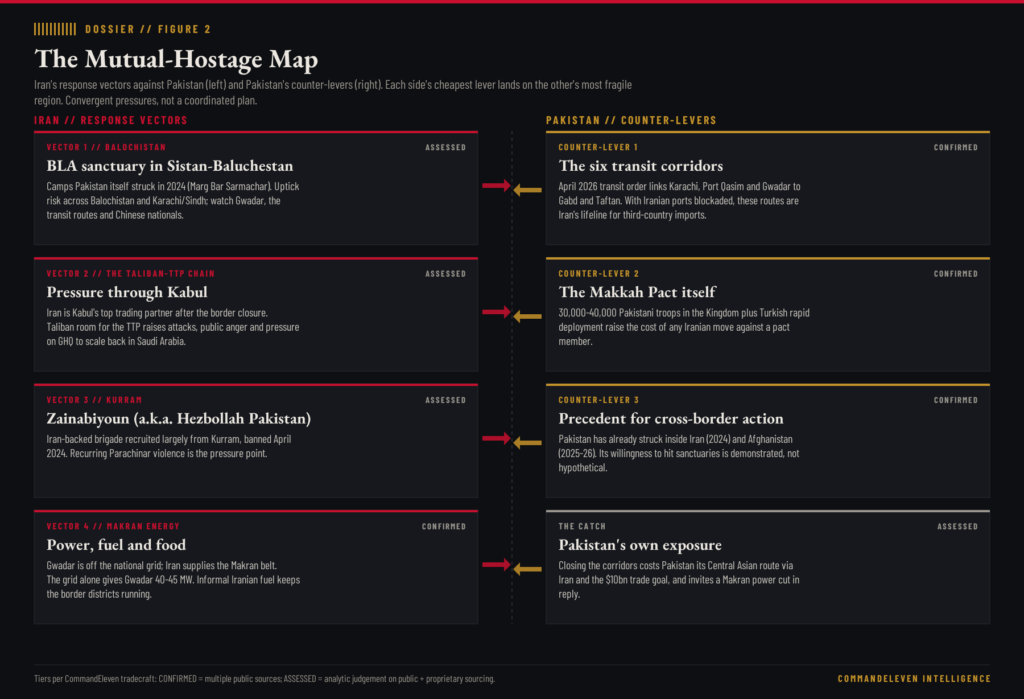
Figure 2: The Mutual-Hostage Map. Iran’s four response vectors against Pakistan set against Pakistan’s counter-levers, showing that each side’s cheapest lever lands on the other’s most fragile region.
Vector 1: The Baluch insurgency inside Pakistan
Why it is credible – The Baluchistan Liberation Army (BLA) has had sanctuaries in Iran’s Sistan-Baluchestan province. Pakistan established that publicly in January 2024, when Operation Marg Bar Sarmachar struck BLA and BLF hideouts around Saravan. [CONFIRMED]
What CommandEleven Intelligence assesses
- [ASSESSED] IRGC tolerance – IRGC tolerance and facilitation of BLA activity from Iranian soil has been significant.
- Multiple sponsors – The BLA is a multi-sponsor network. Pakistan’s own recent intelligence has focused on India, alleging a RAW allocation of more than $7.8 million to coordinate joint BLA and TTP attacks, and on facilitation from inside Afghanistan. These strands are not mutually exclusive.
Expected effect – An uptick in BLA violence in Baluchistan and in Karachi/Sindh. Indicators to watch:
- attacks on Gwadar and on the six transit routes
- attacks on Chinese nationals and CPEC sites
- incidents around Karachi’s ports
Vector 2: The Taliban lever
This is the most dangerous vector because it reaches Pakistan’s population, not just its border.
- The Taliban’s own interest – On 18 September, Afghanistan International reported, citing security sources, that the Taliban was encouraging the Houthis to step up attacks on Saudi Arabia in order to draw Pakistan into the Yemen conflict. The goal, per those sources, was to open a new front for Pakistan, divert its military focus from the Afghan border, and give Taliban-allied groups more room to operate inside Pakistan. This has been cross-confirmed by CommandEleven Intelligence assets on ground in Afghanistan.
- The analytic problem it raises – The Taliban has no obvious direct channel to the Houthis. The natural conduit is Tehran. It points to Iran as the connecting node between Kabul and Sanaa.
Iran’s economic grip on Kabul
- [CONFIRMED] – Tehran’s relationship with the Taliban is tense but pragmatic. Iran’s economic position, however, has grown sharply. With the Pakistani border closed, Kabul has turned to Iran, which is now its top trading partner.
- [CONFIRMED/CONFIRMED-P] – The hinge is Taliban Deputy Prime Minister for Economic Affairs Mullah Abdul Ghani Baradar. Baradar visited Chabahar port in November 2023 and pressed Iran to ease Afghan access. In February 2024, the Taliban announced a $35 million investment in Chabahar. A close aide to Baradar framed the pivot explicitly as ending Afghanistan’s dependence on Pakistan. CommandEleven Intelligence reporting also indicates Afghan capital has flowed into commercial property in Chabahar under the same arrangement.
How the lever works:
- Iran presses the Taliban, using its trade dominance.
- The Taliban gives the TTP more room to operate.
- TTP attacks inside Pakistan rise.
- Public anger in Pakistan grows.
- GHQ comes under pressure to scale back its Saudi commitment.
This is a direct replay of the logic that kept Pakistan out of Yemen in 2015, when the army’s war against the Pakistani Taliban was the reason it could not commit abroad. CommandEleven Intelligence assessed this same operational chain in its analysis for specific quarters on whether the Pakistan Army should engage against the Houthis.
Indicators
- Iranian-Taliban ministerial contacts, especially involving Baradar’s economic portfolio
- TTP attack tempo plotted against Yemen Dawn milestones
- TTP targeting shifting from Khyber Pakhtunkhwa into Punjab
- Taliban public statements on the Makkah Pact
The India strand: a longer history of the same playbook
Using the TTP as a lever against Pakistan is not new, and Iran is not its only practitioner.
- Afghan intelligence and the TTP, 2013 – In October 2013, US special forces seized senior TTP commander Latif Mehsud from an Afghan intelligence convoy. The New York Times reported that Afghan officials had sought to cultivate the TTP as leverage against Pakistan, and that they wanted Pakistan to know Afghanistan could play dirty as well. [CONFIRMED] The Times report documents the Afghan intelligence channel. CommandEleven Intelligence assesses that the effort was shaped by Indian intelligence guidance.
- The scholarly record – Avinash Paliwal’s *My Enemy’s Enemy* (2017) is the standard account of India’s Afghanistan policy. Pakistani journalist Hamid Mir reads it as documenting India playing “Baloch and Pashtun cards” against Pakistan.
- Doval on record – Pakistani commentators have long read a 2014 speech by Ajit Doval, India’s current National Security Adviser, as a blueprint for outspending Pakistan’s influence over militant groups. CommandEleven Intelligence’s archive holds a video of Doval describing how India would win over the Taliban with money and influence it through the Darul Uloom Deoband seminary. The Deoband channel is no longer hypothetical: in October 2025, Taliban Foreign Minister Amir Khan Muttaqi visited Darul Uloom Deoband during his India trip, the first such visit by a senior Taliban official.
- “Removing a thorn with a thorn” – Manohar Parrikar, former Minister of Defense, coined the basis for the Doval strategy with “kante se kanta nikalna” (removing a thorn with a thorn) in dealing with Pakistan, openly stating “why should Indian soldiers be used to neutralize terrorists” in 2015
- Command inside Pakistan – CommandEleven Intelligence’s own ground collection has identified a serving Indian intelligence officer operating under diplomatic cover in Afghanistan as a tactical commander for TTP-linked activity, including his movements to specific camps. The officer’s identity, residence, associates and travel are held by CommandEleven Intelligence and withheld here for source protection. [CONFIRMED-P]
- Noor Wali Mehsud’s confessional video – In May 2025, after the skirmish between Pakistan and India, Noor Wali Mehsud, the emir of the banned Tehreek-e-Taliban Pakistan (TTP), released a video stating it was justified and acceptable to take funds from infidels to fight a jihad. For CommandEleven Intelligence, the timing and the statement from someone at the top of the terror group’s hierarchy, this was full proof that India was directly integrated with the TTP, which CommandEleven Intelligence assets have confirmed on numerous occasions. [CONFIRMED-P]
- The Chabahar cell – CommandEleven Intelligence has physically verified a RAW operational center in Chabahar, Iran, staffed by roughly 20 operatives and analysts under an active-service Indian Army colonel. CommandEleven Intelligence assesses its mission is to generate unrest in Baluchistan. [CONFIRMED-P]
- Public context – Pakistan’s 2016 arrest of Indian national Kulbhushan Jadhav, whom Islamabad says operated from Chabahar, is the best-known public reference point; the case went to the International Court of Justice. That account is contested: in Spy Stories (2021), Adrian Levy and Cathy Scott-Clark argue Jadhav was not a serving Indian intelligence officer. CommandEleven Intelligence’s Chabahar finding does not depend on the Jadhav case.
Chabahar as the node – One Iranian port now ties together:
- the Taliban’s commercial pivot away from Pakistan (Baradar)
- India’s strategic investment in the port
- the RAW cell CommandEleven Intelligence has verified there
CommandEleven Intelligence assesses these as convergent interests sharing a single piece of geography, not a three-way alliance. Each party has its own reasons to see Pakistan pinned on its western frontier. [ASSESSED]
Vector 3: Kurram and the Zainabiyoun
The Zainabiyoun Brigade, also known as “Hezbollah Pakistan,” is the Iran-backed militia of Pakistani Shia fighters raised for the Syrian war. Its recruits have come mainly from Kurram district and Parachinar. Pakistan banned the brigade as a terrorist organization in April 2024.
Kurram sees recurring cycles of violence between armed groups and the Pakistan Army that throw the district into disarray. That makes it a ready pressure point for Iran to activate. [ASSESSED]
Excluded [DATA DEFICIT] – Reporting on a Zainabiyoun network in Karachi exists but is single-source and is excluded from this assessment pending corroboration.
Vector 4: Maran energy
This is Iran’s most direct economic weapon, covered in The Transit Corridors: Pakistan’s Lever and Its Price below.
What is unlikely
Direct Iranian military action against Pakistan in the next 90 days is unlikely. Iran is already fighting the US and Israel, is pressed on two land frontiers, and has previously seen Pakistan answer an Iranian strike in kind within 48 hours (January 2024). [ASSESSED]
The Transit Corridors: Pakistan’s Lever and Its Price
Pakistan’s Lever
On 25 April 2026, Pakistan’s Commerce Ministry issued the Transit of Goods through Territory of Pakistan Order 2026. It designated six overland routes linking Karachi, Port Qasim and Gwadar to the Iranian border crossings at Gabd and Taftan. The order was issued while thousands of containers sat stranded at Karachi because of the US blockade of Iranian ports. With Iranian ports blockaded, these corridors became a lifeline for Iran’s third-country imports. [CONFIRMED]
These are ground lines of communication (GLOCs), not sea lines (SLOCs). Their leverage comes from where they start: they turn Pakistan’s seaports into Iran’s import gateway.
If Tehran moves against Pakistan, closing the corridors is Islamabad’s most direct economic response, and it would hurt.
The price: what closure would cost Pakistan
Iran holds a counter-lever, and it is aimed at the region where Pakistan is weakest.
- Electricity – Gwadar is not connected to Pakistan’s national grid. Iran has supplied power to Gwadar, Kech and Panjgur since 1999. Pakistan has just approved a total of 204 MW of Iranian imports. The utility regulator was told that without them, the national grid can supply Gwadar with only 40-45 MW of uninterrupted power. An Iranian cut would black out the flagship port of the China-Pakistan Economic Corridor. [CONFIRMED]
- Fuel – Informal fuel trade from Iran supplies the Baluchistan border economy at scale. One estimate puts it at around 11.82 million liters of petrol a day entering the province, much of it outside formal channels [60]. When Iranian supply was disrupted during an earlier phase of the Iran conflict, 60-70% of petrol pumps in the affected region closed. [CONFIRMED]
- Food and goods – The border districts also depend on Iran for flour, rice, vegetables and household goods. [CONFIRMED]
- Pakistan’s own route to Central Asia – Iran has given Pakistan access to Central Asian markets that Afghanistan closed. In August 2026, the two governments committed to raising bilateral trade to $10 billion. Closing the corridors would forfeit both. [CONFIRMED]
The Escalation Ladder
If Pakistan closes the corridors, Iran’s cheapest reply lands on Makran’s power, fuel and food: the same districts where border livelihoods and BLA recruitment overlap. A power cut in Gwadar would therefore hand the BLA a grievance, a target set and a recruiting pitch at the same time.
Assessment – The corridors give Pakistan real leverage, but leverage that is costly to use. CommandEleven Intelligence assesses that both governments understand this mutual exposure, and that it will keep their escalation calibrated:
- Iran will prefer deniable militant pressure to economic warfare.
- Pakistan will treat corridor closure as a deterrent to hold in reserve, not a first response.
Outlook and Indicators
Next 30 days
- Arrival – Turkish and additional Pakistani forces arrive in the Kingdom under the pact’s rapid-deployment decision.
- The coast – The coalition attempts to consolidate the Bab el-Mandeb coast. Houthi counter-attacks on Saudi energy and airport targets continue; the Houthis claimed new attacks as the offensive began.
- Tehran – Expect sharper Iranian rhetoric toward Islamabad, building on Baghaei’s 4 October statement.
- Watch for – any official Pakistani acknowledgement of a combat role; a TTP or BLA spike timed to coalition milestones; IRGC statements naming Pakistan.
Next 90 days
- The Houthi node – If coalition gains hold, Iran shifts from defending the Houthi node to imposing costs on pact members.
- Pakistan’s exposure – Pakistan is the most exposed member. The Taliban-TTP chain and Baluch militancy are the likeliest channels.
- Watch for – Iran-Taliban economic agreements or high-level visits; sustained TTP activity in Punjab; attacks on the transit corridors or CPEC sites; any interruption in Iranian electricity to Maran.
Next 180 days
- The pact’s future – Its durability depends on whether Pakistan’s domestic costs stay below the political threshold that forced neutrality in 2015.
- Expansion – Dar has said at least six more countries have expressed interest in joining once the pact is fully operational. Expansion would dilute Pakistan’s centrality but spread the risk.
- Watch for – the pact’s secretariat being stood up in Riyadh; new membership applications; parliamentary pressure in Islamabad for a debate on the deployment.
What This Dossier Does Not Claim
- That Pakistan flew, planned or commanded any part of Operation Yemen Dawn.
- That the pressures on Iran from Yemen, Baluchistan and Kurdistan are coordinated by any single actor.
- That the United States or Israel is providing operational support to Iranian Kurdish fighters.
- That the coalition’s claimed figures of 100 jets and 324 targets are independently verified.
- That every militant incident in Sistan-Baluchestan is attributable to Jaish al-Adl.
- That Iran will take direct military action against Pakistan.
Companion Reading from CommandEleven Intelligence
- Iran’s Mosaic Defense Doctrine – CommandEleven
- Symmetric vs. Asymmetric Warfare: The Framework Behind Iran’s Strategy (Iran War Doctrine & Strategy, Part I)
- Asymmetric Network Integration: Lebanon and Yemen (Axis of Resistance series)
- The ISKP Convergence Cluster (preface): on the ISKP-BLA-TTP-Haqqani “technical handshake”
Sources
- Georges Malbrunot via Libnanews – on the Houthi drone claim against the Jazan refinery two days after signing, 11 Aug 2026.
- Express Tribune – “Pakistan backs KSA after Houthi attacks,” 9 Sept 2026.
- AP via PBS NewsHour – “Saudi-backed coalition forces Houthis from several areas around key strait,” 5 Oct 2026.
- The National – “Yemeni forces claim control of Bab Al Mandeb strait and Mokha,” 5 Oct 2026.
- Al Jazeera – “Yemen forces claim to seize Dhubab sites near Bab al-Mandeb,” 5 Oct 2026.
- The New Region – “Turkey, Saudi Arabia, Pakistan sign defense pact,” 7 Aug 2026.
- Wikipedia – “Strategic Mutual Defence Agreement” (Saudi Arabia-Pakistan, 17 Sept 2025).
- ThePrint – “Saudi-Pakistan defence ties, from 1960s to now & why Houthi ‘attack’ didn’t activate Mecca pact,” 20 Sept 2026.
- Armenpress (citing AP) – “Pakistan vows to defend Saudi Arabia against Houthis by ‘whatever means,’” Sept 2026.
- Gulf News – “Saudi Arabia, Pakistan and Turkey reaffirm joint defence pact under Mecca agreement,” 2026.
- TRT World – “Türkiye, Pakistan activate collective deterrence of Mecca Pact,” 5 Oct 2026.
- Middle East Eye – “Saudi Arabia, Turkey and Pakistan activate Mecca Pact amid war with Houthis,” 5 Oct 2026.
- Khaama Press (citing Reuters) – “Pakistan Deploys Up to 40,000 Troops to Saudi Arabia,” Oct 2026.
- Pajhwok (citing Reuters) – “Pakistan deploys 8,000 troops, fighter jets to Saudi Arabia,” 19 May 2026.
- Middle East Forum – “Which Forces Could Pakistan Deploy to Saudi Arabia?” 2026.
- Middle East Eye – “Pakistan sent four planeloads of weapons to Saudi-backed government in Yemen,” Oct 2026.
- Arab Times – “40,000 Pakistani Troops in Saudi Arabia Alarm Iran,” 4 Oct 2026.
- Middle East Eye – “Pakistan sends combat troops to southern Saudi border” (on the 1980s armored brigade).
- Jakarta Post – “Saudis want jets, ships and troops from Pakistan,” 7 Apr 2015.
- Gulf Times (citing Reuters) – “No Pakistan decision yet on whether to join Saudi coalition,” 27 Mar 2015.
- Al-Monitor – “Yemen conflict: Pakistan parliament resolution,” Apr 2015.
- East Asia Forum – “Pakistan caught in a bind by Sharif’s Saudi debt,” 2015.
- Gulf News (reporting the 2010 WikiLeaks US cables, originally published by The Guardian) – “Saudi preference for military rule in Pakistan.”
- Khaleej Times – “Pakistan to send troops to Saudi Arabia to train, advise” (Raheel Sharif commands the Saudi-led alliance).
- Aaj News – “Operation Ghazb-lil-Haq: 464 Taliban fighters killed,” 3 Mar 2026.
- Gulf News – “Senior IRGC commander killed in clashes in southeast Iran,” 23 Sept 2026.
- The New Arab – “IRGC kill six ‘terrorists’ in restive Sistan-Baluchistan region,” 1 Oct 2026.
- Xinhua – “Iran says 2 ‘terrorists’ killed in counter-terror operation in SE province,” 3 Oct 2026.
- Wikipedia – “2026 Kurdish-Iranian crisis.”
- FDD’s Long War Journal – “Kurdish Iranian opposition groups say Iran targeted them in northern Iraq,” 2 Mar 2026.
- i24NEWS (via Disroot) – “Thousands of Kurdish fighters launch ground offensive into Iran,” Mar 2026.
- The New Region – “Iranian strikes on Kurdish opposition in Erbil injure one fighter,” Mar 2026.
- NoonPost – “Bab el-Mandeb after Hormuz: Iran’s next weapon,” 20 Jul 2026.
- Business Today (citing Reuters) – “Houthis prepared to attack shipping near Bab el-Mandeb,” 17 Jul 2026.
- FDD’s Long War Journal – “Iran reportedly tells Houthis to close Bab al Mandeb Strait if US strikes power grid,” 17 Jul 2026.
- Responsible Statecraft – “Can Pakistan mediate war while opening trade routes to Tehran?” 2026.
- Dawn – “Nine killed in ‘precision strikes’ on ‘BLA, BLF camps,'” Jan 2024.; Wikipedia – “Operation Marg Bar Sarmachar.”
- Afghanistan International – on Pakistani allegations of RAW funding for BLA-TTP attacks (citing Geo News), 19 Sept 2026.
- Afghanistan International – “Taliban Seeks To Draw Pakistan Into Yemen Conflict, Say Sources,” 18 Sept 2026.
- dpa via Yahoo News – “Iran calls Afghan Taliban and Pakistan to de-escalate tensions,” 2026.
- IFRI – “Afghanistan-Pakistan: The Overlooked War,” Mar 2026.
- Pajhwok – “Baradar asks Iran to relax Afghan access to Chabahar port,” Nov 2023.
- Al-Monitor – “How significant is $35M Taliban-Iran Chabahar port deal?” Mar 2024.
- Arab News – “Bypassing Pakistan, Taliban set sights on Iranian port for access to international markets,” 2024.
- Harper’s Magazine – “Proxy Syndrome,” Dec 2013.
- Hurst Publishers – Avinash Paliwal, My Enemy’s Enemy: India in Afghanistan from the Soviet Invasion to the US Withdrawal (2017).
- The News – Hamid Mir, “My enemy’s enemy,” 20 Jan 2021.
- DailyO – “How super sleuth Ajit Doval spooked Pakistan” (on the February 2014 SASTRA speech).
- ETV Bharat – “Afghanistan Foreign Minister Muttaqi Visits Darul Uloom Deoband,” 11 Oct 2025; ORF – “Deoband and the Taliban: Faith Diplomacy and India’s Theological Opportunity,” Oct 2025.
- Tribune India – “Kulbhushan Jadhav was lured by ISI: Book” (on Spy Stories, Levy & Scott-Clark, 2021).
- Jamestown Foundation – “Pakistan Bans Iran-Backed Zainebiyoun Brigade Amid Regional Turmoil.”
- Paradigm Shift – “The Iran-Backed Zainabiyoun Brigade: A Pakistani Shiite Militia.”
- Al Jazeera – “Pakistan opens up road trade routes into Iran amid Hormuz blockade,” 30 Apr 2026.
- Arab News Pakistan – “Pakistan clears transit of third-country goods to Iran through its territory,” 27 Apr 2026
- The News – “Baluchistan,” 2026.; Arab News Pakistan – on Gwadar’s grid isolation.
- TNN – “Fuel shortages, rising prices: Iran-US standoff impacts Baluchistan trade,” 2026
- Asia News Network (Dawn) – “Fuel crisis deepens in Pakistan’s Baluchistan as supply from Iran disrupted.“
- Express Tribune – “Is $10b Pak-Iran trade a pipe dream?” 10 Aug 2026
- The Washington Post (AP) – “Saudi-backed Yemeni forces expel Houthi rebels from several areas around key strait,” 5 Oct 2026.
- The Jerusalem Post – “Mecca defense pact signatories meeting in Riyadh over escalating Houthi attacks,” Oct 2026
- The Hindu – “India to take pro-active steps to thwart terror: Parrikar,” May 21, 2015
- The New York Times – “US Disrupts Afghan’s Tack on Militants,” October 29, 2013
- CommandEleven Intelligence X handle – Noor Wali Mehsud, leader of the banned Tehreek-e-Taliban Pakistan (TTP), announcing it is ok to take funds from infidels to fight a jihad – video recorded and posted after the May 2025 skirmish with India.
The Makkah Pact Series
Series Introduction: The Makkah Pact
- The Makkah Pact’s First Test: Operation Yemen Dawn, Pakistan’s Role, and Iran’s Shrinking Map – Part 1 (you are here)
- The First Test, Tested: Riyadh’s Airport War and the Makkah Pact – Part 2
- Strong in the Air, Weak on the Ground: Why Riyadh Needs the Makkah Pact – Part 3
- Diamond vs. Hexagon: Where Pakistan Sits on Netanyahu’s Map – Part 4
- The Coalition Forms: Typhoons, Syrian Troops and Egypt’s Vote – Part 5