
This is Part 3 of CommandEleven Intelligence’s coverage of the Makkah Pact’s first test. Part 1 examined Operation Yemen Dawn and Pakistan’s role; Part 2 covered the Houthi airport war. This part steps back to ask the structural question underneath both: why Saudi Arabia, with one of the best-equipped militaries in the world, needed a pact at all.
Bottom Line Up Front
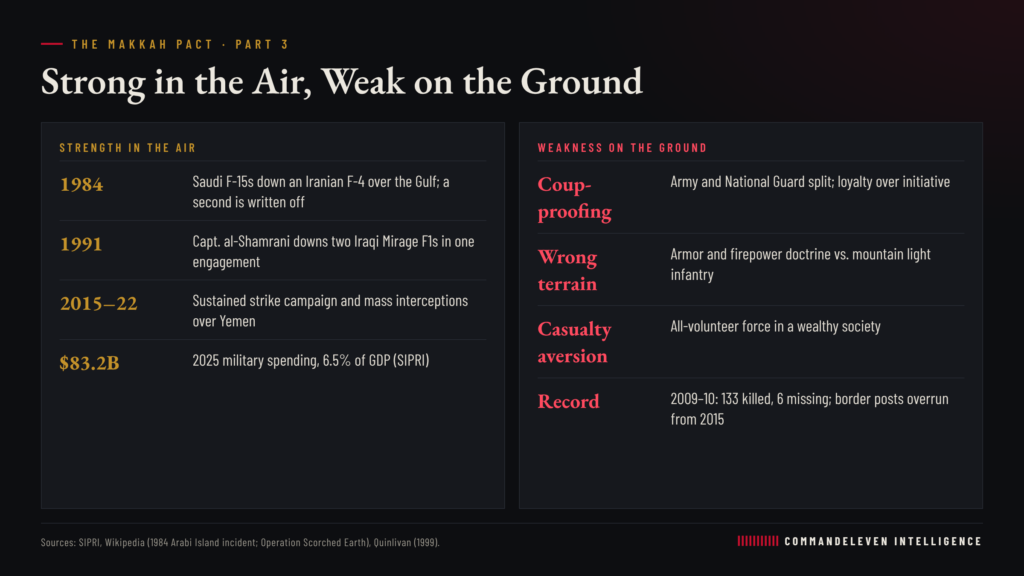
Saudi Arabia spends more on its military than any country in the Middle East: an estimated $83.2 billion in 2025, 6.5% of GDP, the eighth-largest budget in the world. Its air force has a real combat record and flies some of the most capable aircraft in the region. Its ground forces have never carried a hard, sustained ground war on their own, and the Kingdom’s leadership knows it.
That gap explains the shape of every Saudi war in Yemen. Riyadh fights from the air and pays others to fight on the ground: Yemeni government forces, tribal militias, Sudanese fighters in the last war and, since August 2026, the protective umbrella of Pakistani forces under the Makkah Pact. The October airport war added a second lesson. Owning the sky over Yemen is not the same as protecting the sky over Riyadh.
Key Judgments
KJ1: The Royal Saudi Air Force is a capable, combat-tested force. Its record runs from the 1984 shoot-down of an Iranian F-4 over the Gulf through 1991 and a decade of strike and interception missions over Yemen. [CONFIRMED]
KJ2: Saudi ground forces are built for regime security and desert defense, not offensive war in mountains. Splitting the land forces between the army and the National Guard, promoting for loyalty and centralizing decisions in Riyadh protect the monarchy and cost battlefield initiative. [ASSESSED]
KJ3: Riyadh outsources ground combat by design. In 2009, 2015 and 2026 alike, the hard ground fighting in Yemen has been done mostly by non-Saudi forces. [CONFIRMED on the pattern; ASSESSED on intent]
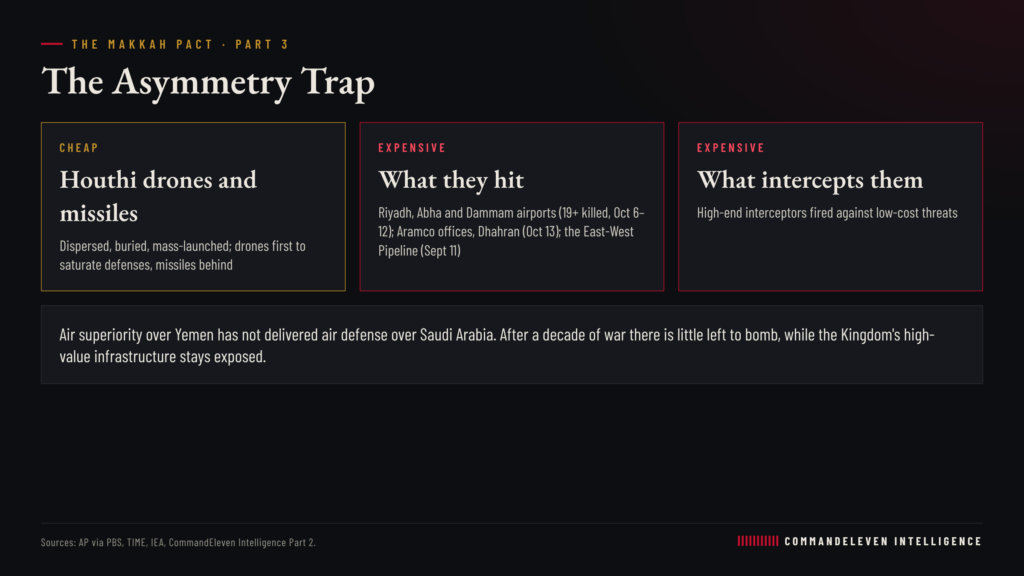
KJ4: Air superiority over Yemen has not delivered air defense over Saudi Arabia. The Houthis have dispersed and buried their arsenal, so there is little left to bomb, while cheap drones and missiles keep reaching Saudi airports and oil sites. [CONFIRMED on outcomes; ASSESSED on cause]
KJ5: The Makkah Pact is Riyadh’s answer to its own ground gap. With Hormuz closed and its oil exports pushed to the Red Sea, the Kingdom could no longer afford a ground weakness on its southern flank. Pakistan supplies mass and credibility, on the condition that it defends Saudi territory and does not cross into Yemen. [ASSESSED]
Strength in the Air: The Record
The Royal Saudi Air Force should not be underestimated. Three episodes built its reputation:
- June 5, 1984, the Tanker War. Guided by a US AWACS aircraft, two Saudi F-15s intercepted two Iranian F-4 Phantoms that had entered Saudi airspace while setting up attacks on oil tankers. One Phantom was shot down; the second was damaged and written off after an emergency landing on Kish Island. Iran scrambled more jets, Saudi Arabia answered with 11 more F-15s, and Tehran backed off.
- January 1991, Desert Storm. Captain Ayedh al-Shamrani, flying an F-15C, shot down two Iraqi Mirage F1s in a single engagement, the kind of result air forces build their identity around.
- 2015 to 2022, Yemen. Saudi pilots flew a sustained strike campaign and intercepted large numbers of Houthi drones and missiles aimed at Saudi cities and infrastructure.
Air power suits the Kingdom. It converts money into capability, depends on a small number of highly trained professionals rather than large formations, and keeps Saudi casualties low. It is also the arm most closely tied to the Kingdom’s Western partners for aircraft, training and intelligence. [ASSESSED]
Weakness on the Ground: Why It Persists
Saudi ground forces are not incompetent. They are trained for defensive and offensive operations in open desert, can maneuver armored units and use artillery with modern intelligence support, and Saudi personnel are capable technicians on complex equipment such as the M1A2 Abrams. The problem shows up when they have to take and hold hostile ground against a determined enemy. Four causes stand out.
1. An army built to prevent coups. Like several Gulf monarchies, Saudi Arabia divides its land power. The regular army answers to the Ministry of Defense; the Saudi Arabian National Guard, historically recruited from loyal tribes, is a separate force under its own ministry. The political scientist James Quinlivan described this pattern as “coup-proofing”: parallel forces, loyalty-based promotion and tight central control that make a coup hard and make battlefield initiative rare. Officers learn not to act without authorization from Riyadh. [ASSESSED]
2. Firepower doctrine in the wrong terrain. Heavy armor and massed fire work in open desert. In Yemen’s northern mountains, where the Houthis fight as light infantry using ambushes, tunnels and raids, they are far less useful. [ASSESSED]
3. Low tolerance for casualties. Saudi Arabia has an all-volunteer military with no conscription. A professional force recruited in a wealthy society, with few incentives for frontline service and high political sensitivity to losses, is poorly suited to a long, bloody ground fight. [ASSESSED]
4. A record that shows it. In the 2009 to 2010 border war with the Houthis, Saudi Arabia lost 133 soldiers killed and six missing by its own count, and relied on Jordanian commandos to help retake the mountain of Jabal al-Dukhan. From 2015 onward, Houthi raids repeatedly overran Saudi border posts in Najran, Jizan and Asir, sometimes capturing equipment left behind. [CONFIRMED]
Outsourcing the Ground War
Aware of these limits, Riyadh has consistently refused to send its own army deep into Yemen. Direct intervention would mean heavy casualties and domestic political risk. Instead, the Kingdom provides the umbrella (air power, intelligence, logistics and money) and others do the ground fighting:
| War | Who fought on the ground |
|---|---|
| 2009 to 2010 | Saudi forces on the border, with Jordanian commandos and reported Moroccan special forces |
| 2015 to 2022 | Yemeni government forces, southern and tribal militias, and Sudanese fighters, including, the New York Times reported, children recruited from Darfur |
| 2026: Operation Yemen Dawn | Yemeni government forces on the Red Sea coast and around Taiz; Saudi air strikes; Pakistani forces inside the Kingdom under the Makkah Pact, defending Saudi territory only |
The October fighting fits the pattern exactly. Reporting from the Taiz front and the Red Sea coast describes Saudi-backed Yemeni government forces fighting the Houthis, with Saudi aircraft striking Houthi positions and Sanaa. No reporting describes Saudi ground formations in the offensive. Pakistan’s Foreign Office has said its forces “would not be crossing the borders of the other side for an attack on the Houthis.” [CONFIRMED]
The Asymmetry Trap
This arrangement leaves Saudi Arabia more exposed to the Houthis than the Houthis are to Saudi Arabia.
- Nothing left to bomb. After a decade of war, Houthi production, storage and launch infrastructure is dispersed and dug in. Air power can punish but struggles to destroy capability. [ASSESSED]
- Cheap weapons, expensive targets. Houthi drones and missiles cost a fraction of the interceptors fired at them and of the airports, refineries and offices they hit. Between October 6 and 12, strikes on Riyadh, Abha and Dammam airports killed at least 19 people and closed the capital’s airport. On October 13, a Houthi strike started a fire at Saudi Aramco offices in Dhahran. [CONFIRMED]
- Sequencing beats numbers. Initial Saudi findings on the October 10 strike, reported by regional officials, are that drones went first to clear the way for cruise and ballistic missiles. This is a lesson about air defense, not about fighter pilots. [CONFIRMED that the findings were reported]
The result is that Saudi superiority in the air is offset twice: by an unwillingness to risk its own ground forces, and by the Houthis’ ability to strike the Kingdom’s exposed, high-value infrastructure at low cost. [ASSESSED]
Why the Truce Didn’t Hold
For a while, Riyadh drew the logical conclusion from its own limits. After the April 2022 truce it opened direct talks with the Houthis, and in March 2023 it restored relations with Iran in a China-brokered deal. The bet was that de-escalation would protect the Vision 2030 economic program better than an unwinnable war.
2026 broke that bet. The US-Israeli war with Iran, Iran’s closure of the Strait of Hormuz in March, and the shift of Saudi oil exports to Red Sea ports turned the Bab el-Mandeb from a regional concern into a lifeline. When the Houthis took Mokha and the islands controlling the strait in September, Riyadh faced a threat it could not answer from the air alone. [CONFIRMED on events; ASSESSED on Saudi calculus]
The Makkah Joint Defence Agreement, signed with Pakistan and Türkiye on August 7, gave the Kingdom what its own army could not: a large, battle-experienced force to secure Saudi territory, freeing the Kingdom to concentrate on the air war and on its Yemeni partners’ ground offensive. Pakistan’s public red line, defense of Saudi territory but no crossing into Yemen, means the pact closes the defensive gap without closing the offensive one. [ASSESSED]
Outlook and Indicators
CommandEleven Intelligence assesses three likely paths over the next six months. [ASSESSED]
- Most likely: a long, grinding standoff. Saudi air strikes and Yemeni government ground offensives trade territory on the coast and around Taiz, while Houthi strikes keep imposing economic costs on the Kingdom.
- Possible: outside help changes the balance. A US decision to strike Houthi launch sites would add capability Riyadh lacks, at the cost of drawing Houthi attacks on US assets.
- Less likely: a return to bargaining. Mounting costs to Vision 2030 push Riyadh back toward talks, as in 2022, but from a weaker position on the strait.
Indicators to watch:
- Any report of Saudi ground units fighting inside Yemen, which would mark a real change in doctrine.
- New recruitment of foreign fighters for the Yemeni front.
- Saudi emergency purchases of short-range air defense and counter-drone systems.
- Any shift in Pakistan’s “defense of the territory” position.
What This Dossier Does Not Claim
- It does not claim Saudi ground forces are ineffective in every role; they are capable in desert defense and technical maintenance.
- It does not claim Pakistani forces are fighting in Yemen or operating Saudi air defenses.
- It does not treat coalition or Houthi battlefield figures as verified.
Frequently Asked Questions
How strong is the Saudi military?
Saudi Arabia spent an estimated $83.2 billion on its military in 2025, the most in the Middle East. Its air force is capable and combat-tested; its ground forces have struggled in offensive operations against the Houthis.
Does Saudi Arabia have conscription?
No. Saudi Arabia’s armed forces are all-volunteer.
Why doesn’t Saudi Arabia send ground troops into Yemen?
A ground war in Yemen’s mountains would likely mean heavy Saudi casualties and political risk at home. Riyadh has preferred to provide air power, intelligence and money while Yemeni and other forces fight on the ground.
What does Pakistan provide under the Makkah Pact?
Pakistan has confirmed its forces are in Saudi Arabia to defend Saudi territory, and has said they will not cross into Yemen to attack the Houthis.
Sources
- Trends in World Military Expenditure, 2025, SIPRI, April 2026
- 1984 Arabi Island incident, Wikipedia
- Operation Scorched Earth, Wikipedia
- Coup-Proofing: Its Practice and Consequences in the Middle East, James T. Quinlivan, International Security, 1999
- Saudi Arabia recruited Darfur children to fight in Yemen: NYT, Al Jazeera, December 2018
- Fighting in Yemen intensifies: What’s the latest on the battlefield?, Al Jazeera, October 15, 2026
- Who Are the Houthis and Why Are They Attacking Saudi Arabia’s Airports?, TIME, October 15, 2026
- Saudis probe how defense systems failed to stop deadly Houthi attack on Riyadh airport, PBS NewsHour (AP), October 12, 2026
- Pakistan has substantial forces deployed in Saudi Arabia: foreign ministry, Arab News, October 9, 2026
The Makkah Pact Series
- The Makkah Pact’s First Test: Operation Yemen Dawn, Pakistan’s Role, and Iran’s Shrinking Map – Part 1
- The First Test, Tested: Riyadh’s Airport War and the Makkah Pact – Part 2
- Strong in the Air, Weak on the Ground: Why Riyadh Needs the Makkah Pact – Part 3 (you are here)

