
Bottom Line Up Front
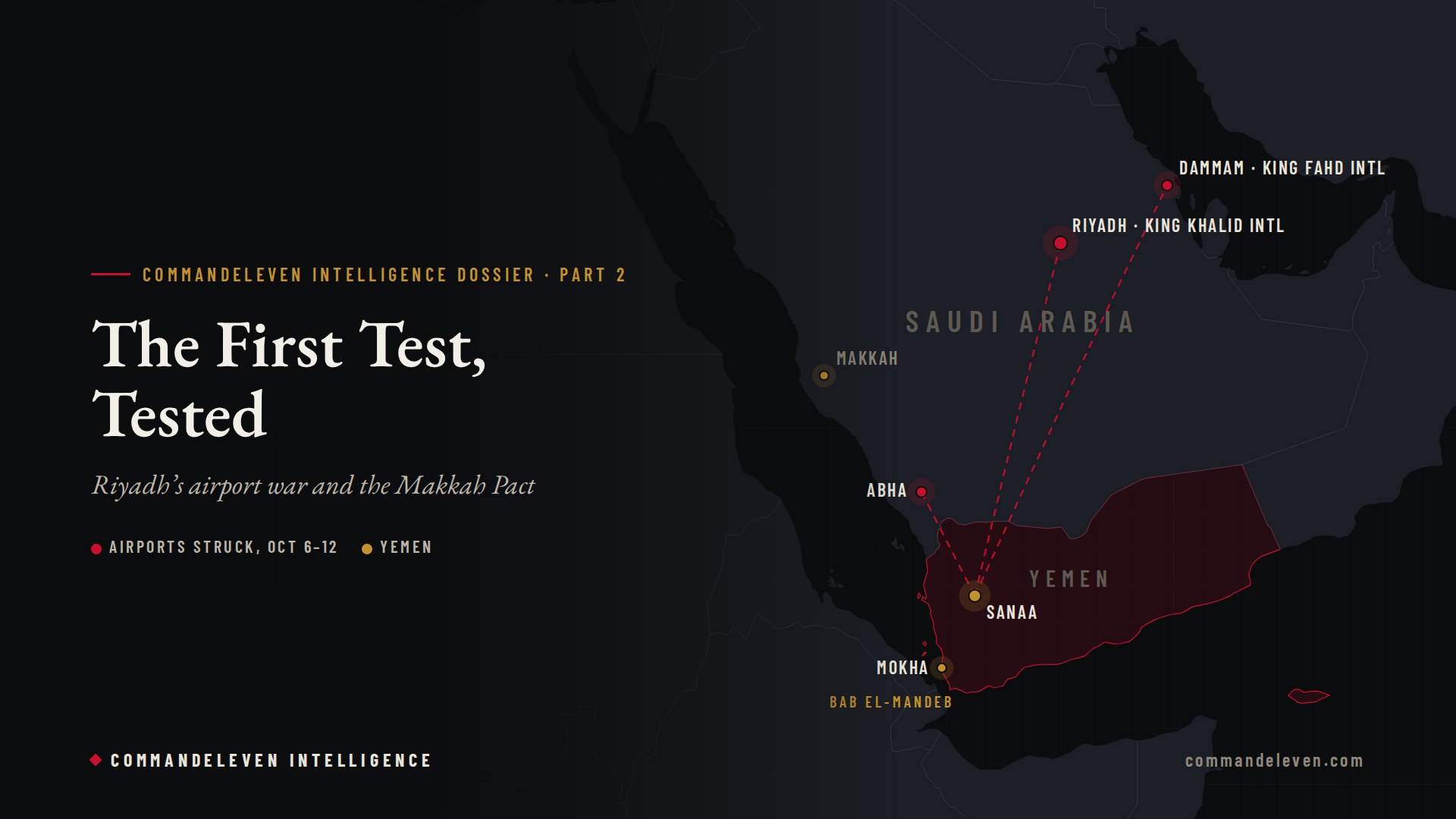
A day after the Makkah Pact’s members pledged rapid deployment to Saudi Arabia, the Houthis answered with a sustained missile and drone campaign against Saudi civilian aviation. Between October 6 and 12, 2026, strikes on King Khalid International Airport in Riyadh, Abha, and King Fahd International in Dammam killed at least 19 people and wounded more than 350, destroyed a Saudia airliner on the ground, and closed the capital’s airport through at least October 17.
In The Makkah Pact’s First Test (October 9), CommandEleven Intelligence assessed that the Houthis would keep hitting Saudi energy and airport targets, that Pakistan would keep its role deliberately quiet, and that the United States would stay out of direct operations in Yemen. Four days after publication, the first two have held. The third is under the most pressure it has faced: President Trump, who declined Saudi requests for strikes in September, now says the US “may” join.
The pact’s first test was whether its members would deploy. They did. The test now is whether a defensive pact can actually defend. Riyadh’s air defenses failed against a drones-first, missiles-second attack, and Pakistan says its forces in the Kingdom are there for “the defense of the territory.” That is exactly the mission the airport strikes have put in question.
Key Judgments
KJ1: The Houthi airport campaign is a deliberate answer to the pact, not a coincidence of timing. It began the day after Operation Yemen Dawn and the pact’s rapid-deployment pledge, and the Houthis have openly framed it as a warning that Saudi Arabia can “no longer wage aggression against Yemen from a safe position.” [ASSESSED]
KJ2: Saudi air defenses were beaten by sequencing, not just numbers. Initial Saudi findings, reported by two regional officials, are that drones were fired first to clear the way for cruise and ballistic missiles, and that the defenses gave no early warning. [CONFIRMED that the probe and its initial findings were reported; ASSESSED on cause]
KJ3: Pakistan has confirmed its forces are in the Kingdom, and is drawing a hard line at Yemen’s border. The military’s spokesman said “the forces of Pakistan are already there”; the Foreign Office said they “would not be crossing the borders of the other side for an attack on the Houthis.” This matches Part 1’s judgment that Pakistan’s role would be large, real and deliberately bounded. [CONFIRMED]
KJ4: A direct US role is now the single biggest variable. Washington has provided intelligence, targeting and planning support but no strikes. A US citizen was among those killed, and Trump says the US “may” join. The Houthis have promised a “swift and painful response” if it does. [CONFIRMED on statements; ASSESSED on significance]
KJ5: The coalition’s battlefield claims on the coast are not yet independently confirmed. Yemeni government forces say they retook Mokha and the Bab el-Mandeb area on October 5. The figures behind those claims (1,747 Houthis “neutralized,” 324 targets destroyed) come from the government side and the coalition. [ASSESSED, single-side sourcing]
KJ6: The economic front matters as much as the military one. With Riyadh’s airport closed, Brent crude above $106 and international carriers suspending service, the Houthis are imposing costs on the Kingdom’s Vision 2030 showcase calendar at very low cost to themselves. [ASSESSED]
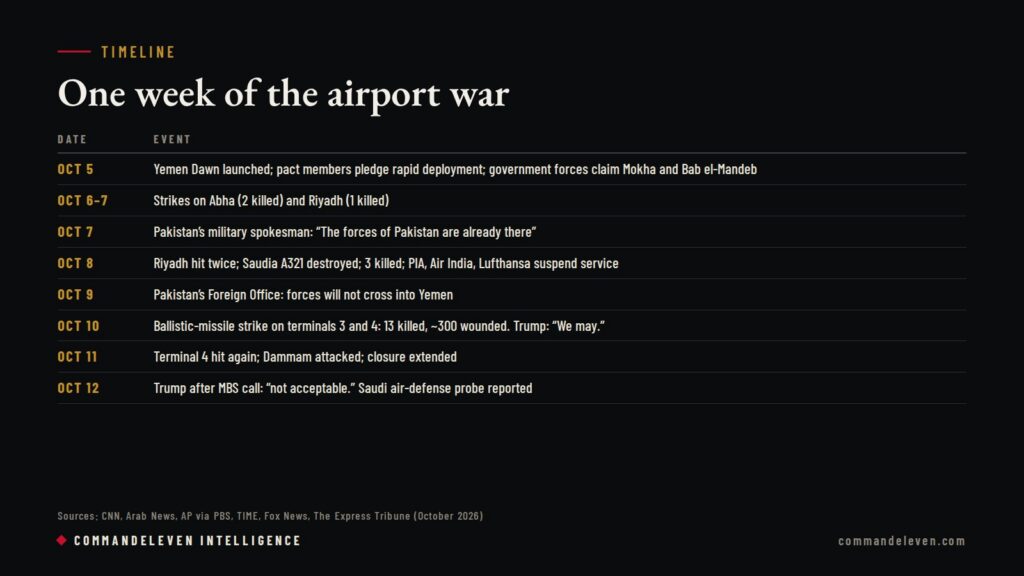
One Week of the Airport War
| Date | Event |
|---|---|
| Oct 5 | Riyadh emergency session; pact members pledge rapid deployment. Operation Yemen Dawn launched. Yemeni government forces claim Mokha and the Bab el-Mandeb area. |
| Oct 6–7 | Missile and drone strikes on Abha (2 killed, 28 wounded) and King Khalid International, Riyadh (1 killed, 8 wounded). |
| Oct 7 | Pakistan’s military spokesman confirms Pakistani forces are already in Saudi Arabia; any involvement “defensive in nature.” |
| Oct 8 | Two strikes on King Khalid International; a Saudia A321 destroyed; 3 Saudis killed, including a pilot. Hundreds of flights canceled; PIA, Air India and Lufthansa suspend service. |
| Oct 9 | Pakistan’s Foreign Office: forces will not cross into Yemen. EU aviation safety agency widens its Saudi airspace warning. |
| Oct 10 | Ballistic-missile strike on terminals 3 and 4: 13 killed, about 300 wounded, including a US citizen. Trump: “We may. We’re going to look at it.” |
| Oct 11 | Terminal 4 hit again (1 killed, 11 wounded); King Fahd International, Dammam, attacked. Airport closure extended. |
| Oct 12 | Trump speaks to Crown Prince Mohammed bin Salman: the attack is “not acceptable.” Coalition intercepts missiles aimed at Riyadh and Khamis Mushait. Saudi probe into air-defense failure reported. |
The Houthis’ stated logic has been consistent. Their spokesman Yahya Saree warned airlines and passengers to avoid Saudi airspace and told workers to stay away from oil facilities and airports, which the group now calls legitimate targets. Mohammed al-Bukhaiti framed the campaign as retaliation for Saudi strikes in Yemen and as a message to the Crown Prince personally.
How the Defenses Failed
The October 10 strike flew more than 1,000 kilometers to reach Riyadh. According to the initial findings of the Saudi investigation, reported on October 12, drones went in first to draw and saturate the defenses, and cruise and ballistic missiles followed. Officials are also examining why there was no earlier warning. [CONFIRMED that the findings were reported]
The Houthi arsenal includes ballistic missiles with warheads that can change direction in flight, which make interception by Patriot-class systems harder. The point for the pact is not technical detail but scale: a defensive alliance with a reported 30,000 to 40,000 Pakistani troops in the Kingdom still could not keep its capital’s airport open. [ASSESSED]
This is where the “defense of the territory” mission Pakistan has described becomes concrete. CommandEleven Intelligence does not know, and this dossier does not claim, what role Pakistani units play in Saudi air defense. What is clear is that the pact’s credibility now depends less on troops on the ground in Riyadh than on whether the Kingdom’s skies can be protected. [ASSESSED]
Pakistan: There, But Not Across the Border
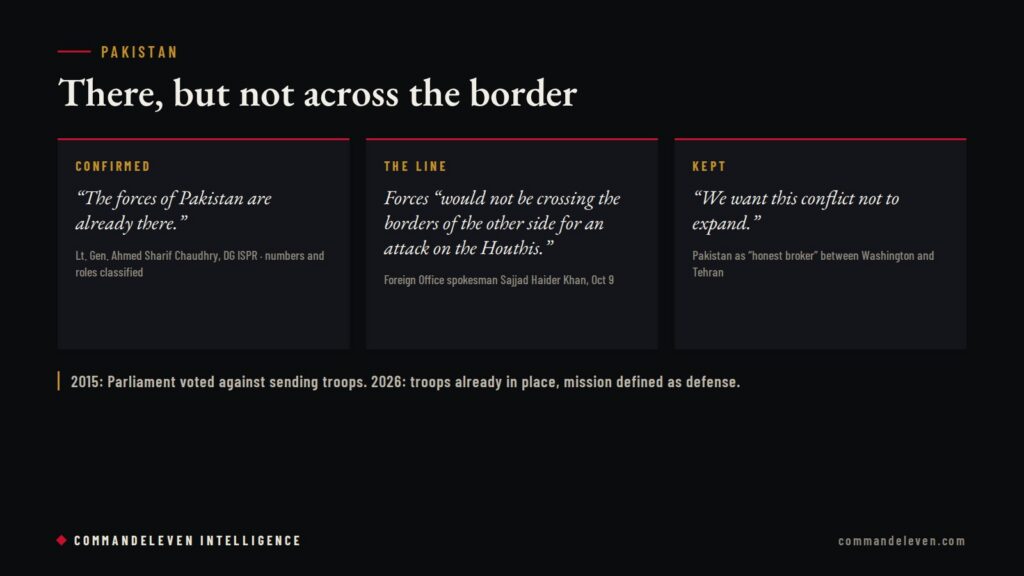
Pakistan’s two official statements in the past week drew the line Part 1 anticipated:
- What it confirmed. Lt. Gen. Ahmed Sharif Chaudhry, director general of Inter-Services Public Relations: “The forces of Pakistan are already there.” Numbers and capabilities are classified; the soldiers serve in “multiple capabilities and domains.” Pakistan’s commitment to Saudi security is “absolute.”
- Where it stopped. Foreign Office spokesman Sajjad Haider Khan: Pakistani personnel “would not be crossing the borders of the other side for an attack on the Houthis” and are acting “in the defense of the territory.”
- What it kept. The mediator role. Chaudhry described Pakistan as an “honest broker” between Washington and Tehran: “We want this conflict not to expand.”
This is the 2015 problem solved a different way. In 2015, Pakistan’s parliament voted against sending troops to fight the Houthis. In 2026, the troops are already there, the mission is defined as defense, and the question of crossing into Yemen has been answered publicly before anyone could ask Parliament to vote on it. [ASSESSED]
The risk Part 1 identified has not gone away: the more visible Pakistan’s role becomes, the more it becomes the pact member Iran has to weigh first, and the likeliest channels for Iranian pressure on Pakistan remain the Taliban-TTP and Baluch insurgent routes. [ASSESSED]
Washington’s Turn
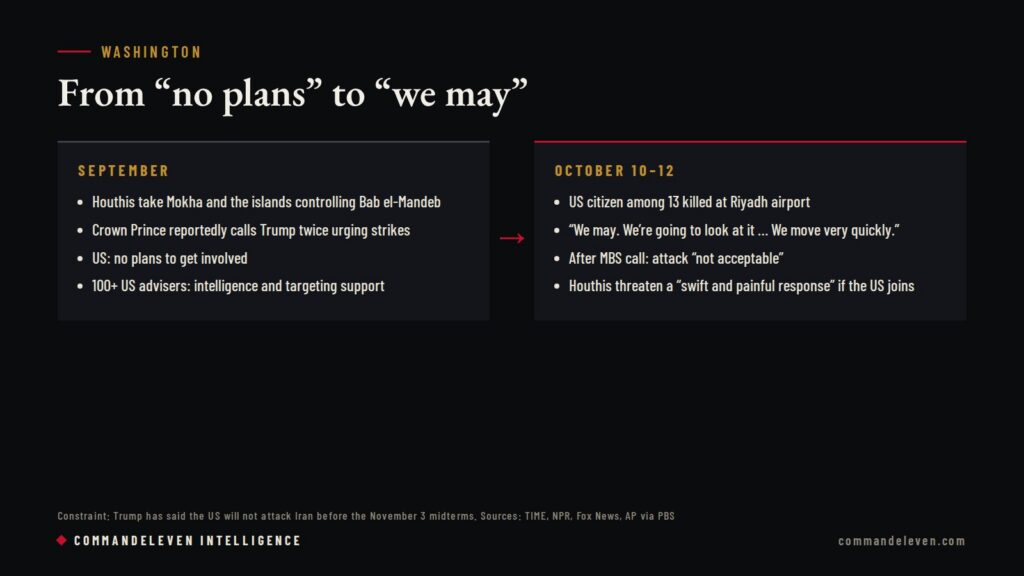
The US position has moved within a month:
- September. As the Houthis took Mokha and the islands controlling Bab el-Mandeb, Crown Prince Mohammed bin Salman reportedly called President Trump twice urging strikes. Washington said it had no plans to get involved. More than 100 US advisers were reported in the Kingdom providing intelligence and targeting support.
- October 10. After the deadliest strike, which killed a US citizen: “We may. We’re going to look at it. … We’ll make a decision. We move very quickly.”
- October 12. After speaking to the Crown Prince: the attack is “not acceptable”; the Houthis are “misbehaving very badly.” No strike decision announced.
Two constraints shape the decision. The US is already at war with Iran, and Trump has said he will not attack Iran before the November 3 midterms. Striking the Houthis is a way to act against Iran’s network without striking Iran itself, but it would also bring the “swift and painful response” the Houthis have promised, likely against US assets in the Red Sea and the Gulf. [ASSESSED]
Part 1 assessed that the US would stay out of direct operations in Yemen. That judgment is holding, but on a timescale of days rather than months. [ASSESSED]
Scoring Part 1: An Early Read
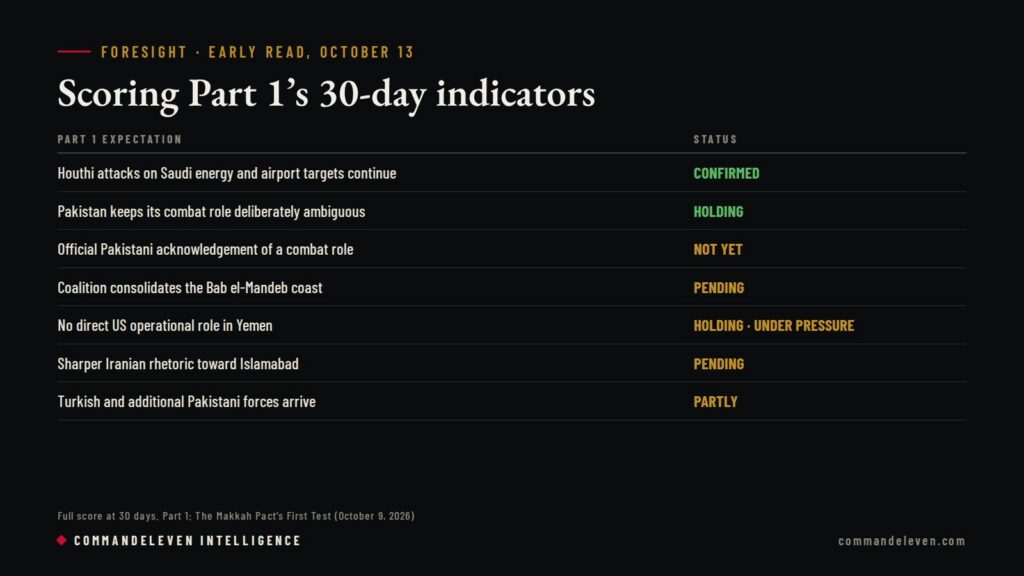
Part 1 set 30-, 90- and 180-day indicators. Four days after publication, here is where the 30-day set stands. These are interim marks; the full score comes at 30 days.
| Part 1 expectation | Status at October 13 |
|---|---|
| Houthi counter-attacks on Saudi energy and airport targets continue | Confirmed. Four days of airport strikes; energy sites declared targets. |
| Pakistan keeps its combat role deliberately ambiguous | Holding. Deployment confirmed; combat in Yemen explicitly ruled out. |
| Official Pakistani acknowledgement of a combat role | Not yet. Pakistan acknowledged presence, not combat. |
| Coalition consolidates the Bab el-Mandeb coast within 30 days | Pending. Mokha and Bab el-Mandeb claimed on Oct 5; not independently confirmed. |
| No direct US operational role in Yemen | Holding, under pressure. Trump says the US “may” join. |
| Sharper Iranian rhetoric toward Islamabad | Pending. Not yet observed in this window. |
| Turkish and additional Pakistani forces arrive | Partly. Pakistani forces confirmed in place; Turkish arrivals unconfirmed. |
Outlook and Indicators
Next 14 days:
- A US strike decision. Watch for US strikes on Houthi launch sites, and for Houthi attacks on US naval assets in response.
- Riyadh airport. Does it reopen on or after October 17, and do foreign carriers return?
- The energy target set. A successful strike on a major Saudi oil facility would mark the next escalation step the Houthis have already announced.
- The coast. Independent confirmation, or reversal, of the government’s Mokha and Bab el-Mandeb claims.
- Pakistan. Any statement or report of Pakistani air-defense units in action, and any TTP or Baluch attack timed to the Yemen campaign.
- Iran. Any IRGC statement naming Pakistan or the pact.
What This Dossier Does Not Claim
- It does not claim Pakistani forces have fought in Yemen or that they operate Saudi air-defense systems.
- It does not claim Iran ordered the airport strikes. The Houthis are Iran-backed; direct Iranian direction of this campaign has not been established.
- It does not treat the coalition’s battlefield figures as verified.
Frequently Asked Questions
What happened at Riyadh’s King Khalid International Airport?
Between October 6 and 12, 2026, Houthi missile and drone strikes hit the airport repeatedly. The deadliest, on October 10, killed 13 people and wounded about 300. The airport’s closure was extended through at least October 17.
Are Pakistani troops fighting the Houthis?
Pakistan has confirmed its forces are in Saudi Arabia under the Makkah Joint Defence Agreement, but says they are there to defend Saudi territory and will not cross into Yemen to attack the Houthis.
Will the United States strike the Houthis?
As of October 13, no decision had been announced. President Trump said the US “may” join Saudi strikes after the October 10 attack, and called the attacks “not acceptable” after speaking to the Saudi Crown Prince.
Why did Saudi air defenses fail?
Initial findings of a Saudi investigation, reported by regional officials, suggest drones were launched first to clear the way for cruise and ballistic missiles, and that defenses gave no early warning.
What is the Makkah Joint Defence Agreement?
A collective defense pact signed by Saudi Arabia, Pakistan and Türkiye on August 7, 2026, under which an attack on one member is treated as an attack on all.
Related CommandEleven Intelligence Coverage
- The Makkah Pact’s First Test: Operation Yemen Dawn, Pakistan’s Role, and Iran’s Shrinking Map – Part 1
- Iran War Doctrine & Strategy: A Six-Part CommandEleven Intelligence Series
- The GPS War: Documenting the Strait of Hormuz Spoofing Campaign
Sources
- October 2026 attacks on Saudi Arabia airports, Wikipedia (casualty compilation, cross-checked against AP, BBC and Al Jazeera reports cited there)
- Saudi Arabia intercepts three missiles as capital’s international airport remains closed after deadly Houthi attacks, CNN, October 10, 2026
- Pakistan confirms it has troops in Saudi as conflict with Yemen’s Houthi rebels escalates, CNN, October 7, 2026
- Pakistan has substantial forces deployed in Saudi Arabia: foreign ministry, Arab News, October 9, 2026
- Saudis probe how defense systems failed to stop deadly Houthi attack on Riyadh airport, PBS NewsHour (AP), October 12, 2026
- Trump Says U.S. May Join Saudi Strikes on Houthis After Riyadh Airport Attacks, TIME, October 10, 2026
- Trump weighs joining the fight against Houthis after Riyadh airport attack, NPR, October 10, 2026
- Trump denounces Houthi attacks after Saudi crown prince call, Fox News live coverage, October 12, 2026
- Yemeni govt forces recapture Red Sea port of Mokha, Bab el-Mandeb Strait from Houthis, The Express Tribune (Reuters, Anadolu), October 5, 2026
- 2026 Yemen offensives, Wikipedia (background, July–September 2026)

