Updated November 13, 2026. Related: Iran’s Underground Missile City, on the IRGC Aerospace Force’s new underground missile facility and what it does and does not show about Iran’s production resilience.
Why This Series, Why Now
Within hours of the February 28, 2026 opening strikes of the current US-Israel-Iran war, Iran’s Supreme Leader and multiple senior military commanders were dead. By the logic that has governed most post-2003 regional-conflict analysis, that kind of decapitation strike should open a window for rapid regime collapse. Six months later, it hasn’t happened – and understanding why requires more than tracking daily strikes and casualty counts. It requires understanding a doctrine.
Iran’s entire military posture is built on a deliberate strategic choice made decades ago: rather than attempt to match U.S. or Israeli conventional capability directly, Iran structured its doctrine around asymmetric cost-imposition – disproportionately cheap, deniable, decentralized means designed to make direct confrontation prohibitively expensive for a technologically superior adversary, and to outlast that adversary’s political will rather than defeat it militarily. This series exists because that doctrine, tested in real time by the current war, explains far more about what has and hasn’t happened over the past six months than conventional order-of-battle analysis can.
CommandEleven Intelligence already maintains an earlier doctrinal series examining these concepts conceptually. This series is different by design: every chapter here is built on dated, confidence-tiered, sourced evidence from the war as it has actually unfolded, not theoretical doctrine alone – the evidentiary companion to, not a replacement for, that earlier work, with explicit cross-links to it throughout.
What This Series Covers
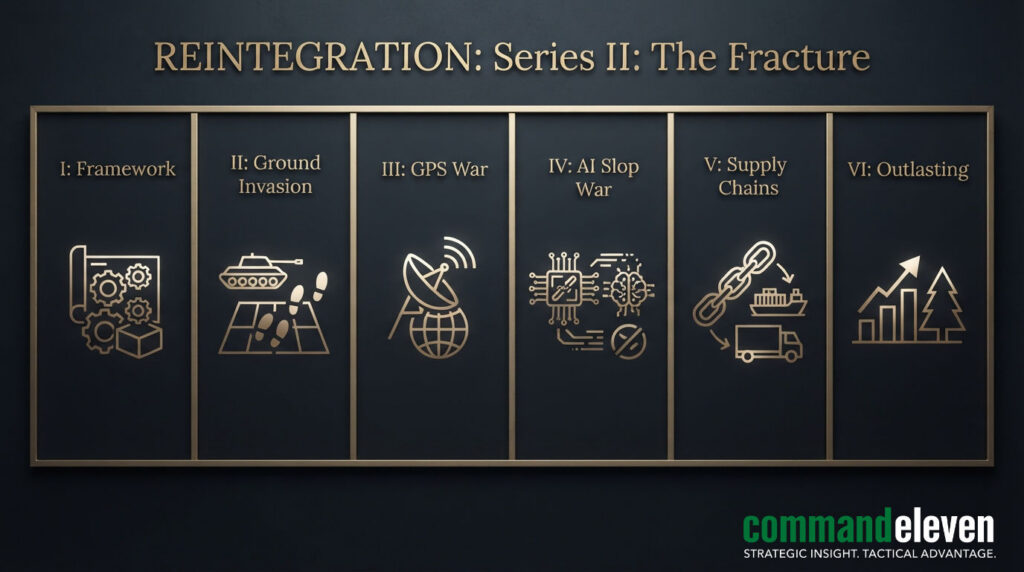
- Part I: Symmetric vs. Asymmetric Warfare – the framework itself: why Iran chose asymmetric doctrine, its four founding pillars, and Operation Epic Fury as mosaic defense’s real-world decapitation-survival test
- Part II: Ground Invasion Risk Assessment – why, six months into the war and despite full air superiority, no ground invasion has been attempted – and what a real limited-objective ground scenario would actually look like
- Part III: The GPS War – the confirmed, dated record of the Strait of Hormuz GPS spoofing campaign: over 1,100 vessels affected within 24 hours, and fifteen years of Iranian investment paying off exactly as designed
- Part IV: The AI Slop War – a fact-checked accounting of Iran’s AI-native disinformation campaign, from fabricated battlefield victories to the “liar’s dividend” weaponization of real footage
- Part V: Sanctions vs. Shadow Supply Chains – the named entities and dated enforcement actions behind Iran’s drone and missile procurement network, and why a decentralized “manufacturing plain” of Chinese micro-suppliers keeps surviving sanctions rounds built to hunt larger targets
- Part VI: Outlasting the Box – six months of accumulated evidence testing Iran’s doctrine of resistance against reality: real cost inflicted on the coalition, a failed regime-change bet, and what “winning” means under a strategy built on endurance rather than victory
A Note on Method
Every claim across this series is confidence-tiered – CONFIRMED, ASSESSED, or explicitly excluded where sourcing does not meet either bar. Several chapters in this series cover ground CommandEleven Intelligence’s existing doctrinal series has already mapped conceptually; where that overlap exists, this series says so explicitly and cross-links to that earlier work rather than silently duplicating it. This series does not predict the war’s outcome or timeline – its evidence supports description of a doctrine and its six-month performance record, not a forecast of how or when this war ends.
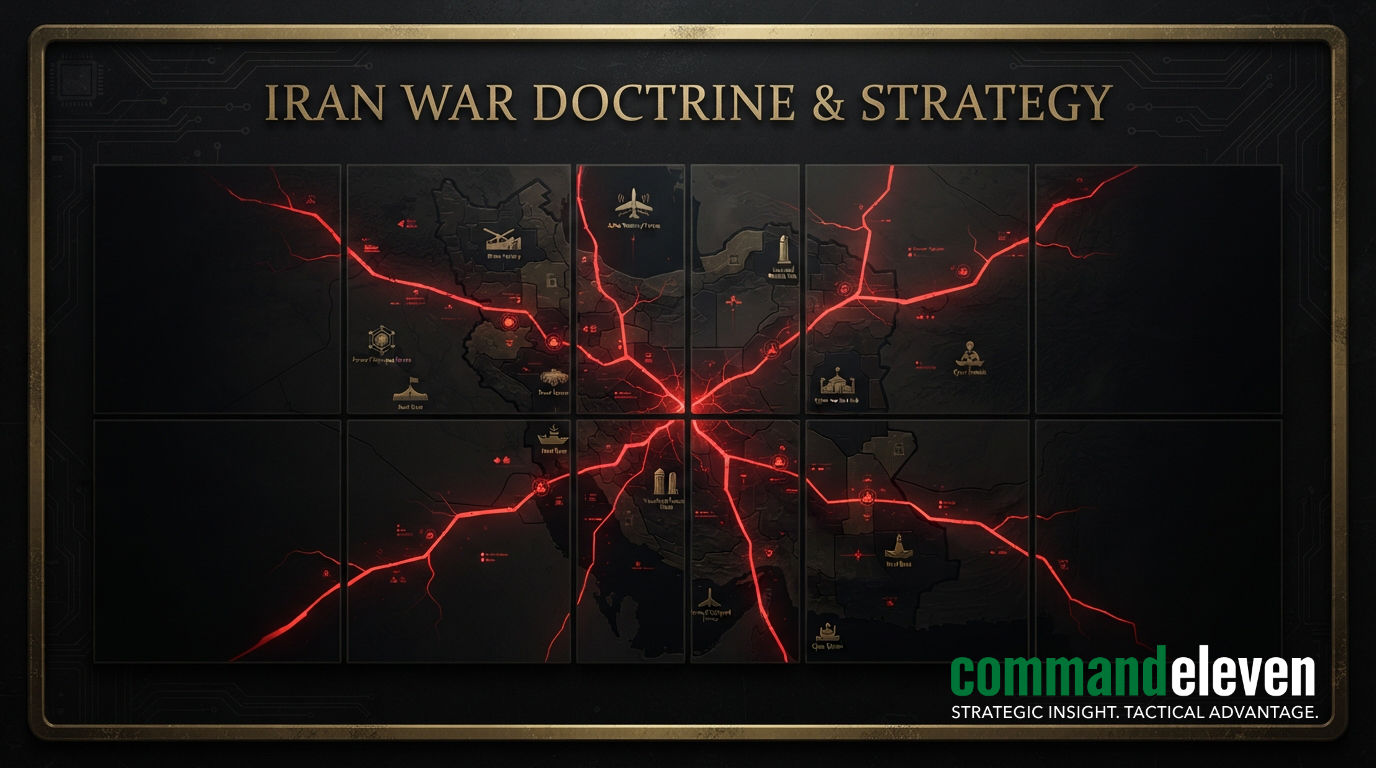
THE IRAN WAR DOCTRINE & STRATEGY
- Part I: Symmetric vs. Asymmetric Warfare – The Framework Behind Iran’s Strategy
- Part II: Ground Invasion Risk Assessment – Six Months Without One
- Part III: The GPS War – Documenting the Strait of Hormuz Spoofing Campaign
- Part IV: The AI Slop War – Fact-Checking Iran’s Disinformation Campaign
- Part V: Sanctions vs. Shadow Supply Chains – The Evidence Trail
- Part VI: Outlasting the Box – Six Months of War-of-Exhaustion Evidence