This dossier is the evidence-based companion to CommandEleven Intelligence’s earlier doctrinal piece, The Logistics of Resilience: Iran’s Shadow Supply Chain – where that piece maps the conceptual logistics architecture, this dossier documents the named entities, dated sanctions actions, and specific enforcement cases making up that architecture in practice.
Key Judgments
- [CONFIRMED] – On February 25, 2026, the US Treasury’s Office of Foreign Assets Control designated more than 30 individuals, entities, and vessels in a single action explicitly targeting what OFAC characterized as a “closed loop”: shadow fleet oil exports generate revenue, which procurement networks convert directly into weapons capability, including financial intermediaries supporting Shahed-series UAV engine production and procurement of missile propellant precursors such as sodium perchlorate.
- [CONFIRMED] – China is the dominant source of critical components sustaining Iran’s drone and missile programs, per Atlantic Council analysis – supplying electronics, engines, navigation components, batteries, and semiconductors for the Shahed series specifically, alongside broader transfers of drones, anti-ship cruise missiles, and surface-to-air missile components.
- [CONFIRMED] – Jamestown Foundation analysis characterizes China’s role not as a small number of large, sanctionable defense contractors but as a “manufacturing plain” – a flat landscape of interchangeable micro-enterprises, each individually targetable but collectively inexhaustible, with minimal staffing and nominal business registrations unrelated to aviation, deliberately structured to survive sanctions enforcement through sheer decentralized redundancy.
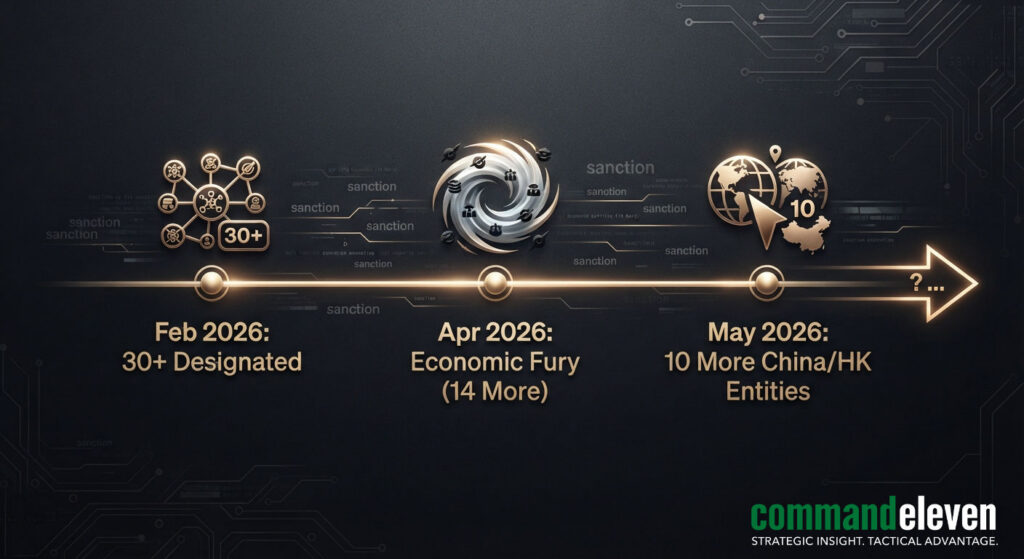
- [CONFIRMED] – US Treasury and State Department sanctions actions against this procurement architecture have escalated in frequency throughout 2026 without eliminating the underlying network: a February 25 action, an April 21 “Economic Fury” campaign designation of 14 individuals/entities/aircraft across Iran, Turkey, and the UAE, and a May 8 action against ten further entities largely based in mainland China and Hong Kong – each round explicitly acknowledging, in Treasury’s own public statements, that Iran “continues to try to find new ways to procure the key components it needs” through new front companies.
- [ASSESSED] – CommandEleven Intelligence assesses the shadow supply chain functions as the industrial-base expression of the same asymmetric doctrine examined throughout this series – a decentralized, individually low-cost, collectively resilient network structurally analogous to the mosaic command structure examined in Part I, applied to procurement rather than military command, and exhibiting the same characteristic this series has identified across every domain examined: hard to eliminate through conventional sanctions enforcement precisely because no single node is significant enough on its own to justify the campaign that would be required to find and close it.
The Closed Loop
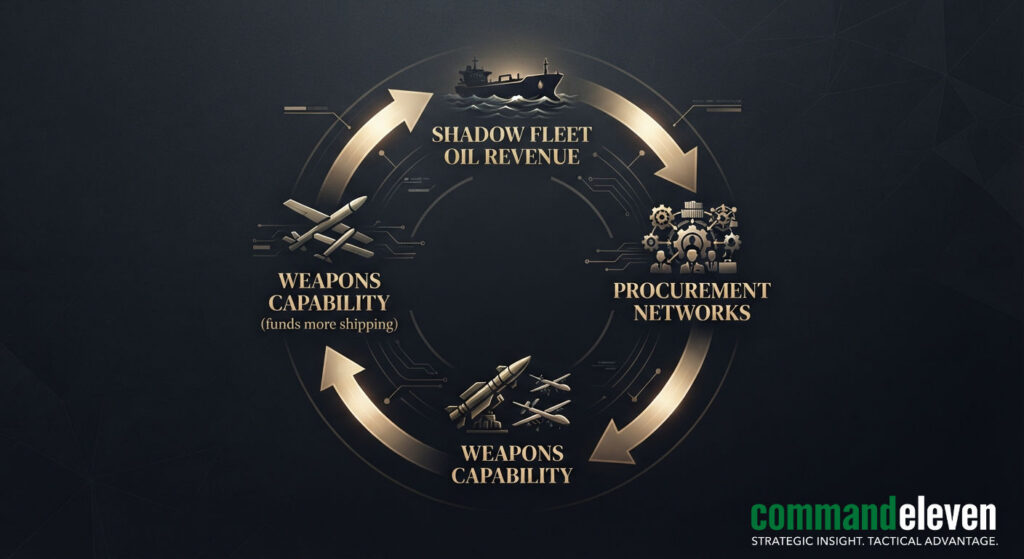
Treasury’s February 25, 2026 designation action is notable less for its scale – over 30 individuals, entities, and vessels – than for the explicit architecture it describes. OFAC characterized the target as two interconnected pillars operating as a single system: maritime oil transport networks (the shadow fleet examined in this series’ companion Ukraine-Russia sanctions dossier, though operating here in an Iran-specific context) generating revenue, and procurement channels converting that revenue directly into military capability. This is not two separate sanctions problems but one integrated financial-industrial system, and Treasury’s own framing treats it as such: designated vessels flagged in Panama, Barbados, Comoros, Palau, Vanuatu, and Iran itself sustain an oil export stream that directly funds financial intermediaries supporting Shahed-series drone engine production and procurement of sodium perchlorate, a key missile propellant precursor. Windward’s tracking separately identified roughly 100 LPG carriers now actively engaged in Iranian trades – evidence the sanctions-evasion maritime footprint has expanded beyond traditional crude oil tankers into additional petroleum product categories.
China’s Manufacturing Plain
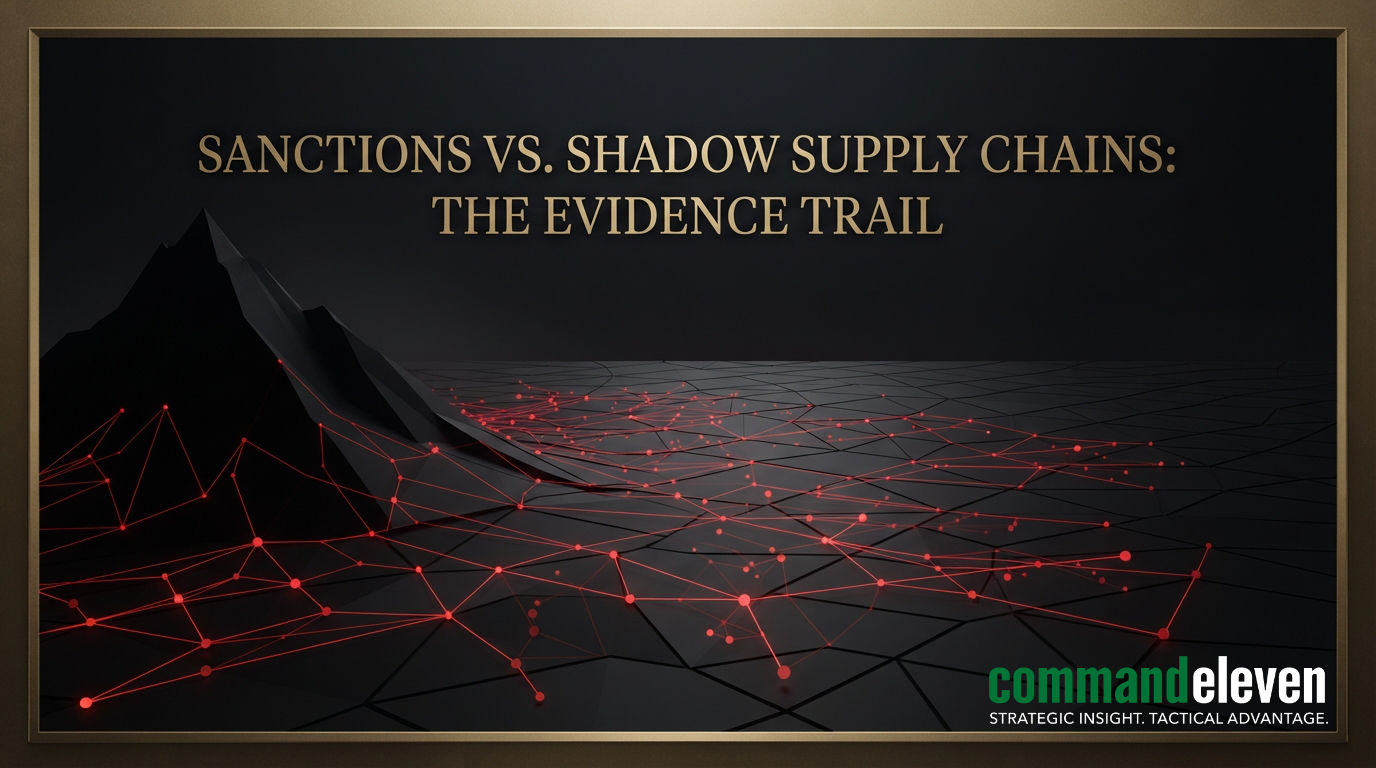
The more analytically significant finding in this dossier’s sourcing concerns not which country supplies Iran’s critical components – China’s role is well documented and largely uncontested across the sourcing reviewed – but the structural form that supply takes. Jamestown Foundation’s analysis draws a distinction between a “mountain peak” model, in which sanctions target a small number of large, identifiable defense contractors, and the “manufacturing plain” model Jamestown assesses China’s role in Iran’s drone supply chain actually follows: a flat landscape of interchangeable micro-enterprises, individually targetable and individually insignificant, but collectively inexhaustible. These firms typically carry minimal staffing and nominal business registrations bearing no apparent relationship to aviation or weapons manufacturing, channeling drone-applicable materiel to sanctioned end-users through private capital acquisition, reverse engineering of dual-use components, and systematic exploitation of ambiguity in dual-use trade classifications.
Strider Technologies’ investigative reporting, relayed by the Daily Telegraph, uses a specific term for this approach – “decentralized procurement” – and notes the network continually restructures itself, using increasingly complex transit paths specifically to stay ahead of sanctions enforcement rather than simply hoping to avoid detection through obscurity.
The Axis of Evasion
Atlantic Council analysis frames this cooperation using a term this dossier finds analytically useful: the “Axis of Evasion” – China and Russia jointly sustaining Iran’s supply chains through trade conducted substantially outside the Western financial system, and therefore substantially outside the reach of Western sanctions and export-control enforcement mechanisms. This cooperation extends beyond simple component trading into technology transfer that improves partner capability directly – a pattern this series’ companion Project C430L dossier documented in the specific case of Russian ramjet propulsion assistance to Iran’s missile program, itself reportedly compensation for Iran’s earlier Shahed drone supply to Russia’s war effort in Ukraine.
- [ASSESSED] – CommandEleven Intelligence assesses the shadow supply chain examined in this dossier and the C430L cooperation examined previously are not separate phenomena but two expressions of the same underlying Axis of Evasion architecture – one focused on component-level procurement resilience, the other on advanced technology transfer, both operating through the same sanctions-resistant, extra-Western-financial-system logic.
Case Studies in Persistence
Two specific cases illustrate both the network’s sophistication and its persistence despite sustained enforcement pressure. The May 2026 action targeted front companies tied to the US-designated Iranian company Pishtazan Kavosh Gostar Boshra (PKGB) and its subsidiary Narin Sepehr Mobin Isatis (NSMI), which Treasury identified as “key suppliers” for Iran’s UAV and ballistic missile programs – a structure of a designated parent entity spawning new subsidiary fronts specifically to continue operations after the parent’s designation. Treasury Secretary Scott Bessent’s own public statement accompanying that action acknowledged the pattern directly: “Iran continues to try to find new ways to procure the key components it needs to bolster its UAV weapons program through new front companies and third-country suppliers.” An earlier but illustrative precedent – the December 2023 indictment of Hossein Hatefi Ardakani, an Iran-based procurement network leader charged with conspiring to illegally export US-made microelectronics to Iran through a Chinese national co-conspirator – demonstrates this pattern of individual-level prosecution has been a persistent enforcement tool for years without eliminating the broader network the individual case represents.
Assessment: The Industrial Mosaic
- [ASSESSED] – Read against this series’ Part I, the shadow supply chain examined here is best understood as the industrial-base counterpart to the mosaic command structure examined there. Both share the same core design logic: decentralization specifically calibrated to survive the loss of any individual node, whether that node is a provincial IRGC command or a single front company in Hong Kong. Just as mosaic defense was built to allow Iran’s military command to survive decapitation, the manufacturing-plain procurement architecture examined in this dossier was built – deliberately, per Jamestown’s analysis – to allow Iran’s weapons production base to survive the loss of any individual supplier, shipping route, or front company. This dossier assesses that recurring structural pattern, now documented across command (Part I), electronic warfare (Part III), information operations (Part IV), and industrial procurement (this part), constitutes the clearest evidence yet in this series that Iran’s asymmetric doctrine is a single coherent design philosophy applied consistently across every domain of the war, rather than a set of independently improvised adaptations.
Series Continuity
Part VI of this series turns to strategic depth and asymmetric attrition – examining how Iran’s geography and population scale function as a deliberate temporal weapon, trading space and time for adversary exhaustion in a manner this series’ preceding parts have each touched on but not yet examined as their own distinct doctrinal dimension.
Sourcing Base (Confidence-Tiered, with Links)
CONFIRMED – Primary/Official Record:
- Windward, “US Treasury Expands Pressure on Iran’s Shadow Fleet and Weapons Procurement Networks” (Feb. 25, 2026 OFAC action, closed-loop framing, LPG carrier figure)
- US Department of State, “Sanctions to Disrupt Iran’s Weapons Procurement Networks and Shadow Fleet,” Feb. 25, 2026
- Herbert Smith Freehills Kramer, “OFAC Expands Economic Fury Sanctions Targeting Iranian Missile and UAV Procurement Networks,” April 27, 2026
- Kharon, “Treasury Department sanctions Iran drone network, shows risks of a single address” (PKGB/NSMI case, Bessent statement)
- Al Jazeera, “US sanctions network accused of supplying Iran’s drone production” (Ardakani indictment detail)
ASSESSED – Credible Secondary/Analytical Reporting:
- Jamestown Foundation, “PRC Supply Chain Ecosystem Behind Iran’s Drone Campaign” (“manufacturing plain” vs. “mountain peak” framework)
- Atlantic Council, “From drones to rocket fuel, China and Russia are helping Iran through supply chains” (“Axis of Evasion” framing)
- Vision Times, “China, Hong Kong Firms Allegedly Help Iran Evade Sanctions for Drones” (Strider Technologies “decentralized procurement” reporting)
- Alexa.ng, “United States Treasury Cripples Iranian Weapon Procurement Networks” (May 8, 2026 action detail)
Excluded from this dossier: Specific named front-company addresses or transshipment routing details beyond what is necessary to establish the network’s structural pattern. This dossier treats granular operational detail of this kind as more useful to those seeking to replicate evasion than to readers seeking to understand the strategic picture.
THE IRAN WAR DOCTRINE & STRATEGY
- Part I: Symmetric vs. Asymmetric Warfare – The Framework Behind Iran’s Strategy
- Part II: Ground Invasion Risk Assessment – Six Months Without One
- Part III: The GPS War – Documenting the Strait of Hormuz Spoofing Campaign
- Part IV: The AI Slop War – Fact-Checking Iran’s Disinformation Campaign
- Part V: Sanctions vs. Shadow Supply Chains – The Evidence Trail
- Part VI: Outlasting the Box – Six Months of War-of-Exhaustion Evidence