
Key Judgments
- [CONFIRMED] – Iran’s warfighting doctrine is built explicitly around asymmetric warfare – using disproportionately low-cost means (drones, ballistic missiles, proxy forces, decentralized command) to impose disproportionately high costs on technologically superior adversaries – rather than attempting to match US or Israeli conventional military capability directly. This is a deliberate strategic choice traceable to specific institutional architects and a specific historical trauma, not an improvised response to weakness.
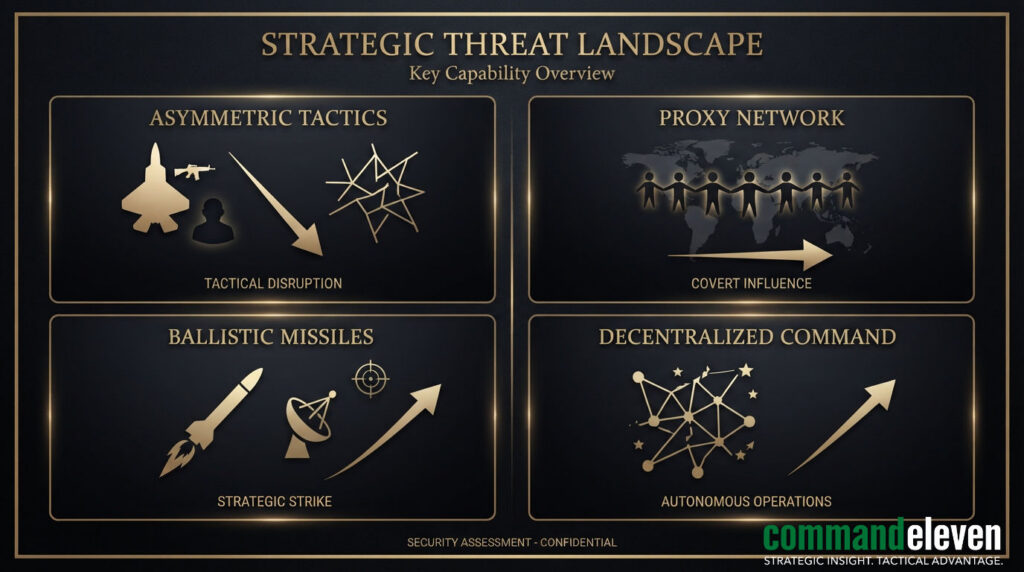
- [CONFIRMED] – Iran’s asymmetric doctrine rests on four documented pillars: asymmetric/unconventional tactics generally, an extensive regional proxy network, heavy reliance on ballistic missiles, and – since 2005 – a decentralized command structure known as Mosaic Defense (also rendered “decentralized mosaic defense” or DMD), developed under IRGC Commander-in-Chief Mohammad Ali Jafari with ideological architecture from Hassan Abbasi of the IRGC’s Center for Borderless Security Doctrinal Analysis.
- [CONFIRMED] – Iran’s own Foreign Minister, Abbas Araghchi, has publicly invoked the mosaic defense concept during the current war, stating Iran studied US warfighting patterns for two decades and asserting Iran – not its adversaries – retains the ability to choose how and when the conflict ends. CommandEleven Intelligence treats this as a deliberate strategic communication act aimed simultaneously at a domestic audience and at Washington, Jerusalem, and Brussels, not merely a descriptive statement of military fact.
- [CONFIRMED] – The February 28, 2026 opening strikes of Operation Epic Fury/Roaring Lion – which killed Supreme Leader Ali Khamenei and multiple senior military commanders within hours – represented exactly the decapitation scenario mosaic defense was designed to survive. Provincial IRGC commands functioning under pre-delegated authority after that decapitation is, per multiple defense analysts cited in this dossier, the clearest real-world validation this doctrine has received since its 2005 conception.
- [ASSESSED] – CommandEleven Intelligence assesses that understanding this asymmetric framework is a precondition for the rest of this series – ground invasion risk, EW/RF spectrum contention, the shadow supply chain, distributed manufacturing, and strategic depth all function as specific tactical expressions of the same underlying doctrinal logic introduced here, not as independent phenomena.
Two Frameworks, One Choice
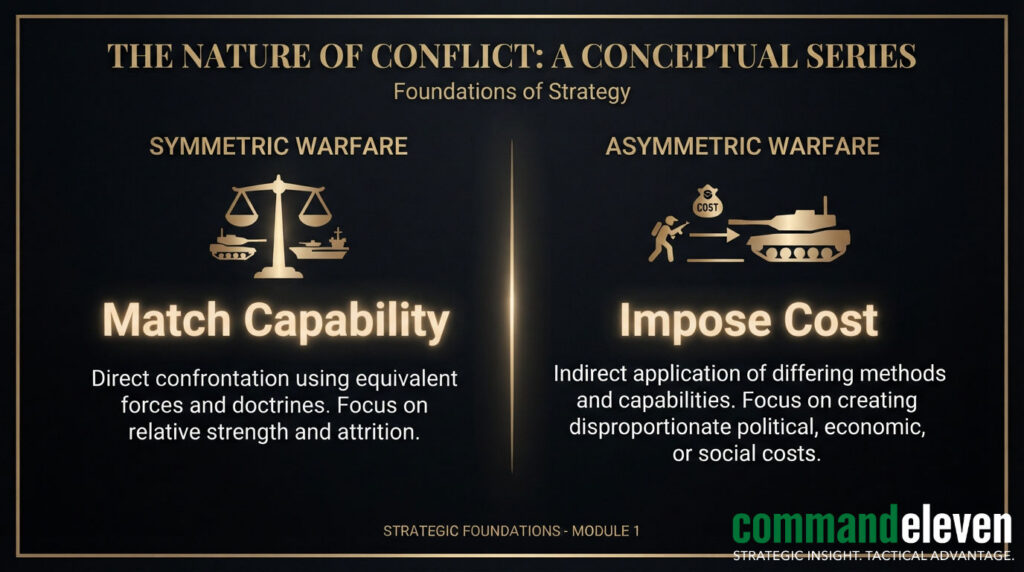
Symmetric warfare assumes rough parity between combatants – comparable technology, comparable force structures, victory determined largely by scale, training, and material advantage. Asymmetric warfare abandons that assumption deliberately: a weaker party accepts it cannot win a symmetric contest and instead structures its entire military posture around imposing cost, absorbing shock, and prolonging conflict rather than achieving decisive battlefield victory in the conventional sense. Iran’s doctrine is unambiguously the latter, and has been for decades – this is not new to the current war, but the current war is its most severe test.
Former US Deputy Special Representative for Iran, Matthew McInnis, traces the doctrine’s roots to two specific historical experiences: the 1980-1988 Iran-Iraq War, in which Iraqi ballistic missile strikes on Iranian cities entrenched missiles as a core Iranian capability rather than merely one weapon among many, and the Islamic Republic’s founding imperative to export and protect the revolution through proxy forces like Hezbollah rather than direct conventional confrontation. Those two experiences, combined with a persistent and accurate Iranian assessment of its own conventional inferiority relative to the US and Israel, produced a doctrine built around four reinforcing pillars: broad asymmetric/unconventional tactics, the regional proxy network, ballistic missiles as a strategic (not merely tactical) capability, and – the newest and most structurally significant pillar – decentralized command.
Mosaic Defense: The Architecture, Briefly
Mosaic Defense was developed starting in 2005 and organizationally implemented from June 2008, when Jafari – a civil engineer and Iran-Iraq War veteran who commanded the IRGC from 2007 to 2019 – launched the most extensive IRGC restructuring since 1985. Its ideological framing came from Hassan Abbasi, whose IRGC-affiliated center focused specifically on doctrines of asymmetric and prolonged warfare. The doctrine’s operational unit is the province: each of Iran’s 31 provinces maintains its own IRGC headquarters, intelligence apparatus, weapons stockpile, and command-and-control chain, explicitly designed – per Washington Institute analyst Farzin Nadimi – so that a province cut off from Tehran can continue functioning as a cohesive military force rather than collapsing.
This dossier does not attempt a full operational examination of mosaic defense – CommandEleven Intelligence’s existing dossier, “Iran’s Mosaic Defense: Asymmetric Warfare and Internal Security,” covers that doctrine’s internal-security dimension and operational specifics in depth, and readers seeking that level of detail should treat this section as a framework summary rather than a substitute for that piece.
The Test: Operation Epic Fury and Decapitation Survival
What makes mosaic defense analytically significant right now, rather than merely historically interesting, is that the current war has subjected it to precisely the test it was designed for. The February 28, 2026 opening strikes killed Khamenei and senior military leadership within hours – a decapitation strike of the kind post-2003 Iraq analysis suggested could trigger rapid regime collapse absent a resilient command structure. Instead, per multiple sources reviewed for this dossier, provincial IRGC commands have continued functioning under pre-delegated authority, exactly the scenario mosaic defense’s provincial architecture was built to survive. This dossier treats that continued functioning as the clearest real-world evidentiary test this doctrine has received since its 2008 implementation – while noting, per CENTCOM’s reported destruction of 17 Iranian naval vessels during the war’s opening phase, that decentralized swarm tactics have shown real vulnerability to concentrated precision strikes before dispersal can occur, a limitation this dossier’s later chapters on naval and EW/RF dynamics will examine further.
Strategic Communication as a Weapon
Araghchi’s public invocation of mosaic defense – asserting Iran studied two decades of US warfighting patterns and retains control over how and when this conflict ends – should be read as an act of strategic communication in its own right, not merely a factual military claim.
- [ASSESSED] – CommandEleven Intelligence assesses this messaging serves two simultaneous audiences: domestically, it projects resilience to a population that has just witnessed the killing of its Supreme Leader, signaling the state is too dispersed and layered to be shattered by leadership losses; internationally, it functions as a deterrent signal to Washington, Jerusalem, and European capitals that Iran’s warfighting capacity is not a single pillar that can be toppled by any single strike, however consequential. This dual-audience messaging pattern – doctrine as much rhetoric as reality – is a recurring feature this series will track across subsequent chapters, particularly those examining information warfare and strategic depth.
Series Roadmap
This framework – asymmetric doctrine built on four pillars, tested in real time by decapitation, and actively communicated as deterrence – underlies every subsequent chapter in this series: ground invasion risk assessment (which asymmetric defense specifically shapes), EW/RF spectrum contention (a tactical extension of the swarm-and-disperse logic examined here), the shadow supply chain and distributed manufacturing (asymmetric doctrine’s industrial-base analog), and strategic depth/asymmetric attrition (this framework’s temporal dimension – trading space and time for adversary exhaustion). Readers should treat this dossier as the conceptual key to the chapters that follow rather than a standalone analysis.
Sourcing Base (Confidence-Tiered, with Links)
CONFIRMED – Primary/Official & Direct Analytical Sourcing:
- The Soufan Center, IntelBrief, March 9, 2026 (four-pillar doctrine framework, McInnis analysis, Iran-Iraq War origins)
- Jerusalem Institute for Strategy and Security, “Iran’s Mosaic Defense Faces Its Real Test,” April 26, 2026 (Jafari/Abbasi architect detail, 2008 restructuring, Caspian Sea naval dispersal, CENTCOM 17-vessel destruction figure)
- Gulf News, “Mosaic defence doctrine: Iran studied US wars for 20 years, says Abbas Araghchi – what it means” (Araghchi’s direct statements)
- Small Wars Journal, “Mosaic Defense and Dispersed Command: Iran Strikes Back,” May 21, 2026 (strategic depth/geography, insurgent-style defense-in-depth)
- CommandEleven Intelligence, “Iran’s Mosaic Defense: Asymmetric Warfare and Internal Security” (companion piece, operational/internal-security depth)
- Wikipedia, “Mosaic defence strategy” (origin dating, general reference)
ASSESSED – Credible Secondary/Academic Sourcing:
- Modern Diplomacy, “War Without a Center: Iran’s Mosaic Defense,” June 2, 2026 (cost-imposition logic, center-of-gravity doctrine contrast)
- ResearchGate, “Iran’s Mosaic Defence: A New Doctrine in Evolving Warfare” (Nadimi provincial-structure quote, “kill web” framing)
- NATO Deep Portal eAcademy, Episode 61 with Mahmut Cengiz (horizontal escalation via proxy timing, cost-imposition strategy)
Excluded from this dossier: Detailed operational specifics of provincial IRGC command structure, weapons stockpile locations, or internal-security applications of mosaic defense. That material is covered in CommandEleven Intelligence’s existing companion dossier and is not duplicated here.
THE IRAN WAR DOCTRINE & STRATEGY
- Part I: Symmetric vs. Asymmetric Warfare – The Framework Behind Iran’s Strategy
- Part II: Ground Invasion Risk Assessment – Six Months Without One
- Part III: The GPS War – Documenting the Strait of Hormuz Spoofing Campaign
- Part IV: The AI Slop War – Fact-Checking Iran’s Disinformation Campaign
- Part V: Sanctions vs. Shadow Supply Chains – The Evidence Trail
- Part VI: Outlasting the Box – Six Months of War-of-Exhaustion Evidence

