Why We Publish These
CommandEleven Intelligence’s analysis is valued for what it gets right before the fact. That claim only means something if we also show what we got wrong. Each Foresight Audit sets our published calls against the public record and scores them, misses included.
This audit covers three CommandEleven Intelligence pieces on China’s role in the 2026 Iran war:
- China’s 2026 Iran Strategy: Munition Attrition Analysis (30 March 2026)
- US-Iran War 2026: Strategy, Attrition & Exit Architectures (15 April 2026)
- Iran Sanctions 2026: Trump’s Toolkit vs. China’s Defiance (21 August 2026)
It checks them against what emerged through 29 September, including the Wall Street Journal’s 24 September report on Chinese shipments to Iran.
Scoring scale
- [CONFIRMED] – Later evidence from a government action, official records or multiple credible outlets supports the call
- [PARTIALLY CONFIRMED] – The core of the call holds, but a specific detail is unverified or overstated
- [NOT YET RESOLVED] – No public evidence either way yet, or the call’s timeframe hasn’t arrived
- [NOT BORNE OUT] – The evidence so far runs against the call
We also separate forecasts, meaning claims about what would happen, from contemporaneous assessments, meaning claims about what was happening at the time of writing. Forecasts are the harder test, and we weight them accordingly.
Scorecard
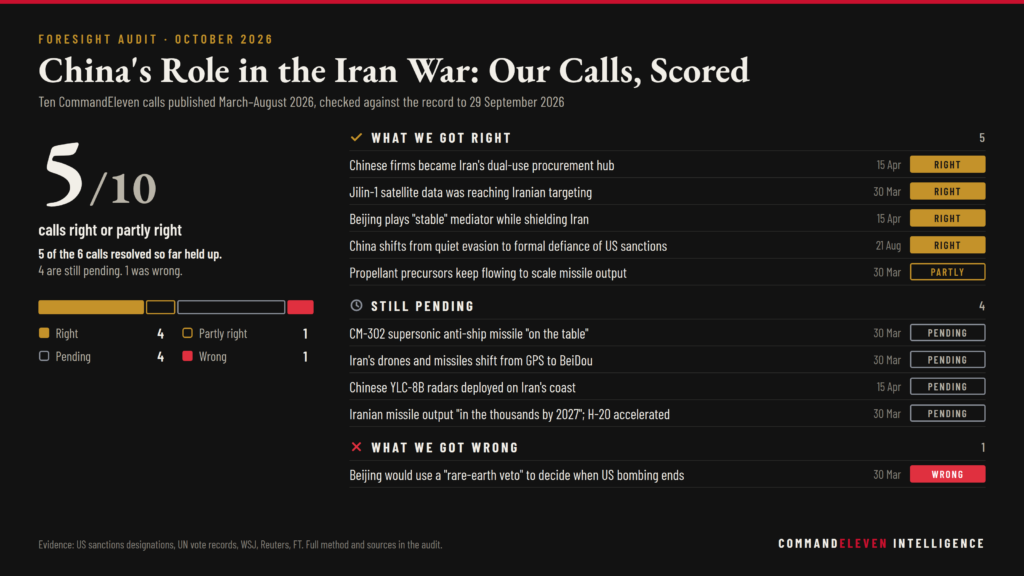
Result – of the 10 calls, 4 confirmed, 1 partially confirmed, 4 not yet resolved and 1 not borne out. The strongest calls were the two that named a mechanism months before official confirmation (calls 1 and 2). The weakest was the boldest: that Beijing could end the US bombing campaign by cutting off minerals (call 9).
The Calls in Detail
The dual-use procurement pipeline: CONFIRMED
- What we wrote (15 April) – “Beijing served as the IRGC’s primary procurement hub. By facilitating the ‘dual-use’ pipeline, Chinese firms provided the 120-day stockpile of micro-electronics and navigation systems required for the mass production of the FPV swarms.”
- What happened – On 24 September, the WSJ reported Iranian customs records showing about 1,300 shipments from Chinese entities to Iran’s Defense Ministry in the first half of 2026. They included GPS devices, electric motors, aircraft-engine parts and other dual-use electronics, some known to be used in Shahed drones. Many were declared under Iran’s defence-import tariff exemption.
- Lead time – about five months.
- Caveat – the “120-day stockpile” figure has not been independently confirmed. We credit the mechanism, not the number.
Satellite data into Iranian targeting: CONFIRMED
What we wrote (30 March) – “With over 120 satellites in the Jilin-1 constellation, Beijing is feeding Tehran real-time video of U.S. troop movements.”
What happened –
- [9 May] – the State Department sanctioned Chang Guang Satellite Technology, the operator of the Jilin-1 constellation, alleging it collected data on US and allied forces at Tehran’s request. Two other Chinese imagery firms were sanctioned with it.
- [12 September] – US officials told the WSJ that Iran used Chinese-sourced imagery before the 17 July strike on Muwaffaq Salti Air Base, which killed three US service members.
Lead time – about six weeks to official US action.
Caveat – “real-time video” was more specific than anything since confirmed. US officials have also not claimed direct Chinese government involvement. Our framing of “Beijing” feeding Tehran ran ahead of the evidence on state direction. We credit the substance (Chinese satellite data reaching Iranian targeting) and flag the attribution.
Propellant precursors and missile scale-up: PARTIALLY CONFIRMED
What we wrote (30 March) – “By shipping specialized carbon fiber and chemical precursors like sodium perchlorate, Beijing is helping the IRGC scale…”
What happened –
- The WSJ’s September reporting tied a sanctioned Chinese firm, Haokun Energy, to export licensing for sodium perchlorate.
- It also reported about 300 tonnes of chemical compounds delivered days before the war began.
Why only partial –
- The sodium perchlorate shipments on IRISL’s Shabdis and Barzin had already been publicly reported on 9 March, three weeks before our piece. That part was not a lead.
- Carbon fibre going to Iran specifically has not been documented. Our later Alabuga dossier documents Chinese carbon fibre going to Russia’s drone production, not Iran’s.
Mediator and shield: CONFIRMED (assessment held)
What we wrote (15 April) – “Beijing is positioning itself as the ‘stable’ alternative mediator, exploiting the US’s perception as the aggressor.”
What happened –
- On 17 September, China and Russia vetoed the extension of the UN panel monitoring sanctions on Iran.
- At Xi’s state visit to Washington in the final week of September, Xi backed a return to the interim agreement, and no breakthrough on Iran was reported.
The dual role we described, mediator in public and supplier in private, held through the summer.
From evasion to defiance: CONFIRMED (assessment held)
- What we wrote (21 August) – China’s invocation of its Blocking Statute in May 2026 “marks a break from the tacit-evasion pattern.”
- What happened – Responding to the WSJ report, Beijing again called US sanctions unilateral and illegal and said it does not consider itself bound by them. The UN veto followed. Beijing has kept to the position we described.
CM-302 anti-ship missile: NOT YET RESOLVED
- What we wrote (30 March) – “the CM-302 supersonic cruise missile is on the table.”
- Status – On 29 July, Reuters reported that Iran was pursuing Chinese anti-ship cruise missiles, with completion unclear. That is consistent with “on the table”, but no delivery has been documented.
GPS to BeiDou: NOT YET RESOLVED
- What we wrote (30 March) – “Iran has ditched GPS for China’s Beidou system, making their drones and missiles virtually interference-proof.”
- Status – Widely discussed but not officially confirmed. Our own 1 September New Axis of Evil dossier kept this at ASSESSED.
A note against ourselves – the WSJ’s customs data lists “GPS devices” among the Chinese shipments. Customs descriptions are generic and modern receivers often work with several satellite systems, so this does not contradict the call. It does not support “ditched GPS” either.
Also – “virtually interference-proof” was an overstatement and should not have been published in those terms.
YLC-8B radars: NOT YET RESOLVED
- What we wrote (15 April) – We referenced “the deployment of Chinese YLC-8B UHF-Band 3D surveillance radars along the Iranian coastline.”
- Status – We have found no public confirmation. [DATA DEFICIT]
The rare-earth veto: NOT BORNE OUT (so far)
What we wrote (30 March) – “Beijing can effectively decide when the U.S. bombing campaign has to end by simply cutting off” rare-earth and gallium supplies.
What happened –
- China did reimpose export controls on US rare-earth and defence-linked firms on 23 June. It framed them as retaliation for a Pentagon listing of Chinese companies, not as a response to the Iran war.
- We have found no evidence that Chinese mineral leverage shaped the course or timing of US operations against Iran.
- Analysts noted the vulnerability, but no cutoff tied to the war was observed.
Our take – The structural vulnerability we described is real. The forecast that Beijing would use it to set the war’s end date has not happened, and we called it with more confidence than the evidence supported.
Long-range calls: NOT YET RESOLVED
- “Thousands [of ballistic missiles] by 2027” – the timeframe has not arrived. We’ll revisit in 2027.
- H-20 acceleration based on B-21 performance – this can’t be verified from open sources at present.
What We Missed
An honest audit lists what we failed to see as well as what we saw.
- The air bridge was the main channel – Although this was repeatedly highlighted on Survival Dispatch News broadcasts, we focused on satellites and seaborne chemicals in our published dossiers. The volume channel turned out to be air freight on Mahan Air, whose China-Iran flights went from 4 a week to about 27. We did not anticipate that.
- Shoulder-fired air-defence missiles – We did not forecast a finished-weapons channel. CNN (11 April), NBC (30 May) and Reuters (29 July) reported one, though it remains unconfirmed by any government.
- An Iranian-owned Chinese satellite – The FT’s 15 April report that the IRGC operated a Chinese-built satellite, TEE-01B, bought in late 2024, was outside our picture. We assumed access through Chinese commercial constellations, not ownership.
- Ceasefire-day resupply – We did not anticipate deliveries landing on the day the June memorandum was signed. In hindsight, this fits the procurement-hub model we described in call 1.
Corrections
- China’s share of Iranian oil exports – Our 15 April piece said Beijing bought “90% of Iran’s sanctioned oil.” Public estimates put the pre-war share at over 80%, which is the figure our 21 August piece used. We will use the lower, better-sourced figure from now on.
- Attribution language – Several March and April lines say “Beijing” where the evidence supports “Chinese firms.” From now on, we will attribute to the Chinese state only where state direction is documented.
Net Assessment
Our early read on China’s role was right about the mechanisms: a dual-use procurement pipeline, and Chinese satellite data reaching Iranian targeting. We were overconfident about leverage: the rare-earth veto. We were imprecise about attribution: firms versus the state.
The two strongest calls came between six weeks and five months before official US action or major investigative confirmation. That is the lead time our readers rely on, and it is the standard we hold ourselves to.
This audit is part of CommandEleven Intelligence’s Foresight Audit series. The companion dossier, Components, Chemicals and Coordinates: China’s Supply Line to Iran’s War, sets out the full evidence base.
Related Reading
- Components, Chemicals and Coordinates: China’s Supply Line to Iran’s War
- The Houthi Arsenal Goes Local: Chinese Parts and an Iranian Design
- Economic D-Day, Eight Weeks On: Bessent’s Promises Scored
- Iran War Status Brief: October 2026
Sources
- China’s 2026 Iran Strategy (30 Mar)
- US-Iran War 2026 (15 Apr)
- Iran Sanctions 2026 (21 Aug)
- The New Axis of Evil (1 Sep)
- Fighting 2026 Terrorism Using The 2000 Playbook: A Foresight Audit
- WSJ shipments report (24 Sep), via Iran International
- US sanctions on Chinese satellite firms (9 May) – Boston Globe
- Chinese imagery and the Muwaffaq Salti strike – Middle East Eye
- Shabdis/Barzin shipments (9 Mar) – Jerusalem Post
- Reuters on shoulder-fired missiles and anti-ship missiles (29 Jul), via Iran International
- China’s rare-earth controls on US firms (23 Jun) – Taipei Times
- China’s export controls and US interceptors – ASPI Strategist
- FT on TEE-01B, via ThePrint
- UN veto (17 Sep) – Al Jazeera
- BeiDou discussion – Al Jazeera (11 Mar)