
Executive Summary
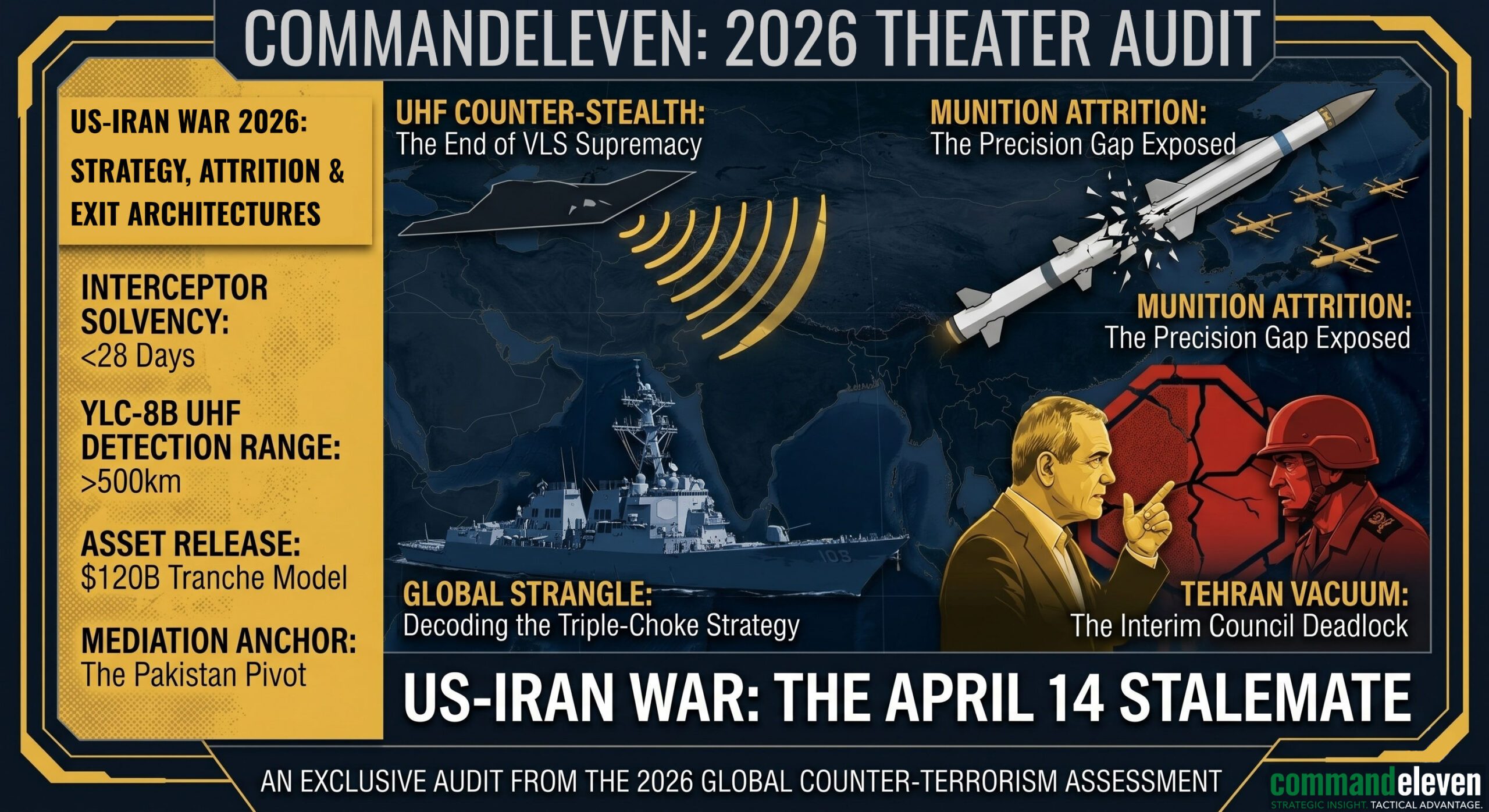
As of April 14, 2026, the US-Iran conflict has evolved into a Global Maritime Interdiction campaign. While the kinetic center remains the Persian Gulf, the strategic center has shifted to the Strait of Malacca and the European Theater.
Key Takeaways:
- Doctrine Failure: The disregard for asymmetric lessons in Millennium Challenge 2002 directly led to the initial maritime vulnerabilities in the Gulf.
- Great Power Spoilers: Russia and China successfully utilized the first six weeks of the war to deplete Western precision reserves, aided by YLC-8B anti-stealth radars.
- The Global Strangle: The April 13 US-Indonesia MDCP and the NATO “Shadow Fleet” interdiction have successfully decoupled the China-Russia-Iran support axis.
Recommendation: The US has leveraged this global stranglehold forcing a Phase 2 technical negotiation in Islamabad. The objective should not be a protracted kinetic campaign but a swift maritime truce that restores energy stability while maintaining the decapitation of the IRGC’s regional C2.
Great Power Interference – The China-Russia Axis
Pre-Negotiation: Establishing the Strategic Floor
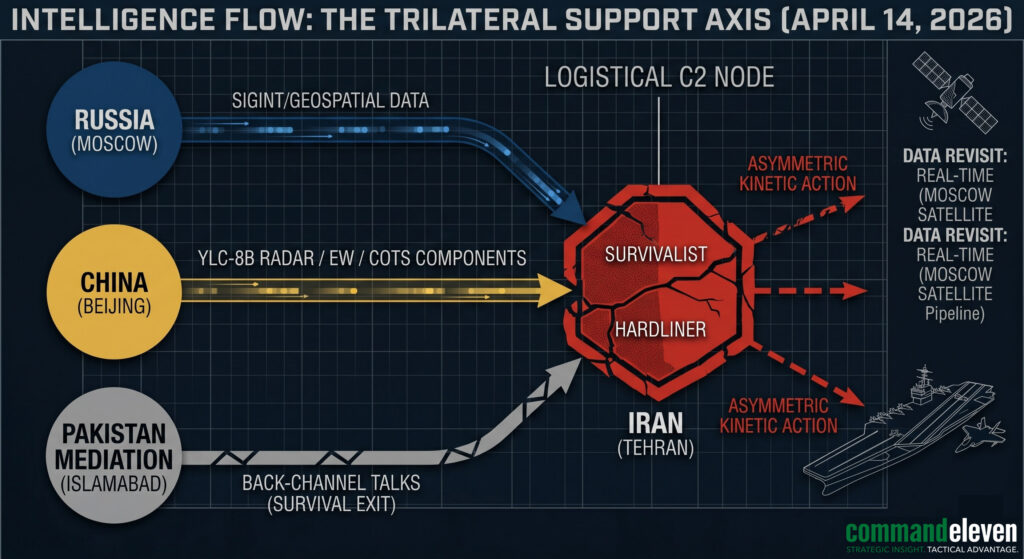
Prior to the February 28 initiation of Operation Epic Fury, Beijing and Moscow provided the foundational stability required for Tehran to maintain a defiant posture. This was not a formal alliance, but a “strategic floor” designed to absorb the shock of Western kinetic action.
- The Russian Intelligence Windfall: In the months leading up to the conflict, Moscow significantly increased its geospatial intelligence sharing with the Islamic Republican Guard Corps – Quds Force (IRGC-QF). By January 2026, Iran was receiving high-revisit satellite imagery and SIGINT regarding US/Israeli force concentrations. This enabled the “Precision Saturation” tactics seen in March, where Iranian cruise missiles successfully bypassed Aegis defenses by exploiting mapped gaps in littoral sensor coverage.
- China’s Economic and COTS Guarantee: Beijing served as the IRGC’s primary procurement hub. By facilitating the “dual-use” pipeline, Chinese firms provided the 120-day stockpile of micro-electronics and navigation systems required for the mass production of the FPV swarms that would eventually challenge the USS Gerald R. Ford task force.
Post-Islamabad: Transitioning to Active Spoilers
The collapse of the Islamabad Talks (April 12) shifted Beijing and Moscow from opportunistic observers to active “tactical spoilers.”
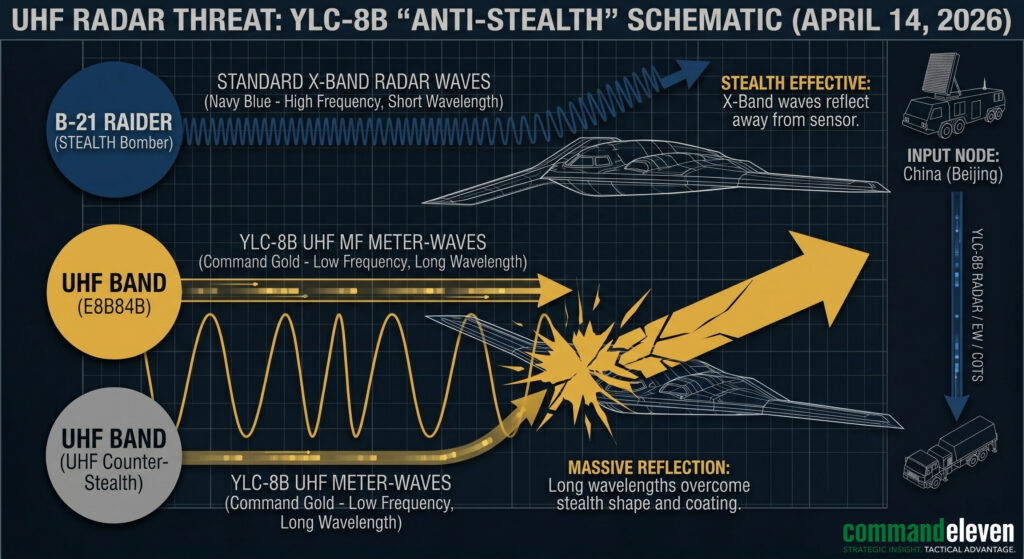
- Advanced Radar Proliferation: Since April 13, US intelligence has confirmed the operational status of Chinese YLC-8B UHF-Band 3D surveillance radars along the Iranian coastline. These systems are specifically tuned to detect low-observable (stealth) platforms, significantly increasing the risk profile for B-21 and F-35 sorties during the current blockade.
- The Attrition Profit Model: For Russia, the conflict serves as a critical “fixer” for US resources. By propping up Tehran’s resistance, Moscow forces a depletion of the US’s precision-guided munition (PGM) reserve. Modeling suggests that for every $1 billion the US spends in the Iran theater, the projected “threat readiness” for a second front in the Indo-Pacific drops by approximately 0.8%, a shift Moscow views as a direct geopolitical victory.
- Diplomatic Encirclement: On April 13, China and Russia utilized their veto power to block a Bahrain-led UNSC resolution for an international tanker escort mission. By framing the US naval blockade as “illegal maritime aggression,” they have positioned their joint China-Pakistan 5-Point Initiative as the only “stable” alternative for regional energy security.
TECHNICAL SIDEBAR: THE YLC-8B “ANTI-STEALTH” THREAT
| Technical Overview | The Chinese-made YLC-8B is a mobile, 3D long-range surveillance radar operating in the UHF (Ultra-High Frequency) band. Unlike standard targeting radars that use high-frequency X-bands to “see” small details, the YLC-8B uses long-wavelength frequencies (meter-wave) that interact with the physical size of an aircraft rather than its specialized stealth coating or shape. |
| Operational Impact (April 2026) | Since April 13, US intelligence has confirmed the deployment of these units along the Iranian coastline. By operating in the UHF band, the YLC-8B can detect “low-observable” platforms like the F-35 and B-21 at ranges exceeding 500km, effectively stripping away the “cloak of invisibility” that US doctrine relies on for deep-strike missions. |
The Millennium Challenge 2002 Precedent
The “Original Sin” of Theater Planning
The tactical success of Iranian maritime swarming in March 2026 was a direct consequence of ignoring Millennium Challenge 2002 (MC ’02). When retired Marine Lt. Gen. Paul Van Riper utilized motorcycle couriers and small-boat swarms to sink a simulated US fleet, the military “refloated” the ships and scripted a victory.
Validation of the Van Riper Playbook
In the current conflict, the IRGC-N executed the MC ’02 playbook with modern enhancements.
- FPV Saturation: By utilizing massed, low-cost drones (COTS-derived), Iran overwhelmed the high-cost interceptors of US task forces, forcing the current Munition Attrition Crisis.
- The Hubris Gap: The US entered the 2026 theater optimized for “Network-Centric Warfare,” assuming C2 dominance. Iranian “low-tech” resilience (couriers, fiber-optic tethers) has rendered those high-tech advantages largely irrelevant in the littoral zone.
The Islamabad Impasse (Technical Breakdown)
The 21-Hour Deadlock (April 11–12)
Negotiations led by VP JD Vance failed primarily due to the “900-pound problem.”
- The Nuclear Sticking Point: Iran refused to relinquish its nearly 900lb stockpile of highly enriched uranium, insisting on its right to “civilian enrichment.”
- The Toll Extortion: US negotiators demanded a total cessation of Strait of Hormuz “tolls.” Iran, emboldened by the China-Pakistan 5-Point Initiative, sought to institutionalize these tolls as a permanent sovereign right.
The Result: The failure of these talks triggered the April 13 Naval Blockade, marking the shift from “negotiated peace” to “economic and kinetic strangulation.
Great Power Interference: The China-Russia Axis
Prior to the Feb 28 strikes, China and Russia provided the “strategic floor” that allowed Iran to ignore US ultimatums. Post-negotiation, they have transitioned into providing the “tactical ceiling” that prevents a swift US victory.
Pre-Negotiation: The Financial and Intelligence Floor
- The Russian Intelligence windfall: Since Jan 2026, Russia has provided Iran with real-time satellite imagery and SIGINT on US/Israeli troop movements. This “calibrated ambiguity” allowed Russia to treat the Iran theater as a tit-for-tat response to Western support in Ukraine.
- China’s Economic Guarantee: Beijing’s purchase of 90% of Iran’s sanctioned oil at a discount provided the IRGC with the liquid capital to stockpile COTS components for the UAV swarms that would later saturate the USS Gerald R. Ford task force.
Post-Islamabad: From Mediation to Material Support
The failure of the Islamabad talks (April 12) marked a shift in Beijing’s posture from a “responsible mediator” to an active logistical partner.
- The Anti-Stealth Surge: Intelligence reports from April 13 indicate the deployment of Chinese YLC-8B UHF-Band 3D long-range surveillance radars across the Iranian coastline. This move is designed specifically to counter US F-35 and B-21 penetration capabilities during the current blockade.
- Russia’s Attrition Profit: By propping up Tehran, Moscow ensures the US remains “fixed” in a high-intensity Middle East conflict. Current modeling suggests Russia could reap an additional $161 billion in energy revenues in 2026 due to the war-driven price surge, effectively neutralizing the impact of Western sanctions on their own budget.
Regional Leverage & Mediation Architectures
Despite the collapse of the formal talks, the Pakistan Pivot remains the only viable exit architecture. As CommandEleven’s prior briefings have noted, the US cannot “bomb its way” to an off-ramp if China and Russia are willing to rebuild Iranian C2 as fast as it is destroyed.
- The 15-Point Pakistani Proposal: While the April 8 ceasefire failed, the framework for “Neutral Maritime Corridors” remains the only plan endorsed by both Beijing and the Gulf states.
- The China-Pakistan Joint Initiative: Last week’s joint proposal for the protection of shipping routes through the Strait of Hormuz suggests that Beijing is positioning itself as the “stable” alternative mediator, exploiting the US’s perception as the aggressor.
Exit Architectures: The “Swift Conclusion” Model
To force a conclusion by the end of Q2 2026, US strategy must move beyond the current naval blockade and address the axis of support:
- Secondary Sanctions on Beijing: Linking the breakdown of talks to increased tariffs on Chinese firms propping up the IRGC.
- The “Van Riper” Correction: Implementing the counter-UAV and maritime hardening tactics,long ignored since MC ’02,to render Iranian (and by extension, Russian) swarm tactics obsolete.
The Triple-Choke Strategy (Straits of Hormuz, Malacca, and European Access)
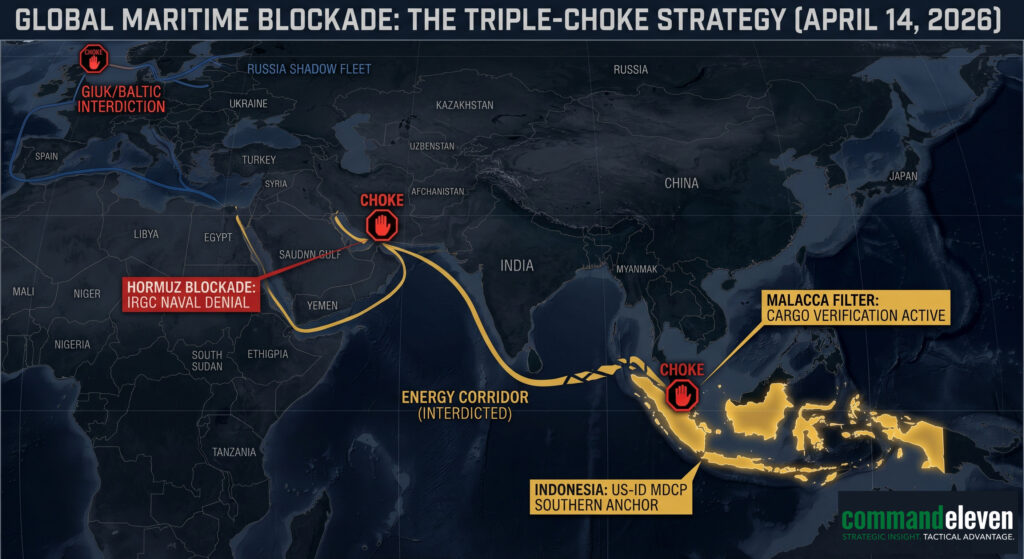
The April 13, 2026, announcement of the U.S.-Indonesia Major Defense Cooperation Partnership (MDCP) provides the “Southern Anchor” for the current naval blockade. This strategy does not just target Iran; it severs the trilateral logistical chain connecting Tehran, Beijing, and Moscow.
The Malacca Filter: The US-Indonesia MDCP
While the Strait of Hormuz is the site of active kinetic interdiction, the Strait of Malacca has become a “Regulatory Filter.” The MDCP enables:
- Asymmetric Maritime Oversight: Co-development of subsurface and autonomous systems with Indonesia to monitor “Dark Fleet” tanker movement.
- Blanket Overflight Access: The April 14 reports of preliminary agreements for US military “blanket overflight” through Indonesian airspace allow for rapid-response surveillance and interdiction from the Indian Ocean directly into the South China Sea.
- The “Cargo Verification” Mandate: By partnering with Jakarta, the US has institutionalized a “cargo oversight” regime that forces China to either permit inspections of suspected Iranian crude or risk a full blockage of its primary energy artery.
The GIUK Gap & Baltic Strangle (Stifling the Russian Pipeline)
Concurrent with the Malacca shift, the US and NATO have tightened the “Greenwich Gate” (GIUK Gap) to intercept the Russian “Shadow Fleet.”
- Shadow Fleet Interdiction: On April 13, the US Navy was instructed to interdict every vessel in international waters that has paid an “illegal toll” to Iran. This includes the elderly, under-insured tankers used by Russia to transport Iranian refined products into Europe.
- Baltic Bottlenecks: Restricting passage through the Danish Straits for “high-risk” vessels prevents the northern delivery of Chinese micro-electronics and Russian munitions components to Iranian ports.
Stifling the “Trilateral Circulatory System”
The objective of this triple-choke is to destroy the Trilateral Circulatory System:
- Iran provides the kinetic proxy force.
- Russia provides the intelligence and battlefield testing.
- China provides the industrial COTS components and economic liquidity.
By blockading these three specific geographic nodes, the US aims to force each actor into an isolated economic crisis, preventing them from “offsetting” each other’s losses.
Strategic Impact on the China-Iran Nexus
The MDCP forces a massive recalculation for Beijing.
- The Double-Filter Reality: China can no longer assume that oil evading the Hormuz blockade will reach its mainland. It must now pass the “Indonesian Filter,” which is backed by US autonomous subsurface detection.
- Mahanian Sovereignty: By controlling the three primary global chokepoints, the US has regained the strategic initiative. To keep Iran operationally viable, Beijing must now risk a direct maritime confrontation in a theater (Malacca) where the US now holds an unprecedented “Overflight” and “Asymmetric” advantage thanks to the Indonesian partnership.
The Levant Theater – Israel’s “Double-Noose” Strategy
While the US focuses on maritime interdiction, Israel’s Operation Roaring Lion is focused on the permanent dismantlement of the “Forward Defense” doctrine.
The Lebanon Security Buffer (April 14 Update)
As of today, Israel has established a 9-kilometer permanent security buffer inside southern Lebanon.
- Tactical Objective: The demolition of villages used for Hezbollah infrastructure and the establishment of 15 permanent Israeli outposts.
- The Ceasefire Paradox: Prime Minister Netanyahu has explicitly stated that the April 8 US-Iran ceasefire does not apply to Lebanon. By continuing to eliminate Hezbollah’s last C2 node in Bint Jbeil, Israel is forcing Tehran to watch its most valuable proxy asset be systematically dismantled while Iran’s hands are tied by the Islamabad framework.
The Syrian “Air Bridge” Interdiction
In Syria, Israel has transitioned from “Grey Zone” strikes to a Total Denied Access posture.
- Targeting the IRGC-QF: Following the April 13 strikes on eight bridge segments and the assassination of the IRGC’s head of intelligence in Damascus, the “Air Bridge” from Tehran to Beirut is effectively severed.
- Decision Impact: For Iranian leadership, a ceasefire that allows Israel to continue destroying their regional architecture in Syria and Lebanon is seen as a “Strategic Trap.” This is the primary reason the Islamabad talks reached an impasse on April 12.
The Iranian Decision-Matrix – Who is in Charge?
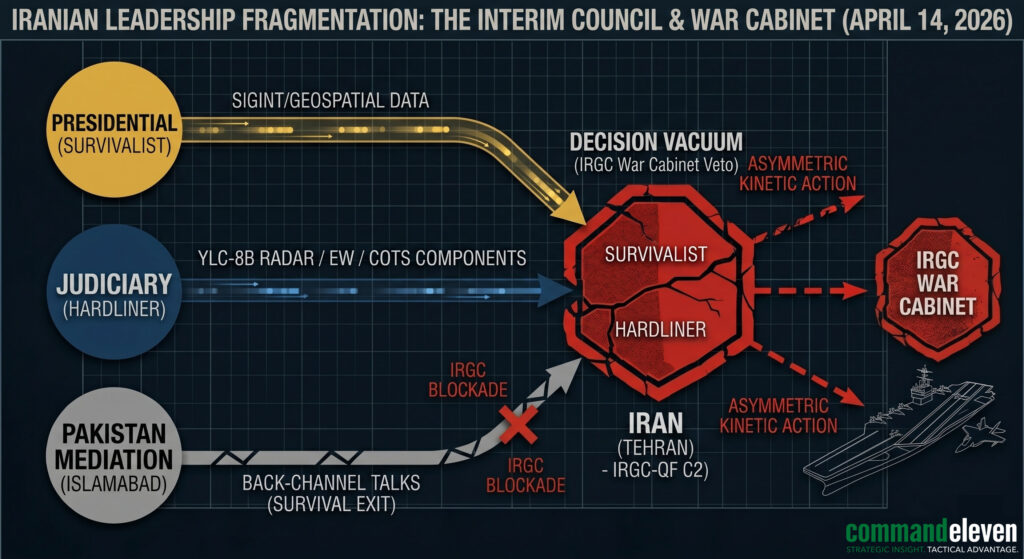
Following the February 28 decapitation of Ali Khamenei, the Iranian decision-making process has shifted from a singular autocracy to a fragmented Interim Leadership Council.
The Power Players:
- Mojtaba Khamenei: Appointed Supreme Leader on March 8, but notably absent from the April 9 memorials. His authority is currently contested by the military elite.
- President Masoud Pezeshkian: Representing the “Pragmatist” wing, pushing for the Pakistan-mediated exit to prevent total economic collapse.
- The IRGC “War Cabinet”: Following the assassination of SNSC Secretary Ali Larijani (March 17), the IRGC has taken de facto control of the nuclear and maritime files. They view the nuclear program as their only remaining “Insurance Policy” against the Venezuela-style regime change openly supported by the Trump administration.
The Interim Leadership Council – A Triad in Conflict
Following the February 28 decapitation of Ali Khamenei, Iran is governed by a constitutional three-man council. Their conflicting ideological loyalties are the primary obstacle to a unified response to the U.S. 15-Point Proposal.
- Masoud Pezeshkian (The Survivalist): As President, Pezeshkian leads the “Pragmatist” wing. He is the primary interlocutor for the Pakistan Pivot, viewing the $120B asset release as the only way to prevent a total domestic collapse. However, his authority is frequently bypassed by the IRGC, leaving him unable to guarantee the “Nuclear Abandonment” clause.
- Gholam-Hossein Mohseni-Ejei (The Hardliner): The Chief Justice and an ultra-conservative loyalist. He represents the security apparatus that views any concession on the nuclear program as a precursor to a U.S.-led “Venezuela-style” regime change. He is the primary advocate for the “Stone Wall” maritime strategy.
- Ayatollah Alireza Arafi (The Ideologue): A senior cleric and the bridge between the religious seminaries and the IRGC. His presence on the Council ensures that the core ideology of “Resistance” is not sacrificed for economic relief. He acts as the spiritual advisor to the IRGC War Cabinet.
The “Hidden” Center of Power: While not officially on the Council, Mojtaba Khamenei (the late Supreme Leader’s son) is currently incapacitated in Qom according to April 7 intelligence. His absence has created a vacuum that Mohammad Bagher Ghalibaf and the IRGC’s Khatam al-Anbiya headquarters have filled, effectively running the “War Cabinet” that dictates kinetic retaliation in the Gulf.
The Pakistan Proposal – Point-by-Point Benefits for Iran
The US recommendations delivered by VP JD Vance in Islamabad were designed to offer a “Survival Exit.” To secure an abandonment of the nuclear program, the US proposed the following:
| US Recommendation | Benefit to Iran | The Trade-Off |
| 1. Sanctions Sunset Clause | Immediate release of $120B in frozen assets. | Total dismantling of all centrifuges >5% enrichment. |
| 2. Sovereign Toll Rights | Recognition of Iran’s right to collect “Security Tolls” in the Strait of Hormuz. | Handover of all 90% enriched material to a neutral third party (Pakistan). |
| 3. Non-Kinetic Guarantee | Formal US pledge against “Kinetic Regime Change” operations. | Permanent cessation of ballistic missile transfers to Hezbollah/Houthis. |
| 4. Reconstruction Fund | $50B multilateral fund (funded by frozen assets) for civilian infrastructure. | Permanent 24/7 IAEA “Anytime, Anywhere” access. |
Why the shift is beneficial: For the Interim Council, accepting these terms trades a theoretical weapon (which they cannot currently use without total annihilation) for immediate state survival. It allows the regime to “live to fight another day,” preserving the domestic economy while ending the April 13 maritime stranglehold.
Final Synthesis: The Strategic “Tug of War”
Iran’s leadership is caught in a tug-of-war between Pezeshkian’s Survivalists (who want the Pakistan deal) and the IRGC Hardliners (who fear that giving up the nuclear program will lead to an immediate Israeli ground invasion of Tehran).
As of April 14, 2026, the strategic landscape for CommandEleven’s analysis has reached a critical bottleneck. The failure of the Islamabad Talks on April 12 was not merely a diplomatic stumble; it was the result of a profound internal fragmentation within the Iranian state and an irreconcilable divergence between U.S. “exit” terms and Israeli “security” objectives.
Recommendation to The White House
The Impossibility of Maximalism
The current April 13 Naval Blockade is an effective tactical tool but a strategic liability. By demanding “Total Nuclear Abandonment” as a prerequisite for asset release, the U.S. is strengthening the IRGC Hardliners who argue that the nuclear program is the regime’s only insurance policy against a total Israeli ground invasion of Tehran.
The Levant De-Linking Strategy
The U.S. must force a distinction between the Islamabad Framework and Israel’s Operation Roaring Lion.
- Recommendation: Formalize a “Regional Security Buffer” that acknowledges Israel’s 9km Lebanon zone as a separate kinetic reality from the Iranian state-level ceasefire. Failing to de-link these allows Tehran to use “Israeli aggression” as a pretext to abandon the nuclear file.
The Pakistan Proposal: Beneficial Shifting
To secure a “Swift Conclusion,” the U.S. should pivot to a Benefit-First Model in the next round of talks (April 16):
- Asset Liquidity for Compliance: Instead of a full sunset of sanctions, implement a “Tranche-Based Release.” For every 50kg of 60% uranium shipped to Pakistan, $10B in frozen assets is released specifically for civilian infrastructure reconstruction.
- Maritime Toll Sovereignty: Formally recognize Iran’s right to collect environmental and security “tolls” in the Strait of Hormuz,contingent upon these funds being audited by a neutral board (including Indonesia and Pakistan) to ensure they do not fund IRGC proxy operations.
Counter-Spoiler Protocols
To neutralize the China-Russia Axis identified in Section II, the U.S. must:
- Leverage the U.S.-Indonesia MDCP to actively filter Chinese energy flows until Beijing pressures Tehran to accept the “Phase 2” terms.
- Utilize the YLC-8B Radar countermeasures (Directed Energy/Electronic Warfare) to restore the B-21/F-35 stealth advantage, signaling that the “Anti-Stealth” floor provided by China is insufficient to protect Iranian C2.
Conclusion
The path to peace is not through the total collapse of the Iranian state, but through the Managed Attrition of its militarized hardliners in favor of the survivalist presidency.
OPERATIONAL INSIGHT: To evaluate the technical frameworks CommandEleven utilizes to mitigate these specific risks, view our Operational Architecture or explore our broader Sector Assessment portfolio.