
Summary
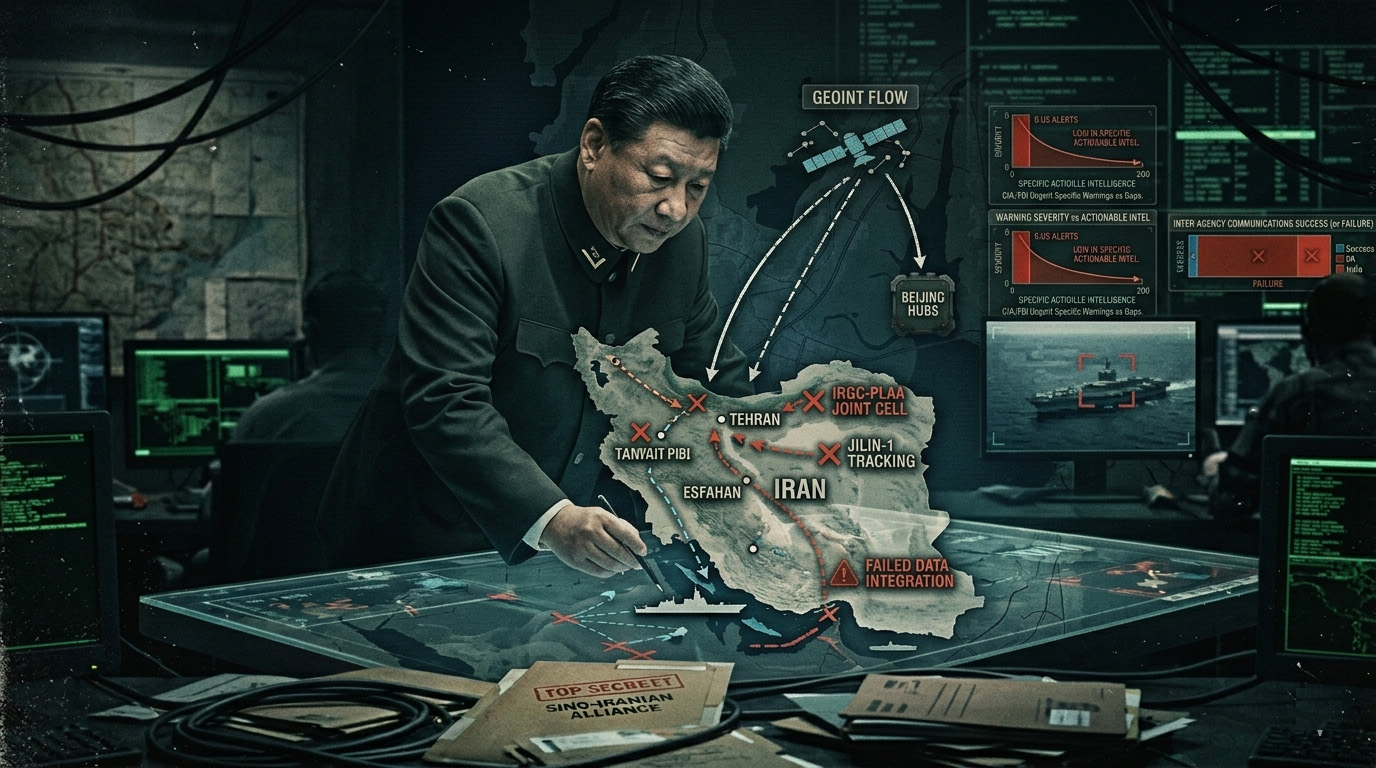
Beijing is utilizing the 2026 Iran conflict to conduct a non-kinetic multi-domain stress test on the United States. By leveraging the Jilin-1 satellite network and controlling 98% of dual-use gallium, China is successfully degrading U.S. strike capacity and strategic munitions reserves without direct military intervention.
While the world’s eyes are glued to the escalating conflict in Iran, Beijing isn’t just watching from the sidelines – it’s running the scoreboard. By acting as Tehran’s industrial heart and digital “eye,” China is effectively field-testing its own advanced doctrines while letting the U.S. defense industrial base hollow itself out.
This isn’t just “support”; it’s a strategic drain. Beijing is ensuring that while Washington burns through its “silver bullets” in the Middle East, the People’s Liberation Army (PLA) remains fresh, fortified, and ready for the real prize: the Indo-Pacific.
The 3 Big Realities
- The End of Orbital Secrecy: Between the Jilin-1 satellite constellation and the switch to Beidou navigation, U.S. “stealth” logistics are now an open book for Iranian targeting.
- The Math of Attrition: The U.S. is firing Tomahawks at a rate that would take five years to replenish. We are watching a “vulnerability window” open wide for a second front in Taiwan.
- The Mineral Veto: With 98% control over gallium and rare earths, Beijing holds the “kill-switch” for the very components needed to repair American radar and guidance systems.
Bottom Line Up Front (BLUF)
Beijing is using the 2026 Iran war as a multi-domain stress test. By providing the intel and the raw materials, they are degrading U.S. capabilities and strategic patience without firing a single shot.
CommandEleven’s Strategic Deep Dive
The Digital Shield
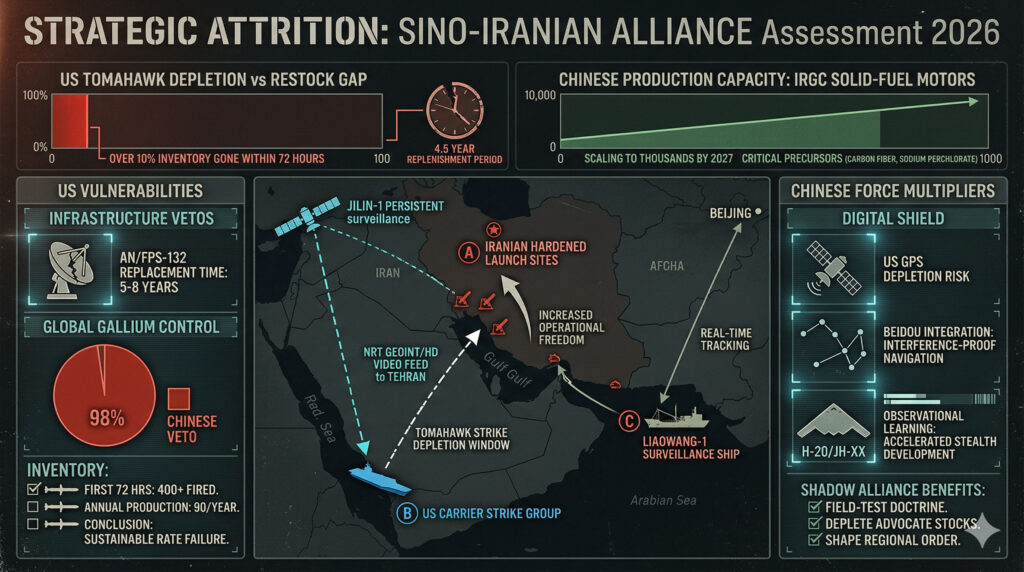
The Western monopoly on high-res intel is officially over. With over 120 satellites in the Jilin-1 constellation, Beijing is feeding Tehran real-time video of U.S. troop movements. By leaking this through “private” firms like MizarVision, they’re signaling that U.S. operations are no longer invisible. Even worse? Iran has ditched GPS for China’s Beidou system, making their drones and missiles virtually interference-proof.
The Industrial Forge
China is the silent partner in Iran’s missile boom. By shipping specialized carbon fiber and chemical precursors like sodium perchlorate, Beijing is helping the IRGC scale its ballistic production toward a staggering thousands by 2027. On top of that, the CM-302 supersonic cruise missile is on the table – a Mach-3 “carrier killer” designed specifically to overwhelm U.S. naval defenses.
The Tomahawk Trap
The math is terrifying. In just the first 72 hours of Operation Epic Fury, the U.S. Navy spent 400 Tomahawks – 10% of its entire ready inventory. Since the U.S. only builds about 90 a year, replacing those three days of work will take 4.5 years. This isn’t just a supply chain issue; it’s a strategic crisis.
The “Rare Earth” Kill-Switch
Washington is fighting on a borrowed clock. Critical systems like the AN/FPS-132 radar in Qatar rely on gallium – a mineral China almost entirely controls. With Pentagon reserves reportedly down to two months, Beijing can effectively decide when the U.S. bombing campaign has to end by simply cutting off the spare parts.
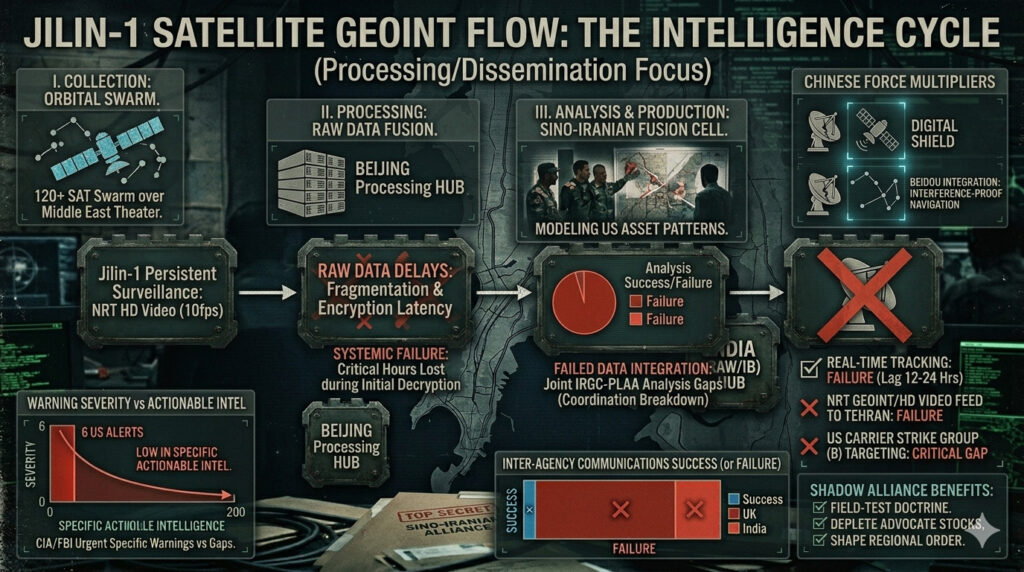
The Intelligence Loop: How Beijing Optimizes the IRGC
China isn’t just a vendor; they’ve integrated themselves into the Iranian decision-making cycle:
- Planning: Beijing identifies “Tomahawk Depletion” as the win condition.
- Collection: Jilin-1 and the Liaowang-1 surveillance ship track every U.S. launch signature.
- Processing/Analysis: Chinese analysts model U.S. air defense “blind spots” created by damaged arrays.
- Dissemination: Actionable targeting data is fed to Tehran, turning U.S. strikes into a predictable, open book.
The Macro View (PMESII-PT)
- Political: Beijing uses the “Rare Earth Veto” as a diplomatic leash, stalling U.S. support for Taiwan while Washington is distracted in the Gulf.
- Military: The Iran war is a lab for the PLA. They are accelerating the H-20 stealth bomber based on how U.S. B-21s perform against hardened targets.
- Economic: The U.S. is spending millions to destroy targets that China helps Iran rebuild for pennies. It’s an unsustainable exchange rate.
- Information: High-res satellite leaks serve as psychological warfare, shattering the myth of American orbital dominance.
- Infrastructure: Replacing a single high-end radar array can take 5–8 years. China’s control of the supply chain ensures those “eyes” stay closed.
- Time: This is a game of “Restock Gap.” Every day the U.S. stays entangled in Iran is a day its Pacific readiness withers.
Key Intelligence Questions
The following areas represent high-priority intelligence requirements for assessing the next phase of the 2026 Iran-China axis:
- Sustained Attrition Thresholds: What is the precise “red line” for U.S. Vertical Launch System (VLS) cell depletion before Pacific Command (PACOM) mandates a strategic withdrawal of assets to Hawaii or Guam?
- Beidou-Ground Integration: To what extent has Iran integrated Chinese ground-based augmentation systems (GBAS) to increase the terminal accuracy of Fateh-110 missiles in GPS-denied maritime environments?
- Secondary Sanction Resilience: Are Chinese “small-cap” financial institutions successfully clearing IRGC aerospace transactions outside of the SWIFT network, and can these channels withstand a Tier-1 U.S. Treasury escalation?
- H-20 Operational Data: To what degree is the PLA Air Force (PLAAF) receiving telemetry or “lessons learned” from U.S. B-21 Raider strike patterns over hardened Iranian targets to refine the H-20’s stealth profile?
OPERATIONAL INSIGHT: To evaluate the technical frameworks CommandEleven utilizes to mitigate these specific risks, view our Risk Operational Architecture or explore our broader Government and Defense portfolio.