Key Judgments
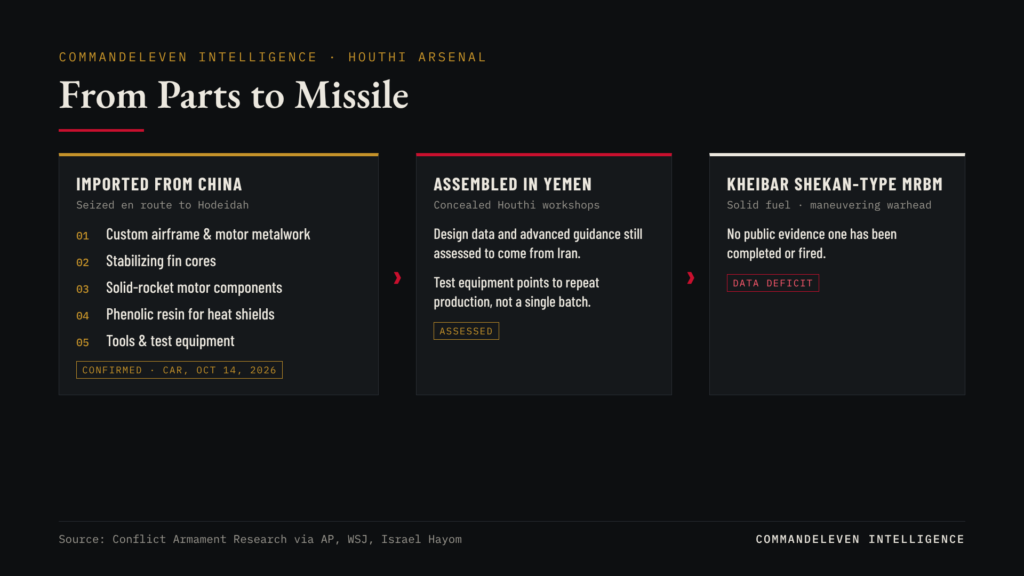
- [CONFIRMED] Conflict Armament Research (CAR) reported on October 14, 2026 that two shipments seized by Yemeni government authorities, originating in China and bound for the Houthi-held port of Hodeidah, carried parts for a solid-propellant medium-range ballistic missile. CAR assesses the parts match a Houthi attempt to build a version of Iran’s Kheibar Shekan.
- [ASSESSED] The seizure confirms a shift already visible since 2024: the Houthis are moving from importing finished Iranian missiles to importing components and assembling them in Yemen. Kits are easier to hide than missiles, and they can come from more than one country.
- [DATA DEFICIT] There is no public evidence that a Yemeni-built Kheibar Shekan has been completed or fired. CAR’s own analyst says production may be underway or may be struggling. Advanced guidance components are still assessed to come from Iran.
- [ASSESSED] A Chinese supplier is not proof of a Chinese state policy. What the case does show is that China’s dual-use export controls are not stopping missile-specific parts from reaching an embargoed group, the same deniability gap CommandEleven Intelligence documented in China’s supply line to Iran’s war.
- [ASSESSED] For the Makkah Pact campaign, the finding moves the interdiction problem upstream. Blockading Hodeidah and hunting launchers will not be enough if the supply chain runs through Chinese factories and shipping paperwork. Saudi Arabia, China’s largest trading partner in the region, holds leverage over that supply chain that it has not yet used in public.
What Was Seized
CAR is a UK-based investigative group that traces weapons through their supply chains, usually from the physical items themselves. Its October report rests on material that Yemen’s internationally recognized government made available to its investigators in July. The missile-related equipment was hidden among other goods in two consignments shipped from China toward Hodeidah, the Red Sea port that Israeli and Western officials have long described as the main entry point for Iranian weapons.
Reporting on the report describes the seized items in five groups:
- Airframe and motor metalwork. Custom-made metal parts for a missile’s motor casing and fuselage.
- Stabilizing fins. Fin cores for flight stability.
- Rocket motor components. Parts associated with the solid-propellant motor used in the Kheibar Shekan series.
- Heat-shield material. Phenolic resin, used to make the ablative layers that protect a missile from the heat of high-speed flight through the atmosphere.
- Tools and test equipment. Equipment for checking components, which points to an intention to keep producing rather than assemble a single batch.
Fabian Hinz, CAR’s senior analyst, told the Associated Press that these are “not goods that can be used for a variety of civilian applications,” and that “the local ambition of the Houthis for manufacturing is beyond what was previously assumed.” Making parts this specialized, he said, would have required access to the missile’s design data.
[DATA DEFICIT] The timing is reported two ways. The Wall Street Journal and Al Arabiya say the shipments were intercepted in 2025 and the evidence was handed to CAR in July 2026. The Associated Press says the seizures took place in July 2026. CommandEleven Intelligence has not been able to see CAR’s report directly and treats the seizure date as unresolved. Nothing in this dossier depends on which date is correct.
From Finished Missiles to Kits
The Houthi arsenal has been built in three stages, and this seizure belongs to the third.
- Inherited stocks. When the Houthis took Sana’a in 2014, they took Soviet-era and North Korean missiles from the Yemeni army’s depots.
- Iranian systems, smuggled whole or nearly whole. Through the Saudi-led war that followed, Iranian missiles and drones reached Yemen by sea, often broken into large sections on dhows and reassembled in Houthi workshops.
- Components and local production. Shipments have shifted from intact weapons toward parts. CAR documented imports of similar custom metal parts in late 2024, linked to the shorter-range Sadr missile. The new seizure shows the same method applied to a longer-range, more capable design.
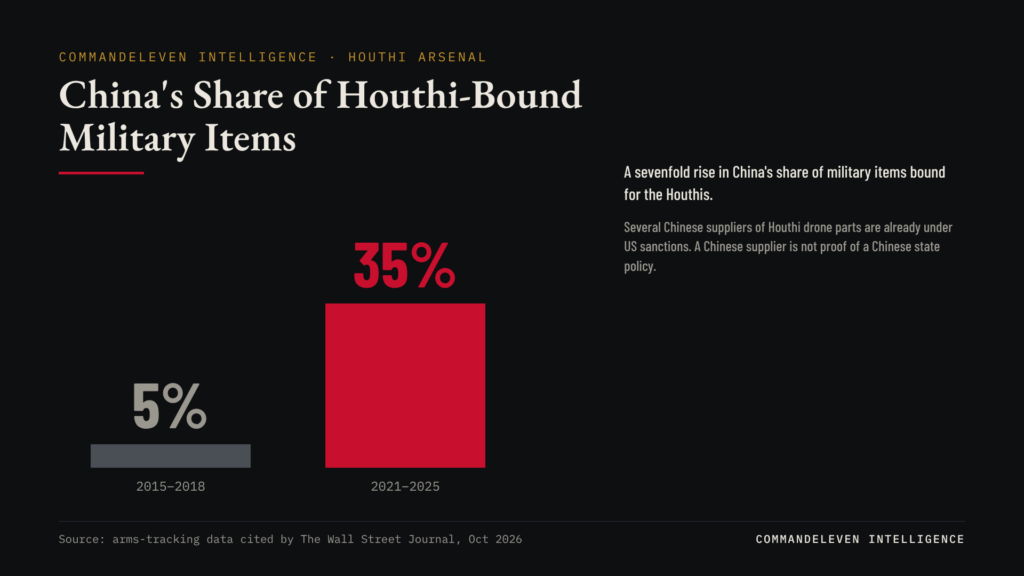
[CONFIRMED] China’s share of the supply chain has grown sharply. According to arms-tracking data cited by the Wall Street Journal, 35 percent of military items bound for the Houthis between 2021 and 2025 originated in China, up from 5 percent in 2015 to 2018. UN reporting likewise identifies China as the largest source of seized shipments destined for the group, and several Chinese suppliers of Houthi drone components are already under US sanctions.
[ASSESSED] The supply network is wider than Iran and China. Research by The Century Foundation, cited by AP, describes a “hybrid” chain that runs through tribally connected smugglers inside Yemen and businessmen in eastern China. Amwaj’s reporting on Iraq adds a third leg: Houthi representational and charitable networks in Iraq that function as logistical and financial conduits, built on ties that predate Iran’s dominant role. Forces loyal to Yemen’s government have repeatedly intercepted missile components and launch equipment at Aden, according to the Aden Counter Terrorism Unit.
Behnam Ben Taleblu of the Foundation for Defense of Democracies summed up the logic to AP: “Redundancy is an asset, not a liability in military planning.” With Iran under a US naval blockade and its own stocks drained by the war, a Houthi movement that depends only on Tehran is a Houthi movement that can be starved. A movement that buys parts from several countries and assembles them at home is harder to cut off.
The Range Question
The Kheibar Shekan is an IRGC Aerospace Force missile, first shown in February 2022, with a solid-fuel motor and a warhead built to maneuver in its final phase to complicate interception. Iran has used it repeatedly, including in the 2024 strikes on Israel and throughout the 2026 war.
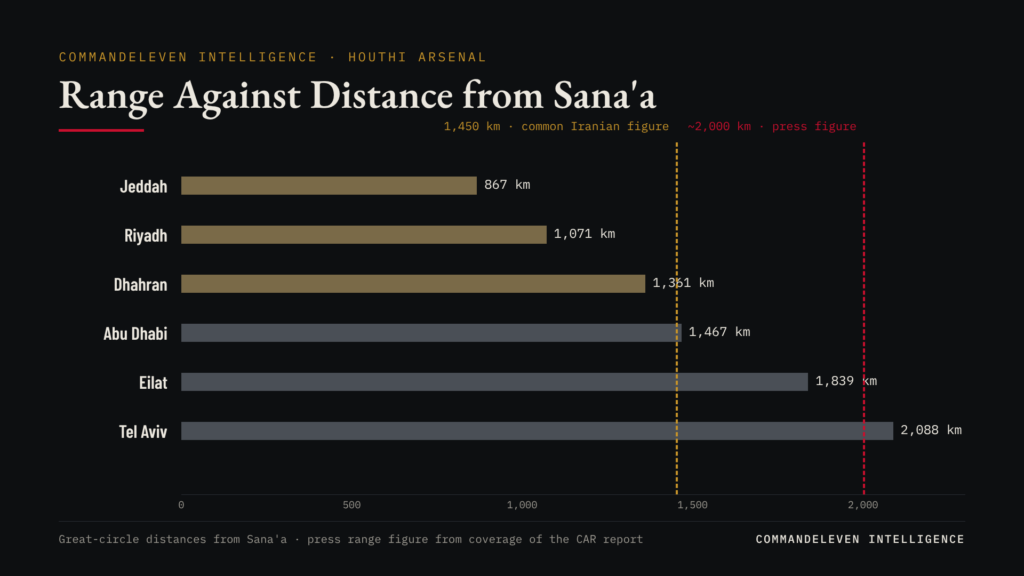
[DATA DEFICIT] Its range is reported inconsistently. The commonly cited figure for the Iranian missile is about 1,450 kilometers. Press coverage of the CAR report gives about 1,900 to 2,000 kilometers (roughly 1,200 miles). The difference matters:
- At about 1,450 km, a missile launched from northern Yemen reaches Jeddah (about 870 km from Sana’a), Riyadh (about 1,070 km) and the Eastern Province oil hub at Dhahran (about 1,360 km), which covers nearly all of Saudi Arabia. Abu Dhabi sits right at the limit, at about 1,470 km. Israel, about 1,840 km (Eilat) to 2,090 km (Tel Aviv) away, is out of reach.
- At about 2,000 km, it reaches southern Israel as well, which is how most coverage framed the story.
[ASSESSED] CommandEleven Intelligence reads the program as a Saudi problem first. The Houthis already have missiles that have reached Israel, including the solid-fuel “Palestine-2,” which observers have compared to Iranian designs. What they lack is a reliable way to replace what they fire. In the current war, Houthi strikes on Riyadh’s King Khalid International Airport killed at least 18 people in a single week, and the Saudi-Yemeni campaign that began in September is aimed precisely at the group’s launch capacity. A Yemeni-built missile with nearly all of Saudi Arabia in range is a direct answer to that campaign.
The China Question
Shipping records given to investigators identify the supplier as a Chinese precision-metal manufacturer that advertises custom aerospace parts. The company has not been publicly named.
[CONFIRMED] Beijing denies any breach of the UN arms embargo on the Houthis. A spokesperson for the Chinese Embassy in Washington said China fulfills its “international obligations” and “strictly controls the export of dual-use items.” China’s ambassador to Israel, Xiao Junzheng, said China “never sell[s] weapons or provide[s] ammunition to countries at war or to conflict zones.”
[ASSESSED] Two things can be true at once. A private Chinese manufacturer filling an order is not evidence that Beijing is running a weapons pipeline to Yemen, and CommandEleven Intelligence does not claim it is. But parts that CAR describes as having no civilian use left Chinese ports bound for a group under a UN embargo, which means the export-control system did not stop them. Michael Knights of the Washington Institute put the critics’ case bluntly: China has “neither the will nor the means to control the final destination of its dual-use technologies.”
This is the same pattern CommandEleven Intelligence found in Components, Chemicals and Coordinates: components, chemicals and commercial services moving from Chinese companies to Iran’s war effort in ways that keep the Chinese state one step removed. Our Foresight Audit of our China-Iran calls scored how that thesis has held up. The Houthi case extends it one link down the chain.
The Saudi lever. China is Saudi Arabia’s largest trading partner, buys its oil, and brokered the 2023 Saudi-Iran rapprochement. It has also condemned the Houthi attacks on Saudi airports. Kristian Ulrichsen of the Baker Institute told AP that Riyadh’s pressure on Beijing could increase. [ASSESSED] If Riyadh wants the supplier named, sanctioned and shut, a quiet request to Beijing is likely to achieve more than any blockade. Whether it makes that request, and whether it does so publicly, is one of the indicators below.
What It Means for the Makkah Pact Campaign
CommandEleven Intelligence’s Makkah Pact series has tracked the campaign from Pakistan’s deployment and Operation Yemen Dawn, through Riyadh’s airport war, to the gap between Saudi air power and Saudi ground forces. The CAR findings change the picture in three ways.
- Interdiction has to move upstream. A blockade of Hodeidah is built to stop large items. Kits arrive as ordinary-looking cargo in mixed consignments. Stopping them depends on shipping documents, supplier intelligence and pressure on the country of origin, not just ships at sea.
- Workshops become the target. If assembly is local, the campaign’s targets include production and test sites inside Houthi territory, which are concealed and hard to find from the air. That is the same ground-force gap Part 3 identified, and it raises the value of Pakistan’s contribution on the ground.
- The cost exchange stays against the defender. The Houthis have already shown, against US and allied navies in the Red Sea, that cheap munitions can force expensive interceptions. A US Marine Corps Gazette study counted more than $1 billion in US munitions and operating costs in the Red Sea alone. Local production of a heavier missile adds to that pressure on Saudi and Pakistani air defenses.
[ASSESSED] Iran is still central. Experts cited by AP believe the Houthis depend on Iran for advanced guidance and navigation systems, and making the parts CAR found required Iranian design data. Local assembly reduces the Houthis’ reliance on Iranian shipping. It does not reduce their reliance on Iranian know-how. For the wider Axis of Resistance, it is the clearest sign yet that Tehran is passing on the ability to produce weapons, not just the weapons, as its own supply routes close.
Outlook and Indicators (Foresight Entry)
[ASSESSED] The base case is that the Houthis keep trying to source parts from several countries, that more seizures follow, and that no public confirmation of a Yemeni-built Kheibar Shekan emerges before early 2027. The variable to watch is whether outside pressure falls on the supplier rather than only on the ports.
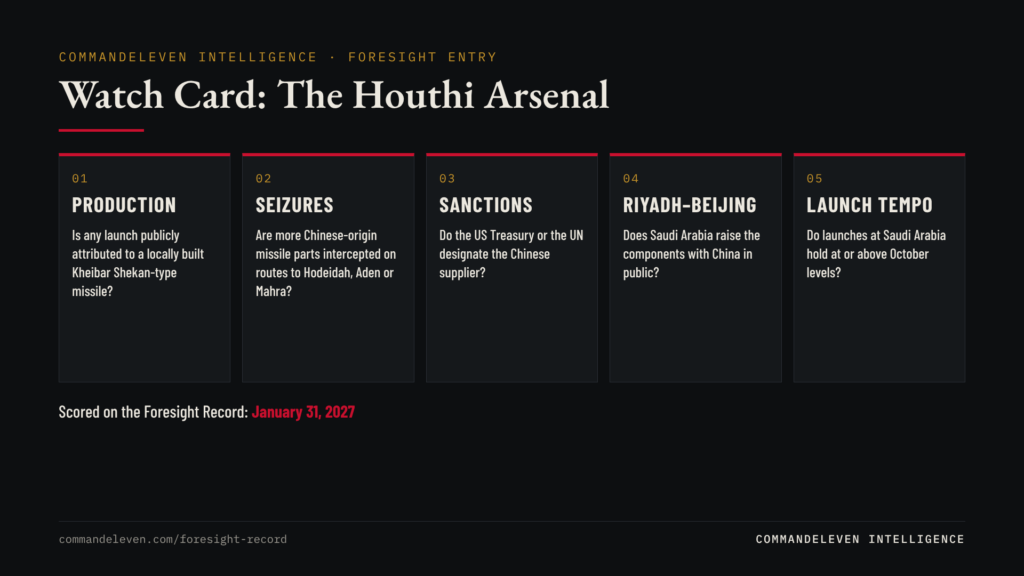
CommandEleven Intelligence will score these indicators on the Foresight Record on January 31, 2027:
- Production. Is any Houthi launch publicly attributed, by the US, Saudi Arabia, Israel or a UN body, to a locally assembled Kheibar Shekan-type missile?
- Seizures. Are further Chinese-origin missile components intercepted on routes to Hodeidah, Aden or the Mahra coast?
- Sanctions. Do the US Treasury or the UN sanctions committee designate the Chinese supplier?
- Riyadh and Beijing. Does Saudi Arabia raise Houthi missile components with China in a public statement or joint readout?
- Launch tempo. Do Houthi ballistic-missile launches at Saudi Arabia continue at or above their October level despite the campaign?
Frequently Asked Questions
Are the Houthis building their own ballistic missiles?
They are trying to. Seized shipments contained parts for a version of Iran’s Kheibar Shekan, along with tools and test equipment. Whether any have been completed is not publicly known.
Is China arming the Houthis?
A Chinese manufacturer supplied parts, according to shipping records. That is not evidence that the Chinese government directed the supply, and Beijing denies breaching the UN embargo. It does show that China’s export controls did not stop missile-specific parts.
What is the Kheibar Shekan?
An Iranian solid-fuel medium-range ballistic missile with a maneuvering warhead, unveiled in 2022 and used in Iran’s strikes on Israel and in the 2026 war.
Could a Yemeni-built version reach Israel?
Only if its range is closer to the 2,000 km cited in press coverage than to the roughly 1,450 km usually given for the Iranian missile. At the lower figure, it covers nearly all of Saudi Arabia but not Israel.
Do the Houthis still need Iran?
Yes. Advanced guidance systems are still assessed to come from Iran, and the parts themselves required Iranian design data.
Sourcing Base (Confidence-Tiered, with Links)
CONFIRMED — Reporting on the CAR Report:
- Associated Press via KPRC, Yemen’s Houthis look to build ballistic missiles with more Chinese supplies, report says, October 14, 2026
- Al Arabiya English, Houthis attempting to build advanced missiles using Chinese parts: Report, October 14, 2026 (citing The Wall Street Journal)
- ThePrint, Houthis using Chinese parts to build ballistic missile that could reach Israel, Saudi Arabia: WSJ report, October 15, 2026
- Israel Hayom, Report: Chinese firm supplies Houthis with advanced ballistic missile parts, October 14, 2026
ASSESSED — Analysis and Context:
- The Week, Houthis developing 2,000-km-range missiles with Chinese parts, putting Israel within reach, October 15, 2026
- Amwaj.media, Deep Dive: Iraq’s underestimated role in the rise of Yemen’s Houthis (Farea Al-Muslimi)
- Marine Corps Gazette, Lessons from an Unlikely Enemy, November 2025 (Capt Tyler C. Gunn)
- LBC, Houthi rebels unveil solid-fuel missile that resembles Iranian hypersonic weapon
- Wikipedia, Kheibar Shekan (compiled record of the missile’s unveiling, specifications and combat use)
Excluded from this dossier: Any claim that the Chinese government directed the supply, which no investigation has found. The supplier’s identity, which has not been made public. Any claim that a Yemeni-built Kheibar Shekan has been completed or fired. Technical detail about the missile’s construction beyond the component categories already published.
The Makkah Pact Series
This dossier is companion reading to CommandEleven Intelligence’s Makkah Pact series.
- The Makkah Pact’s First Test: Operation Yemen Dawn, Pakistan’s Role, and Iran’s Shrinking Map – Part 1
- The First Test, Tested: Riyadh’s Airport War and the Makkah Pact – Part 2
- Strong in the Air, Weak on the Ground: Why Riyadh Needs the Makkah Pact – Part 3
- Diamond vs. Hexagon: Where Pakistan Sits on Netanyahu’s Map – Part 4