

Key Judgments
- [CONFIRMED] Russia’s Cosmos 2612 manoeuvred over three weeks to match the orbit of ICEYE-X36, a commercial radar satellite registered to ICEYE US and linked to Ukraine. On October 16 it was about three miles (5 km) away, down from more than 200 miles a day earlier.
- [ASSESSED] Independent trackers estimate a closer pass early on October 18, within a few hundred metres or less. That would make it the closest known non-consensual approach between two working satellites in low Earth orbit. ICEYE-X36’s orbit shows no sign of disturbance, and its status is not public.
- [ASSESSED] The manoeuvres are deliberate. A plane change in low Earth orbit costs a great deal of fuel, and Russia has now paid that cost twice to reach this one satellite, in May and again from September 30.
- [ASSESSED] The most likely purpose is inspection, intimidation or interference, not destruction. A kinetic attack would cross a line no state has crossed in orbit. But a satellite that fails after an approach like this would be very hard to attribute, and that ambiguity is the point.
- [ASSESSED] This is grey-zone activity moved into orbit: deniable, below the threshold of attack, aimed at a commercial asset that a combatant relies on. Germany’s space commander has already warned that the same playbook could wear down Starlink.
What Happened
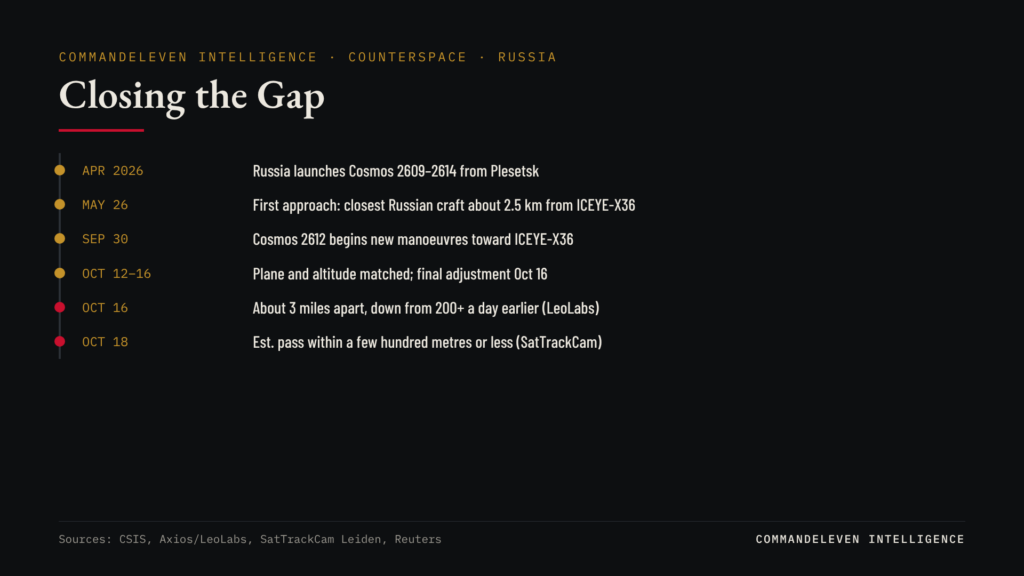
[CONFIRMED] Russia launched six satellites, Cosmos 2609 through 2614, from Plesetsk in April 2026. In May, several of them made high-energy manoeuvres to match the orbital plane of ICEYE-X36. The closest came within about 2.5 km on May 26. ICEYE moved its satellite, and the Russian craft manoeuvred again, according to ICEYE CEO Rafal Modrzewski. The orbital planes later drifted apart.
[DATA DEFICIT] Accounts differ on how many satellites took part in May. CSIS says five of the six; the US Space Force and Reuters say four, Cosmos 2610 to 2613. Neither count changes the conclusion.
The second approach began on September 30, when Cosmos 2612 started a new series of manoeuvres. Further burns followed on October 12, 15 and 16, bringing it back into ICEYE-X36’s plane at nearly the same altitude and orbital period.
- October 16. LeoLabs tracked Cosmos 2612 about three miles from ICEYE-X36 and called it “a deliberate approach,” adding that “the intent remains uncertain.” CSIS senior fellow Clayton Swope called the gap “bumper-to-bumper.” [CONFIRMED]
- October 17, 18:15 UTC. SatTrackCam Leiden, an independent tracker, put the two satellites within 1–2 km. [ASSESSED]
- October 18, about 01:35 UTC. SatTrackCam’s updated analysis points to a close approach of “a few hundred meters or possibly (much) closer,” with signs that Cosmos 2612 made small manoeuvres around that time. [ASSESSED] Public orbital data has large uncertainties at this range.
The US Defense Department and ICEYE declined to comment. A Ukrainian official told Axios that the military works with ICEYE but could not confirm that this satellite supports its operations. In May, the US Space Force described the target as a “Western commercial radar satellite used by Ukraine for imagery intelligence.”
Why ICEYE Matters
ICEYE operates synthetic aperture radar satellites that image through cloud and at night. Ukraine has used the constellation since 2022, and Ukraine’s Ministry of Defence has said that 38 percent of ICEYE data contributed directly to strikes, according to RUSI. ICEYE-X36 is a small satellite, under 100 kg, with no known defences. Moscow has said Western commercial satellites that help Ukraine may be treated as legitimate targets.
[ASSESSED] That combination is why this target was chosen. A commercial satellite is not a military asset of a NATO state, so interfering with it is less likely to draw a state response. It matters to Ukraine’s targeting. And it is defenceless.
What It Could Be
Once coplanar, a satellite can move into close proximity with little extra fuel. CSIS notes that this capability supports benign missions such as inspection or servicing, but also kinetic, non-kinetic or grappling attacks. Russia has a record here: in July 2020, Cosmos 2543 released a projectile in orbit, which the US and UK condemned as a weapons test.
| Option | What it would look like | Likelihood |
| Inspection | Close imaging and signals collection on a Western SAR satellite | Likely, alongside other aims |
| Intimidation | A public demonstration aimed at ICEYE, its customers and European governments | Likely |
| Non-kinetic interference | Jamming, dazzling or forcing fuel-costly avoidance manoeuvres | Plausible |
| Kinetic or grappling attack | Damage or capture of the satellite | Unlikely now; capability cannot be ruled out |
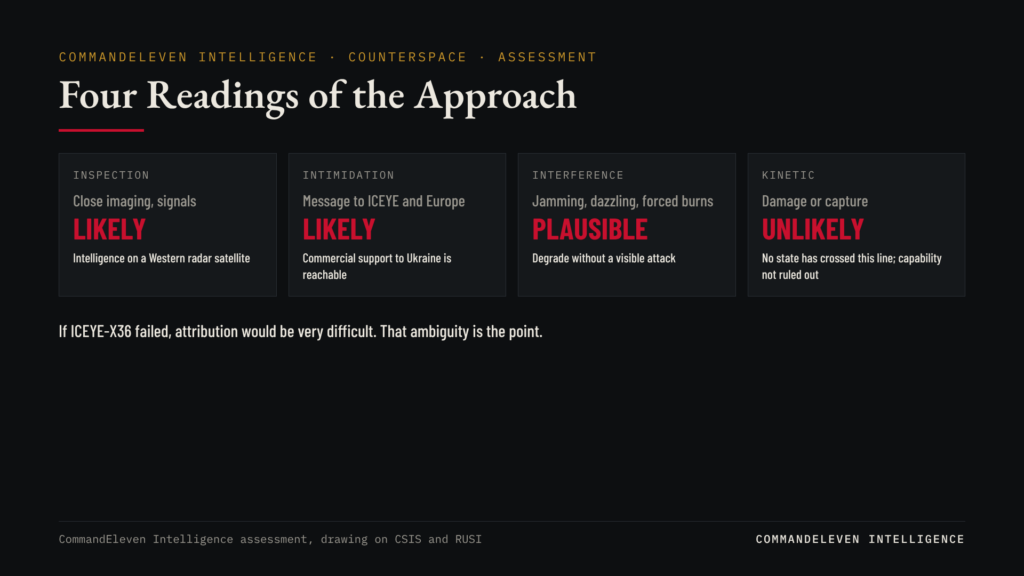
[ASSESSED] The likeliest answer is more than one at once. Russia gathers intelligence on a Western satellite, shows that it can reach commercial assets supporting Ukraine, and tests how Western governments react. RUSI’s Juliana Suess reached a similar conclusion after the May approach, judging non-kinetic interference most likely and a kinetic strike unlikely. SatTrackCam’s own caution is the key point: if ICEYE-X36 failed, attributing the failure to Cosmos 2612 would be very difficult.
The Grey Zone in Orbit
Our grey-zone series defines the method as action designed to stay below the threshold that triggers a military response, with deniability built in. Part 3 traced how Russia runs that playbook across Europe: GPS jamming, sabotage plots, drones over airports. Cosmos 2612 extends it to orbit.
Germany is reading it the same way. On October 9, Maj. Gen. Michael Traut, head of German Space Command, told Reuters that Russian spacecraft were “chasing” ICEYE’s satellite and that the method “concerns me quite a lot.” He warned that Russia could shorten the life of a mega-constellation such as Starlink without an overt attack, for example by forcing fuel-costly avoidance manoeuvres. Germany is developing inspector satellites, is considering orbital systems that could disrupt hostile satellites without destroying them, and has contracted ICEYE and a German partner for dozens of satellites to support NATO’s eastern flank.
[ASSESSED] The response gap is the same one our Ukraine-Russia series identified on the ground. There are no agreed rules for how close a satellite may approach another; operators usually keep about six miles apart by convention. CSIS argues that a muted Western response would tell Moscow it can expand grey-zone action in space at little cost, and proposes linking it to levers such as the US-Russia diesel arrangement covered in our Diesel Before Victory annex.
Outlook and Indicators (Foresight Entry)
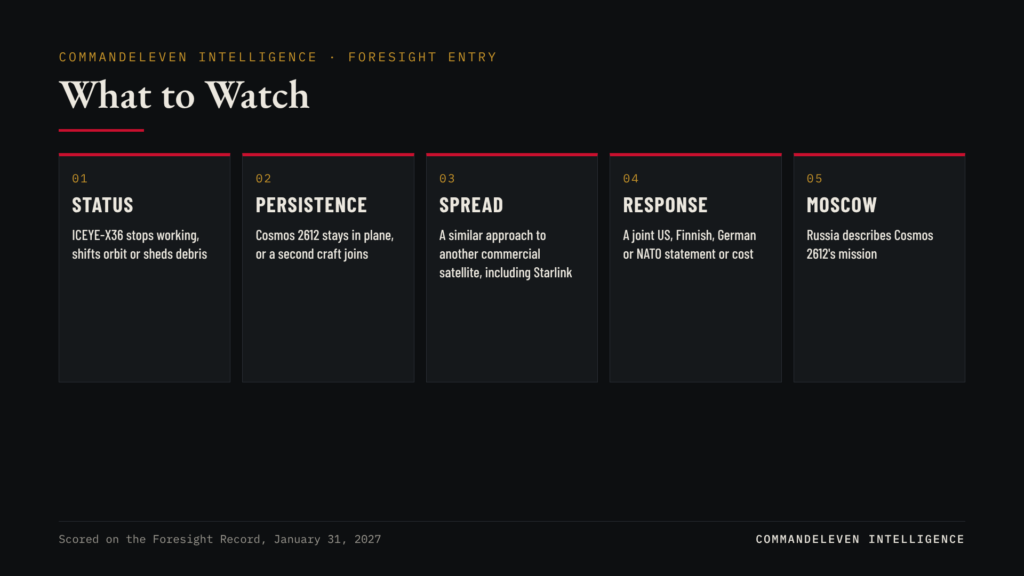
[ASSESSED] The base case is continued shadowing without a visible attack: Cosmos 2612 stays near ICEYE-X36 or repeats the approach, Western governments protest without a coordinated response, and the episode becomes a template for approaches to other commercial satellites. CommandEleven Intelligence will score these indicators on the Foresight Record on January 31, 2027:
- Status. Does ICEYE-X36 stop operating, change orbit unexpectedly, or produce debris?
- Persistence. Does Cosmos 2612 stay in ICEYE-X36’s plane, or does a second Russian satellite join it?
- Spread. Does a Russian satellite make a similar approach to another commercial satellite, including Starlink?
- Response. Do the US, Finland, Germany or NATO make a joint public statement or impose a cost tied to the approach?
- Moscow. Does Russia publicly describe Cosmos 2612’s mission?
Frequently Asked Questions
What is Cosmos 2612?
A Russian military satellite launched from Plesetsk in April 2026 as one of six. Russia has not disclosed its mission.
How close did it get to ICEYE-X36?
About three miles on October 16, according to LeoLabs. Independent trackers estimate a closer pass early on October 18, within a few hundred metres or less, but public data is uncertain at that range.
Was ICEYE-X36 damaged?
There is no public evidence of damage. Its orbit appears undisturbed, and ICEYE has not commented.
Why would Russia target a commercial satellite?
ICEYE’s radar imagery supports Ukraine’s military, and Moscow has said such satellites may be legitimate targets. A commercial satellite is also less likely to draw a direct state response than a military one.
Could this affect Starlink?
Germany’s space commander has warned that similar tactics could shorten the lifespan of large constellations such as Starlink without an overt attack.
Sourcing Base (Confidence-Tiered, with Links)
CONFIRMED — Reporting and Official Statements:
- Axios, Russian space satellite approaches U.S. satellite, raising alarms about intent, October 17, 2026
- Reuters via Arab News Pakistan, Russian satellite activity raises concerns for Starlink, German space commander says, October 9, 2026
ASSESSED — Analysis and Independent Tracking:
- CSIS, Clayton Swope and Chantal Li, Could Russia Be Poised to Use an On-Orbit Weapon Against a Commercial Satellite?, October 15, 2026
- SatTrackCam Leiden, Marco Langbroek, KOSMOS 2612 and ICEYE-X36: a worrisome cat-and-mouse-game in Space, October 17–18, 2026
- RUSI, Juliana Suess, Checkmate? Russian Orbital Manoeuvring Threatens Ukraine’s Space Capability, June 17, 2026
- SOFX, Russian Military Satellite Comes Within Three Miles of Ukraine-Linked ICEYE Radar Satellite, October 19, 2026
Excluded from this dossier: Single-figure miss distances (such as “26 metres”) generated automatically from public orbital data, which is too uncertain at this range. An AI-generated video circulating online that shows a Russian satellite colliding with an ICEYE satellite. Any claim that ICEYE-X36 has been damaged or disabled.