
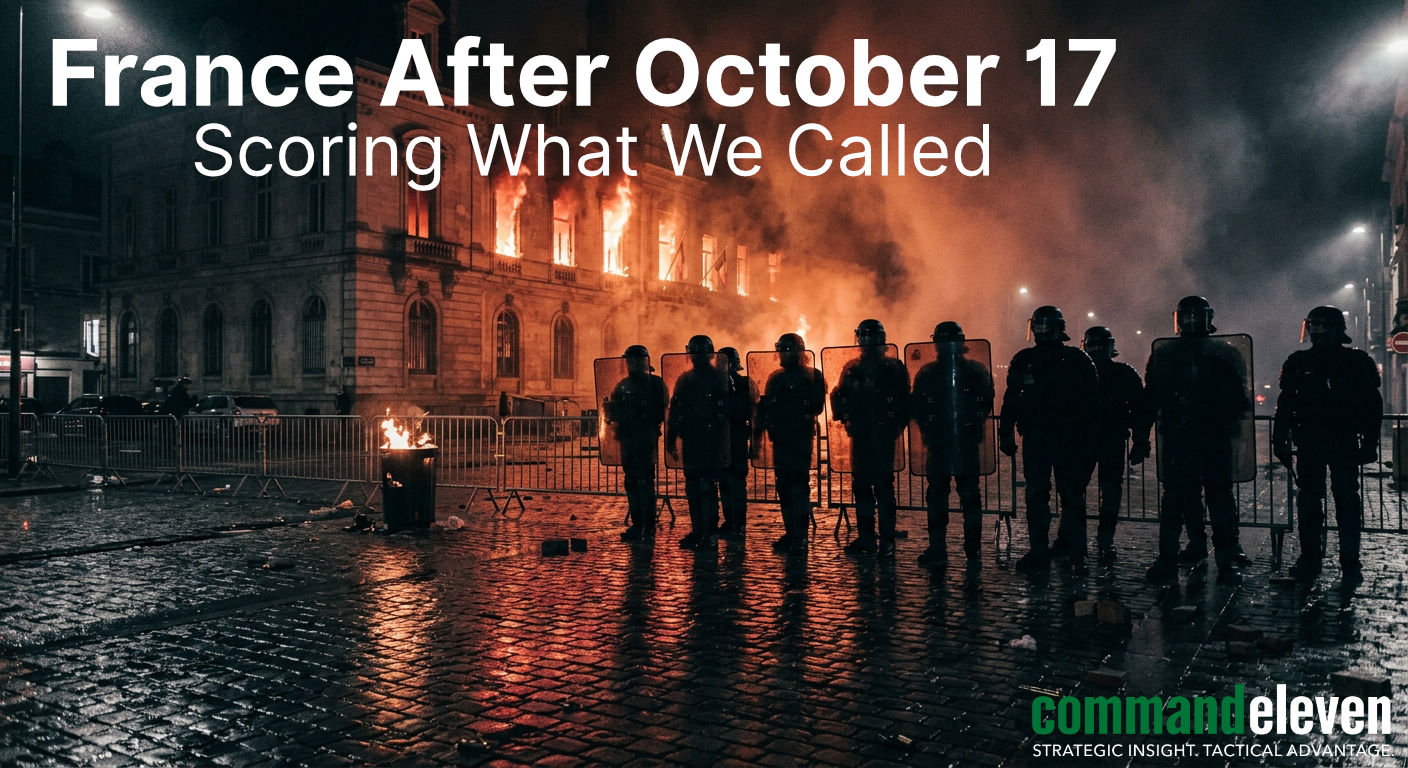
A Foresight Audit of CommandEleven Intelligence’s October 14 dossier, France and Belgium Before October 17: When Student Protest Becomes Organized Political Violence, and of the calls Syed Khalid Muhammad made on Survival Dispatch in the days before the mobilization.
Key Judgments
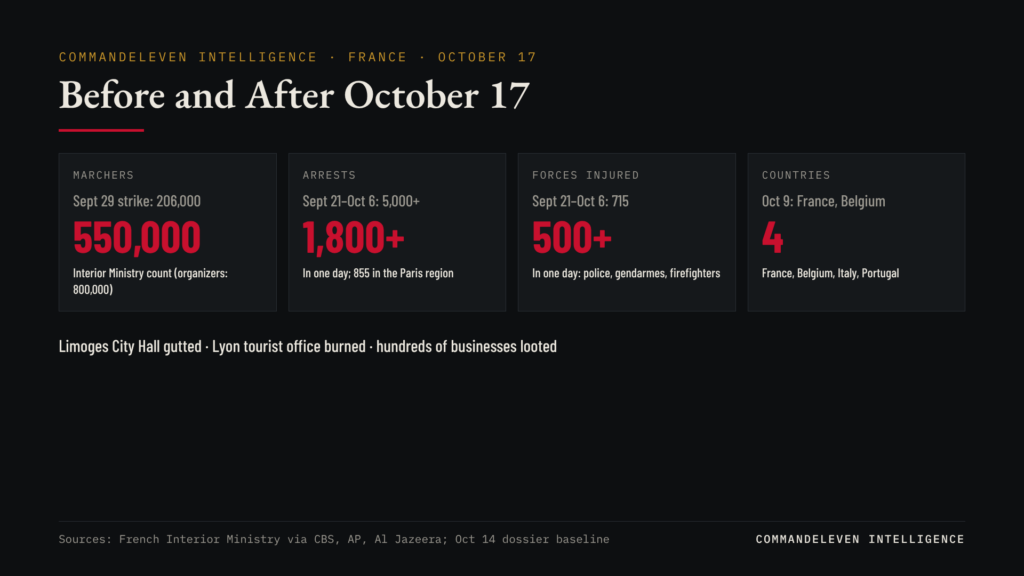
- [CONFIRMED] October 17 was the largest and most violent day of France’s 2026 unrest. The Interior Ministry counted about 550,000 marchers (organizers claimed 800,000), more than 1,800 people were arrested, more than 500 police, gendarmes and firefighters were injured, and Limoges’s 19th-century City Hall was gutted by fire.
- [CONFIRMED] The core of our October 14 assessment held. October 17 became the convergence point we described, the violence moved from schools to public buildings, businesses and police, and it spread across borders on the same day: Belgium, Italy and Portugal also saw protests, with violence in Brussels, Liège and Milan.
- [CONFIRMED] Three of our seven October 14 indicators are already met, two have not been met so far, and two remain open until our October 31 scoring date. No evidence of foreign funding has emerged, which is what we said to expect.
- [ASSESSED] The on-air calls were mostly right and one was clearly wrong. The prediction that October 17 was “a real date” and that the next wave would turn to arson and attacks on businesses was borne out. The warning of an IED or vehicle bomb and a mass-casualty event did not happen, and we record it as a miss.
- [ASSESSED] President Macron’s language moved toward ours. He vowed to hold accountable those who “sought to bring down the Republic,” and his government blames “radical far-left groups.” France has not, however, used emergency powers or treated the violence as domestic terrorism.
What Happened on October 17
- Turnout. About 550,000 nationwide by the Interior Ministry’s count, and about 800,000 by the organizers’. Marches ran in Paris, Marseille, Nice, Nantes, Bordeaux, Limoges, Lille, Toulouse, Strasbourg and Lyon.
- Arrests. At least 1,800 nationwide, 855 of them in the Paris region, where prosecutors kept 557 in custody. Interior Minister Laurent Nuñez later put the total above 2,000.
- Injuries. More than 500 police officers, gendarmes and firefighters, and more than 600 by Nuñez’s later count. One person died of a heart attack in Paris. Prosecutors are investigating, and no link to the violence has been established.
- Damage. Fire collapsed the roof of Limoges City Hall. Protesters set fire to Lyon’s tourist office, briefly entered the lobby of Marseille’s City Hall and damaged a police station there. Hundreds of businesses were looted in Paris, Marseille, Lyon and Bordeaux, and part of the base of the Marianne statue at Place de la République was torn down.
- Beyond France. Belgian police arrested 195 people, 150 in Brussels and 45 in Liège, where about 50 protesters fired pyrotechnic mortars at the Prince-Bishops’ Palace. In Milan, rioters looted stores and set fires, and about 50 people were detained. Tens of thousands marched peacefully in Lisbon.
The response. Macron held an emergency meeting on Sunday and addressed the nation that evening, vowing to hold accountable those who “sought to bring down the Republic” and saying “those who looted will have to pay back for the damage.” Nuñez and Prime Minister Sébastien Lecornu blamed “radical far-left groups” and criminals. Jean-Luc Mélenchon, who joined the Paris march, accused Lecornu of “playing with fire.” The mayors of Paris, Marseille and Lyon asked to meet the prime minister.
The students’ demands. A spokesperson for the Les Lycéens! movement listed abolishing Parcoursup, the national university admissions platform, recruiting school nurses, support for students with disabilities and reformed school schedules, and said students were waiting for Macron to “put in place concrete measures.”
Our October 14 Indicators, Scored
The October 14 dossier set seven indicators and a scoring date of October 31. This is an interim score. The two open indicators will be closed on that date on the Foresight Record.
| Indicator | Record | Score |
| 1. Turnout above the September 29 strike (about 206,000 by the Interior Ministry’s count) | About 550,000 by the same ministry’s count. | Met |
| 2. Serious attacks on police, teachers or officials, beyond property damage | More than 500 police, gendarmes and firefighters injured; a Marseille police station damaged. | Met |
| 3. Arson of schools or public buildings continuing after October 17 | Limoges City Hall and Lyon’s tourist office burned on the day. Continuation after the 17th still to be scored. | Open (Oct 31) |
| 4. Belgian escalation around October 17 | 195 arrests in Brussels and Liège, barricades, mortars fired at the Prince-Bishops’ Palace. | Met |
| 5. Open calls for the fall of the Lecornu government | Published demands stayed on schools and the cost of living. We have found no organized call for the government to fall. | Not met so far |
| 6. Emergency powers or dissolution of a group | Neither announced as of October 19. | Open (Oct 31) |
| 7. Credible evidence of foreign money reaching organizers | None has emerged. We rated this speculative on October 14. | Not met so far |
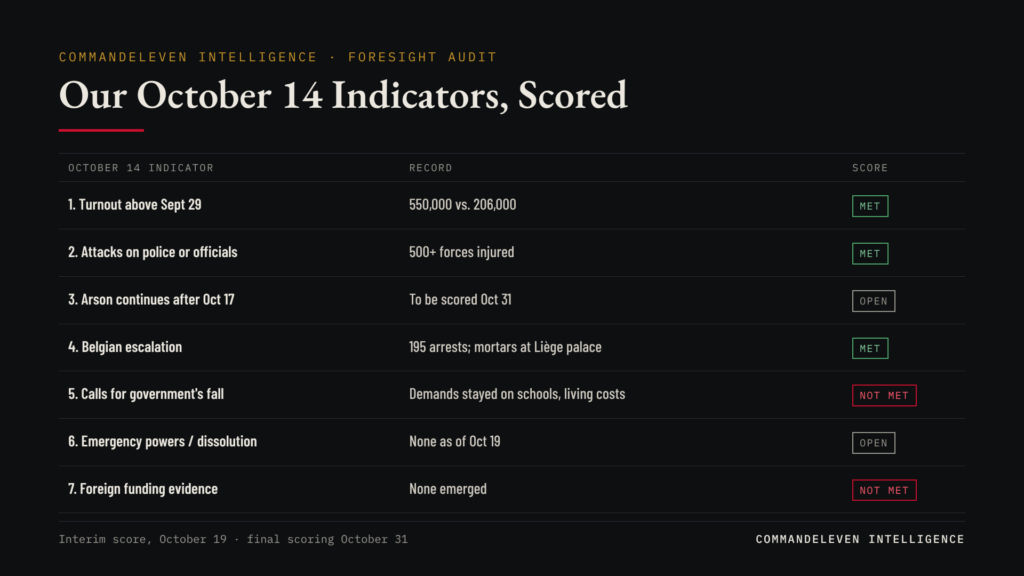
[ASSESSED] The two indicators not met point the same way. The movement has escalated in violence without escalating in political demands. That fits a pattern of a large protest carrying an organized violent core, which was the distinction the October 14 dossier drew, rather than a movement aiming at the government itself. On attribution, French intelligence’s reported pre-October 17 assessment that the movement was “an operation organised by” La France Insoumise remains single-sourced through Le Figaro. Since the 17th, ministers have blamed “radical far-left groups” without naming a party.
The On-Air Calls, Scored
On Survival Dispatch’s France episode, “France Is Burning: Is America Next?“, broadcast in the days before October 17, Syed Khalid Muhammad made several specific calls. They are scored here to the same standard as our written work. Timestamps refer to the episode recording.
| Call (timestamp) | Record | Score |
| “10/17 is a real date… They are organizing to do it.” (1:40:41) | The largest and most violent day of the unrest. | Right |
| The next wave would start “setting fire to things” and “attacking businesses.” (0:31:58) | Hundreds of businesses looted; Limoges City Hall and Lyon’s tourist office set on fire. | Right |
| An “escalation ladder”: the next round would be “two, three steps above” the last. (1:20:58) | Arrests, injuries and damage on October 17 all exceeded earlier days. | Right |
| Action across several cities and countries, naming Belgium, Berlin, Bonn, Nice, Paris and Marseille. (1:38:58) | Paris, Nice, Marseille and Belgium, yes, plus Italy and Portugal. No protests reported in Germany. | Partly right |
| “There’s going to be an IED that blows up, a VBIED… and this will turn into a mass casualty event.” (1:40:06) | No explosive attack occurred. One death, from a heart attack, is under investigation. | Wrong |
| The French government could collapse. (1:41:13) | Has not happened. | Not borne out so far |
| It should be treated as domestic terrorism, not protest. (0:30:19) | Macron spoke of those who “sought to bring down the Republic,” but France has not used terrorism laws or emergency powers. | Partly borne out |
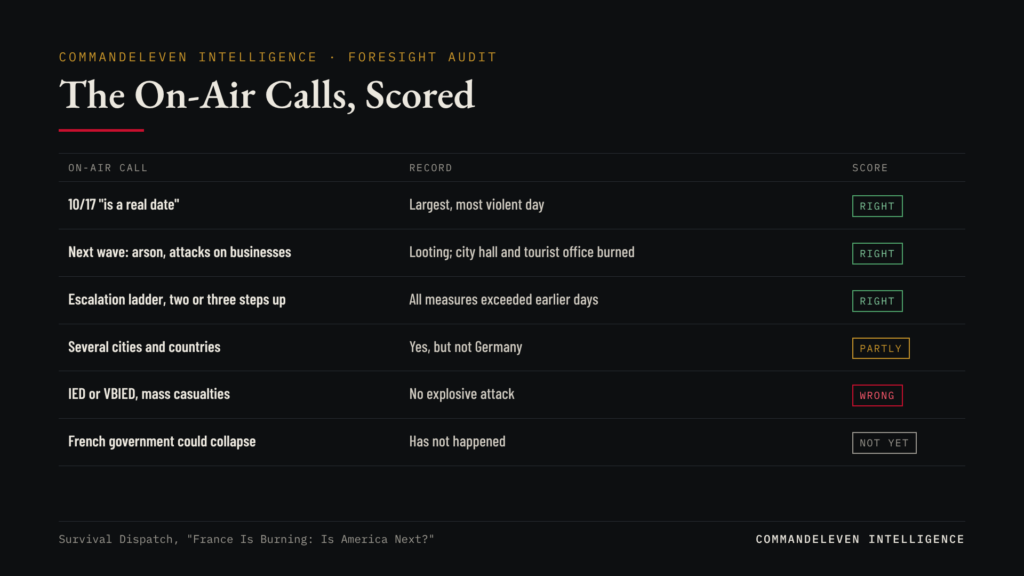
On the miss. The IED warning was the most serious call made and the one that did not happen. CommandEleven Intelligence publishes it here for the same reason we publish our hits: a record that shows only the right calls is not a record. The warning reflected chatter we were tracking about October 17 being treated as an attack date. The chatter about the date was right. The form we expected it to take was not.
What Comes Next
[ASSESSED] The movement now has two tracks. The student track has a concrete list of education demands and is waiting for the government’s answer. The violent track has shown it can turn a mass march into arson and looting in several cities on the same day, and it does not depend on the students’ demands being met or refused. Alberto Alemanno, quoted by Al Jazeera, expected mobilization in Greece, Germany and Austria “in the coming week.”
The lesson for the United States, which our Domestic Threat Landscape series treats Europe as a leading indicator for, is the speed of the convergence: a school protest in one Paris suburb on September 21 became a 550,000-person national day with coordinated violence in under four weeks.
Indicators to October 31
- Arson. Do attacks on schools or public buildings continue after October 17? (Closes indicator 3.)
- The state. Does France use emergency powers or dissolve a group under its laws against violent associations? (Closes indicator 6.)
- The government. Does Macron answer the students’ demands, and does any part of the movement turn to calling for the government’s fall?
- Spread. Do Germany, Greece or Austria see comparable mobilization?
Frequently Asked Questions
What happened in France on October 17, 2026?
About 550,000 people marched nationwide over the cost of living and school conditions. Protests turned violent in several cities, with more than 1,800 arrests, more than 500 police and firefighters injured, looting and an arson fire that destroyed Limoges City Hall.
Who is behind the violence?
The French government blames “radical far-left groups” and criminals. A French intelligence assessment reported by Le Figaro before October 17 named La France Insoumise, which the party denies.
Did the protests spread outside France?
Yes. Belgium, Italy and Portugal also saw protests on October 17, with violence in Brussels, Liège and Milan.
What did CommandEleven Intelligence get wrong?
An on-air warning of an IED or vehicle bomb and a mass-casualty event did not happen. We also expected calls for the government’s fall, which have not appeared.
Sourcing Base (Confidence-Tiered, with Links)
CONFIRMED — Reporting:
- CBS News, French police arrest more than 1,800 people after violent protests erupt across country, October 18, 2026
- ABC News (AP), Macron condemns those who ‘sought to bring down the Republic’, October 18, 2026
- NPR, France’s Macron vows to hold accountable those who ‘sought to bring down the Republic’, October 17, 2026
- The Week, France protests: 1,800 arrested after violent clashes, looting; students call for ‘concrete measures’, October 18, 2026
- Al Jazeera, Cost of living protests hit Belgium, Italy, Portugal and France, October 17, 2026
- TRT World, Nearly 200 arrested as education and budget protests turn violent in Belgium, October 2026
ASSESSED — Single-Source and Analysis:
- Latin Times, France’s Student Uprising Is Being Hijacked, and an Intelligence Report Names Who Is Doing It, October 2026 (reporting Le Figaro’s account of the September 29 French intelligence report)
- Survival Dispatch, “France Is Burning: Is America Next?“, October 2026 (episode recording; timestamps cited above)
Excluded from this dossier: Any claim that immigrants as a group drove the violence, which French authorities have not found. Any claim of foreign funding, which remains undocumented. Unverified social-media claims about who organized the violence.