
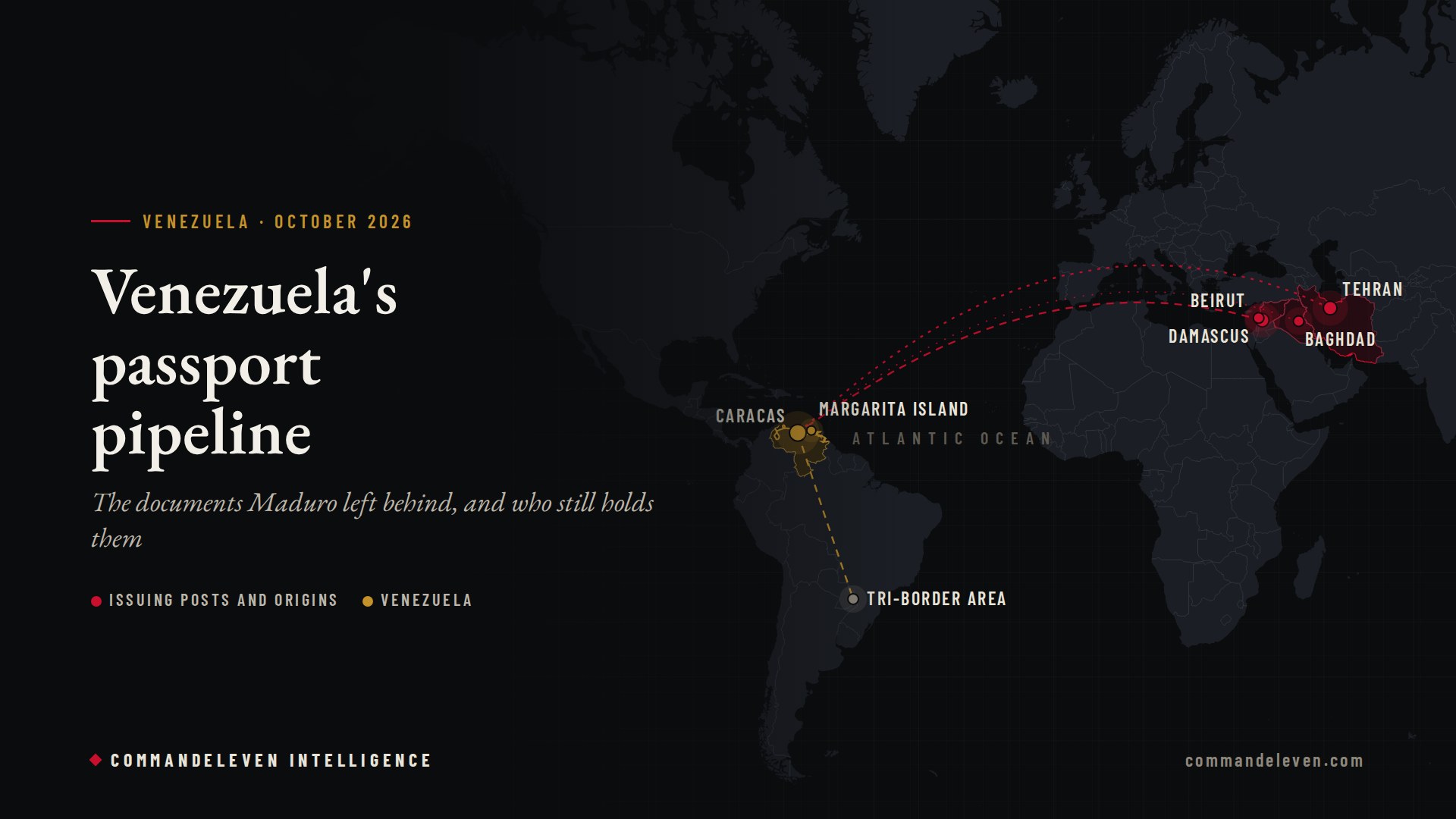
Key Judgments
- [CONFIRMED] Venezuelan state officials helped Hezbollah members travel on Venezuelan documents. In 2008 the US Treasury found that Ghazi Nasr al Din, then Venezuela’s chargé d’affaires in Damascus, “facilitated the travel of Hizballah members to and from Venezuela.”
- [ASSESSED] The scale has never been proven. The figures in circulation run from 173 documents to more than 10,400 people and on to claims of over 20,000. None of them comes from a published, audited list. The higher figures measure how many people from Lebanon, Syria and Iran received Venezuelan papers, not how many of them were operatives.
- [ASSESSED] Nicolás Maduro’s capture in January 2026 removed the political protection behind the scheme, but not the documents. Passports and naturalizations issued under Hugo Chávez and Maduro stay valid unless the state revokes them.
- [DATA DEFICIT] As of October 2026, there is no public record that the interim government of Delcy Rodríguez has audited, revoked or handed over any of these documents or the records behind them.
- [ASSESSED] The clearest test is whether the records leave Venezuela. Tareck El Aissami, who ran the passport agency and later the Interior Ministry, has been detained in Caracas since April 2024 and is reportedly sought by Washington. His transfer to US custody would be the strongest sign that the passport files are being opened.
Bottom Line Up Front (BLUF)
For two decades, a Venezuelan passport was one of the most useful documents a Hezbollah facilitator could hold. It was genuine and issued by a sovereign state, and it opened doors across Latin America and beyond. The core of the story is on the record: a US Treasury designation, a former embassy lawyer’s testimony and a decade of congressional hearings. The numbers are not. With Maduro in a New York jail and his former vice president running an interim government that cooperates with Washington, the question has changed. It is no longer whether Caracas handed out documents, but what happens to the thousands already issued. So far the answer is nothing visible. CommandEleven Intelligence’s base case is a partial cleanup: high-profile figures handed to the United States, but no systematic audit of the documents themselves.
What the Record Shows
The evidence builds over seventeen years, from designations and court filings to testimony and investigative reporting. Each item below carries its own confidence tier.
- 2002–2003, Margarita Island [ASSESSED]. Former Treasury official Marshall Billingslea told a Senate caucus in October 2025 that there were indications of document forgery on the island as early as 2002–2003, which he linked to facilitating terrorist travel.
- 2003 onward, the identity system [ASSESSED]. Venezuela rebuilt its identity and passport systems from 2003, starting with the Misión Identidad program, with Cuban advisers and Cuban-linked software suppliers, according to a 2014 investigation by Armando.info.
- June 2008, the Damascus channel [CONFIRMED]. The US Treasury designated Ghazi Nasr al Din, the chargé d’affaires in Damascus, as a Hezbollah supporter. It found that he had “facilitated the travel of Hizballah members to and from Venezuela.”
- 2013–2015, the Baghdad embassy [ASSESSED]. Misael López Soto, legal adviser at Venezuela’s embassy in Iraq, reported that genuine passports and visas were being sold to non-Venezuelans. He says his reports were ignored, and he later took them to the FBI.
- February 2017, CNN’s investigation [ASSESSED]. CNN’s “Passports in the Shadows” linked El Aissami to 173 passports and identity documents issued to people from the Middle East. Venezuela denied the reporting and took CNN en Español off the air.
- February 2017, El Aissami sanctioned [CONFIRMED]. The US Treasury designated El Aissami, then vice president, under the Kingpin Act. The designation was for drug trafficking, not for passports.
- May 2020, US indictments [CONFIRMED as charges]. Federal prosecutors in New York charged Adel El Zabayar, a former PSUV deputy, with narco-terrorism. They alleged that he helped recruit members of Hezbollah and Hamas. He rejects the charges, which have not been tested in court.
What the record does not contain is a published case in which a Venezuelan-issued passport is proven, in court, to have carried a Hezbollah or IRGC operative to an attack. The cases most often cited, such as the 2012 Burgas bombing in Bulgaria, rest on press reports about the passports involved rather than on court findings.
The Numbers Problem
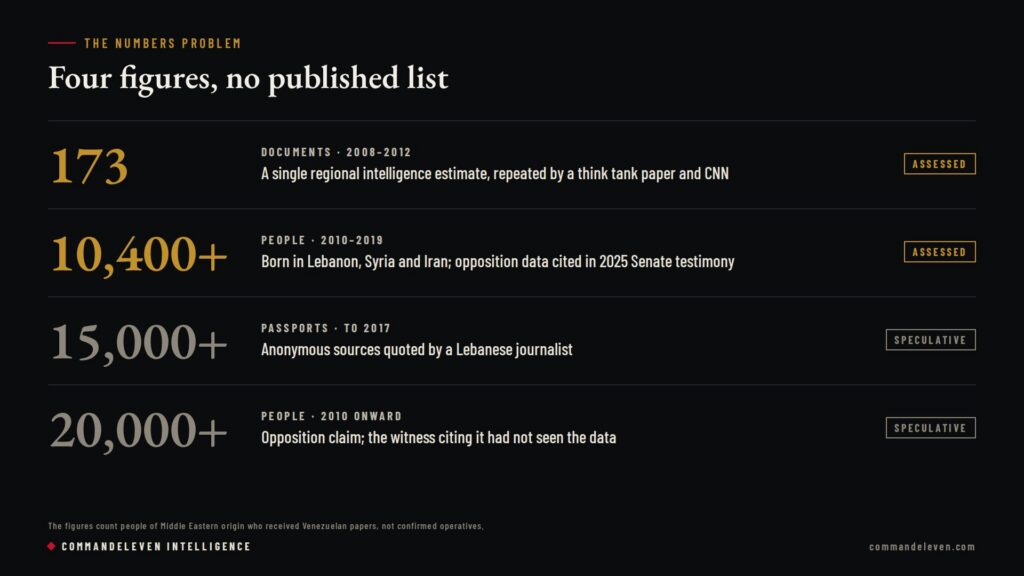
| Figure | Period | Source | What it measures | Confidence |
|---|---|---|---|---|
| 173 documents | 2008–2012 | A single “regional intelligence” estimate, repeated by a 2014 think tank paper and by CNN in 2017 | Passports, visas and IDs issued to people from the Middle East | ASSESSED: one origin, repeated |
| More than 10,400 people | 2010–2019 | Opposition deputy Carlos Paparoni, cited in Billingslea’s 2025 Senate testimony; a list reported by the Daily Mail in August 2025 | Venezuelan passports or nationality granted to people born in Lebanon, Syria and Iran | ASSESSED: specific, but unpublished |
| “More than 20,000” | 2010 onward | Opposition figures cited by Billingslea, who said he had not seen the data | The same, extended | SPECULATIVE |
| More than 15,000 | To 2017 | A Lebanese journalist’s anonymous sources | Passports issued “to pro-Iranian groups” | SPECULATIVE |
Two cautions apply.
First, the figures count nationalities, not operatives. Venezuela has a large, long-established Lebanese and Syrian diaspora, and the 2010–2019 period includes the Syrian war. Paparoni himself said he could not be certain the 10,400 had Hezbollah ties. CommandEleven Intelligence treats the 10,400 figure as the size of the population that needs screening, not as the size of Hezbollah’s network.
Second, the sources overlap. The 173 figure appears in the think tank paper, the op-ed that cited it and CNN’s report, but it traces back to a single estimate. Repetition is not corroboration.
Why a Venezuelan Passport Was Worth Having
The value of a Venezuelan passport to a facilitator was not that it was forged, but that it was real. A genuine document backed by a genuine nationality survives any check of whether the passport itself is authentic. A forgery does not. Analysts cited by Alhurra say the passport offered visa-free entry to more than 130 countries. It also allowed travel across Latin America, where Hezbollah’s financial networks run through the Tri-Border Area, Colombia’s Maicao and Venezuela’s own Margarita Island. CommandEleven Intelligence’s Unit 910 assessment and cartel logistics assessment set out those networks.
The skeptical case deserves a hearing. A Venezuelan passport never gave visa-free entry to the United States, so a holder still had to pass US visa screening. Passport fraud is also common across the region and is not unique to Venezuela. Both points limit the threat to the US homeland specifically. Neither changes the core problem: a state issued genuine identities on request, and those identities moved freely through the countries where Hezbollah raises and launders its money.
After Maduro: What Has Changed and What Hasn’t
US forces captured Maduro in Caracas on January 3, 2026. Delcy Rodríguez, his vice president, was sworn in as acting president two days later. Washington restored relations in March and recognized her as Venezuela’s sole head of state.
What has changed:
- US policy is explicit. The day after the raid, Secretary of State Marco Rubio said: “No more Iran/Hezbollah presence there.”
- Caracas is handing people over. The interim government helped deport Alex Saab, the Maduro-linked businessman, to the United States in May, and he pleaded guilty to money laundering in July. In October it sent businessman Álvaro Pulido Vargas to face US charges. Bloomberg reported on October 12 that US authorities are also seeking El Aissami and former Supreme Court president Maikel Moreno.
- Relations with Tehran have cooled. On July 28, Venezuela summoned Iran’s ambassador to deliver a formal protest over comments it called “contemptuous and inappropriate.”
What hasn’t changed:
- [DATA DEFICIT] No audit. There is no public record of a review of passports or naturalizations issued from 2008 to 2019, no published list and no reported revocations.
- The documents remain valid. Under Article 35 of Venezuela’s constitution, naturalized nationality can be revoked only by a court ruling. Each case would need its own proceeding.
- The issuing apparatus is still in place. CommandEleven Intelligence assessed in August that the PSUV state and its mid-level officials remain largely intact after Maduro. The passport file is where that continuity matters most. Rodríguez was foreign minister when López Soto says his reports from Baghdad were ignored.
- Venezuela stayed out of the regional statement. On October 5, ten governments in the hemisphere, including the United States and Canada, issued a joint warning about Iranian activity in the region. Venezuela was not among them.
Where the Risk Goes Now
Scenario A: The files are opened (low to moderate likelihood). El Aissami and other officials who ran the passport and naturalization system are handed to the United States, and their records go with them. Venezuela, under US pressure, reviews the 2008–2019 grants, and partner governments receive lists to check against their own entry records. The threat shrinks, but slowly, through screening and not a single event.
Scenario B: Partial cleanup (base case) [ASSESSED]. High-profile figures sought by Washington are handed over one by one, as Saab and Pulido Vargas were, because each handover buys the interim government goodwill. The documents themselves are not systematically reviewed, because a review would expose officials still in the government. Holders keep valid Venezuelan identities.
Scenario C: Displacement (already underway in part) [ASSESSED]. Facilitators who leave Venezuela do not leave their documents behind. The Soufan Center and Alhurra both report that Hezbollah-linked figures may relocate elsewhere in Latin America or turn to West Africa. Those who leave will carry valid Venezuelan passports issued before 2019. The risk moves from Caracas to the border posts and banks of the countries where they settle.
Scenarios B and C are not alternatives. CommandEleven Intelligence assesses that both are likely to run at the same time.
Indicators to Watch
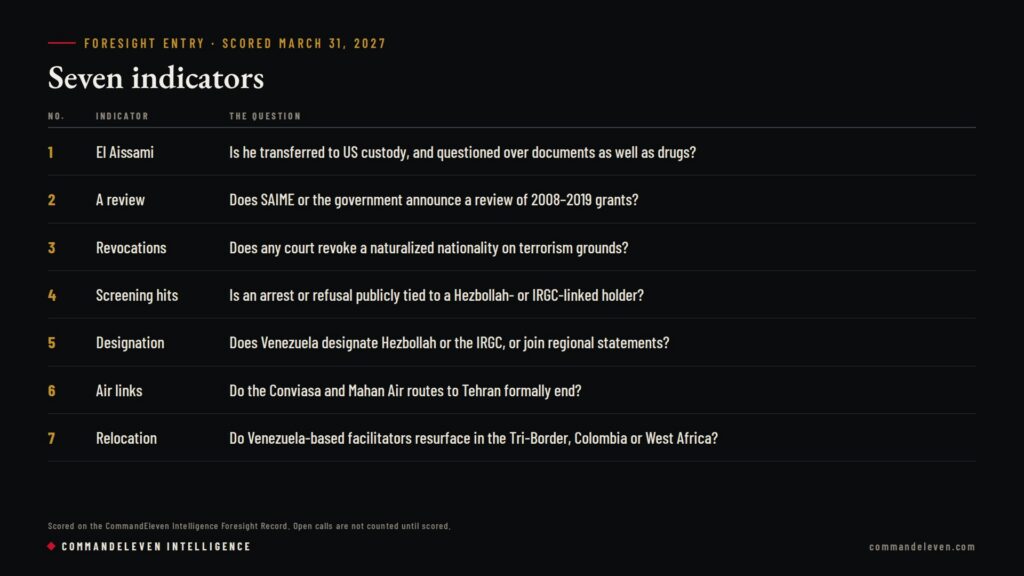
CommandEleven Intelligence will score these seven indicators on the Foresight Record on March 31, 2027:
- El Aissami in US custody. Is he transferred, and is he charged or questioned over documents as well as drugs?
- An announced review. Does Venezuela’s identity and passport agency, SAIME, or the government announce a review of passports or naturalizations issued from 2008 to 2019?
- Revocations. Does any Venezuelan court revoke a naturalized nationality on terrorism grounds?
- Screening hits. Is any arrest or entry refusal in the hemisphere, the United States or Europe publicly tied to a Hezbollah- or IRGC-linked holder of a Venezuelan passport?
- Designation. Does Venezuela designate Hezbollah or the IRGC as terrorist organizations, or join regional statements on Iran?
- Air links. Do the Conviasa and Mahan Air routes between Caracas and Tehran formally end?
- Relocation. Is there credible reporting of Venezuela-based Hezbollah facilitators resurfacing in the Tri-Border Area, Colombia or West Africa?
Frequently Asked Questions
Did Venezuela give passports to Hezbollah?
The US Treasury found in 2008 that a Venezuelan diplomat in Damascus facilitated the travel of Hezbollah members to and from Venezuela. The wider claim that thousands of Venezuelan passports went to Hezbollah members has not been proven with a published list.
How many passports were involved?
The estimates range from 173 documents (2008–2012) to more than 10,400 people from Lebanon, Syria and Iran (2010–2019). The higher figure counts people of those origins who received Venezuelan papers, not confirmed operatives.
Are those passports still valid after Maduro?
Yes, unless they have expired or been revoked. As of October 2026, there is no public record of any revocation or audit by the interim government.
Why does Tareck El Aissami matter?
According to Billingslea’s testimony, he ran ONIDEX, the agency that issued passports, before becoming interior minister, and CNN linked him to 173 documents. He has been detained in Venezuela since April 2024 and is reportedly sought by the United States.
Can a Venezuelan passport get someone into the United States?
Not on its own. Venezuelans need a US visa, and in June 2025 Venezuela was placed under partial US entry restrictions. The greater exposure is in Latin America and in countries where the passport gives visa-free entry.
Sourcing Base (Confidence-Tiered, with Links)
CONFIRMED — Official Record:
- US Department of the Treasury, “Treasury Targets Hizballah in Venezuela,” June 18, 2008
- US Department of the Treasury, designation of Tareck El Aissami and Samark López under the Kingpin Act, February 13, 2017
- Hudson Institute, “Global Gangsters: Hezbollah’s Latin American Drug Trafficking Operations,” Marshall Billingslea’s testimony to the Senate Caucus on International Narcotics Control, October 2025
- House of Commons Library, “Venezuela: What has happened since Maduro’s capture in January 2026?,” September 2026
ASSESSED — Credible Reporting and Analysis:
- The Soufan Center, “With Maduro Gone, What Happens to Hezbollah’s Presence in Venezuela?,” January 30, 2026
- Alhurra, “Venezuela, Hezbollah and the ‘Keys’ to 130 Countries,” January 8, 2026
- Fox News, “Rubio vows to eliminate Hezbollah, Iran operations from Venezuela after Maduro capture,” January 4, 2026
- Iran International, “Venezuela summons Iranian envoy over ‘inappropriate’ remarks,” July 29, 2026
- Iran International, “Iran-linked operatives may have entered US with Venezuelan passports,” August 7, 2025 (citing the Daily Mail)
- CiberCuba, “Bloomberg points to Tareck El Aissami and Maikel Moreno as potential next individuals to be handed over to the U.S.,” October 13, 2026
- Infobae, “Estados Unidos y sus aliados alertaron de posibles planes letales de Irán en América Latina,” October 6, 2026
- OCCRP, “Former Venezuelan Oil Minister and Vice President Arrested for Corruption,” April 2024
- Runrunes, “Paparoni: se le dio nacionalidad venezolana a 10.400 personas de Irán, Siria y Líbano,” October 23, 2025
- Armando.info, “Pasaportes para el terror,” August 30, 2014
- The Amit Terrorism and Intelligence Research Institute, “Hezbollah’s Activity in Venezuela and How the Recent American Arrest of Maduro May Affect It,” January 2026
- Wikipedia, “Passport fraud in Venezuela and Iraq” (compiled record of the 2017 CNN investigation and the López Soto account)
- Wikipedia, “Adel El Zabayar” (compiled record of the 2020 indictment)
The Skeptical Case:
- Venezuelan Politics and Human Rights, “Fact Checking Venezuelan Passports-to-Terrorists Allegations,” February 2017
CommandEleven Intelligence Prior Work:
- Hezbollah’s Unit 910: IRGC’s Latin American Reach – Part 4, August 2026
- Asymmetric Proxies on the Border: IRGC-QF and Cartel Logistics – Part 3, August 2026
- Asymmetric Proxies: IRGC Infiltration of Latin American Cartels – Part 5, May 2026
- The Invisible Axis: The IRGC’s Quiet Buildup in Latin America, September 2026
Excluded from this assessment: Claims that specific holders of Venezuelan passports entered the United States, which no source documents with a named case. The “more than 20,000” and “15,000” figures are recorded as speculative and not used in the judgments. Claims about Venezuelan passports issued by Lebanon’s foreign ministry are not covered here.

