Bottom Line Up Front
China has not fought in the 2026 Iran war, but it has fed it. Since the US-Israeli strikes began on 28 February 2026, Beijing has supported Iran’s war effort along three supply lines:
- An industrial line – Dual-use components and propellant chemicals.
- A space line – Commercial satellite imagery and geospatial data.
- A diplomatic line – UN vetoes and the refusal to enforce US sanctions.
Each line is built for deniability. Most of what moved was dual-use, moved through sanctioned Iranian carriers, or came from “commercial” Chinese firms. Beijing can therefore deny state involvement while the material arrives. The Wall Street Journal’s 24 September report adds the hardest evidence so far: Iranian customs records showing roughly 1,300 air shipments from China to Iran’s Defense Ministry in the first half of 2026. Some arrived on the day the mid-June ceasefire memorandum was signed.
This is the third leg of the Axis of Evil supply picture. Russia supplies Iran across the Caspian. North Korea supplies Russia’s war with labor and munitions. China supplies the components that let all of them produce weapons at volume.
Key Judgments
- KJ1 – [ASSESSED, high confidence] – China has supplied Iran’s war effort along three lines (industrial, space, diplomatic) while avoiding any acknowledged transfer of major finished weapons systems
- KJ2 – [CONFIRMED as reported from customs records; single investigative source] – The industrial line is the best documented, and it held up through the ceasefire. Customs data reported by the WSJ shows about 1,300 shipments to Iran’s Defense Ministry between January and June 2026, including GPS devices, electric motors, aircraft-engine parts and chemical precursors. Shipments arrived on 17 June, the day the US-Iran memorandum was signed, and more than a dozen followed within two days.
- KJ3 – [CONFIRMED that the US government has made the allegation; ASSESSED on state direction] – Chinese commercial satellite data reached Iranian targeting. The US government sanctioned three Chinese imagery firms on 9 May 2026. In September, US officials told the WSJ that Iran used Chinese-sourced imagery before the 17 July strike on Muwaffaq Salti Air Base in Jordan, which killed three US service members. Whether the Chinese state directed this has not been established.
- KJ4 – [ASSESSED, moderate confidence] – Finished weapons are the thinnest part of the record. The case for Chinese shoulder-fired air-defence missiles reaching Iran rests on anonymous US officials and sources. The officials say an F-15E was “probably” downed by one, and Reuters reported a deal for up to 400 launchers. That is significant if true, but it is not documented to the standard of the component flows.
- KJ5 – [ASSESSED, moderate-high confidence] – Beijing treats ceasefires as windows to resupply, not as reasons to stop. The cargo arriving on the day the memorandum was signed, and the doubling of Mahan Air’s China-Iran flights since before the war, point to deliberate stockpiling during lulls.
- KJ6 – [CONFIRMED (vote record); ASSESSED (intent)] – China is now actively shielding Iran in the UN, not just declining to criticize it. The 17 September Russia-China veto ended the UN panel that monitored sanctions on Iran. That removes the main independent source of reporting on the very supply flows described here.
Context: The War and Beijing’s Position
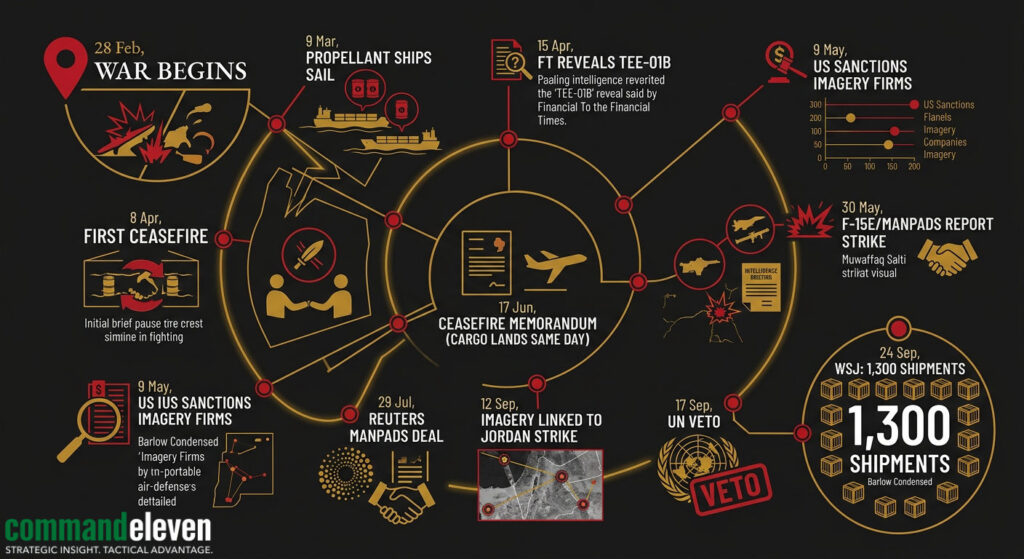
The war began with coordinated US-Israeli strikes on 28 February 2026. A Pakistan-mediated ceasefire followed on 8 April. A memorandum signed on 17 June set up a 60-day window to negotiate a final settlement. That truce did not hold: Iran struck Muwaffaq Salti Air Base in Jordan on 17 July, and as of 29 September no ceasefire was in force and indirect talks were continuing.
Beijing’s public line has not changed. It says it is “objective and impartial”, that it “strictly controls exports of dual-use goods”, and that US sanctions are unilateral and illegal. In private, China remains Iran’s largest trading partner and its buyer of last resort for crude. Xi Jinping’s state visit to Washington in the final week of September produced no reported breakthrough on Iran. Xi said only that he supported a return to the interim agreement.
The Industrial Line: Components by Air
The customs record
The WSJ’s 24 September investigation is the most important single piece of evidence. Using Iranian customs records covering January 2025 to June 2026, it reported:
- About 1,300 shipments from Chinese entities to Iran’s Defense Ministry in the first half of 2026.
- Contents – GPS devices, electric motors, aircraft-engine parts and other dual-use electronics. A CSIS economist quoted in the coverage said some components are known to be used in Iran’s Shahed drones.
- Paperwork – many consignments cited Iran’s tariff exemption for defence imports. In other words, Tehran’s own customs system recorded them as defence goods.
- Timing – cargo landed on 17 June, as the memorandum was signed, and more than a dozen further shipments worth over $6 million followed within two days.
Sourcing note: the shipment count rests on one investigative source (WSJ, drawing on customs data and unnamed officials). Treat the specific figure as reported rather than independently verified. CommandEleven Intelligence has not seen the underlying records.
The Mahan Air bridge
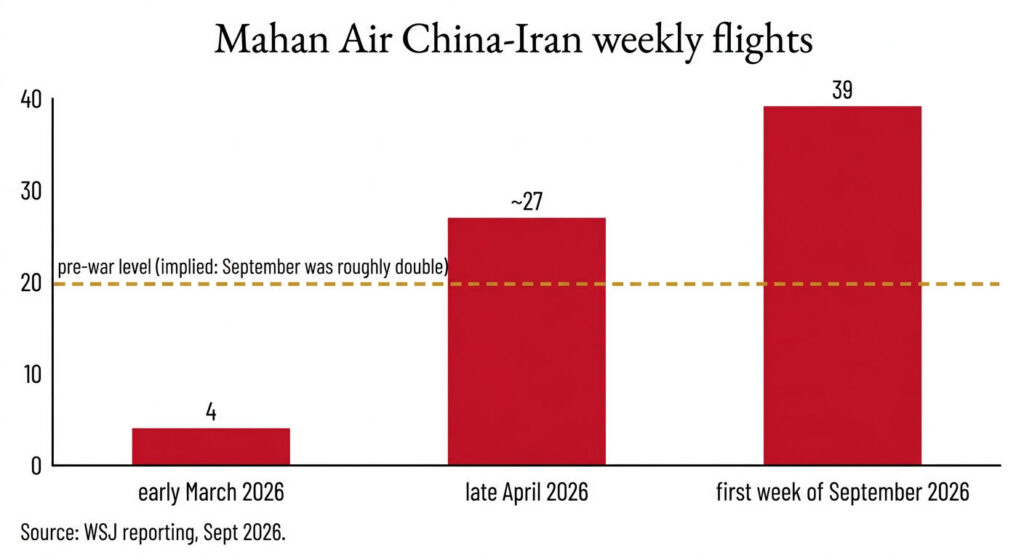
The air route ran largely on Mahan Air, an Iranian carrier the US has sanctioned for IRGC logistics. Its flights from Beijing, Shanghai and Guangzhou to Tehran rose from four a week in early March to about 27 a week by late April. As reported, it ran 39 China-Iran flights in the first week of September, roughly double the pre-war level. Some of those flights could not be booked by passengers.
CommandEleven Intelligence assessment – Air freight trades capacity for speed and resistance to interdiction. Small, valuable items such as navigation modules, motors and engine parts are exactly what you move by air when sea routes are watched and a naval blockade is in force. That blockade ran from 13 April to 18 June. The surge in flights fits a supplier moving its highest-priority cargo by the hardest route to stop.
The pre-war baseline
The pipeline did not start with the war:
- November–December 2025 – the US sanctioned, then intercepted off Sri Lanka, the Honestar, carrying Chinese gyroscopes and spectrometers usable in guided missiles.
- Days before 28 February – about 300 tons of chemical compounds were delivered, according to the WSJ’s reporting.
CommandEleven Intelligence assessment – The industrial line was a peacetime procurement network that scaled up when the war began, not a wartime improvisation.
The Industrial Line: Chemicals by Sea
Solid-propellant missiles depend on oxidizer precursors, and those moved by sea.
- 9 March 2026 – two vessels operated by Islamic Republic of Iran Shipping Lines (IRISL), Shabdis and Barzin, left Gaolan port in Zhuhai, a known loading point for sodium perchlorate, bound for Bandar Abbas and Chabahar. Washington Post analysis of ship tracking, satellite imagery and Treasury records assessed that they were likely carrying sodium perchlorate. IRISL is sanctioned by the US, UK and EU.
- A Carnegie analyst noted that China “could have held these vessels at port, imposed an administrative delay,” and chose not to.
- The WSJ’s September reporting links a sanctioned Chinese firm, Haokun Energy, to confidential export licensing for the propellant precursor, including a Beijing shell company set up for the transaction.
CommandEleven Intelligence assessment – Letting sanctioned ships sail with propellant precursors during an active war is a choice, not a failure of enforcement. China could have stopped these departures and did not.
The Space Line: Imagery and Coordinates
An owned satellite
The Financial Times reported on 15 April that the IRGC Aerospace Force had acquired TEE-01B, a high-resolution reconnaissance satellite built by the Chinese firm Earth Eye Co. It was bought in late 2024 for about 250 million yuan and has roughly half-meter resolution. Reported targets included Prince Sultan Air Base, Muwaffaq Salti Air Base, the US Fifth Fleet base in Bahrain and Erbil airport, as well as ports and power plants across the Gulf. China’s embassy called the report “speculative and insinuating disinformation.”
Commercial imagery on demand
On 9 May 2026, the State Department sanctioned three Chinese firms:
- Meentropy Technology (MizarVision) – Published imagery of US military activity during Operation Epic Fury
- The Earth Eye – Provided satellite imagery to Iran
- Chang Guang Satellite Technology (operator of the Jilin-1 constellation) – Collected data on US and allied forces at Tehran’s request
From imagery to casualties
On 12 September, US officials told the WSJ that Iran obtained high-resolution Chinese satellite images of Muwaffaq Salti before the 17 July strike that killed three US service members. The officials did not name the Chinese entities or claim the Chinese government was directly involved. They also said Iran relied on its own satellites, human sources and Russian imagery. Later reporting quoted a US official saying Iran’s targeting “has improved, and it is due to some assistance.” China’s embassy accused critics of “maliciously linking and smearing other countries.”
CommandEleven Intelligence assessment – The space line is the hardest to attribute and the most consequential, because it links Chinese commercial activity to American casualties. The line between “commercial firm” and “state” is thin in China’s satellite sector, but it has not been publicly crossed with evidence. Present it as US-government allegation plus circumstantial pattern, not as proven state direction.
Finished Weapons: Shoulder-Fired Air Defence
This is where the evidence is weakest:
- 11 Apr 2026 – US intelligence indicates China is preparing to ship air-defence systems to Iran
- 30 May 2026 – An F-15E lost over Iran in April was “probably” hit by a Chinese-made shoulder-fired missile
- 29 Jul 2026 – Deal for up to 400 launchers worth $60–70 million, first delivery “within weeks”, routed from Urumqi via Pakistan (Pakistan’s military called this “absolutely concocted and false”)
China’s embassy responded to the F-15E report by saying China “always acts prudently and responsibly on the export of military products”. That is notably softer than a flat denial.
CommandEleven Intelligence assessment – A transfer is plausible. Iran has fielded Chinese-derived shoulder-fired missiles for decades, so a missile of Chinese origin does not prove a wartime transfer. The F-15E attribution is “probable” and the Reuters deal is unconfirmed by any government. Until a delivery is documented, this sits below the component flows in the evidence.
- [DATA DEFICIT] – Reuters also reported that Iran was separately pursuing Chinese anti-ship cruise missiles, with completion unclear.
The Diplomatic Line: Cover and Capacity
- Oil – Before the war, China bought more than 80% of Iran’s seaborne crude. In May 2026, Beijing went further than quiet evasion: it invoked its Blocking Statute against US sanctions on independent refiners and told domestic firms to disregard the designations (see CommandEleven Intelligence’s Iran Sanctions 2026 assessment). The revenue funds the procurement described above.
- The UN – On 17 September, Russia and China vetoed a US-backed resolution to extend the UN Panel of Experts that monitors sanctions on Iran. The vote was 11 in favor, with Pakistan and Somalia abstaining. The US described the panel as “the principal source of impartial, evidence-based reporting on sanctions violations.”
- Mediation – Beijing has presented itself as the stabilizing party. It co-sponsored a five-point peace proposal with Pakistan on 31 March and helped persuade Tehran to accept the 8 April ceasefire. Being Iran’s mediator and its quartermaster at the same time is not a contradiction for Beijing. Each role protects the other.
CommandEleven Intelligence assessment – The veto matters more than its headlines suggest. It closes the main independent channel that would document the supply flows in this dossier. Future reporting will depend more on national intelligence leaks and investigative journalism, both of which are easier for Beijing to call politically motivated.
Synthesis: Three Supply Lines, One War
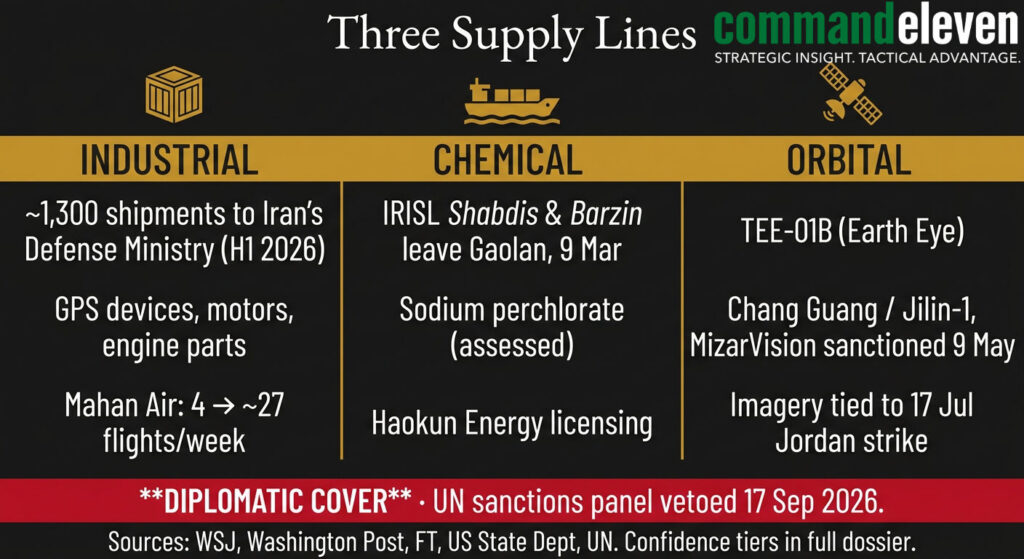
- China – Dual-use components, propellant chemicals, imagery, diplomatic cover
- Russia – Weapons and military cargo (see The New Axis of Evil, Project C430L
- North Korea – Munitions and labor, including at Alabuga (see Alabuga)
The pattern across the Axis of Evil series is division of labor by risk tolerance:
- Russia, already at war and heavily sanctioned, ships finished military goods
- China, which has far more to lose, ships what it can deny: parts, chemicals and data.
The effect on the battlefield can be similar, but the diplomatic cost to Beijing is far lower.
What would change this assessment
- A documented, government-confirmed delivery of finished Chinese weapons to Iran would move China from deniable supplier to open supplier.
- A sustained drop in Mahan Air frequencies, or Chinese enforcement against IRISL calls at Gaolan, would indicate that Beijing is changing course.
Indicators to Watch
- Mahan Air weekly China-Iran frequencies, especially any further surge during ceasefire talks.
- IRISL vessel calls at Gaolan/Zhuhai and other chemical ports.
- New US designations of Chinese firms by OFAC, State or Commerce, especially satellite and propellant suppliers.
- Chinese MOFCOM Blocking Statute orders covering further refiners or shippers.
- Any documented delivery of shoulder-fired missiles or anti-ship cruise missiles, or official confirmation by the US or Pakistan.
- Replacement monitoring after the UN panel’s end: whether the EU, UK or a coalition stands up its own sanctions-reporting mechanism.
Cross-Referenced Links:
- The New Axis of Evil
- Alabuga: The Axis of Evil’s Drone Assembly Line
- Project C430L: Russia’s Covert Missile Assistance to Iran
- China’s 2026 Iran Strategy
- Iran Sanctions 2026: Trump’s Toolkit vs. China’s Defiance
- The Petroyuan Pivot
- Foresight Audit – What We Called on China’s Role in the Iran War
Related Reading
- Foresight Audit: Our China-Iran War Calls, Scored Honestly
- The Houthi Arsenal Goes Local: Chinese Parts and an Iranian Design
- Sanctions vs. Shadow Supply Chains: The Evidence Trail – Part 5
- Iran’s Invisible Army: The Basij Force and the Real Power Behind the Regime
Sources
- Wall Street Journal investigation on Chinese shipments to Iran (24 Sep 2026), as reported by Times of Israel, Iran International and IranWire
- WSJ on Chinese imagery and the Muwaffaq Salti strike (12 Sep 2026), via [Middle East Eye
- US sanctions on Chinese satellite firms (9 May 2026) – Boston Globe/Bloomberg
- FT on TEE-01B, via ThePrint
- Shabdis/Barzin sodium perchlorate shipments – Jerusalem Post and SAFETY4SEA
- Honestar interception – Maritime Executive
- Reuters on shoulder-fired missile deal (29 Jul 2026), via Iran International
- NBC on the F-15E (30 May 2026), via The Aviationist
- CNN on planned air-defence shipment (11 Apr 2026)
- Russia-China veto of UN monitoring (17 Sep 2026) – Al Jazeera
- Trump-Xi summit takeaways – Al Jazeera
- Conflict status, 29 Sep 2026 – CBS News
- Chinese satellite data and Iranian targeting – HNGN (28 Sep 2026)