
Bottom Line Up Front
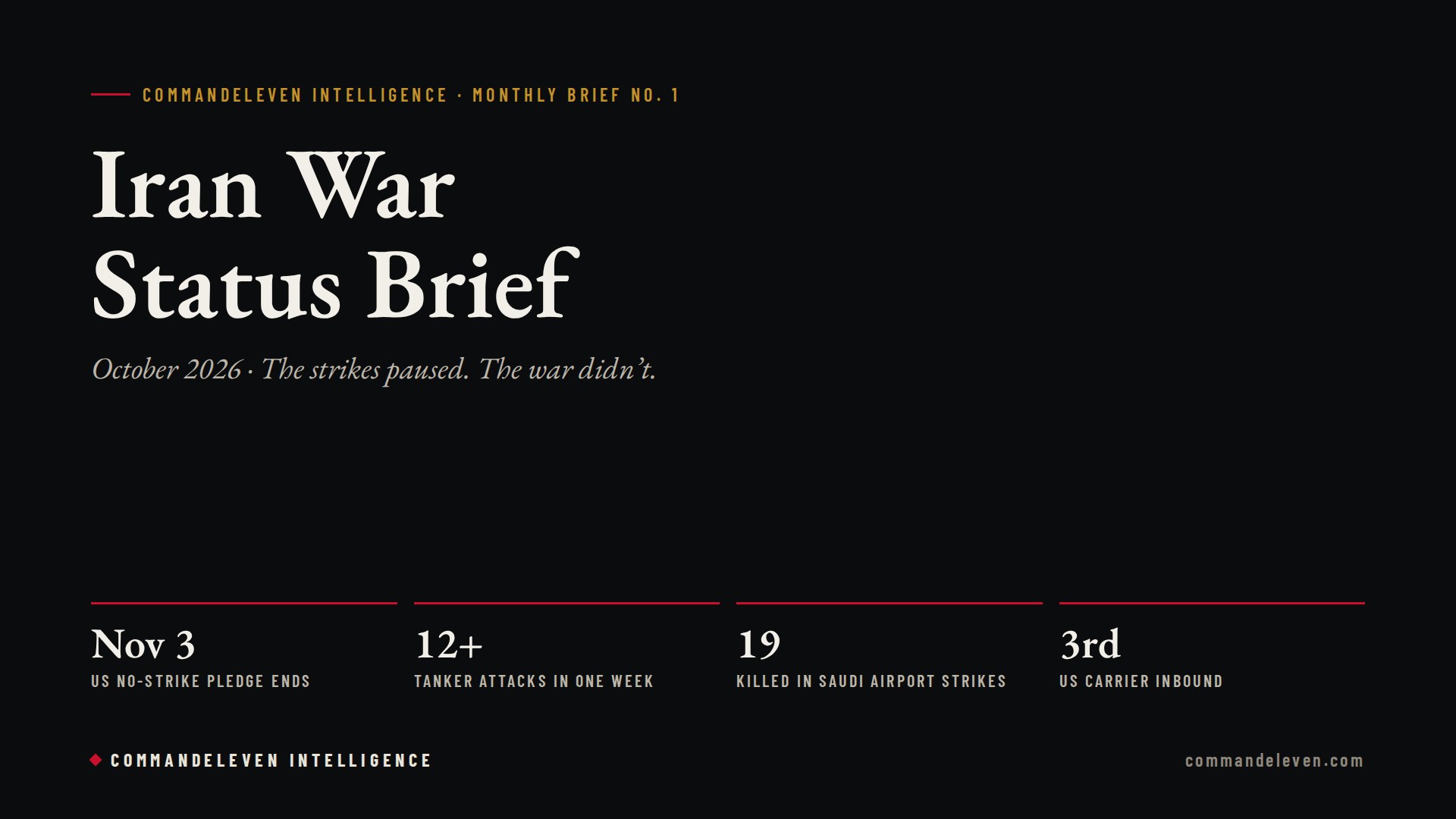
Eight months into the war, the fighting between the United States and Iran is paused, but the war is not. Washington has stopped striking; Iran and its partners have not. President Trump said on October 8 that the US “will not be attacking Iran at any time prior to the Midterm Elections” on November 3, while his team holds “productive discussions” with Tehran. In the same weeks, attacks on tankers around the Strait of Hormuz hit their highest weekly level of the war, the Houthis opened an air campaign against Saudi airports, Western officials assessed that Iran’s missile and drone production survived, and the last US troops left Iraq.
CommandEleven Intelligence assesses that Iran is using the pause the way its doctrine predicts: to rebuild, to keep pressure on shipping and on US partners at low cost, and to bargain from endurance rather than defeat. The decisive window opens after November 3, when the US pledge expires and a third carrier is due in the region. [ASSESSED]
Status Board
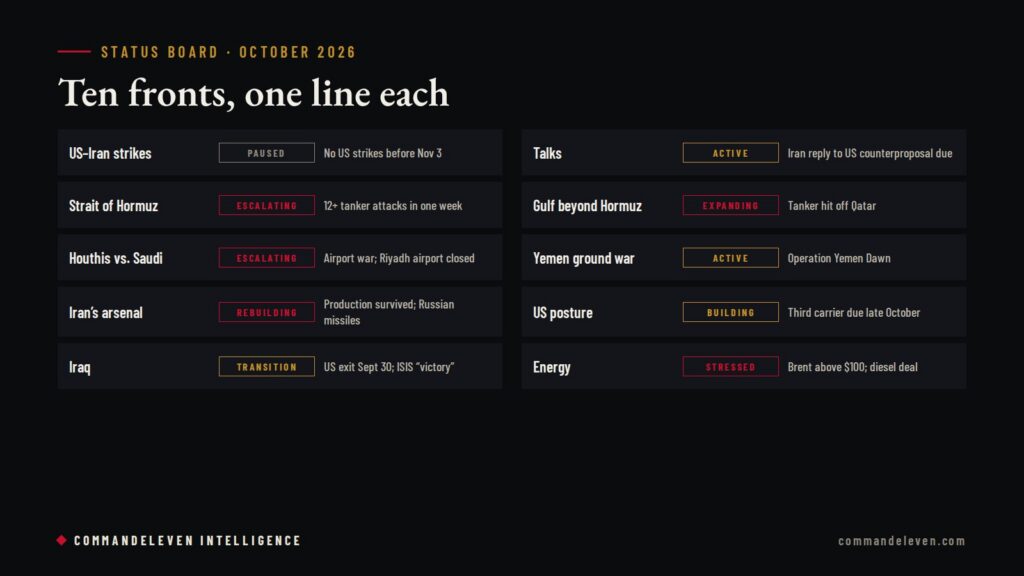
| Front | Status | This month |
|---|---|---|
| US–Iran strikes | Paused | No US strikes before November 3, by Trump’s own pledge |
| Talks | Active | US counterproposal delivered; Iran’s formal reply expected “within days” |
| Strait of Hormuz | Escalating | At least 12 tanker attacks in one week (Sept 28–Oct 5), the war’s worst |
| Gulf beyond Hormuz | Expanding | Tanker Acers hit off Qatar with casualties |
| Houthis vs. Saudi Arabia | Escalating | Airport war: Riyadh, Abha, Dammam hit; Riyadh airport closed |
| Yemen ground war | Active | Operation Yemen Dawn; government forces claim Mokha and Bab el-Mandeb |
| Iran’s arsenal | Rebuilding | Production capacity preserved; Russia supplying missiles |
| US posture | Building | Third carrier, USS Theodore Roosevelt, due as early as late October |
| Iraq | Transition | US mission ended September 30; ISIS calls it a “great victory” |
| Energy | Stressed | Brent above $100; Washington trades Russian sanctions relief for diesel |
What Changed This Month
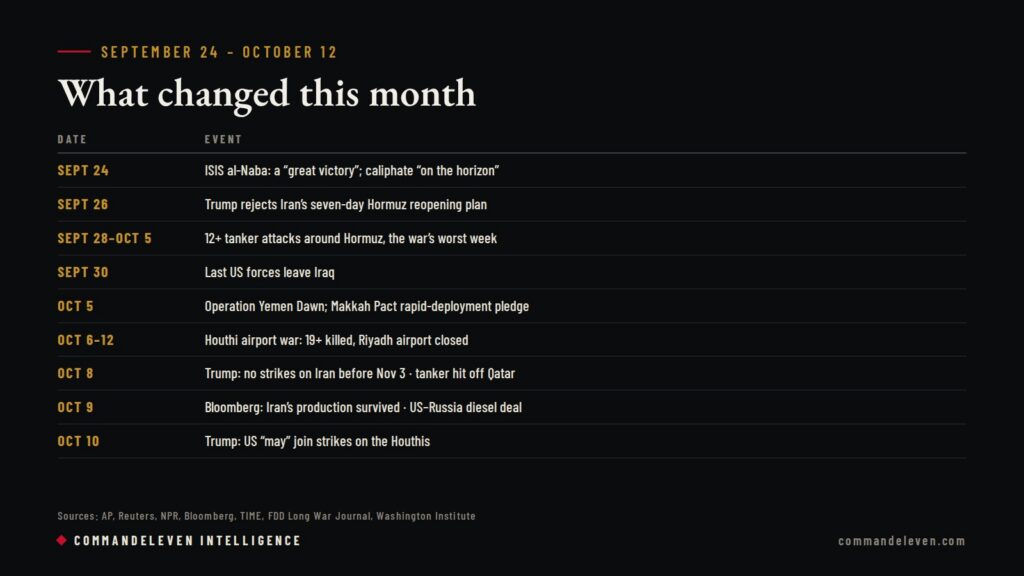
- September 24: ISIS’s al-Naba declares a “great victory” and says the caliphate’s return is “on the horizon.”
- September 26: Trump rejects Iran’s “concrete seven-day plan” to reopen the Strait of Hormuz, presented at the UN General Assembly and passed through Qatar. Iran’s offer included access for UN nuclear inspectors if the US resumed nuclear talks and showed it does not seek regime change.
- September 28 to October 5: At least 12 attacks on oil, LNG and LPG tankers around Hormuz, according to maritime security sources; the IMO logged nine incidents. The IRGC ordered one tanker near Khasab to turn back “or it would be targeted.”
- September 30: The last US forces under Operation Inherent Resolve leave Iraq.
- October 5: Operation Yemen Dawn begins; Makkah Pact members pledge rapid deployment to Saudi Arabia.
- October 6 to 12: Houthi missile and drone strikes on Saudi airports kill at least 19 and wound more than 350; Riyadh’s King Khalid International closes.
- October 8: Trump rules out US strikes on Iran before November 3. A tanker is struck off Qatar, extending the threat beyond Hormuz.
- October 9: Bloomberg reports Western officials’ assessment that Iran preserved missile and drone production capacity and is receiving missiles from Russia. The same day, Washington announces a deal for Russian diesel exports in exchange for sanctions relief.
- October 10: Trump says the US “may” join strikes on the Houthis after a strike on Riyadh’s airport kills 13, including a US citizen.
Doctrine Check
How this month’s evidence tests the judgments in the Iran War Doctrine & Strategy series:
| Series judgment | This month’s evidence | Verdict |
|---|---|---|
| Part 1: Mosaic defense lets Iran fight on after decapitation | Iran sustains maritime pressure and negotiates in parallel, with no sign of command breakdown | Holding |
| Part 3: Hormuz is Iran’s primary lever, contested with harassment and electronic warfare | Record week of tanker attacks; IRGC hails, drone overflights and “turn back” orders | Holding, intensified |
| Part 4: The Axis of Resistance extends the war through partners | The Houthis open a second front against Saudi Arabia while US strikes on Iran are paused | Holding |
| Part 5: Shadow supply chains keep the arsenal alive | Western officials say Russia is supplying missiles | Strengthened |
| Part 6: Endurance is Iran’s fifth doctrinal pillar | Production lines survived; Iran rebuilds during the pause | Strengthened |
Foresight Log
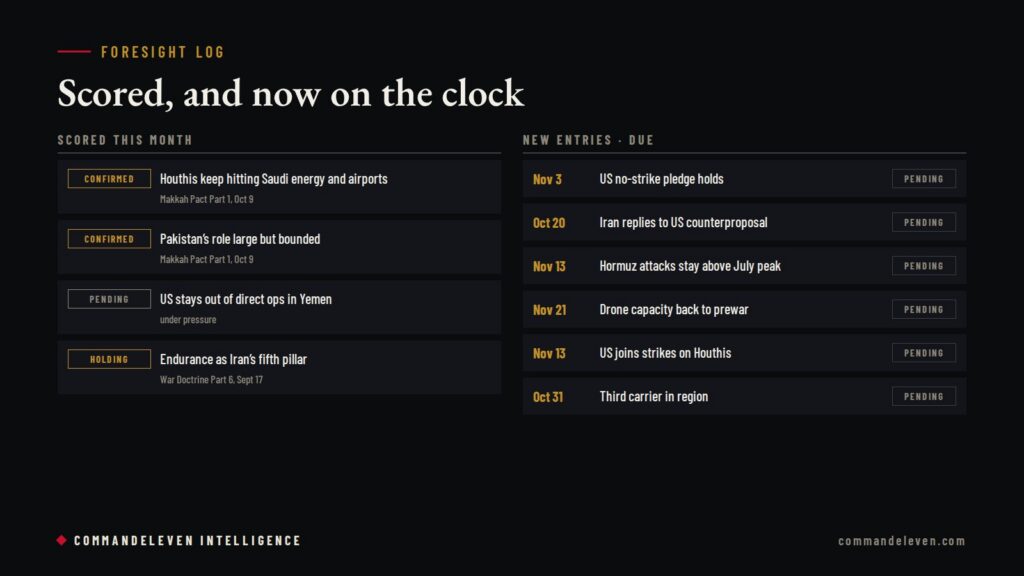
Scored this month
- The Makkah Pact’s First Test (October 9): the Houthis would keep hitting Saudi energy and airport targets. Confirmed within days. Pakistan would keep its role deliberately bounded. Confirmed (forces in the Kingdom, not crossing into Yemen). The US would stay out of direct operations in Yemen. Pending, under pressure after Trump said the US “may” join.
- Outlasting the Box, Part 6 (September 17): endurance as a confirmed doctrinal pillar. Holding, strengthened by the production reporting.
New entries
| No. | Call | Due | Status |
|---|---|---|---|
| 1 | Trump’s pledge of no US strikes on Iran before November 3 holds | Nov 3 | Pending |
| 2 | Iran delivers a formal reply to the US counterproposal | Oct 20 | Pending |
| 3 | Hormuz tanker attacks stay above the July peak through the pause | Nov 13 | Pending |
| 4 | Iran’s drone strike capacity returns to prewar levels (US estimate reported May 21) | Nov 21 | Pending |
| 5 | The US joins strikes on the Houthis | Nov 13 | Pending |
| 6 | USS Theodore Roosevelt arrives in the region by end-October | Oct 31 | Pending |
CommandEleven Intelligence assesses that, if the pledge holds and talks stall, the likeliest moment for renewed US strikes is the first two weeks after November 3, when the third carrier is in place and the electoral constraint is gone. [SPECULATIVE]
Indicators for November
- Iran’s formal reply to the US counterproposal and whether it repeats the September Hormuz offer.
- Hormuz incident rate from UKMTO and JMIC, and any attack inside the Arabian Gulf or Gulf of Oman.
- US strikes on the Houthis, and any Houthi strike on US assets in response.
- Saudi energy infrastructure: any successful hit on Aramco processing or export sites.
- Iraq: militia attacks on remaining US interests or on Kurdistan; ISIS claims above September’s pace.
- Russian deliveries: any confirmed missile or air-defense transfer to Iran.
- Post-midterm signals: carrier movements and US statements in the first week after November 3.
What This Brief Does Not Claim
- It does not claim the war is ending. A pause in US strikes is not a ceasefire, and none has been agreed.
- It does not attribute every Hormuz incident to Iran. Several attacks are by “unknown projectiles,” and the IRGC disputes at least one US attribution.
Frequently Asked Questions
Is the US still striking Iran?
Not as of mid-October 2026. President Trump said on October 8 that the US will not attack Iran before the November 3 midterm elections while talks continue.
Is the Strait of Hormuz open?
Partly. Gulf exporters shipped above prewar levels for about half of September, but the week of September 28 saw at least 12 attacks on tankers around the strait, the most of any week in the war.
Why are the Houthis attacking Saudi airports?
The Houthis say the strikes answer Saudi-led air strikes and Operation Yemen Dawn, the offensive launched on October 5. Strikes between October 6 and 12 killed at least 19 people.
How often is this brief published?
Monthly. Each issue updates the status board, tests the Iran War Doctrine series against new evidence, and logs dated forecasts for scoring.
Related CommandEleven Intelligence Coverage
- Iran War Doctrine & Strategy: A Six-Part CommandEleven Intelligence Series
- Outlasting the Box: Six Months of War-of-Exhaustion Evidence – Part 6
- The GPS War: Documenting the Strait of Hormuz Spoofing Campaign – Part 3
- The Makkah Pact’s First Test: Operation Yemen Dawn, Pakistan’s Role, and Iran’s Shrinking Map
- Strike Back Capabilities and Escalation Potential – Part 5
- MacDill Breach & RAF Fairford Plot: Two Bases, One War – Part 2
Sources
- Trump says US will not resume military strikes on Iran before the midterm elections, Associated Press via WECT, October 8, 2026
- Trump calls Iranian plan to reopen Strait of Hormuz “not acceptable”, NPR via Hawaiʻi Public Radio, September 26, 2026
- Attacks on tankers in Hormuz hit highest of any week since start of Iran war, sources say, Reuters via gCaptain, October 7, 2026
- More tankers hit in Hormuz as IRGC orders ship to turn back, gCaptain, October 5, 2026
- Crew casualties in attack on tanker off Qatar, Seatrade Maritime, October 8, 2026
- Houthi attacks on Abha and Riyadh airports killed 3 and injured 36, Saudi aviation authority says, AeroCorner, October 8, 2026
- October 2026 attacks on Saudi Arabia airports, Wikipedia (casualty compilation)
- Trump Says U.S. May Join Saudi Strikes on Houthis After Riyadh Airport Attacks, TIME, October 10, 2026
- Yemeni government forces launch Saudi-backed counteroffensive against Houthis, FDD’s Long War Journal, October 6, 2026
- Iran retains missile and drone production capacity, Bloomberg reports, Iran International (republishing Bloomberg), October 9, 2026
- The Islamic State in Iraq After the U.S. Withdrawal, The Washington Institute, October 8, 2026

