
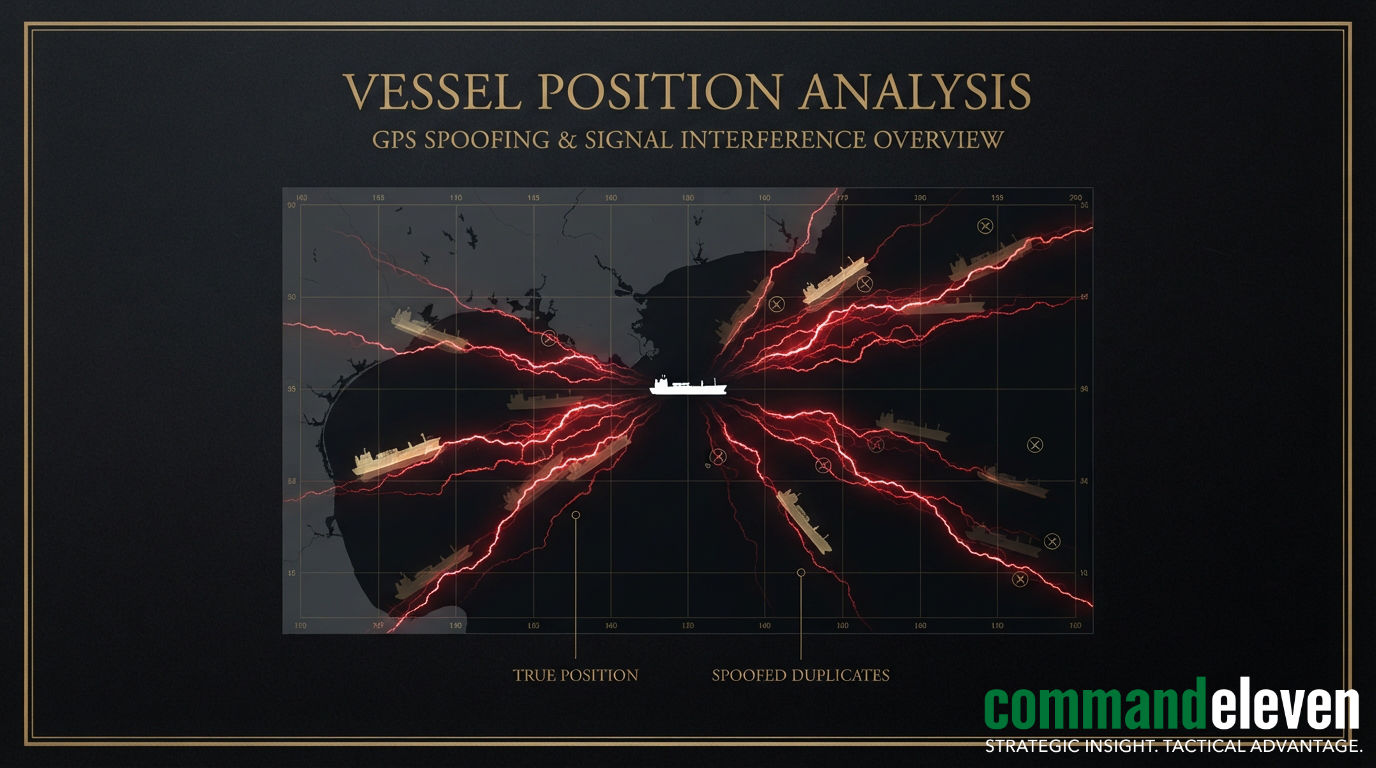
This dossier is the evidence-based companion to CommandEleven Intelligence’s earlier doctrinal piece, EW and RF Spectrum Contention: Iranian Defensive Architectures – where that piece maps the conceptual architecture, this dossier documents the confirmed, dated, sourced incidents of the campaign as it has actually unfolded since February 2026.
Key Judgments
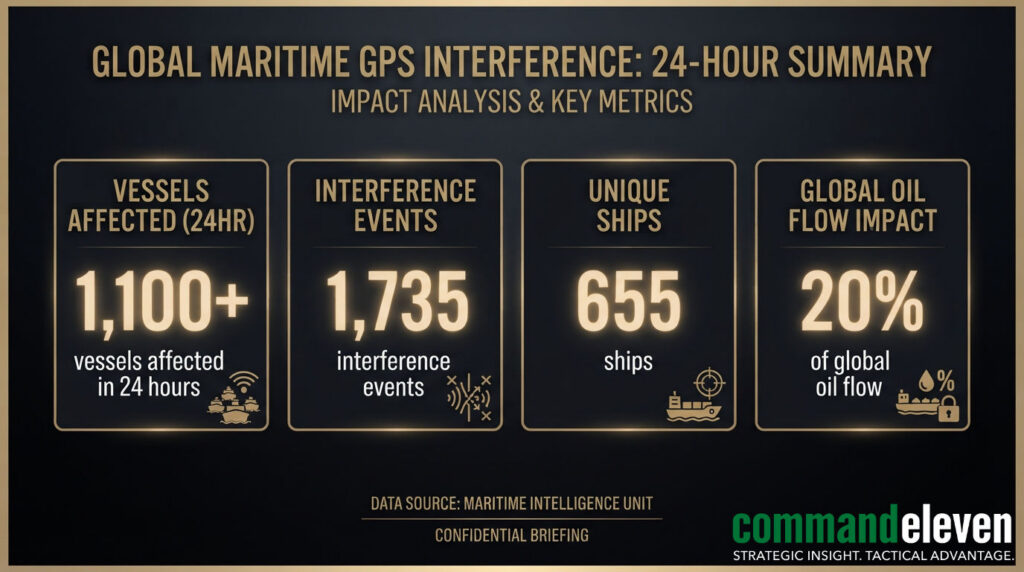
- [CONFIRMED] – Within 24 hours of the February 28, 2026 opening strikes, more than 1,100 commercial vessels across UAE, Qatari, Omani, and Iranian waters reported navigation failures consistent with GPS spoofing; by the end of the first week, Lloyd’s List Intelligence had logged 1,735 distinct interference events affecting 655 vessels, with onboard systems placing ships at airports, nuclear plants, and landlocked locations – a signature investigators characterize as classic active spoofing rather than simple jamming.
- [CONFIRMED] – Iran has invested steadily in GPS jamming and spoofing infrastructure since 2011, a deliberate, long-horizon strategy specifically intended to offset the United States’ substantial advantage in air- and space-based electronic warfare capability. This dossier treats that investment timeline as direct evidence supporting this series’ Part I framework: EW/RF contention is not an improvised wartime response but a mature, pre-planned pillar of Iran’s asymmetric doctrine.
- [CONFIRMED] – Iran’s electronic warfare toolkit draws on domestically produced systems supplemented by equipment sourced from Russia and China; Iran has separately attempted to disrupt Starlink terminal service inside the country using military-grade jamming equipment, and has employed Chinese-sourced spoofing technology against satellite navigation signals, according to on-record industry commentary reviewed for this dossier.
- [CONFIRMED] – Electronic warfare in this conflict has been bidirectional, not an Iranian-only phenomenon: independent EW researchers identify Israel, alongside Russia and Ukraine, among the most active sources of GPS spoofing transmitters globally, and U.S./Israeli information operations conducted parallel SMS-based psychological operations targeting Iranian civilians directly (“Help has arrived,” “lay down your weapons”) alongside website defacements of Iranian state media outlets including IRNA.
- [ASSESSED] – CommandEleven Intelligence assesses the Strait of Hormuz GPS/AIS spoofing campaign as Iran’s most operationally successful asymmetric domain of the war to date – a low-cost, technically modest, highly deniable capability that has imposed measurable global economic cost (energy price spikes, elevated Gulf shipping insurance rates, carrier route diversions) disproportionate to Iran’s investment, consistent precisely with the cost-imposition logic this series’ Part I identified as the defining feature of Iran’s doctrine.
The First 24 Hours: A Region Goes Dark
The speed and scale of the initial electromagnetic disruption is itself notable. Within 24 hours of the war’s opening strikes, maritime intelligence firm Windward logged over 1,100 vessels across the Gulf experiencing AIS interference – a figure that grew by a further 55% within a week. Lloyd’s List Intelligence’s more granular count, 1,735 distinct interference events affecting 655 vessels by the end of the first week, captured a specific and identifiable pattern: affected vessels’ onboard GPS systems reported positions at airports, nuclear facilities, and landlocked locations kilometers from their actual position – the signature of deliberate spoofing (transmission of false position data) rather than simple jamming (blanket signal denial). The Strait of Hormuz, a 39-kilometer-wide chokepoint carrying roughly 20% of global oil flow, became functionally unnavigable by GPS-dependent systems within the war’s first day.
The economic transmission of this disruption was immediate and global: energy prices spiked, Gulf shipping war-risk insurance rates rose sharply (a dynamic this series’ Part I Ukraine-Russia companion dossier examined in a different theater), and major shipping carriers diverted routes entirely, adding cost and delay to global supply chains extending well beyond the immediate conflict zone.
A Fifteen-Year Bet
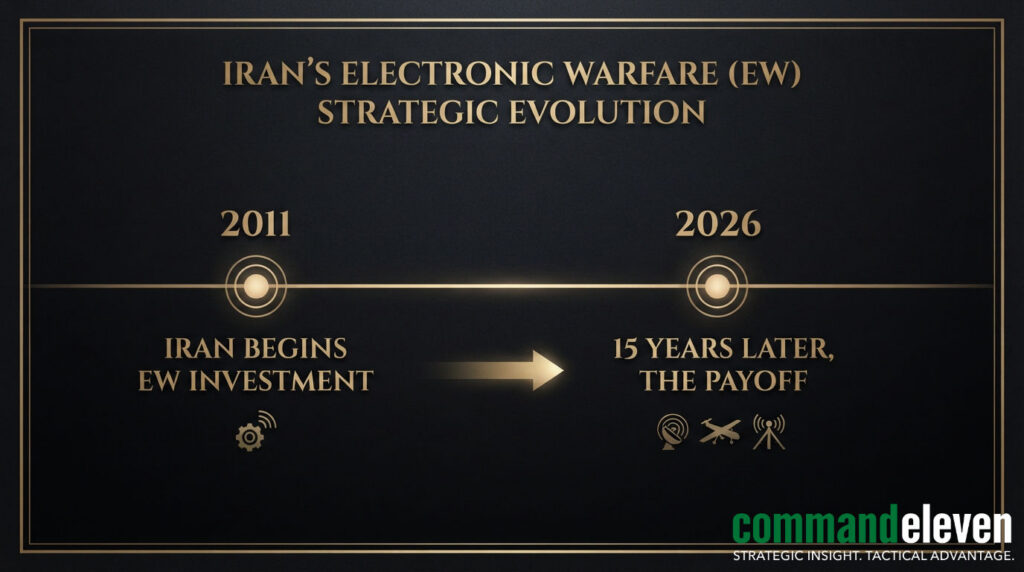
What distinguishes this campaign from an improvised wartime tactic is its documented timeline. Iran has invested steadily in GPS jamming and spoofing infrastructure since 2011 – long before the current war, and specifically as a deliberate hedge against the air- and space-based electronic warfare superiority the United States has maintained throughout that period.
- [ASSESSED] – CommandEleven Intelligence assesses this timeline is the clearest available confirmation of this series’ Part I thesis: Iran’s asymmetric doctrine is not a set of improvised wartime adaptations but a set of capabilities built and matured over more than a decade specifically because Iranian planners assessed, correctly, that they could never compete with U.S. EW capability directly and needed a cost-imposing alternative instead.
The Toolkit: Domestic, Russian, and Chinese
Iran’s EW capability draws on a mixed sourcing base. Royal United Services Institute analyst Thomas Withington assesses the tools in use are likely domestically produced or sourced from Russia or China – a sourcing pattern this dossier notes sits alongside the Russia-Iran missile-propulsion cooperation this series’ companion Project C430L dossier examined, suggesting a broader pattern of Russian technical transfer to Iran across multiple weapons and warfare domains, not an isolated case. SandboxAQ CEO Jack Hidary has separately stated on record that Iran has employed Chinese-sourced technology specifically to spoof satellite navigation signals – relevant given Iran’s own BeiDou migration, examined in CommandEleven Intelligence’s prior grey-zone series coverage, since experts note BeiDou-reliant systems remain vulnerable to the same jamming and spoofing risks as GPS, meaning Iran’s own navigation infrastructure is not immune to the tactics it deploys against adversaries.
Iran has also directed EW capability inward: reporting reviewed for this dossier describes Iranian attempts to disrupt domestic Starlink terminal service using military-grade “kill switch” GPS jammers, degrading internet performance nationally – read by analysts as evidence Iranian EW planners are adapting creatively within genuine capability constraints rather than simply replicating Western EW doctrine at smaller scale.
Not Just Iran: A Bidirectional Contest
This dossier’s sourcing does not support characterizing GPS/RF interference in this conflict as a purely Iranian tactic. University of Texas at Austin aerospace engineering professor Todd Humphreys identifies Israel, alongside Russia and Ukraine, among the most significant sources of GPS spoofing transmitters globally – indicating Israeli EW capability has been active in this same electromagnetic environment, not merely defending against it. Parallel information operations targeted Iranian civilians directly: SMS messages reading “Help has arrived,” “It’s time for reckoning,” and calls to “join the forces of liberation” were sent to Iranian phone numbers, while Iranian state media outlets including IRNA experienced website defacements with anti-regime messaging, and additional intrusions targeted government services and military systems to disrupt coordinated Iranian responses. A parallel cyber campaign – including the March 2026 Handala group attack on U.S. medical technology firm Stryker Corporation, which disrupted global operations – illustrates that Iran-aligned actors were conducting offensive cyber operations against U.S. targets simultaneously with the EW campaign examined here, a related but analytically distinct domain this series’ forthcoming information warfare chapter will examine in more depth.
- [DATA DEFICIT] – This dossier does not have a reliable comparative measure of total EW capability or effect between Israeli/U.S. and Iranian systems – the available sourcing documents both sides’ activity without providing the kind of standardized metric that would support a confident relative-effectiveness judgment.
Assessment: Iran’s Most Successful Domain
- [ASSESSED] – Set against this series’ Part II finding – that Iran’s conventional and ground-force position has been almost entirely defensive and reactive throughout this war – the EW/RF domain stands out as the one area where Iranian asymmetric doctrine has produced a clearly disproportionate effect relative to cost and risk. A relatively modest, largely deniable jamming and spoofing capability, built over fifteen years for exactly this contingency, disrupted global shipping, spiked insurance rates, and forced route diversions affecting a chokepoint carrying a fifth of the world’s oil – all without a single Iranian soldier, aircraft, or missile directly engaging an adversary force. This dossier assesses this is precisely the kind of cost-imposition outcome Iran’s Part I doctrine was designed to produce, and represents the clearest single case study this series has yet identified of that doctrine functioning as intended in practice rather than merely in theory.
Series Continuity
Part IV of this series, “The AI Slop War,” turns to information warfare specifically – the psychological and narrative-shaping dimension this dossier’s Section IV touched on only briefly, examined here as its own distinct battlespace.
Sourcing Base (Confidence-Tiered, with Links)
CONFIRMED – Primary/Official & Direct Reporting:
- Observer Research Foundation, “Signals Before Strikes: Electronic Warfare in the Iran War” (2011 investment timeline, 1,735 events/655 vessels figure, Starlink jamming, Handala/Stryker attack)
- CNBC, “Electronic warfare in the Persian Gulf: How GPS interference is disrupting the Middle East” (Windward 1,100-vessel/55% increase figures, BeiDou vulnerability, Clayton Swope commentary)
- CNN, “Ships and planes are vulnerable to GPS jamming. The Iran war is revealing just how bad the problem is” (spoofing mechanics, June 2025 Adalynn/Front Eagle precedent)
- Wikipedia, “Cyberwarfare during the 2026 Iran war” (SMS psy-ops messaging, IRNA defacement, 1,100-ship AIS disruption figure)
- Seeking Alpha, “Iran is using Chinese technology to ‘spoof’ satellite navigation signals” (Jack Hidary/SandboxAQ commentary)
ASSESSED – Credible Secondary Reporting:
- The Week, “How GPS jamming is playing havoc in the Middle East” (Withington sourcing assessment, Philip Ingram commentary)
- Asio Tech, “GPS Jamming & GNSS Interference in the Iran War“
- Techlusive, “GPS Jamming explained: The hidden tech war between Iran, Israel, and the United States”
Excluded from this dossier: Any precise comparative quantification of Israeli/U.S. versus Iranian EW capability or effectiveness. Available sourcing documents both sides’ activity without a standardized metric supporting confident relative comparison.
THE IRAN WAR DOCTRINE & STRATEGY
- Part I: Symmetric vs. Asymmetric Warfare – The Framework Behind Iran’s Strategy
- Part II: Ground Invasion Risk Assessment – Six Months Without One
- Part III: The GPS War – Documenting the Strait of Hormuz Spoofing Campaign
- Part IV: The AI Slop War – Fact-Checking Iran’s Disinformation Campaign
- Part V: Sanctions vs. Shadow Supply Chains – The Evidence Trail
- Part VI: Outlasting the Box – Six Months of War-of-Exhaustion Evidence

