This dossier is the evidence-based companion to CommandEleven Intelligence’s earlier doctrinal piece, The Information War: US vs. Iran (Cognitive Warfare – where that piece compares US and Iranian information-warfare doctrine conceptually, this dossier documents the specific, verified fabrications and fact-checked incidents of the campaign as it has actually run since February 2026.
Key Judgments
- [CONFIRMED] – The war has produced information manipulation at a scale and technical sophistication without clear historical precedent: The New York Times identified over 110 distinct AI-generated images and videos in just the first two weeks of fighting, while NewsGuard documented at least 18 false war-related claims originating from Iranian state media since February 28, 2026 – compared to only five false claims from the same sources in the two weeks immediately preceding the war.
- [CONFIRMED] – Iranian state media has employed a consistent fabrication pattern to project military success: falsely celebrating failed missile intercepts as downed U.S. F/A-18 jets, presenting a Russian-made Geran-2 drone as a captured advanced U.S. LUCAS drone, displaying an empty Iranian tanker as proof of a Strait of Hormuz blockade of foreign vessels, and fabricating New York Times quotes to falsely claim domestic protests were a foreign-orchestrated conspiracy.
- [CONFIRMED] – Citizen Lab has documented a state-linked influence operation that pre-stages deepfake content for deployment within hours of actual military strikes – a synchronization of kinetic and narrative operations at machine speed that this dossier treats as a qualitative escalation in information warfare, distinct from and more sophisticated than reactive post-hoc propaganda.
- [CONFIRMED] – Iran has pursued a documented “digital isolation” strategy, per Filterwatch: severing ordinary Iranian citizens from inbound global information platforms while retaining state access to those same platforms specifically to conduct outbound external influence operations – a deliberate asymmetry between what the regime allows its own population to receive and what it projects outward.
- [ASSESSED] – CommandEleven Intelligence assesses Iran’s information warfare performance in this conflict is structurally, not incidentally, effective – multiple analysts frame Iran’s position as an underdog “punching up” against dominant powers as conferring an inherent narrative advantage, and this dossier assesses information warfare functions as a fourth asymmetric pillar alongside the proxy network, missile capability, and mosaic command structure examined in this series’ Part I, sharing the same low-cost, high-volume, cost-imposing logic this series’ Part III identified in the EW/RF domain.
The Scale: An AI-Native War
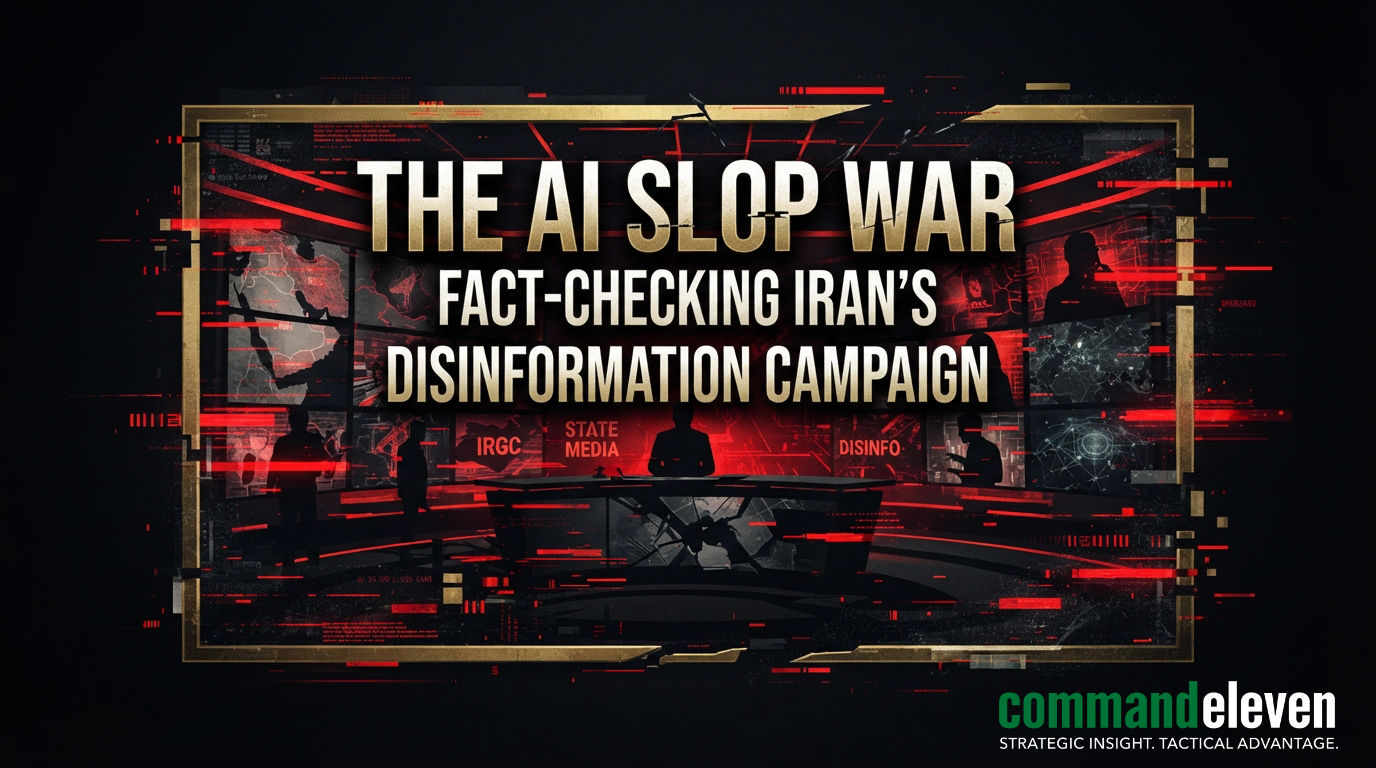
Analysts across the sourcing reviewed for this dossier converge on a common framing: this is the first war conducted with industrialized generative AI as a core information-operations tool rather than an emerging or experimental one. The volume figures support that framing directly – 110-plus distinct AI-generated images and videos identified by the New York Times in the war’s first two weeks alone, and an almost fourfold increase in documented false claims from Iranian state media (18, versus 5 in the preceding two weeks) once the war began. Analysts at RSIS have termed this an “AI Slop Propaganda War,” describing a strategy of content saturation rather than persuasion: flooding the information environment with high volume, often low-quality synthetic content specifically designed to overwhelm fact-checking capacity rather than to convince through careful narrative construction. The most visible manifestation identified in this dossier’s sourcing has been a viral series of Lego-style three-dimensional AI-animated videos depicting pro-Iran military content, widely circulated since the war’s opening days.
The Fabrication Playbook
Iranian state media’s pattern of asset misidentification follows a documented, repeatable template rather than ad hoc exaggeration. Failed missile intercepts have been reframed as successful shoot-downs of U.S. aircraft; a Russian-made Geran-2 drone (the same platform examined in this series’ companion Project C430L dossier) was presented as a captured advanced American LUCAS drone; an empty Iranian tanker was displayed as evidence of a blockade against foreign shipping in the Strait of Hormuz that had not actually occurred. A March 4, 2026 video initially celebrated by IRGC-linked Telegram channels as proof of a downed U.S. F-15 was later identified by the Israeli Air Force as footage of an Israeli F-35 shooting down an Iranian Yak-130 – the opposite outcome from what was originally claimed. Beyond battlefield claims, digitally altered footage from 2022 domestic protests was recirculated to falsely claim Iranian agents had hacked BBC Persian during a live broadcast, and domestic unrest during December 2025-January 2026 protests was systematically reframed by state messaging as the work of U.S. and Israeli agents – a pattern the Institute for the Contemporary Threats has traced specifically to regime-survival messaging rather than general propaganda theater.
The Liar’s Dividend
A distinct and more analytically significant tactic than straightforward fabrication is what researchers term the “liar’s dividend“: in an information environment saturated with genuine AI-generated content, authentic footage becomes deniable by simple assertion. This dossier’s sourcing documents a clear example: a minor, contained laundry-room fire aboard the USS Gerald R. Ford was exaggerated via AI-generated video into a depiction of catastrophic flight-deck fires and circulated widely on Instagram – a genuine event, artificially inflated. In the reverse direction, social media accounts falsely claimed that an authentic press conference broadcast by Israeli Prime Minister Benjamin Netanyahu was itself an AI-generated deepfake, weaponizing public AI-skepticism to delegitimize real footage rather than to fabricate false footage.
- [ASSESSED] – The Carnegie Endowment’s analysis identifies a genuine irony specific to this conflict: Iran’s own years-long disinformation track record has so thoroughly contaminated the information space that its legitimate victimhood claims – genuine civilian casualties, real infrastructure damage – are now met with international skepticism precisely when that credibility matters most to Tehran. CommandEleven Intelligence assesses this self-undermining dynamic as a real and probably durable cost of the broader AI slop strategy, not merely a rhetorical criticism from Iran’s adversaries.
Machine-Speed Propaganda
The most operationally sophisticated element this dossier identified is Citizen Lab’s documentation of a state-linked operation pre-staging deepfake content in advance, ready for deployment within hours of actual military strikes occurring. This represents a meaningfully different capability than reactive propaganda produced after an event: it requires anticipating strike patterns and preparing narrative content in parallel with military planning, synchronizing the kinetic and information domains at a operational tempo previous generations of state propaganda could not achieve. This dossier’s sourcing notes this development has received considerably less public attention than the more visible AI slop content itself, despite arguably greater strategic significance – pre-staged, rapid-deployment narrative content is a harder capability to counter than obviously low-quality saturation content, because it can be calibrated for higher individual-item credibility rather than relying purely on volume.
Digital Isolation: A One-Way Information Valve
Iran’s domestic information strategy runs in a specifically asymmetric direction: per Filterwatch’s documentation, the regime has pursued what it terms “absolute digital isolation” for its own population – severing ordinary Iranian citizens from global information platforms – while simultaneously retaining state-level access to those same platforms specifically for conducting external influence operations targeting foreign audiences. This is a materially different posture than simple domestic censorship: it is domestic information denial paired with international information projection, using the same infrastructure for opposite purposes depending on which direction the information is traveling.
Assessment: The Fourth Pillar
- [ASSESSED] – This dossier’s findings against this series’ Part I framework, CommandEleven Intelligence assesses information warfare functions as a fourth practical pillar of Iran’s asymmetric doctrine, alongside the proxy network, missile capability, and mosaic command structure already examined. The Foreign Affairs Forum’s analysis frames this explicitly in doctrinal terms: Iran’s position as the weaker conventional power confers a structural narrative advantage in “punching up” against the United States and Israel, independent of the truth value of any specific claim. This mirrors precisely the cost-imposition logic this series’ Part III identified in the EW/RF domain – a comparatively low-cost, high-volume, difficult-to-fully-counter capability that degrades adversary information advantage disproportionately to Iran’s investment, consistent with the doctrine’s founding logic examined in Part I. This dossier assesses information warfare should be read by future analysts not as a separate or secondary conflict dimension, but as fully integrated into Iran’s broader asymmetric warfighting approach.
Series Continuity
Part V of this series, “Sanctions vs. Shadow Supply Chains,” turns to the shadow supply chain – the industrial and procurement network sustaining Iran’s material capability across every domain examined so far in this series.
Sourcing Base (Confidence-Tiered, with Links)
CONFIRMED – Primary/Direct Fact-Checking & Research Documentation:
- Erkan’s Field Diary, “Disinformation and War Propaganda in the Iran-Israel-US War (As of 23 March 2026)” (NYT 110+ AI images/videos figure, NewsGuard 18-claims figure, Citizen Lab pre-staged deepfake finding, Carnegie “liar’s dividend” analysis)
- FactNameh (Substack), “Iran’s Information War: Patterns and Trends in Information and Narrative Manipulation” (F/A-18 misidentification, Geran-2/LUCAS drone swap, empty-tanker blockade claim, USS Gerald R. Ford AI-fire video, Netanyahu deepfake-denial case)
- Euronews, “Iran’s state media ramps up disinformation campaign as the US-Iran conflict wages” (NewsGuard pre/post-war comparison, March 4 F-15/Yak-130 video correction)
- Wikipedia, “Misinformation during the 2026 Iran war”
ASSESSED – Credible Secondary/Analytical Reporting:
- RSIS, “Inside Iran’s Information War on the US – AI, Propaganda, and Perception Management” (“AI Slop Propaganda War” framing)
- Foreign Affairs Forum, “Iran Is Winning the Vibe War” (structural “punching up” advantage thesis, digital isolation/Filterwatch sourcing, Lego video series detail)
- Factually.co, “iran propoganda” (Dec 2025-Jan 2026 protest reframing, Institute for the Contemporary Threats analysis)
Excluded from this dossier: Detailed technical methodology for producing or evading detection of AI-generated deepfake content. This dossier treats such detail as unsuitable for public release given its dual-use potential.
THE IRAN WAR DOCTRINE & STRATEGY
- Part I: Symmetric vs. Asymmetric Warfare – The Framework Behind Iran’s Strategy
- Part II: Ground Invasion Risk Assessment – Six Months Without One
- Part III: The GPS War – Documenting the Strait of Hormuz Spoofing Campaign
- Part IV: The AI Slop War – Fact-Checking Iran’s Disinformation Campaign
- Part V: Sanctions vs. Shadow Supply Chains – The Evidence Trail
- Part VI: Outlasting the Box – Six Months of War-of-Exhaustion Evidence