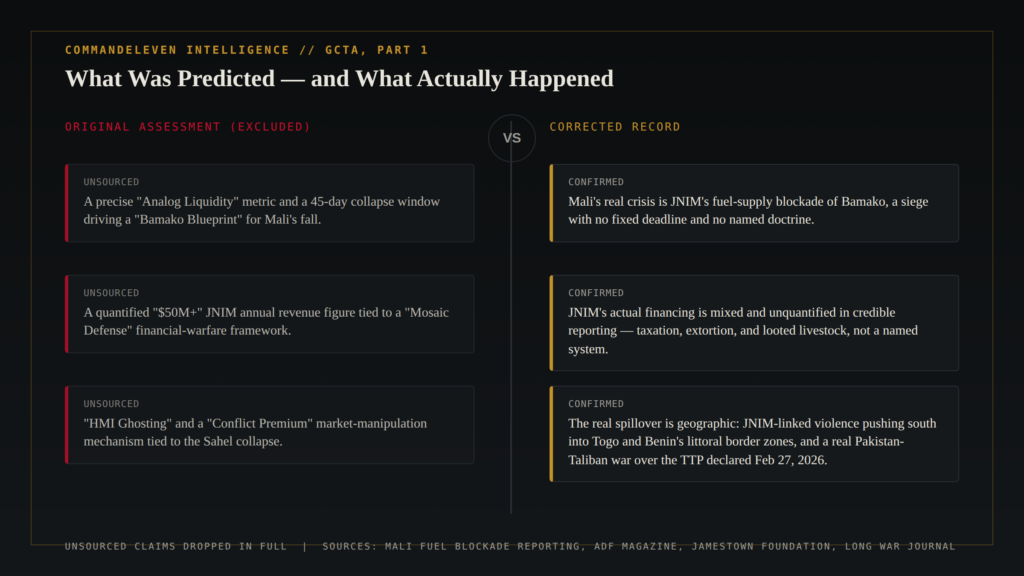
This is a corrected version of CommandEleven’s mid-2026 Global CT Assessment. The original relied on an invented quantitative framework — a fabricated “Analog Liquidity” financial metric, a precise “45-day terminal collapse window,” a “Mosaic Defense” doctrine, and an unsourced “Bamako Blueprint” — that did not hold up to source review. This version keeps the real, sourced threat picture and drops what could not be independently verified. The Iran and IRGC material previously folded into this piece has been superseded by CommandEleven’s rewritten Garrison State series; it is linked below rather than repeated here.
Key Judgments
- CONFIRMED — JNIM (Jama’at Nusrat al-Islam wal-Muslimin), al-Qaeda’s Sahel affiliate, has run a real, sustained blockade against Bamako, Mali’s capital, since September 2025: ambushing and burning fuel convoys, taxing drivers at checkpoints, and seizing territory. Mali depends on fuel imports routed through Senegal and Ivory Coast for roughly 95 percent of its supply, and the blockade produced genuine fuel shortages, school closures, and rolling blackouts in the capital through late 2025.
- CONFIRMED — JNIM announced a renewed, fuller blockade of Bamako on April 28, 2026, in retaliation for an April 25 Malian army offensive, with roadblocks reported at Soribougou, Naréna, and Ouélessébougou.
- CONFIRMED — Pakistan’s defense minister declared the country in “open war with Afghanistan” on February 27, 2026, following weeks of Afghan ground assaults and drone strikes on the Pakistani border and on Islamabad and Rawalpindi, and Pakistani airstrikes reaching Kabul and Kandahar. A Qatari-Turkish-Saudi-brokered truce in late March 2026 was timed to Ramadan’s end and has not produced a durable settlement.
- CONFIRMED — More than 660 Pakistani military and paramilitary personnel and 580 civilians were killed in 2025 in attacks mostly attributed to the Tehreek-e-Taliban Pakistan (TTP), which has gained organizational cohesion under leader Noor Wali Mehsud.
- ASSESSED — JNIM finances itself through a mix of overlapping illicit streams rather than a single centralized mechanism: a protection cut taken from artisanal gold miners, livestock theft and resale through regional markets, kidnapping-for-ransom (though at reduced levels versus prior years), and reinvestment of cash into legitimate local businesses and lending. No credible, independently sourced total revenue figure exists for the group; cited numbers vary widely across outlets and are not well substantiated.
- ASSESSED — JNIM and the Islamic State’s Sahel affiliate have both expanded operations into littoral West Africa, including confirmed incidents in Togo (a July 2024 attack overrunning a Togolese army base near the Burkina Faso border) and Benin (Islamic State-claimed attacks from 2022 onward, concentrated in the country’s north). This is a real and ongoing trend, not a single scripted “Bamako Blueprint” campaign.
- ASSESSED — The Afghan Taliban government has shown no indication it will move against the TTP. Analysts attribute this to the TTP’s standing as battlefield allies of the Taliban and as leverage against Pakistan, and to Kabul’s fear that cracking down on the TTP could push its fighters toward the rival Islamic State Khorasan Province.
- EXCLUDED — The original assessment’s quantitative and doctrinal framework — “Analog Liquidity” exceeding a precise 0.85 threshold, a uniform “45-day terminal collapse window,” a named “Bamako Blueprint,” the “Mosaic Defense” model, “HMI Ghosting” cyber-sabotage claims, and a weaponized “Conflict Premium” — is not independently sourced anywhere CommandEleven can verify. It is dropped from this revision in full.
Mali’s Real Collapse Dynamic: The Fuel Siege of Bamako
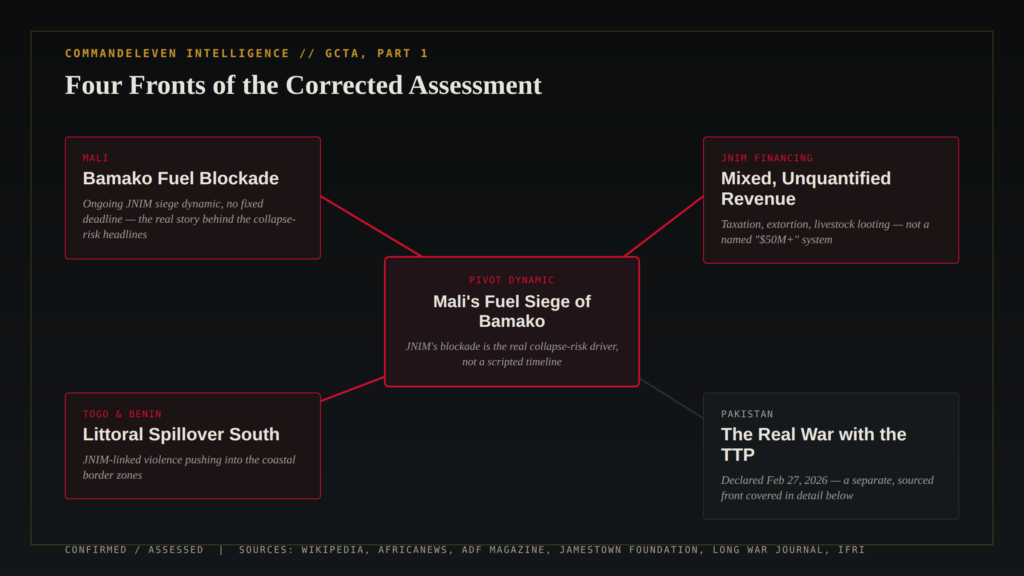
The original assessment’s “45-day terminal collapse window” was an invented metric. What’s actually happening in Mali is slower, messier, and arguably more dangerous precisely because it doesn’t resolve on a schedule. JNIM announced a blockade on fuel imports into Bamako on September 3, 2025, and has sustained it, with pauses and escalations, for more than a year. The tactics are not covert cyber-sabotage; they are a conventional, if effective, interdiction campaign: ambushing and burning tanker convoys on the roads from Senegal, Guinea, and Ivory Coast (a single attack near Kaniara and Lakamane hit a convoy of roughly 80 tankers under military escort), setting up checkpoints to tax drivers, briefly kidnapping Senegalese truckers, and pressuring transport companies directly. JNIM seized the town of Loulouni and pushed into Koulikoro and Sikasso regions as the siege widened.
The effects on the capital have been real and measurable: fuel shortages paralyzed civil services, with scarce supply going first to military and government facilities; Bamako saw reduced nighttime lighting and rolling blackouts, and the city of Mopti went over a month without fuel; schools closed from late October to mid-November 2025; foreign governments urged their citizens to leave, and the US and UK pulled some embassy staff; Russia pledged 200,000 tons of petroleum to the junta, and the UN drew down its own emergency fuel stockpile to help. Mali’s army has publicly dismissed the blockade as “information warfare,” even as it has needed military escorts to get fuel convoys through — at least 1,200 tankers reached Bamako under protection since late October 2025. On April 28, 2026, JNIM announced a renewed, fuller blockade in retaliation for a Malian army offensive three days earlier, with new roadblocks reported south and southwest of the capital.
How JNIM Actually Finances Itself
The original assessment’s “Analog Liquidity” framework and its precise “$50M+ USD monthly” revenue figure are not independently sourced. What researchers who study JNIM’s finances actually describe is a mix of overlapping illicit streams, not a single centralized war chest. The clearest is a protection economy around artisanal gold mining: JNIM attacks mining communities and then takes a cut of miners’ earnings in exchange for leaving them alone, and in parts of southern Burkina Faso has opened protected forest land to mining in exchange for a similar arrangement. Livestock theft is a second stream: armed men on motorbikes seize herders’ cattle, which are trucked quickly to markets in Ghana, Mali, or Senegal before owners can intervene. Kidnapping-for-ransom remains a factor, though researchers describe it as a smaller share of financing than in earlier years; incident counts in Burkina Faso rose roughly thirtyfold between 2017 and 2022 per ACLED tracking, with victims more often Burkinabe nationals than foreigners. Finally, researchers describe JNIM reinvesting cash into legitimate local commerce — lending to merchants, backing small shops — which both launders proceeds and builds local economic leverage; researchers describe violence against people who interfere with these investments.
No credible source CommandEleven can verify puts a reliable total dollar figure on JNIM’s income. Public estimates vary enormously and are often poorly sourced. This assessment does not repeat any of them as fact.
The Littoral Spillover: Togo and Benin
The original assessment’s claim of a scripted expansion vector into coastal West Africa overstated the mechanism but not the underlying trend, which is real and has been building for several years. JNIM fighters overran a Togolese army base, Kpekakandi, in northern Togo along the Burkina Faso border in July 2024, reportedly killing several soldiers and capturing weapons and armored vehicles — a clear sign the group was extending operations beyond its traditional Mali-Burkina Faso-Niger core into Togo. The Islamic State’s Sahel affiliate separately claimed its first attacks inside Benin in 2022, concentrated in the country’s northern Alibori department near the Burkina Faso and Niger borders; Benin has recorded jihadist attacks from both JNIM and the Islamic State affiliate since 2019. Analysts have also flagged reported contact between JNIM and Ansaru, an al-Qaeda-linked group in northwestern Nigeria, raising the possibility that the Togo-Benin corridor becomes a connecting route between Sahelian and Nigerian jihadist networks, though this link is not independently confirmed.
Pakistan’s Real War with the TTP and the Taliban
The original assessment described a vague “Villages-to-Cities inversion” without grounding it in what’s actually happened on the Pakistan-Afghanistan border, which escalated into open conflict in early 2026. Pakistan carried out its first airstrikes on Kabul in October 2025; Qatari and Turkish mediation produced a ceasefire that was quickly violated, and Saudi-backed talks stalled by late November. In February and March 2026, Afghan forces launched ground assaults on the Pakistani side of the border and drone strikes on Islamabad and Rawalpindi over roughly three weeks; Pakistan expanded its own airstrikes to border areas, Kabul, and Kandahar, and on February 27 its defense minister declared the country in “open war with Afghanistan.” A five-day, Qatar-Turkey-Saudi-brokered truce in late March, timed to the end of Ramadan, has not produced a lasting settlement. Pakistan has closed its border with Afghanistan, cutting off one of the country’s main routes to the outside world, and has deported close to a million of the more than 4 million Afghan refugees it had hosted; Afghanistan has shifted toward Iran as a trade partner, though access to the Iranian ports of Bandar Abbas and Chabahar remains uncertain.
Islamabad’s core complaint, that the Taliban government shelters the TTP and tolerates its cross-border operations, is the proximate cause of the escalation, and more than 660 Pakistani military and paramilitary personnel and 580 civilians were killed in 2025 in attacks mostly attributed to the TTP, which has gained cohesion under leader Noor Wali Mehsud. The Taliban have shown no sign of turning against the group: analysts describe the TTP as the Taliban’s wartime comrades and as leverage against Pakistan, and note Kabul’s fear that moving against the TTP could push its fighters toward the rival Islamic State Khorasan Province instead. A durable resolution is not evident in the current trajectory.
The Middle East: The IRGC Garrison State
The original version of this assessment folded in the same fabricated Garrison State and Fujairah-sabotage claims that CommandEleven has separately corrected. For the current, sourced account of the IRGC’s wartime consolidation inside Iran, the succession question, and the real Gulf energy flashpoint, see CommandEleven’s rewritten three-part Garrison State series, which supersedes what previously appeared here.
Frequently Asked Questions
Is Mali’s fuel blockade still ongoing?
It has eased and escalated in cycles since September 2025. JNIM announced a renewed, fuller blockade of Bamako on April 28, 2026, in retaliation for a Malian army offensive.
How much money does JNIM actually make?
There is no reliable, independently sourced total figure. Researchers describe a mix of gold-mining protection payments, livestock theft, reduced-but-ongoing kidnapping, and reinvestment into local businesses, without a credible consolidated revenue estimate.
Is Pakistan at war with Afghanistan?
Pakistan’s defense minister declared “open war with Afghanistan” on February 27, 2026, after weeks of cross-border strikes. A truce in late March 2026 has not produced a durable settlement.
Where does the IRGC/Garrison State material from the original assessment now live?
It has been superseded by CommandEleven’s rewritten three-part Garrison State series, which should be treated as the current account.
Sources
- Mali fuel blockade, Wikipedia (sourced compilation of wire and outlet reporting)
- Desperate search for fuel in Mali’s capital as al-Qaida-linked group enforces blockade, Africanews, October 8, 2025
- Terror Groups Diversify to Find Steady Flow of Illicit Financing, Africa Defense Forum, September 2025
- Togo Resurfaces as Conflict Zone After JNIM Overruns Border Military Base, Jamestown Foundation, August 2024
- Islamic State Claims First Attacks Inside Benin, Long War Journal
- Afghanistan-Pakistan: An Overlooked War on the Margins of the Middle East Conflict, Ifri, March 31, 2026
- The Garrison State: A Three-Part CommandEleven Intelligence Series