
CommandEleven Intelligence // Africa Desk. Foresight Audit, status as of November 3, 2026. This audit scores the 2026 Global Counter-Terrorism Assessment (GCTA), published in April 2026, against evidence published afterwards.
Bottom Line Up Front
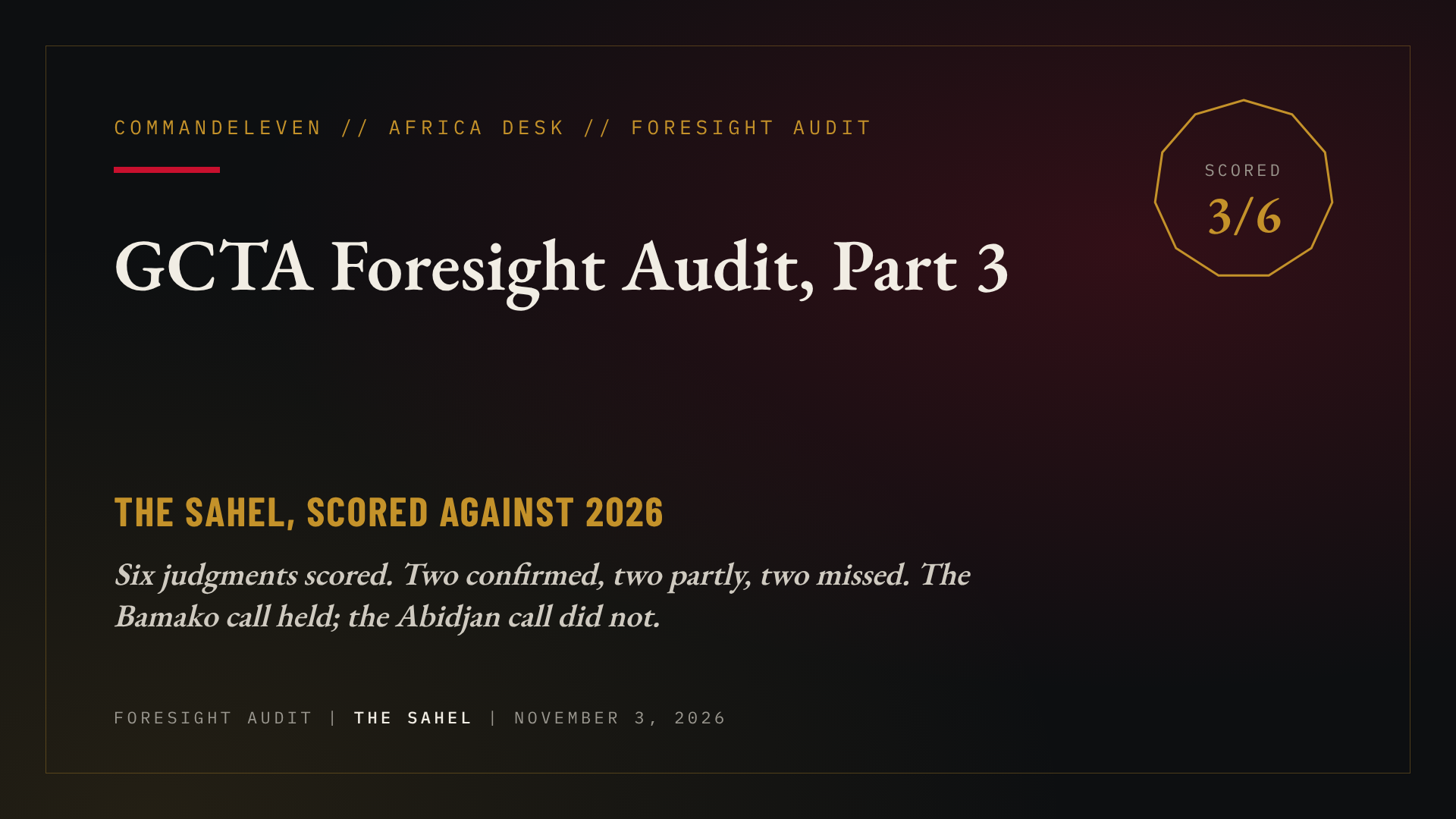
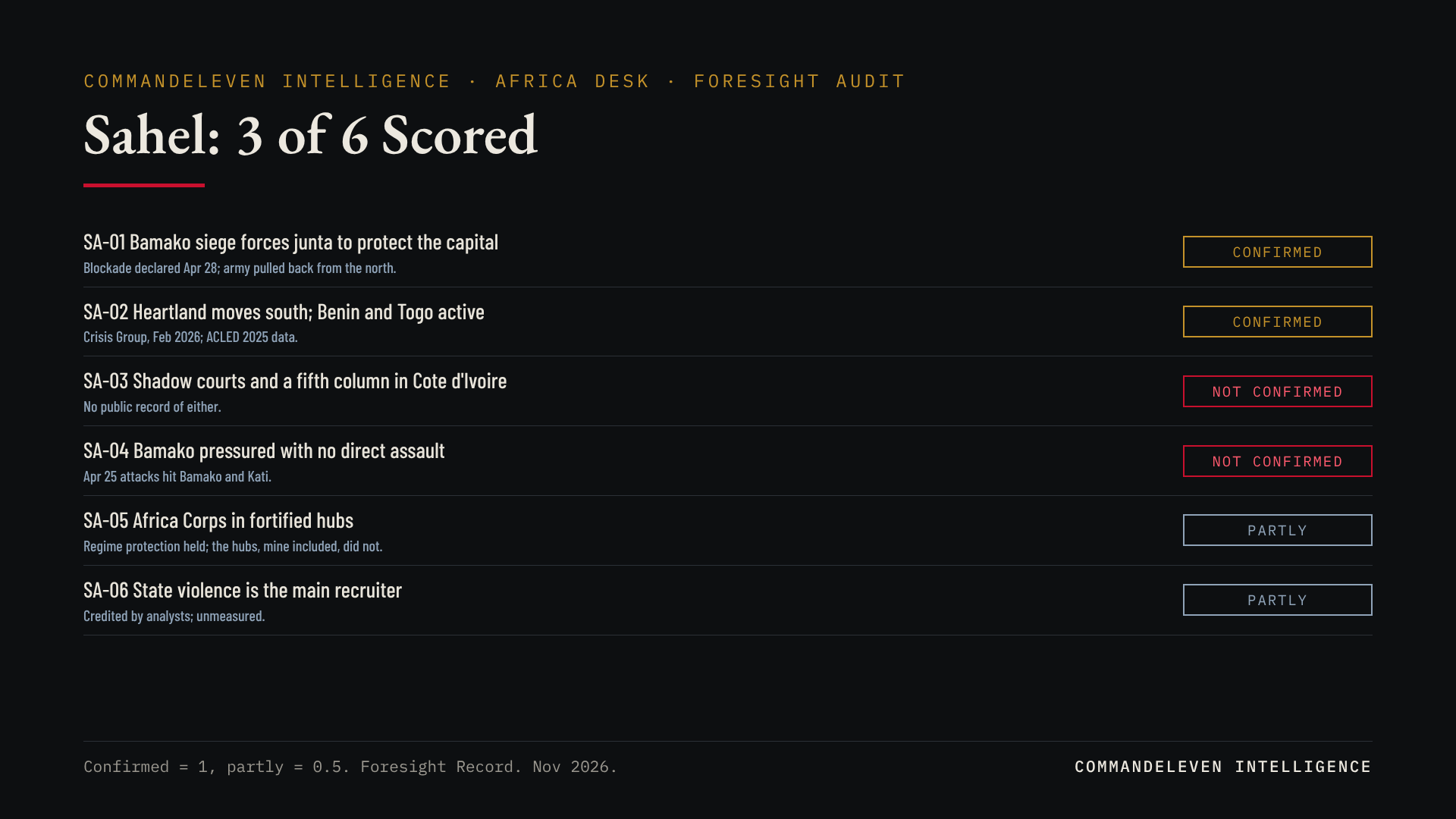
The GCTA’s Sahel chapter made six judgments we can score against what happened after publication. Two are confirmed, two are partly confirmed and two are not confirmed: 3 of 6, or 50 percent, on the Record’s method. The rest of the chapter’s figures are checked separately as baseline facts and do not count.
The judgment that held is the one that mattered most. The GCTA said JNIM had turned Bamako’s supply lines into a siege and that the junta would put urban survival ahead of the rural war. After the April 25 JNIM and FLA offensive the Malian army and Russia’s Africa Corps pulled out of Kidal, Tessalit and other northern positions, and JNIM declared a new blockade of the capital on April 28. The miss is on the same page. We wrote that JNIM had hollowed out Bamako “without ever launching a direct assault on the city”. On April 25, ten days after the assessment appeared on April 15, JNIM and its Tuareg allies struck Bamako and Kati and a car bomb killed the defense minister. We also scored a second miss: the GCTA’s claim of JNIM shadow courts and a sleeper network in northern Côte d’Ivoire has no support in the public record.
Key Judgments
KJ1: The Bamako siege call is confirmed. JNIM announced a blockade of the capital on April 28, 2026 and kept pressure on the roads through the summer. The army and Africa Corps pulled back from the north to protect the capital. [CONFIRMED]
KJ2: The push toward the coast is real but uneven. Benin and Togo are where JNIM’s expansion is most visible. Nigeria saw its first JNIM attack in late 2025. Côte d’Ivoire has had no JNIM attacks on its forces since January 2022. [CONFIRMED for Benin and Togo; NOT CONFIRMED for Côte d’Ivoire]
KJ3: We understated how far JNIM would go in the capital region. The attrition model survived, but the claim that it avoided direct assaults on Bamako did not. [CONFIRMED miss]
KJ4: Africa Corps retreated further than we said. We expected fortified hubs. It abandoned several, including the Intahaka gold mine, and has moved to a back-seat role built on air power. [ASSESSED, partly confirmed]
How We Scored
Every call is scored under the Foresight Record rules, set out in full in the GCTA Foresight Audit introduction. The original is quoted and dated, the score rests on evidence published after the GCTA appeared, and confirmed counts 1 and partly confirmed counts 0.5. Where an official attributes something without publishing evidence, we score partly confirmed. A call that depends on a verdict or a data release is held open. Only our own judgments count.
The Sahel chapter of the GCTA (pages 49 to 53) mixes judgments with reported facts. We scored only statements that predict how the situation would develop or that characterize how JNIM operates, and we checked the numbers separately. Our separate dossier on Russia‘s Sahel influence network covers the information side and is not scored here.
The Scored Calls
| ID | Judgment | GCTA page | Score |
|---|---|---|---|
| SA-01 | JNIM’s blockade of Bamako forces the junta to put urban survival ahead of rural counter-insurgency | p. 52 | CONFIRMED |
| SA-02 | The lethality heartland is moving south; Benin and Togo are active theaters | p. 50 | CONFIRMED |
| SA-03 | JNIM has shadow Sharia courts in northern Côte d’Ivoire and a fifth column for strikes in Abidjan | p. 50 | NOT CONFIRMED |
| SA-04 | JNIM controls Bamako’s economy without ever launching a direct assault on the city | pp. 49, 52 | NOT CONFIRMED |
| SA-05 | Africa Corps has retreated to fortified hubs and protects regime and resources over territory | p. 52 | PARTIALLY CONFIRMED |
| SA-06 | State and Russian violence is JNIM’s main recruitment engine | pp. 49, 53 | PARTIALLY CONFIRMED |
SA-01. The Bamako siege
What we said (GCTA, p. 52). “JNIM has successfully maintained a suffocating blockade on the Malian capital. By intercepting fuel and food convoys from Senegal and Côte d’Ivoire, they have triggered a national energy crisis, forcing the junta to prioritize urban survival over rural counter-insurgency.” [ASSESSED]
What the record shows. ACLED reported in December 2025 that the embargo had lost momentum as Africa Corps escorted convoys. It returned. JNIM spokesman Bina Diarra announced a blockade of Bamako on April 28, and by July JNIM had also cut the road between Bamako and Sikasso, according to the compiled record of the 2026 offensives. In June Africa Corps was escorting convoys from Côte d’Ivoire, Guinea and Senegal to counter the blockade, and analysts told Africa Defense Forum it was pulling fighters out of northern Mali to protect the capital and the junta. That is the trade the GCTA described.
Score: CONFIRMED. The blockade has varied in intensity, and the GCTA did not predict that variation.
SA-02. The coastal push
What we said (GCTA, p. 50). “The 2026 threat is no longer landlocked. The lethality heartland is expanding southward into the relatively stable coastal states.” and “Benin and Togo are now active theaters.”
What the record shows. Crisis Group’s February 2026 report finds Benin and Togo are where JNIM’s expansion phase is most apparent, with about 638 incidents and 699 deaths in northern Benin from 2022 to the end of 2025. ACLED recorded nearly 70 percent more fatalities in Benin in the first 11 months of 2025 than in 2024, the deadliest year there on record. JNIM claimed its first attack in Nigeria in late 2025. Neither Benin nor Togo is a JNIM mantiqa, a formal operating zone, so the presence is raids and not governance.
Score: CONFIRMED. The score applies to Benin and Togo. SA-03 tests the further claims about Côte d’Ivoire.
SA-03. Shadow courts and a fifth column in Côte d’Ivoire
What we said (GCTA, p. 50). “JNIM has successfully established shadow Sharia courts in northern Côte d’Ivoire, effectively creating a fifth column that can be activated for urban strikes in Abidjan.”
What the record shows. Crisis Group finds that attacks on Ivorian forces ran from March 2021 to January 2022 and have stopped. Jihadists based in Burkina Faso cross the north to resupply, steal cattle and kidnap. The report does not describe shadow courts or sleeper cells in northern Côte d’Ivoire, and records no JNIM attack on a coastal city. It also says that in peripheral areas JNIM “rarely taxes or exercises judicial functions.” We found no other public reporting of the courts the GCTA describes.
Score: NOT CONFIRMED. This is a judgment from public sources. It would be revised if the GCTA’s underlying source is produced or the pattern shows up in reporting.
SA-04. No direct assault on Bamako
What we said (GCTA, pp. 49, 52). “they have hollowed out the urban economy without ever launching a direct assault on the city.” and JNIM “exerts control through economic attrition rather than direct conquest.”
What the record shows. On April 25, 2026, JNIM and the Azawad Liberation Front launched coordinated attacks across Mali, including Bamako, Kati, Gao, Sévaré, Mopti and Kidal. A car bomb killed Defense Minister Sadio Camara and wounded intelligence chief Modibo Koné, and the junta called it a coup attempt. The army said it had the situation under control by mid-morning. The attrition model survived: a JNIM source told the Soufan Center in October the group is “not seeking territorial control,” and its September attack at Dioura killed at least 150 soldiers.
Score: NOT CONFIRMED. The claim of no direct assault failed in April. The broader attrition thesis did not.
SA-05. Africa Corps in fortified hubs
What we said (GCTA, p. 52). “Russian forces have retreated to heavily fortified basing hubs, notably in Gao, Mopti, and near the Intahaka mines. From these hubs, they prioritize regime protection and resource security over territorial control.” [ASSESSED]
What the record shows. The direction was right and the geometry was not. Africa Corps left Kidal, Aguelhok and Tessalit under negotiated deals after April 25, and left Tessit, Ber, Léré and the Intahaka gold mine. It reportedly lost aircraft in July and September fighting. By June it had settled into what one analyst called a back-seat role, using air strikes, drones and convoy escorts and pulling forces toward Bamako. A joint force retook Kidal without a fight on October 6.
Score: PARTIALLY CONFIRMED. Regime protection over territory held. The fortified hubs, including the mine named in the GCTA, did not.
SA-06. Violence as recruitment
What we said (GCTA, pp. 49, 53). “Africa Corps has pivoted to high-altitude drone strikes and scorched earth tactics, which have inadvertently served as the primary recruitment engine for JNIM.” [ASSESSED]
What the record shows. Africa Defense Forum reported in June that airstrikes on Kidal destroyed infrastructure and forced residents to flee, and that analysts say the Malian state’s tactics push northern communities toward JNIM. The reporting we reviewed gives no casualty or recruitment figures, and the “primary” engine claim cannot be tested without them.
Score: PARTIALLY CONFIRMED. The mechanism is credited by analysts. Its weight is unmeasured.
Baseline Facts Checked
These are factual statements in the GCTA that were checkable. They are not forecasts and are not counted in the Foresight Record totals. A claim we could not reproduce is marked unverified, which is not the same as wrong.
| GCTA statement | What we found | Status |
|---|---|---|
| A single $50 million JNIM ransom “in early 2026” | The payment was at least $50 million, but it was made at the end of October 2025, about two weeks before the report that carried it. It freed a UAE royal family member and two partners. | Amount confirmed; date corrected |
| JNIM fielded fiber-optic FPV drones in late 2025 | Africa Defense Forum attributes the first Sahelian use of fiber-optic drones, in 2025, to the FLA. It says JNIM used commercial armed drones but does not say fiber-optic. The April attack on Aguelhok is only suspected. | JNIM use unverified |
| “Record-breaking 9,362 deaths in 2025” | ACLED counts more than 10,000 political-violence deaths in Burkina Faso, Mali and Niger from January 1 to November 28, 2025. The categories differ, and we could not reproduce 9,362. | Not reproduced |
| The Sahel accounts for over half of global terrorism deaths | A summary of the Council on Foreign Relations conflict tracker, updated July 29, 2026, says the tri-border area now accounts for more than half of global terrorism-related deaths. | Confirmed via secondary source |
What Would Change These Scores
- A public record of the Côte d’Ivoire courts, from the GCTA’s source or from independent reporting, would move SA-03 up.
- A verified count of civilian deaths by state and Russian forces against those by insurgents would settle SA-06.
- A JNIM assault inside Bamako that holds ground would show the attrition thesis itself is out of date.
What We Learned
We treated JNIM’s economic pressure as a substitute for force. The April offensive showed it as a preparation for force. The lesson for the 2027 assessment is to describe the blockade as a shaping operation and to watch the FLA and JNIM as one campaign.
We gave detail on the coast that the public record cannot support. The Côte d’Ivoire passage reads like a finding and is not one. Future editions will mark which coastal claims rest on reporting and which on projection.
What This Audit Does and Doesn’t Establish
- It establishes that, against the public record to November 3, 2026, the GCTA’s Bamako and coastal-expansion judgments held and two other Sahel claims did not.
- It does not establish that the Côte d’Ivoire network is absent, only that the public record does not show it.
- It does not claim that officials or other analysts relied on the GCTA.
Frequently Asked Questions
Did the GCTA predict the April 25 Mali offensive?
No. It described a siege of Bamako that avoided a direct assault, and the offensive included attacks inside Bamako and Kati. We score that as a miss.
Is JNIM winning in Mali?
The record is mixed. JNIM and the FLA forced Africa Corps out of several northern positions and overran army camps, while a joint force retook Kidal on October 6. JNIM says it is waging attrition, not seeking territory.
Why are numbers like the $50 million ransom not scored?
They are reported facts, not judgments. We check them and mark errors, but only judgments count toward the Foresight Record.
What comes next in the GCTA audit?
Part 4 covers East Africa and Part 5 the Middle East and Levant. Parts 6 to 8 follow, then the closing synthesis.
Sources
- Wikipedia, 2026 Mali offensives (compiled record, accessed November 3, 2026; secondary and open to editing, so each date should be checked against its cited outlet)
- The Soufan Center, What Kidal Portends: JNIM, Islamic State, and the Sahelian Security Landscape (October 28, 2026)
- Africa Defense Forum, Africa Corps Shifts Tactics in Mali (June 16, 2026)
- Africa Defense Forum, Malian Insurgents Attack With Drones (April 28, 2026)
- International Crisis Group, Understanding JNIM’s Expansion Beyond the Sahel (February 20, 2026)
- ACLED, Economic Warfare Escalates as Militants Expand Beyond the Sahel (December 11, 2025)
- Al-Monitor, Royal ransoms a top money maker for Mali’s jihadist kidnappers (November 13, 2025)
- Rio Times, JNIM Blockades Bamako Fuel Supply as Sahel Deaths Top Half of Global Terror Toll (September 7, 2026; a secondary summary of the Council on Foreign Relations tracker)
Related CommandEleven Intelligence Reporting
- The GCTA Foresight Audit
- GCTA Foresight Audit, Part 1: Financing and the Stealth State
- GCTA Foresight Audit, Part 2: The Indian Subcontinent
- Russia’s Sahel Playbook: The Leaked Files on the SVR and Wagner’s Influence Arm
- The Foresight Record: Every Call We Have Scored, Misses Included
- 2026 Global Counter-Terrorism Assessment (download)
